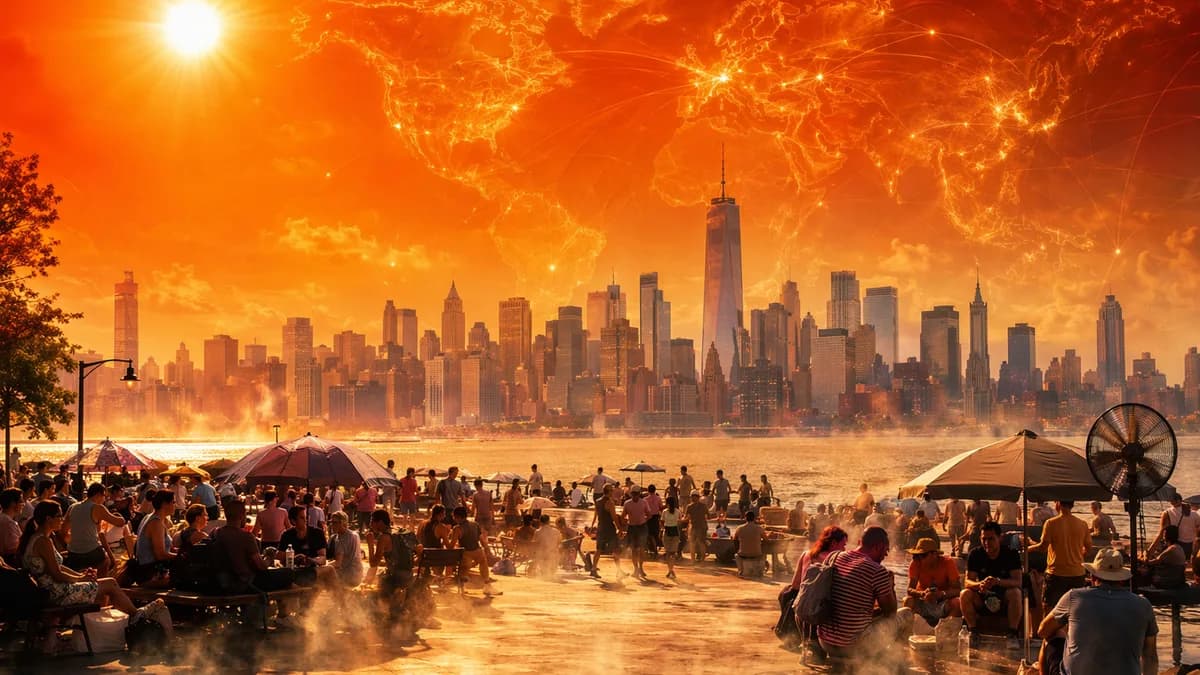
On Tuesday, New York City warned that the July Fourth heat dome would hit just as residents and visitors were preparing to spend long hours outside, a timing problem that turns ordinary holiday behavior into a heatwave public-health risk. Temperatures are expected to reach 100 degrees Fahrenheit (38 Celsius) by Thursday, with a heat index between 105 and 110 degrees, according to Wired.
XOOMAR Intelligence
Analyst Take
That matters because heat illness rarely starts as a dramatic medical event. It starts as one more hour outside, one more drink, one more crowded venue, one more decision to wait before finding air conditioning. During a holiday weekend with World Cup festivities in the mix, those small delays become the danger.
“These are extremely dangerous conditions, and they will affect every part of our city,” New York City mayor Zohran Mamdani said Tuesday.
XOOMAR analysis: The risk is not just that temperatures are high. It’s that the social calendar is working against the body’s cooling system.
Tuesday's warning lands before the July Fourth heat dome peaks
New York has activated its heat emergency plan ahead of the latest heat wave, after first doing so on May 19, the earliest activation on record for the city. That earlier spring heat wave pushed temperatures past the 90-degree mark across the Northeast.
This time, the city is preparing more than 650 cooling stations, including libraries, recreation centers, Petco stores, government buildings, and other nontraditional sites. The Mamdani administration is also deploying cooling vans to provide wellness checks, medical care, water, electrolytes, sunscreen, and transportation to cooling centers or health care facilities.
The city is using LinkNYC kiosks to show walking directions to the nearest cooling center. Business owners are being asked to set thermostats to 78 degrees, in line with Department of Energy guidance for peak summer months, to help manage grid strain.
For unhoused people, the city’s Department of Social Services will conduct in-person outreach. People needing short-term housing will not have to go through the usual shelter intake process under the heat plan.
| City | Immediate heat response | Specific pressure point |
|---|---|---|
| New York City | More than 650 cooling stations, cooling vans, LinkNYC cooling-center directions | Heat index expected at 105 to 110 degrees |
| Philadelphia | Heat emergency plan, evening shift for FIFA Fan Festival hours, cooling tents, water refill stations, medical stations | July 4 World Cup match kicks off at 5 pm ET |
Thursday's 100 F forecast turns humidity into the real hazard
A heat dome forms when a high-pressure system settles over a region and traps heat and humidity. The air sinks, pressure rises, and temperatures stay elevated for days. As Fortune summarized from climate scientists, the warm air expands upward, creating the dome-like atmospheric setup that can lock a region into prolonged heat.
The heat index is the more practical number for public health because humidity slows the body’s ability to cool itself through sweat. Pavement and buildings make the problem worse by absorbing heat during the day and releasing it at night. AccuWeather reported that New York City may see three consecutive nights when temperatures do not drop below 80 degrees, a rare stretch.
That lack of overnight relief matters. Bodies need recovery time. Without it, the next day starts from a more stressed baseline.
Wired’s medical sources describe a clear escalation path:
- Heat exhaustion: excessive sweating, nausea and vomiting, muscle cramps, and weakness.
- Heat stroke: dry, hot skin, rapid pulse, confusion, slurred speech, unconsciousness, or altered mental status.
- Highest-risk groups: babies, older adults, people with chronic diseases, and anyone exposed for long periods without reliable cooling.
“Anybody who has an altered mental status who is hot, that is an indicator that they may be critically ill,” said Reed Caldwell, chief of service at Tisch Hospital’s emergency department, part of NYU Langone Health.
May 19 was the early alarm for New York's heat plan
The May 19 activation shows how heat planning is moving earlier in the calendar. XOOMAR analysis: That’s the buried signal in this story. Heat response is no longer a late-summer function for city agencies. It is becoming an operational problem that can arrive in spring, return around a holiday, and collide with major events.
A recent Yale University study cited by Wired found that deaths associated with high temperatures nearly doubled in the US over the past two decades, from an annual average of 2,670 between 2000 and 2009 to more than 4,000 between 2010 and 2020.
Most heat-related deaths occur indoors after prolonged exposure without air conditioning. That complicates the usual holiday framing. The danger is not limited to people visibly baking outside. It also includes people in apartments, shelters, or rooms where heat accumulates and never clears.
This pattern echoes broader heat concerns XOOMAR has covered in England's Hottest June Forces Red Heat Alert Reckoning, where the policy challenge was not recognizing that heat was dangerous, but moving public systems fast enough when abnormal heat became operationally disruptive.
July 4 at 5 pm puts Philadelphia's World Cup test in the danger window
Philadelphia has activated its heat emergency plan and moved its FIFA Fan Festival hours into the evening. The city will provide cooling and tents, free water refill stations, shaded areas, and multiple medical stations for fans.
Still, the Paraguay vs. France match kicks off at 5 pm ET on July 4, when Wired reports it is forecast to still feel well above 100 degrees with heat and humidity.
That timing is brutal. A late-afternoon event can catch people after they have already spent hours in heat. Alcohol makes that worse because it contributes to dehydration, and it can make early heat symptoms easier to dismiss as fatigue or too much sun.
“There’s great value in pre-hydration and even greater value in not being dehydrated before you go somewhere,” Caldwell said.
World Cup events also bring crowd-management challenges beyond weather. XOOMAR has separately covered public-safety pressures around football gatherings, including 3 Die as Mexico City World Cup Celebrations Turn Deadly and Gunfire at San Jose World Cup Fan Zone Kills 1, Injures 1. Those incidents are not heat cases, but they show why large-event planning cannot treat any single risk in isolation.
Hospitals are preparing for bodies that cannot cool down
Emergency departments in New York are preparing for more patients with acute heat illness. Erik Blutinger, an emergency medicine physician at Mount Sinai Queens, told Wired the hospital is stocking up on towels, fans, and other supplies to treat heat sickness.
The clinical response can be aggressive because heat stroke is time-sensitive. Doctors may mimic sweating through evaporative cooling, stripping away clothing, misting skin with water, and fanning continuously. Cold water immersion and ice-filled body bags can also be used.
XOOMAR analysis: The hospital detail is a reminder that heat emergencies are logistics events before they are medical events. Cooling centers, water access, shade, transport, and early symptom recognition all reduce the chance that hospitals become the first effective cooling site.
Employers and event organizers face the same tradeoff. If people are doing manual labor, staffing venues, standing outside, or moving through crowded areas, the advice to “stay indoors” may not match their reality. The practical response has to include shade, water, cooling breaks, visible medical stations, and messages that tell people to leave before confusion or collapse starts.
The next decision point is whether plans change before symptoms start
For families, fans, workers, and planners, the useful question is simple: how do you cut exposure before the body loses the ability to compensate?
That means drinking water before thirst, limiting alcohol before going into heat, using sunscreen because sunburn can worsen dehydration, and building real cooling breaks into the day. It also means treating confusion, slurred speech, unconsciousness, dry hot skin, and rapid pulse as emergency signs, not as something to wait out.
The July Fourth heat dome is a test of whether cities and event organizers can move from alerts to execution. More cooling stations help. So do shifted event hours, water refill stations, shaded areas, medical tents, and location-based directions to cooling centers.
The evidence to watch now is concrete: whether emergency departments see a surge, whether cooling centers draw enough people, whether Philadelphia’s event changes keep fans out of trouble, and whether New York’s new outreach tools reach people before they become patients. If those measures work, holiday heat planning will start to look less like weather advice and more like core public safety infrastructure.
Impact Analysis
- Holiday crowds and outdoor events increase the risk of heat illness during extreme temperatures.
- New York City is expanding cooling access with more than 650 cooling stations and mobile support.
- Small delays in finding shade, water, or air conditioning can become dangerous in a heat dome.
NYC July Fourth Heat Risk Indicators
Primary Sources & Disclosures

Written by
XOOMAR Insights Team
Research and Editorial Desk
The XOOMAR Insights Team pairs automated research with human editorial judgment. We track hundreds of sources across technology, fintech, trading, SaaS, and cybersecurity, cross-check the facts, and explain what happened, why it matters, and what to watch next. We do not just rewrite headlines. Every article is fact-checked and scored for reliability before it goes live, and we link back to the original sources so you can verify anything yourself.