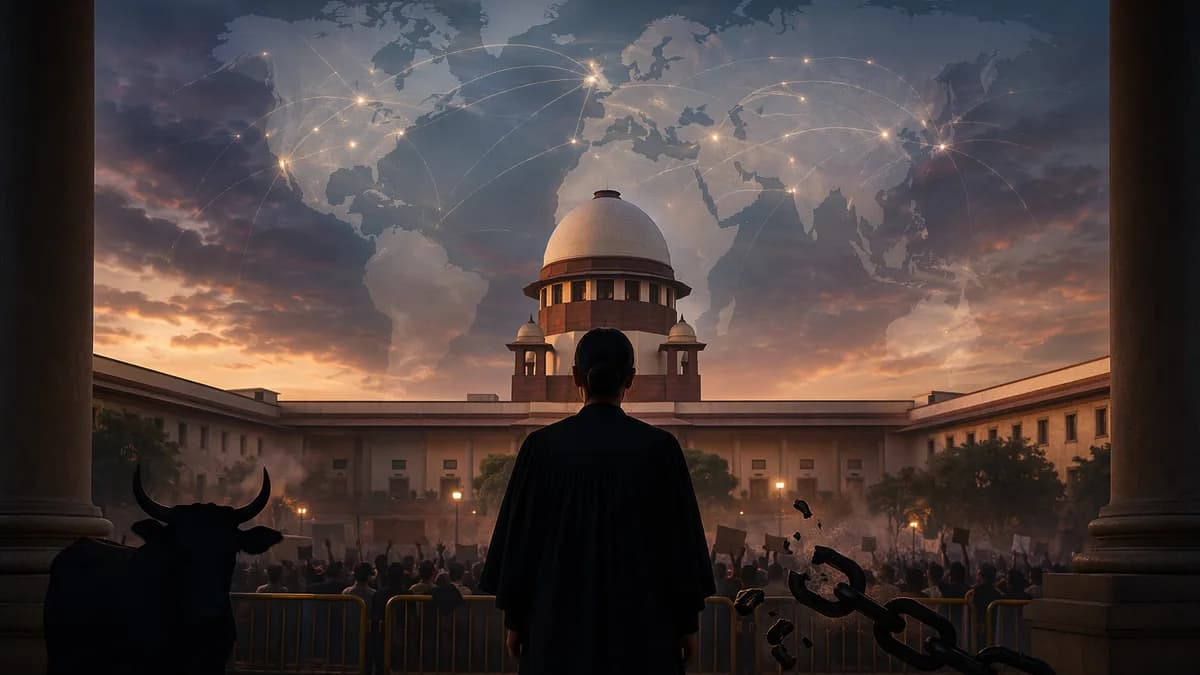
The threats against Tabassum Khan signal something more dangerous than anger over one verdict: a judge is being targeted because a mob-lynching conviction cut across religion, cow politics, and judicial authority in India.
XOOMAR Intelligence
Analyst Take
Khan, an additional district and sessions judge in Madhya Pradesh, sentenced 14 Hindu men to life imprisonment after finding them guilty in a 2022 lynching case, according to BBC World. The victim, 50-year-old Nazir Ahmad, was transporting cattle at night when a group of self-styled “gau rakshaks” (cow protectors) intercepted him and two companions. Ahmad died from his injuries. His companions survived and testified.
Tabassum Khan’s verdict has become a test of whether India protects judges under pressure
The core issue is not whether a verdict can be criticised. It can. The issue is whether a judge can be threatened for delivering one. Khan’s judgment described the crime as a clear case of mob lynching. The reaction that followed, according to the BBC, attacked her Muslim identity rather than her legal reasoning.
That distinction matters. A judiciary can absorb legal disagreement. It cannot function if verdicts in communal cases trigger campaigns that frame the judge’s religion as proof of bias. Former Supreme Court judge Markandey Katju put the danger plainly in a post on X:
"Her Muslim identity became the principal basis upon which the legitimacy of the judgement was questioned. This represented a dangerous inversion of justice. Judicial decisions are meant to be evaluated through legal reasoning, not through the religious identity of the individual delivering them,"
The strongest counterpoint is obvious: families of convicted people often protest harsh sentences, especially life imprisonment. But the material here goes beyond grief outside a courthouse. The BBC reports communal slurs, rape threats, death threats, and a warning of “bloodshed” unless the convicted men were freed within 10 days.
For broader XOOMAR readers tracking India beyond this case, our separate coverage of India's brainstem atlas sits in a very different science lane. This story, by contrast, is about whether lower-court authority holds when communal mobilisation moves from the street to the judge’s doorstep.
The 14-man conviction turned a cow vigilante lynching case into a communal flashpoint
Khan convicted the men on 12 June of offences including murder, attempt to murder, rioting, and wrongful restraint. The case arose from a 2022 attack in which Ahmad and his companions were pulled from a vehicle and assaulted on suspicion of smuggling cows.
The political charge is built into the facts. Hindus consider cows sacred, and killing them is illegal in many Indian states. That context helps explain why the accused were publicly framed by supporters as men who had acted to “save cows.” It does not explain away the court’s finding that a lynching occurred.
The split between courtroom and backlash is stark:
| Arena | Central claim | Evidence in the source |
|---|---|---|
| Courtroom | The attack was a mob lynching | Khan convicted 14 men and noted the crime was a clear case of mob lynching |
| Street protests | The convicted men were punished for “saving cows” | Family members protested outside court and allegedly tried to stop the police convoy |
| Online campaign | Khan’s religion made the verdict illegitimate | Videos used communal slurs and threats against Khan, a Muslim judge |
The thesis still holds because the abuse did not mainly contest witness credibility, statutory interpretation, or sentencing logic. It challenged Khan’s authority through identity. Evidence that would weaken this reading would be a backlash focused primarily on legal defects in the judgment, not religious attacks and threats.
The available numbers show a case-level crisis, not a complete national map
The source material gives hard numbers for this case, but not a verified national count of cow vigilante violence. That limit is important. The BBC article identifies 14 convictions, one dead victim, two surviving companions, a 50-year-old man lynched in 2022, police protection for Khan, and two arrests linked to the threats.
It also reports that many threatening videos remained online at the time of writing, drawing thousands of likes and shares, with faces and social media handles visible. That detail is not cosmetic. It suggests that some speakers did not treat public threats against a judge as risky enough to hide.
Police official Sudhakar Baraskar told the BBC that a case had been registered under relevant sections of the Indian Penal Code, that two people had been arrested, and that the cyber cell was tracing people sharing inflammatory videos while monitoring social media.
The missing number is also revealing. The supplied material does not provide one clean, official database for cow vigilante attacks, convictions, acquittals, or threat cases. XOOMAR analysis: that makes public accountability harder, because every case can be fought as an isolated controversy rather than assessed as part of a measurable enforcement problem.
Cow protection protests followed the verdict beyond the courtroom
The reaction moved quickly from courthouse protest to organised public pressure. The BBC reports that after the verdict, family members of the convicted men gathered outside the courtroom, protested, and attempted to stop the police convoy taking the men to prison.
The online campaign then widened. A Sudarshan News anchor expressed solidarity with the families of the convicted men, saying:
"they might have never imagined that their family members, who had put everything on the line to save cows, would be imprisoned for it"
He also urged viewers to “speak up” because “now was the time to fight for the sake of the protectors of cows”.
On 22 June, the Gau Raksha Parishad staged a protest in Punjab where protesters assaulted and burnt an effigy of Khan. Three days later, the Rashtriya Bajrang Dal held a protest in Uttar Pradesh, demanding that the “cow protectors” be freed.
That sequence matters. The backlash did not stay attached to the district where the case was tried. It travelled across states and platforms, turning a criminal conviction into a symbolic fight over cow protection and religious identity.
Judges, police, Hindu groups, Muslim citizens, and rights advocates are reading different stakes
For judicial bodies, this is a direct threat to the bench. The Supreme Court Advocates-on-Record Association and the Supreme Court Bar Association condemned the threats and demanded action. Vikas Singh, president of the SCBA, told the BBC:
"If we allow this to happen, no judge will be able to dispense justice,"
"In a democracy, a judge must be able to perform their duty without fear or favour."
Police face the operational test: protection, arrests, digital tracing, and visible follow-through. Hindu right-wing groups and self-described cow protection organisations, based on the reported protests, are framing the convicted men as protectors rather than convicts in a murder case.
For Muslim citizens, the signal is sharper. XOOMAR analysis: when a Muslim victim is lynched and a Muslim judge is then threatened for convicting the attackers, the case can deepen fear that legal accountability itself will be communalised.
Readers interested in how public scrutiny can pressure official handling of sensitive cases can also read XOOMAR’s separate report, Missing Hours Haunt Nolan Wells Death Investigation. The facts are unrelated, but both stories show why process, protection, and public confidence matter when institutions face pressure.
The Khan threats expose an enforcement gap for courts and platforms
The immediate institutional risk sits with lower-court judges. They handle politically charged cases, often far from the public visibility and security profile of higher judiciary figures. If threats become a predictable part of communal trials, the chilling effect will not need to be formally announced. Judges, witnesses, prosecutors, and complainants will feel it.
Supreme Court advocate Sanjay Hegde argued in Live Law, as cited by the BBC, that the state and judiciary should do more to ensure Khan’s safety. He compared the situation with threats faced by Gautam Patel, a former Bombay High Court judge, and his family for more than 10 months after a 2024 judgment in a succession dispute within a Muslim community.
Hegde’s principle is blunt:
"If a retired judge of a high court deserves state protection and judicial supervision of his case, so does a serving sessions judge in a district court. The principle cannot bend to rank. It cannot bend to religion. It cannot bend to the political weather around a particular verdict,"
Platforms are part of the enforcement gap too. The BBC reports that many videos remained online at the time of writing despite visible handles, visible faces, and explicit incitement. If threats against judges can gather thousands of interactions before meaningful action, digital intimidation becomes a second courtroom.
The next battles are security for Khan, appeals, and political silence
The case now turns on three tests: protection, prosecution, and political signalling. Last week, the Madhya Pradesh High Court asked senior officials to explain what steps had been taken to protect Khan and identify those behind the threats. It also ordered that her police protection continue.
The convicted men may pursue legal remedies, and any appeal could keep the case alive as a communal flashpoint. That is legitimate if argued through law. It becomes dangerous if the appeal process is accompanied by threats meant to punish the judge for the trial result.
The evidence that would confirm the thesis is clear: more arrests for threats, sustained protection for Khan, faster removal or investigation of violent posts, and public condemnation that separates faith from mob violence. Evidence that would weaken it would be a disciplined shift toward legal appeal and away from communal intimidation.
If the threats against Tabassum Khan fade without consequence, future cow vigilante cases will be harder to try, harder to testify in, and harder to judge without fear. That is the real verdict India’s institutions now have to deliver.
Impact Analysis
- Threats against Judge Tabassum Khan raise concerns about judicial independence in communal violence cases.
- The case highlights how cow vigilantism and religious identity can intensify pressure on India’s courts.
- Targeting a judge over her religion risks undermining trust in verdicts based on evidence and law.
Primary Sources & Disclosures

Written by
XOOMAR Insights Team
Research and Editorial Desk
The XOOMAR Insights Team pairs automated research with human editorial judgment. We track hundreds of sources across technology, fintech, trading, SaaS, and cybersecurity, cross-check the facts, and explain what happened, why it matters, and what to watch next. We do not just rewrite headlines. Every article is fact-checked and scored for reliability before it goes live, and we link back to the original sources so you can verify anything yourself.