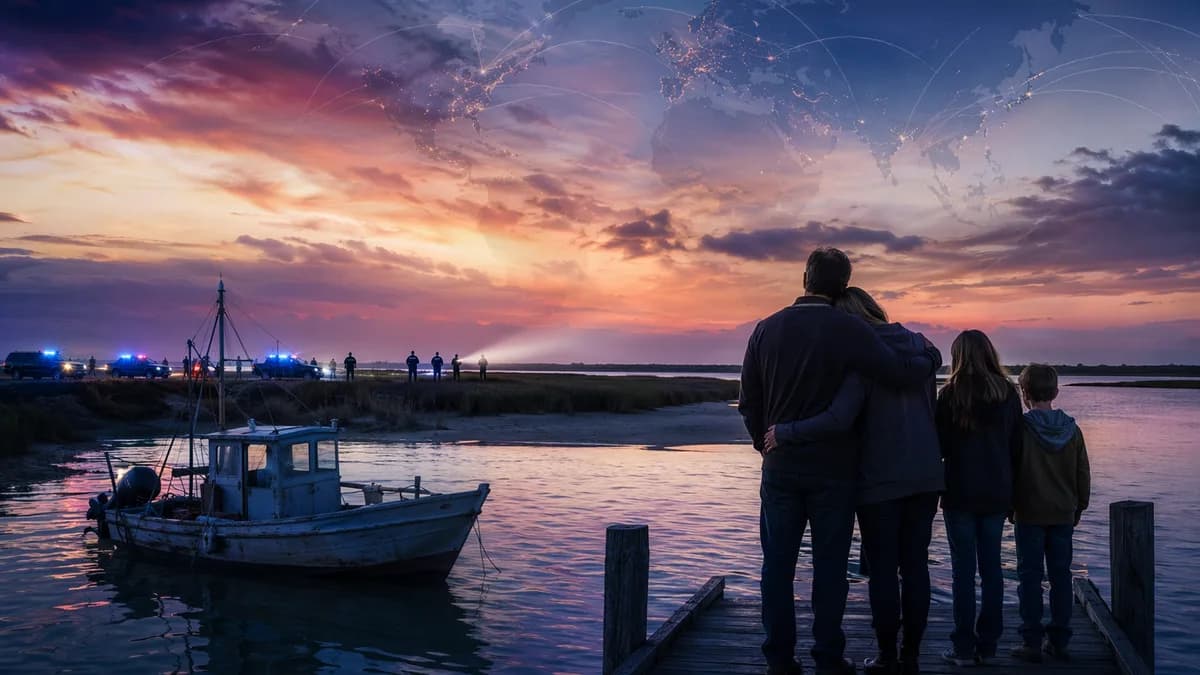
Nolan Wells' death turns a Horn Island boating trip into a demand for accountability
Nolan Wells is now the center of a harder question than how a holiday boating trip ended: whether investigators can build a clear, public timeline around the death of an 18-year-old Mississippi teenager whose family says the story still doesn’t add up.
XOOMAR Intelligence
Analyst Take
Wells went to Horn Island with friends on 4 July, did not return with them, and was found dead in the water two days later, according to BBC World. The Jackson County Sheriff's Office has said "no foul play was suspected", but it is still asking the public for information, including original, unedited photos and videos from the island.
That tension defines the case. Officials have not publicly alleged a crime. The family is not accepting a vague explanation. Their lawyer, Ben Crump, says there are conflicting witness statements and has ordered an independent autopsy.
"The family has concerns about the state of Mississippi doing an investigation of the death of a young black man where young white students may be looked at as having some culpability," Crump told ABC News' Linsey Davis.
The strongest counterpoint is simple: unanswered questions do not prove misconduct. But in a death involving friends, an isolated island, delayed recovery, and unreleased autopsy results, uncertainty itself becomes the issue.
The Horn Island timeline investigators need to lock down in the Nolan Wells case
The timeline is the case. Wells was last seen on Horn Island after traveling there by boat with friends to celebrate the holiday, according to reporting from CBS News. Jackson County Sheriff John Ledbetter told The Associated Press that Wells’ friends were cooperating and that, based on people investigators had spoken to, it sounded like Wells chose to stay on the island with the assumption he would ride back with someone else.
That account is exactly where the family’s challenge begins. Crump has questioned conflicting reports about whether Wells planned to leave with friends or asked to remain behind. His parents, Christine Wonsley and Elmore Wonsley, told CBS Mornings they do not believe their son would have decided to stay alone.
"That's not in his character," said Elmore Wonsley.
The confirmed sequence is narrow but consequential:
| Point in the case | Reported status |
|---|---|
| 4 July | Wells went by boat to Horn Island with friends |
| Later 4 July | He did not return to the mainland with them |
| Evening 4 July | His mother raised the alarm after he failed to return |
| 6 July | Authorities found his body off the coast of the island |
| After recovery | Dental records confirmed the body was Wells |
| Autopsy | Initial autopsy completed, results not released |
The counterpoint for investigators is that they may have reasons to move slowly. Witness interviews, photo and video review, and medical findings can conflict early. But the family’s pressure still holds weight because the unresolved issue is basic: how did Nolan Wells end up alone on Horn Island, and how did he die?
Horn Island’s isolation makes small facts carry more weight
Horn Island is not a controlled setting. The National Park Service described it as having "no staff, drinking water, shelter, facilities, or communication". That detail matters because the setting limits easy assumptions about safety, rescue, and decision-making.
The search involved multiple local, state, and federal agencies, including the U.S. Coast Guard, the Mississippi Department of Marine Resources, and the National Park Service, according to CBS News. That does not prove the trip was unusually dangerous. It does show that once someone is missing in that environment, the response can become complex quickly.
The source record does not include weather, tide, boat-condition, phone-record, alcohol, life-jacket, or swimming-ability findings. Those gaps should not be filled with speculation. They should be treated as investigative categories that could reshape the reconstruction if authorities later release evidence.
A useful way to read this case is not as an instant allegation, but as a chain of dependency. If one link is unclear, the whole account weakens.
- Last confirmed sighting: Who saw Wells last, and at what exact time?
- Departure account: Who left the island, and what did they believe Wells planned to do?
- Emergency trigger: When did concern become a missing-person report?
- Digital evidence: Are there unedited videos, photos, or phone records that clarify events?
- Medical findings: Do autopsy results support drowning, injury, impairment, or another cause?
The strongest fact in favor of caution is the sheriff’s statement that no foul play is currently suspected. The strongest fact in favor of continued scrutiny is that authorities are still asking for evidence of "alleged altercations" and unusual activity.
Family, friends, investigators, and the public are pulling the Nolan Wells story in different directions
The family’s demand is not a side issue. It is now part of the evidentiary pressure around the case. Crump said the family has "serious, unanswered questions about the circumstances that left Nolan alone on the island and about how he died". That framing turns the case from a private tragedy into a public accountability test.
Friends who traveled with Wells may be central witnesses, but the available source material does not support treating them as suspects. Ledbetter said they were cooperating. That matters. Fairness requires separating proximity from culpability until evidence says otherwise.
Investigators face a different burden. They need to verify statements, preserve the integrity of the case, and avoid public conclusions before autopsy findings are available. The initial autopsy has been completed, but results have not been released. Crump has ordered an independent autopsy, which may either reinforce the official findings or create new pressure for disclosure.
Public attention can help or damage the case. The Jackson County Sheriff's Office has asked anyone on or near Horn Island on July 4 to contact the department, especially anyone with original, unedited photos and videos. That request is targeted. Online speculation is not.
For readers following XOOMAR’s broader coverage of public accountability under pressure, the same verification discipline applies across very different cases, including Armed Teen Seized After Schongau School Attack Hurts Girls and Graham Platner Senate Campaign Craters After Assault Claim. Facts first. Timelines second. Judgment last.
The evidence trail now matters more than the early label
The phrase "no foul play was suspected" is not the same as a complete explanation. It describes the current investigative posture, not the final story of Nolan Wells’ death.
CBS News reported that Wells’ body was confirmed through dental records by Jackson County coroner Bruce Lynd. That confirms identity, not cause or manner of death. The autopsy results remain unreleased, and the family has hired one of the country’s most visible civil rights lawyers to press for a fuller account.
The public evidence now points to several possible routes for the investigation:
| Evidence path | How it could clarify the case |
|---|---|
| Autopsy findings | Establish cause and manner of death when released |
| Witness interviews | Resolve conflicting accounts about whether Wells stayed by choice |
| Unedited videos and photos | Confirm or challenge claims about altercations or unusual activity |
| Phone data | Help reconstruct timing, location, and attempted communication |
| Boat records and passenger accounts | Clarify who left, when they left, and what they understood |
A credible resolution would need more than a cause-of-death label. It would need a timeline that explains how Wells became separated from the group, why he did not return, when others realized he was missing, and whether any evidence contradicts the current view that no foul play is suspected.
If the autopsy and witness record align cleanly, the family’s concerns may narrow. If they conflict, or if official updates stay sparse, pressure will build. The demand for answers is the mechanism keeping this from fading into a vague boating tragedy.
The Stakes
- The case hinges on whether investigators can establish a clear timeline of what happened on Horn Island.
- The family's concerns highlight broader questions about trust, race, and transparency in death investigations.
- Public photos and videos could become critical evidence if witness accounts remain inconsistent.
Key positions in the Nolan Wells case
| Officials | Family and attorney |
|---|---|
| Jackson County Sheriff's Office says no foul play is suspected. | The family says the explanation remains unclear and wants accountability. |
| Investigators are asking the public for original, unedited photos and videos from Horn Island. | Attorney Ben Crump cites conflicting witness statements and has ordered an independent autopsy. |
| Sheriff John Ledbetter said Wells' friends were cooperating. | The family is concerned about whether the investigation will fully examine possible culpability. |
Primary Sources & Disclosures

Written by
XOOMAR Insights Team
Research and Editorial Desk
The XOOMAR Insights Team pairs automated research with human editorial judgment. We track hundreds of sources across technology, fintech, trading, SaaS, and cybersecurity, cross-check the facts, and explain what happened, why it matters, and what to watch next. We do not just rewrite headlines. Every article is fact-checked and scored for reliability before it goes live, and we link back to the original sources so you can verify anything yourself.