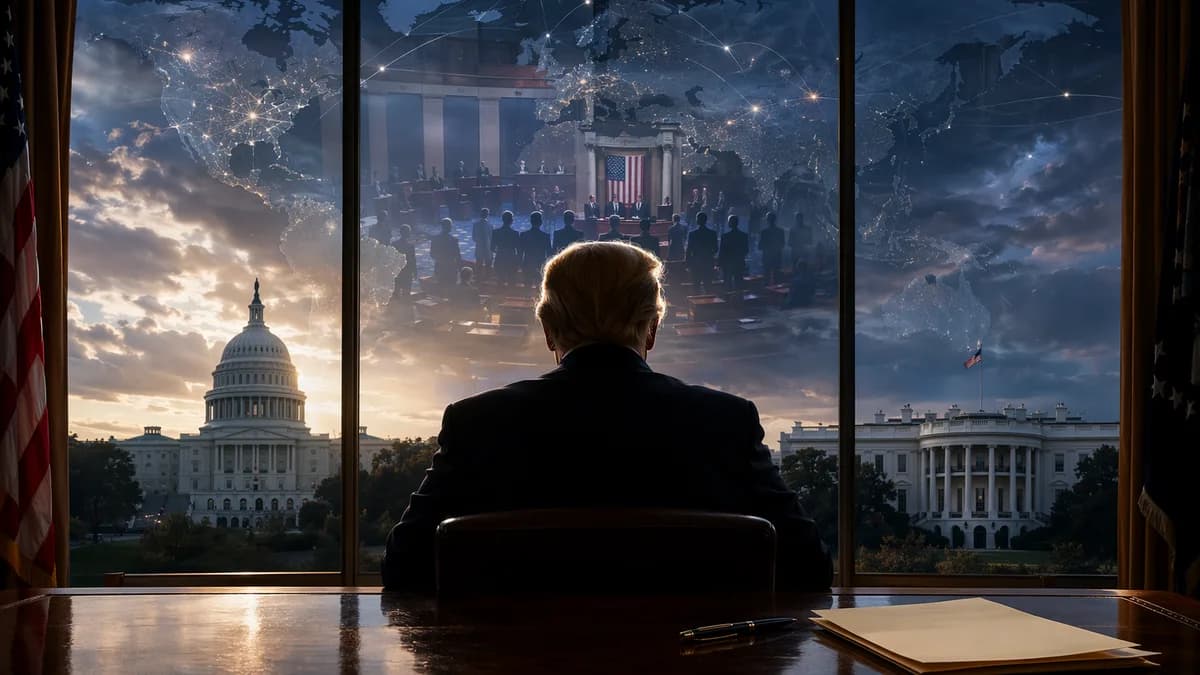
On Friday morning, President Donald Trump turned the housing bill into a loyalty test over election legislation, saying he will not sign a bipartisan measure that can still become law at midnight without his signature.
XOOMAR Intelligence
Analyst Take
The move matters because non-signature is not the same as a veto. Trump has not said he will veto the bill, and the package passed Congress with overwhelming bipartisan support, according to American Banker. That leaves the president in a narrow lane: protest the bill publicly, but possibly let Congress’s work take effect anyway.
Friday’s Truth Social post turned the housing bill into a SAVE Act fight
Trump said the quiet part directly. His objection was not centered on the housing bill’s contents. It was tied to the Senate’s failure to pass separate election legislation.
“I will not sign the Housing Bill, which has been fully approved by Congress and sent to the White House, in PROTEST over the fact that the United States Senate is not capable of passing THE SAVE AMERICA ACT,” Trump said.
The SAVE Act is a Republican election initiative that would require voters to show certain forms of ID before voting, among other measures. Democrats oppose it, arguing there is little evidence of voter fraud for the bill to counter and that it could suppress Democratic turnout, according to the source material.
That linkage is the real signal. Trump is using a broadly supported housing bill as pressure on Senate Republicans and Democrats over an unrelated voting measure. But he has not taken the harder step: issuing a veto.
XOOMAR analysis: This is a tactical disavowal. Trump can tell supporters he refused to bless the housing package, while avoiding, at least for now, the consequences of killing legislation that cleared both chambers with large majorities.
For readers tracking the same pattern of Trump-centered policy fights across other arenas, see XOOMAR’s coverage of Trump's Patriot Missile Licence Won't Save Kyiv Soon, Trump’s 1,400-Person NATO Summit Entourage Tests Allies, Avi Loeb’s UAP role, and Reflecting Pool repairs.
Midnight is the decision point because “won’t sign” is not “veto”
The bill is set to become law without Trump at midnight if Trump does not veto it. ABC News reports that the measure was presented to Trump on June 29, with the 10-day clock beginning on June 30, and that a bill becomes law without a signature after 10 days while Congress is in session, excluding Sundays, according to ABC News.
That creates three possible paths:
| Trump’s action | Legal result | Political effect |
|---|---|---|
| Signs the housing bill | Becomes law with presidential approval | Trump shares credit for the bipartisan package |
| Vetoes the housing bill | Congress must attempt override | Trump triggers a direct fight with lawmakers |
| Takes no action by midnight | Becomes law without his signature | Trump protests while avoiding an immediate veto battle |
The distinction is not procedural trivia. If Trump vetoes the bill, Congress would need a two-thirds vote in both the House and Senate to override him. The source material says the bill passed with veto-proof majorities, though American Banker notes it is unclear whether Republicans would vote to overturn a veto right before the midterm elections.
That uncertainty gives the midnight deadline its power. A veto forces every lawmaker back onto the record. Non-signature lets the president step away from the bill without forcing that confrontation.
June votes gave Congress the leverage Trump lacks at the deadline
The housing measure passed the Senate 85-5 on June 22 and the House 358-32 on June 23, according to ABC News. Those margins matter because they exceed the two-thirds threshold that would be relevant in a veto override fight.
The bill’s stated aim is to increase housing supply by cutting red tape across several programs that its authors say will make new construction easier. American Banker adds an important qualifier: the construction impact appears relatively limited outside the manufactured housing sector, which helps explain why mortgage bankers have paid little attention.
The package also includes provisions that matter outside the headline housing debate:
- Community banks: The bill includes several community bank-favored riders.
- Brokered deposits: Two brokered deposit bills are included.
- Bank exams: One provision reduces the examination cycle for some small banks.
- Institutional investors: The package includes a partial ban, softened from earlier versions, on institutional investors owning some single-family homes.
The affordability backdrop gives Congress an obvious incentive to move. ABC News cited National Association of Realtors data showing the median home price increased 1.8% in June from a year ago to $440,600, described as an all-time high. BBC, citing similar housing pressure, reported that the bill includes more than 40 provisions and is called the 21st Century Road to Housing Act.
XOOMAR analysis: The bill’s politics are broader than its policy reach. Even if the construction effects take time, lawmakers can argue they acted on supply, investor ownership, and community banking rules in one package. That is useful in a midterm year when affordability is already central to voter anger.
Banks, builders, renters, and homeowners are reading different bills
Congressional supporters can sell the package as an affordability response. For community banks, the win sits in the riders, especially brokered deposit changes and exam-cycle relief. For housing advocates, the focus is supply, manufactured housing, and limits on some institutional ownership of single-family homes.
The White House posture is different. Trump is not arguing, at least in the quoted post, that the housing provisions are unacceptable. He is saying the Senate’s failure to pass the SAVE Act justifies withholding his signature.
That difference matters for implementation. If the bill becomes law without his signature, agencies and stakeholders still move into execution mode. But the political ownership gets muddier. Congress can claim the statute. Trump can say he protested it. Opponents can argue he refused to visibly support an affordability package.
A federal housing bill also collides with a practical limit: construction and affordability are shaped by national programs, but land use, permitting, and local development politics remain heavily state and local fights. The source material supports caution here. American Banker says the bill’s housing construction scope is “relatively limited” outside manufactured housing.
So the likely effect is uneven. Community bank provisions may have clearer beneficiaries. Housing supply provisions may take longer to show up, if they show up at all.
The unsigned path lets Trump avoid owning the housing compromise
Presidents can allow bills to become law without signature when they object to part of a measure but do not want to block it outright. The supplied sources do not provide historical examples, so the relevant comparison here is internal to this episode: Trump has a live veto option, but has chosen so far to emphasize protest rather than rejection.
CNN reported that Trump previously dismissed the housing bill as “a yawn” and “so unimportant” compared with the elections legislation. It also reported that Republicans had hoped to promote the bill as an economic achievement before the midterms, but that a planned signing moment was disrupted after Trump tied the measure to election legislation.
That makes the unsigned route politically cleaner for Trump than a signing ceremony and less explosive than a veto. He avoids the image of celebrating a bipartisan compromise. He also avoids, unless he vetoes before midnight, forcing Republicans into an override fight over a bill many already supported.
XOOMAR analysis: The housing bill has become a proxy fight over control of the Republican agenda. Congress built a cross-party package around affordability and bank-policy riders. Trump redirected the spotlight to the SAVE Act and the filibuster. If the bill becomes law anyway, it will show that Congress can still move policy when the vote margins are large enough, even under presidential protest.
After midnight, the fight shifts from Trump’s desk to execution
If no veto arrives by midnight, the housing bill becomes law without Trump’s signature. The next stage will be less theatrical and more consequential: agency guidance, rule details, program execution, and how states and localities respond.
The most immediate practical questions are narrow:
- Which provisions move fastest, especially the community bank riders?
- How agencies interpret the housing supply measures, particularly around manufactured housing.
- How the partial institutional-investor ban is implemented, given that American Banker says it was softened from earlier versions.
- Whether the bill’s housing provisions produce visible relief, or whether voters see only a symbolic affordability vote.
The evidence that would confirm the strongest version of the bill is clear: faster implementation, measurable uptake in the affected programs, and visible movement in the specific housing channels the legislation targets. The evidence that would weaken it is just as clear: slow rulemaking, limited construction impact outside manufactured housing, or a political fight that turns the statute into another partisan trophy rather than a working affordability tool.
Trump’s refusal to sign the housing bill is not the same as stopping it. That is the point. If midnight passes without a veto, the law will carry Congress’s fingerprints, not his signature.
Impact Analysis
- Trump is using a bipartisan housing bill to pressure lawmakers over unrelated election legislation.
- Because he has not threatened a veto, the bill may still become law despite his public opposition.
- The episode shows how housing policy is being pulled into broader partisan fights over voting rules.
Trump's Options on the Housing Bill
| Action | What It Means | Status in Article |
|---|---|---|
| Not signing | Allows Trump to protest while the bill can still become law without his signature | Trump says he will not sign |
| Vetoing | Would actively block the bipartisan housing package | Trump has not said he will veto |
| Signing | Would formally approve the housing bill passed by Congress | Trump says he will not do this |
Primary Sources & Disclosures

Written by
XOOMAR Insights Team
Research and Editorial Desk
The XOOMAR Insights Team pairs automated research with human editorial judgment. We track hundreds of sources across technology, fintech, trading, SaaS, and cybersecurity, cross-check the facts, and explain what happened, why it matters, and what to watch next. We do not just rewrite headlines. Every article is fact-checked and scored for reliability before it goes live, and we link back to the original sources so you can verify anything yourself.