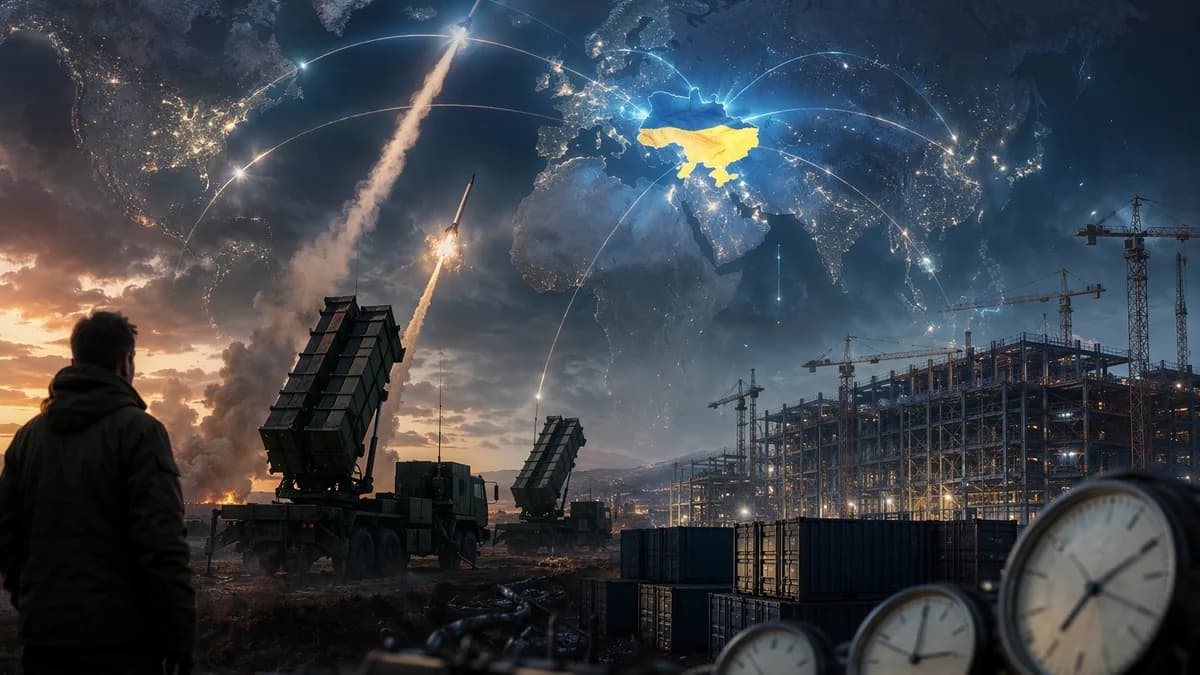
Donald Trump’s Patriot missile licence offer would give Ukraine a path to make one of the few interceptors that can stop Russia’s ballistic missiles, but it won’t fix Kyiv’s shortage on the timeline civilians need.
XOOMAR Intelligence
Analyst Take
Trump told Volodymyr Zelensky at Wednesday’s Nato summit in Ankara that the US would give Ukraine permission to produce Patriot interceptor missiles, according to BBC World. The immediate stakes are grim: Ukraine says it lacks enough interceptors, while Russia has intensified ballistic missile strikes that have killed dozens in Kyiv over the past week.
“We are gonna give you a licence to make Patriots,” Trump told Zelensky. “I think they can produce them very quickly once we explain it.”
That sentence sounds like a production breakthrough. XOOMAR analysis: based on the source details, it is better read as a political signal with a manufacturing problem attached. A Patriot missile licence could reduce Ukraine’s dependence on US stockpile transfers over time. It does not create missiles next week.
Trump’s Patriot missile licence shifts Ukraine from stockpile requests to factory politics
The core news is simple: Trump says Kyiv will get a Patriot missile licence. The deeper move is sharper. Ukraine has spent years asking for more air defence systems and interceptors. In late May, Zelensky confirmed that Ukraine had formally asked the US to authorise licensed production of Patriots.
That matters because Trump also made clear why direct transfers are constrained.
“We have Patriots, but we don’t have that many. We need them for ourselves too,” Trump said.
The Patriot system is expensive and slow to produce. The BBC reports that a single battery, with missiles, is worth around $1bn (£740m). It also cites the US Department of Defence saying only 600 missiles are produced per year. The US is also reluctant to part with more because it used more than half of its stockpile during its war with Iran earlier this year, according to the Center for Strategic and International Studies.
The question for Kyiv is blunt: does a licence mean usable interceptors before Russia’s missile campaign inflicts more damage?
Right now, the answer is not established by the sources. Trump said he had not yet informed Lockheed Martin and Raytheon of his decision, adding that “that’ll work out alright.” That is not the same thing as a signed production plan, a staffed facility, or a delivery schedule.
Lockheed Martin, Raytheon and Ukraine face the hard part: turning permission into missiles
For the builders, the licence is only the first gate. The supplied reporting points to several unresolved issues: contractor involvement, technical complexity, production location, and time.
The Guardian described Trump’s commitment as “vaguely framed” and said it remained unclear how quickly manufacturing could be increased. It also reported that the process would likely be expensive, complex and long, according to the Guardian.
A Ukrainian military expert quoted by the BBC, Ivan Stupak, was even more cautious.
“Unfortunately, Ukraine is not able to produce such kinds of advanced munition, because it's really sophisticated, cutting-edge equipment.”
Stupak said he thought production would more likely be deployed on European soil and supervised, rather than immediately produced inside Ukraine, and “could take many months.”
That distinction is central:
| Possible outcome | What the sources support | Battlefield effect |
|---|---|---|
| Licence announcement | Trump said Ukraine would get the right to make Patriots | Political signal now |
| European-supervised production | Stupak said this was more likely than production in Ukraine | Possible help later, timing unclear |
| Immediate Ukrainian production at scale | Sources do not establish this | Not supported by current reporting |
The practical bottleneck is not just permission. It is whether contractors, governments and secure facilities can turn that permission into actual interceptors.
Ukrainian cities need interceptors now, not a manufacturing slogan
For Ukrainian civilians and air defence crews, the production timeline is not abstract. Russia’s ballistic missiles travel at high velocity and on a steep path, making them hard to stop. Zelensky has called ballistic missiles Russia’s “last major advantage.”
Ukraine has adapted to nightly drone attacks more effectively than to ballistic missile strikes, according to the BBC’s summary of the war after four-and-a-half years. The front line has mostly stalled. The Black Sea is at a standstill. But ballistic missiles still punch through depleted air defences.
The recent data point is severe: Ukraine’s Air Force said a “serious shortage” of interceptor missiles meant none of the 23 ballistic missiles Russia fired on Sunday night were shot down. More than 20 people died in that attack.
That is why the Patriot missile licence lands so hard. Patriot interceptors are among Ukraine’s most valuable tools because they can engage the missile class that many other systems struggle to defeat.
For related XOOMAR coverage on the same pressure point, see Russia Missile Attack Kills 22 as Patriot Gap Bites and Zelensky Forces Nato Air Defence Fight After Kyiv Strikes.
The live question is brutal: can a future production pipeline matter if Ukraine cannot bridge the current interceptor gap?
Moscow gets an escalation signal, while NATO inherits a supply problem
For Moscow, Trump’s pledge gives an easy propaganda line: the US is moving deeper into Ukraine’s defence production. Defense News reported that Russian state media quickly picked up the announcement and that state-aligned outlets had previously amplified sceptical Western voices warning about risks to US national security.
Trump also linked Ukraine’s long-range strikes on Russia to pressure for a settlement.
“It's an escalation, but it's also an escalation that can help lead to an end,” Trump said.
Marco Rubio, sitting next to Trump, said Ukrainian strikes on Russian refineries were needed to show Moscow “how difficult it is to defend its airspace,” and push the Kremlin to end the war.
NATO’s concern is different. If US stockpiles are tight and Patriot production is constrained, a Ukrainian licence raises allocation questions. Who gets interceptors first? How are scarce missiles split among US needs, Ukraine’s wartime demand, and allies already relying on the system?
The sources do not show a NATO-wide production agreement. They show a US presidential pledge, contractor discussions still pending, and a battlefield shortage that is already killing people.
Defence suppliers get demand pressure, not instant revenue
For defence investors and suppliers, the signal is demand, not immediate execution. A Patriot battery with missiles is worth around $1bn (£740m), and the Guardian reports that individual interceptors cost about $3m depending on context. The US production base is already under pressure, with the BBC citing 600 missiles produced per year.
XOOMAR analysis: if the licence becomes a real production arrangement, pressure would likely concentrate on the companies and suppliers tied to interceptor manufacturing, testing, guidance, and integration. But the sources do not establish new contracts, order volumes, funding, or a production site.
That matters. A licence is not a factory. Ukraine would still need secure facilities, trained workers, imported know-how or components, contractor participation, and guaranteed orders. If production happens in Ukraine, facilities could become high-value Russian targets. If production happens elsewhere in Europe, the political burden shifts to allies hosting or supervising the work.
The market signal is therefore narrow but important: air defence capacity is now part of the diplomacy, not just the logistics.
The next fight is speed, secrecy and control of the Patriot supply chain
The near-term effect of Trump’s Patriot missile licence pledge is political. It tells Kyiv the US may support a longer-term path to production. It tells Moscow that Washington is not simply rationing old stockpiles. It tells contractors that the White House wants movement, even though Trump said they had not yet been informed.
The practical test comes next.
Evidence that would strengthen the pledge: a named contractor role, a defined production location, a timeline, funding, and clarity on which Patriot interceptor variant Ukraine would be allowed to produce. Defense News noted that it remains unclear whether Trump means the simpler PAC-2 or the more capable PAC-3.
Evidence that would weaken it: no contractor agreement, no facility plan, no funding route, or a timeline measured in years while Russia keeps firing ballistic missiles into Ukrainian cities.
If the pledge becomes production capacity, Ukraine gains depth in the one category where Russia still holds a dangerous edge. If it stays a summit line, Kyiv remains trapped in the same arithmetic: too many incoming missiles, too few interceptors, and no second chance when a ballistic missile gets through.
Impact Analysis
- Ukraine urgently needs more interceptors as Russia intensifies ballistic missile attacks on cities.
- A Patriot production licence could shift Ukraine’s air defence strategy from aid requests to domestic manufacturing.
- The offer signals political support but does not address the near-term shortage threatening civilians.
Ukraine’s Patriot Options
| Option | What It Offers | Main Limitation |
|---|---|---|
| US stockpile transfers | Faster access to existing Patriot interceptors | US says it has limited supplies and needs them for itself |
| Licensed production in Ukraine | A longer-term path to reduce dependence on US transfers | Manufacturing cannot solve Ukraine’s immediate interceptor shortage |
Primary Sources & Disclosures

Written by
XOOMAR Insights Team
Research and Editorial Desk
The XOOMAR Insights Team pairs automated research with human editorial judgment. We track hundreds of sources across technology, fintech, trading, SaaS, and cybersecurity, cross-check the facts, and explain what happened, why it matters, and what to watch next. We do not just rewrite headlines. Every article is fact-checked and scored for reliability before it goes live, and we link back to the original sources so you can verify anything yourself.