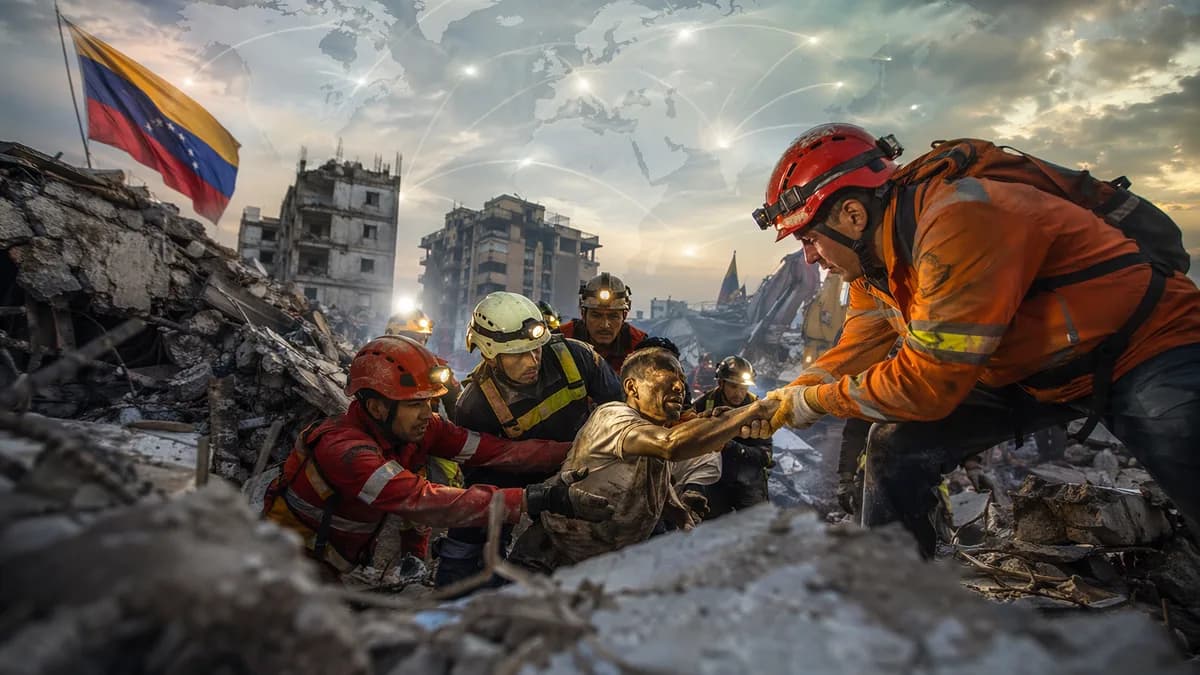
Hernán Gil, a Venezuela quake survivor, has been pulled out alive after spending eight days trapped beneath a collapsed car park, a rare rescue in a disaster that has killed almost 2,300 people and left tens of thousands missing.
XOOMAR Intelligence
Analyst Take
Gil, a security guard, had been on duty in a small concrete booth in the basement parking area next to the Galerias Playa Grande mall in Catia La Mar when twin earthquakes struck Venezuela on 24 June, according to BBC World. Emergency crews freed him after spending more than 100 hours working toward him under 140 tonnes of rubble.
Hernán Gil found alive eight days after Venezuela car park collapse
The rescue gives families in Venezuela’s quake zone one verified survival story after days of widening loss. Almost 2,300 people are confirmed dead, according to the BBC, and tens of thousands remain missing.
Gil was not found in an open void or an accessible basement corridor. He was trapped inside the wreckage of a multi-storey car park that had flattened around him. Hundreds of rescuers worked against repeated collapses inside access ducts they were building to reach him.
Teams from Venezuela, Chile, Costa Rica, El Salvador, Mexico, Portugal and the United States joined the operation. The scale of that effort shows how difficult this rescue became once crews confirmed a living person was still inside the structure.
A Chilean firefighter described the operation as:
"without doubt the most complex and technically difficult which I've had to tackle".
Rescuers eventually made visual contact with Gil overnight using a small camera inserted through the rubble. Footage showed him wearing a face mask that crews had passed through a small hole to protect him from dust and debris. One of his eyes appeared bloodshot.
Ricardo Arias of the Costa Rican Red Cross told local journalist Joan Camargo that Gil was stable. Crews had given him water and attached him to an intravenous drip.
Marco Antonio Franco of the Mexican Red Cross described Gil as "a cheerful man" and said he "even asked for hydration drinks of specific flavours he likes", adding that "of course we indulged him".
Gil’s survival now sits against the wider rescue timeline XOOMAR has been tracking in Critical Hours Squeeze Venezuela Earthquake Rescues and Venezuela Earthquake Rescue Falls Silent for Survivors. Those links matter because this case resets the emotional clock for families still waiting beside collapsed buildings.
Concrete hut may have shielded security guard as quake brought down parking structure
The most important detail in Gil’s survival may be where he was standing when the car park failed. He had been inside a small concrete booth in the basement of the parking lot next to the mall.
The BBC reports that the booth appears to have created a shell around him, protecting him from the 140 tonnes of rubble that fell around and above him. That does not prove the structure was designed to save him. It means the booth may have preserved enough space for him to survive until rescuers reached him.
That distinction matters. In collapsed buildings, survivable pockets can form by chance when slabs, beams, walls or enclosed rooms hold back debris. In Gil’s case, the booth appears to have acted as that protective pocket.
XOOMAR analysis: The rescue does not answer why the car park collapsed, whether the booth met any specific standard, or whether the wider structure had known weaknesses. The source material does not include inspection records, construction details or official engineering findings. Those questions remain open.
What is clear is that the rescue itself created danger. Parts of the access ducts built by rescue teams collapsed several times. That forced crews to balance speed against the risk of burying rescuers alongside the survivor they were trying to save.
A basic comparison shows the tension emergency teams faced:
| Rescue factor | Verified detail |
|---|---|
| Survivor location | Small concrete booth in basement parking area |
| Rubble above him | 140 tonnes |
| Time trapped | Eight days |
| Time after location to rescue | More than 100 hours, according to BBC |
| Condition before extraction | Stable, given water and IV support |
| Main rescue hazard | Collapsing access ducts and unstable debris |
CNN, citing the Chilean fire brigade, reported that Gil was transferred to a medical facility after being freed. The BBC source material says he was stable before the rescue and had received water and IV support.
Rescue teams shift from miracle search to safety checks after Venezuela quake
Gil’s extraction changes the immediate priority for his rescuers. First comes medical monitoring after eight days under debris. Then comes the harder operational question: how to keep searching without sending crews into structures that are still moving.
Search teams are still working in a disaster zone where tens of thousands are missing, according to the BBC. That number is the grim context for every decision at collapsed sites, including whether noises, voids or sensor readings justify another high-risk tunnel.
XOOMAR analysis: Gil’s case will likely sharpen scrutiny of three areas, even before any formal investigation is public: how teams identify possible survivors under dense rubble, how long they keep high-risk searches active, and how unstable buildings are secured while crews work inside them. Those are not abstract process questions. In this rescue, access routes collapsed several times while teams were inside the debris field.
The human side is just as direct. Franco said Gil kept talking with rescuers about his family and the operation itself.
"He himself drives us on, telling us to carry on. He recognises our team members, saying 'how nice that you came back and that you're with me again'."
That kind of contact can sustain a rescue effort, but it can also raise the stakes. Once crews know a person is alive, every delay and every collapse carries a different weight.
For families still waiting, this Venezuela quake survivor story cuts both ways. It proves survival after eight days was possible in at least one collapsed structure. It does not prove others are alive, nor does it reduce the danger facing crews at damaged buildings.
The next practical test is whether authorities and international teams can convert the lessons from Gil’s rescue into safer searches across the remaining collapse sites. Watch for official updates on Gil’s medical condition, new survivor detections, and any engineering review of the Galerias Playa Grande car park collapse.
Why It Matters
- Hernán Gil’s rescue after eight days offers a rare survival story amid a disaster with almost 2,300 confirmed deaths.
- The operation highlights the extreme risks and technical difficulty faced by rescue crews working under 140 tonnes of rubble.
- International teams joined the response, underscoring the scale of Venezuela’s quake emergency and the need for continued aid.
Primary Sources & Disclosures

Written by
XOOMAR Insights Team
Research and Editorial Desk
The XOOMAR Insights Team pairs automated research with human editorial judgment. We track hundreds of sources across technology, fintech, trading, SaaS, and cybersecurity, cross-check the facts, and explain what happened, why it matters, and what to watch next. We do not just rewrite headlines. Every article is fact-checked and scored for reliability before it goes live, and we link back to the original sources so you can verify anything yourself.