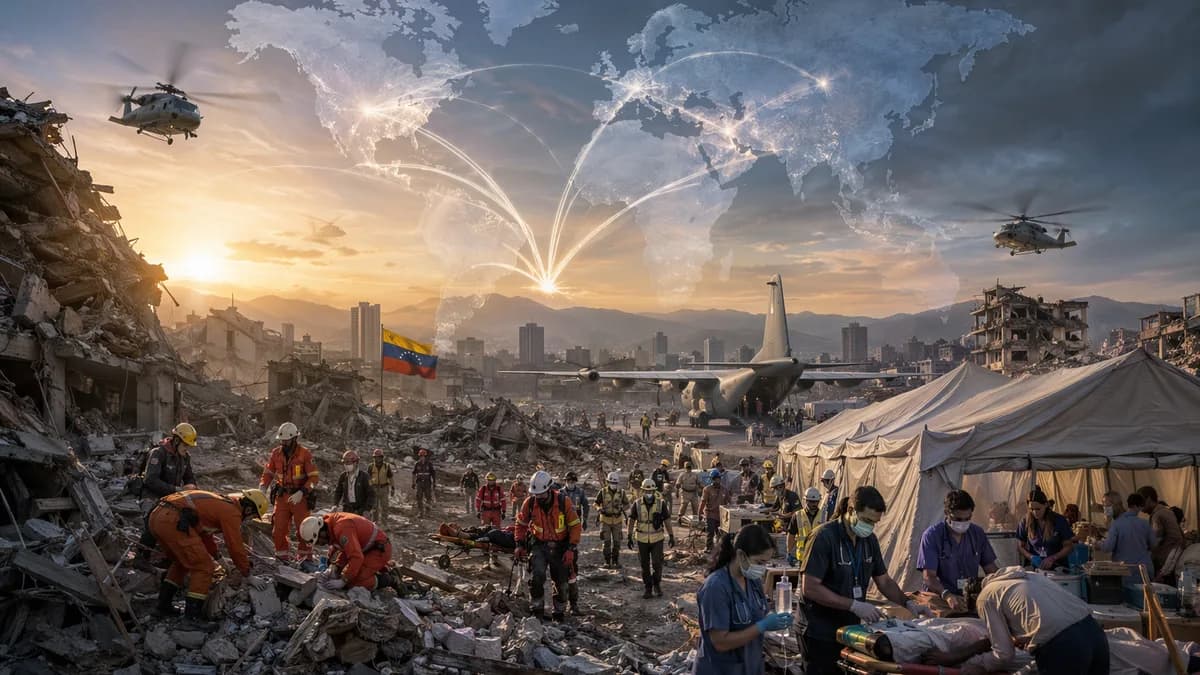
The Venezuela earthquake rescue has reached the point where silence is no longer a pause. It is a tool, a test, and, for families in La Guaira, sometimes the last thin line between hope and grief.
XOOMAR Intelligence
Analyst Take
At the Mariola and Maribel Residences, rescuers stopped engines, cranes, and drills after someone thought they heard a voice under the rubble, according to BBC World. People passed the order down the street: quiet, please. For 10 minutes, a crowd held its breath while rescue teams listened for a survivor beneath concrete, iron, and dust.
That silence ended in a false alarm.
The cruelest sound in Venezuela's rescue zone is silence
The most revealing detail from La Guaira is not the rubble itself. It is the discipline required to stop touching it.
Rescuers climbed onto an unstable mound where one tower had collapsed and the other still stood, leaning and at risk of falling. They knelt, bowed their heads, and listened. That is what the Venezuela earthquake rescue has become in its most desperate phase: less brute force, more controlled stillness.
"Please, let us listen. Don't make noise! It seems like there's someone here," one rescuer called out from above.
The command matters because noise can bury evidence. Engines, drills, crowds, and panicked shouting can drown out the one sound that changes a search site: a voice, a tap, a groan, or any sign that someone trapped under tons of debris is still alive.
XOOMAR analysis: the reporting shows a rescue effort caught between urgency and restraint. Families want digging to accelerate. Rescuers need quiet, access, and time to verify signals before heavy equipment moves again. Courage is everywhere in La Guaira. Coordination is the scarcer resource.
Related XOOMAR coverage tracks the same shrinking rescue window in Venezuela Earthquake Rescuers Race a 72-Hour Clock and Critical Hours Squeeze Venezuela Earthquake Rescues.
Tens of thousands missing turns every minute under rubble into a calculation
The scale is still hard to fix with confidence. BBC's summary says tens of thousands are still believed missing. Separate BBC News Mundo reporting carried by Yahoo says officials have confirmed at least 1,430 deaths, after magnitude 7.2 and 7.5 earthquakes struck Venezuela on Wednesday, and says the UN estimates around 50,000 people are missing.
That missing figure should be read carefully. It does not mean every person is confirmed alive under rubble. It means families, responders, and officials do not yet have a reliable accounting of who escaped, who is displaced, who is dead, and who may still be trapped.
The same reporting says hundreds of buildings collapsed, with La Guaira among the hardest-hit areas. It also says authorities reported 861 volunteers from Mexico, the US, El Salvador, Switzerland, Colombia, and other countries were in Venezuela, with more arriving.
Humanitarian agencies cited in the supplied reporting say the first 48 to 72 hours are critical for live rescues, though survival can extend beyond that if trapped people have air, water, or survivable voids. That detail explains why nobody at Mariola, Maribel, or the nearby Caribe residential complex can treat silence as final.
Listening can beat machinery in collapsed neighborhoods
Heavy machinery is visible in La Guaira. So are bare hands, shovels, drones, nurses, relatives, neighbors, and volunteers.
But the BBC scene shows why machines are not always the fastest route to a survivor. At Mariola and Maribel, cranes and drills were stopped so rescuers could listen. At Caribe, people again ran through the street asking for silence after a young man said he heard someone inside the rubble.
Belkys Valecillo, whose brother, nephew, and sister-in-law were buried on the first floor of a tower, said she had been told heavy machinery should only be used once search and rescue efforts were called off.
"It's only been four days," she said.
XOOMAR analysis: that line captures the operational dilemma. Heavy equipment can clear mass quickly, but the reporting shows families fear it may arrive too soon, while trapped people may still be alive. Hand searches are slower and dangerous. Machine searches are faster but riskier when voids may contain survivors.
The supplied material does not verify the use of seismic sensors, rescue dogs, or thermal cameras at these specific sites. It does mention drones scanning overhead in affected areas. That distinction matters. The Venezuela earthquake rescue described here is not a polished technical operation in every location. It is a patchwork of professional teams, international volunteers, neighbors, and families working around unstable structures.
Families, rescuers, officials, and volunteers hear different things in the same silence
For families, silence can sound like abandonment.
Ronnie Navarro traveled 350km (220 miles) from Puerto La Cruz to La Guaira to help pull his uncle from the rubble. He accused the authorities of failing to help.
"There are bodies there, trapped. The relatives of those who lived there are helping because the government doesn't want to help," he said.
Zuly Marín, a 66-year-old biologist who had lived in Mariola and Maribel for more than a decade, survived because she went shopping and then visited her father instead of returning home. She told BBC Mundo she lost her niece and brother-in-law.
"There has been a delay in the rescue process. I think that if [the authorities] had arrived sooner, many people would have been saved," she said.
Officials, meanwhile, are under pressure to project control without making claims that collapse under scrutiny. The supplied reporting says authorities have distributed food and water to survivors, and that Delcy Rodríguez said the government was deploying a response during the critical hours to rescue people alive.
Those positions are not mutually exclusive. Aid can be arriving while families still experience rescue as absent, late, or uneven. That gap is where anger grows.
This record supports caution, not easy disaster comparisons
The outline of this crisis resembles other major collapses in one limited, verifiable way: early numbers move, and the first days are defined by incomplete information. But the supplied source material does not provide verified comparisons with Haiti, Turkey, Mexico, or Chile, so a responsible analysis should not pretend otherwise.
What the record does show is enough. At Mariola and Maribel, a hopeful silence became a false alarm. At Caribe, another burst of activity ended the same way. Half an hour later, someone saw two motionless bodies deep in the rubble.
That sequence is the emotional violence of earthquake rescue. A sound can mobilize dozens. A false alarm can drain them in minutes. A body can reset the whole site from rescue to recovery, even as other families nearby keep listening.
For broader context on the casualty reporting, see XOOMAR's related brief, 1,430 Dead as Venezuela Earthquakes Shatter the North.
Venezuela's rubble searches are also a test of public information
The most practical rescue tool after silence may be credible information.
Accurate lists reduce duplicate searches. Clear site control keeps crowds from drowning out signals. Reliable updates help families stop chasing rumors without forcing them to accept uncertainty blindly. The supplied reporting shows the opposite pressure at street level: people waiting beside ruins, digging themselves, or watching heavy machinery with fear that it is too soon.
XOOMAR analysis: transparency and outside coordination should be treated as rescue assets, not political concessions. The reporting says international rescuers from Mexico, Spain, the US, and the UK have joined the effort, while national teams are described as scarce in the related BBC News Mundo material. If that is the operating reality, then access, routing, and shared information matter as much as manpower.
The next week will test whether silence remains hope or becomes evidence
Live rescues may still happen. The supplied reporting says 33 people were found alive as recently as Saturday. But optimism in La Guaira is fading with each passing hour, and humanitarian agencies cited in the reporting place the critical rescue window at 48 to 72 hours, with exceptions possible when conditions allow.
The next signals to watch are practical:
- Rescue discipline: whether teams can keep sites quiet, controlled, and revisited when faint sounds are reported.
- Missing-person clarity: whether the huge missing figure narrows as families reconnect, bodies are recovered, or survivors are registered.
- Aid coordination: whether international volunteers, local families, and Venezuelan authorities can work without clogging the same streets and ruins.
- Public trust: whether official updates match what families are seeing at collapsed buildings.
In the first days after the quakes, silence in La Guaira means someone might still be alive. If coordination fails, that same silence will begin to mean something harsher: time lost when people could still hear.
The Stakes
- Rescuers in La Guaira are balancing speed with silence as they search for possible survivors under unstable rubble.
- False alarms show how emotionally brutal the rescue phase is for families waiting for signs of life.
- The operation highlights how coordination, discipline, and time can determine survival after a major disaster.
Primary Sources & Disclosures

Written by
XOOMAR Insights Team
Research and Editorial Desk
The XOOMAR Insights Team pairs automated research with human editorial judgment. We track hundreds of sources across technology, fintech, trading, SaaS, and cybersecurity, cross-check the facts, and explain what happened, why it matters, and what to watch next. We do not just rewrite headlines. Every article is fact-checked and scored for reliability before it goes live, and we link back to the original sources so you can verify anything yourself.