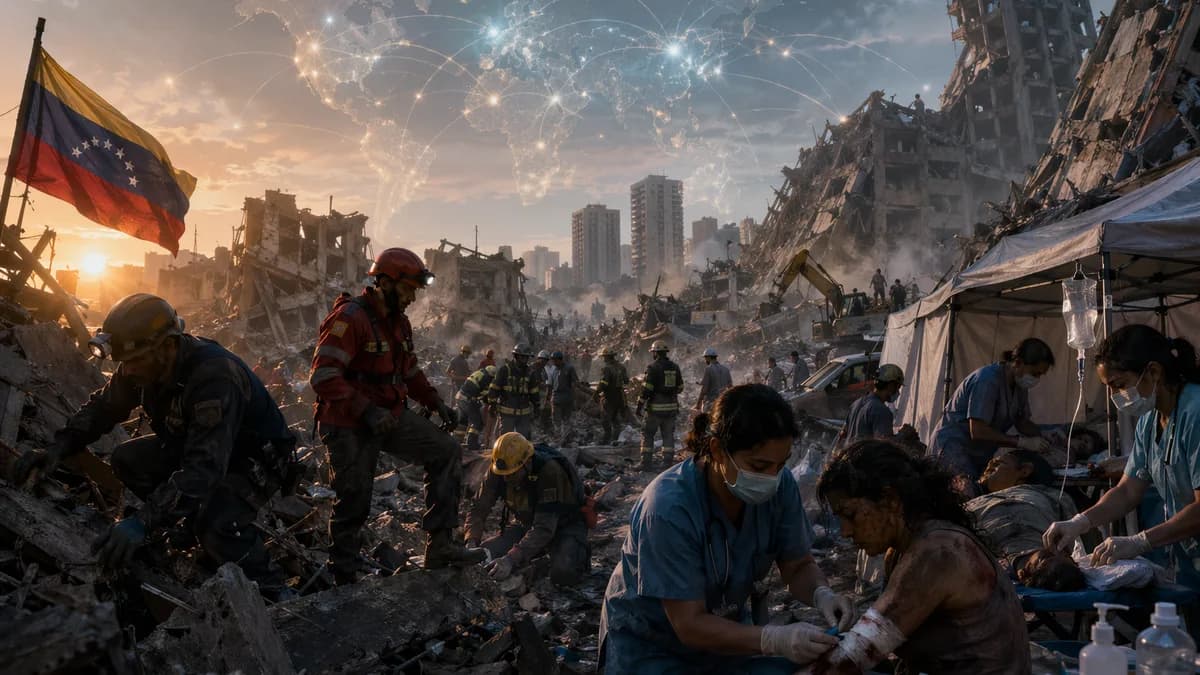
The Venezuela earthquakes are shifting from a race to find survivors into a race to stop infections among the people who made it out alive.
XOOMAR Intelligence
Analyst Take
A week after the June 24 twin earthquakes, doctors say the biggest danger now facing survivors is no longer only collapsed concrete. It is untreated wounds and infectious diseases, according to ABC International, citing Associated Press reporting from Caracas.
That shift changes the center of gravity of the disaster. Search teams are still working. Families are still waiting at collapsed buildings. But the medical system now has to absorb a second emergency: thousands of displaced people sleeping in crowded shelters or outside, without access to clean water, while hospitals themselves have been damaged.
“The issue we foresee just around the corner are the infections that patients who have been exposed to the disaster for the longest time might bring,” said Eugenio Cova, head of the trauma unit at Hospital del Oeste Dr. José Gregor Hernández in Caracas.
XOOMAR analysis: the final toll from the Venezuela earthquakes will not be shaped only by who survived the initial collapse. It will be shaped by how fast officials, hospitals, and foreign rescue teams can turn a rescue operation into a disciplined public-health response.
Venezuela earthquakes are moving from rescue math to infection math
The reported figures already show a disaster entering a harsher phase.
Venezuelan officials had counted over 1,900 deaths as of Tuesday, with the number rising daily. A non-governmental digital database where families can register missing relatives showed over 40,600 people still unaccounted for as of Wednesday. That second figure is not an official death toll, but it shows the scale of uncertainty facing families and responders.
The hospital damage is just as important. The government says the earthquakes damaged or otherwise compromised 38 hospitals nationwide. At Hospital del Oeste Dr. José Gregor Hernández, Cova said parts of the public hospital are now inaccessible because of possible earthquake damage. He also said the hospital lacks screws and plates needed for orthopedic surgery and medicated gauze to prevent infections.
That is the operational squeeze: patients need wound care and surgery at the same time hospitals are losing space, supplies, and capacity.
A basic before-and-after view shows the shift:
- First phase: Pull trapped people from rubble, treat severe trauma, identify the dead.
- Current phase: Keep wounded survivors from developing infections while displaced families lack clean water.
- Next risk: Medical complications rise faster than the relief system can track and treat them.
The rescue window is narrowing. The AP report notes that survival under rubble is typically 48 to 72 hours, though teams are still finding a small number of survivors against the odds, including a toddler who had been trapped for six days Tuesday. For readers following the earlier rescue phase, XOOMAR has tracked the pressure of those hours in Critical Hours Squeeze Venezuela Earthquake Rescues and the fading sound of live rescues in Venezuela Earthquake Rescue Falls Silent for Survivors.
Damaged hospitals are now part of the disaster, not just the response
Cova’s warning is blunt because the medical threat is no longer theoretical.
The hospital has treated scores of severely injured people since the quake, despite shortages of crucial equipment. That matters because trauma care does not end when a patient reaches a ward. Open wounds need cleaning. Fractures may need hardware. Dressings need to be changed. Infection prevention depends on materials that are easy to take for granted until they vanish.
“We’ve already gone through the period of complex trauma, which will continue to occur, but now it’s complicated by infections,” Cova added.
The AP account does not provide infection rates, tetanus coverage, antibiotic availability, diarrhea case counts, or hospital bed capacity. Those gaps matter. They are the metrics that would show whether the health crisis is stabilizing or spreading.
XOOMAR analysis: the most important dashboard now is not only the death count. It is a public-health dashboard. Authorities and aid groups should be judged by whether they can publish timely updates on:
- Hospital capacity: Which of the 38 damaged or compromised hospitals can still treat trauma patients?
- Wound-care supplies: Are medicated gauze, surgical hardware, and related materials reaching hospitals that need them?
- Clean water access: How many displaced people remain without reliable clean water?
- Infection signals: Are hospitals seeing more infected wounds among patients exposed to rubble and poor sanitation?
- Missing-person data: Can official counts be reconciled with non-governmental registries?
The numbers will probably keep moving. But movement alone is not clarity. Families need to know who is missing. Doctors need to know which facilities can take patients. Aid groups need to know where supplies will save lives fastest.
Families, doctors, officials, and foreign teams are solving different emergencies at once
The same earthquake has created several overlapping crises.
| Group | Immediate pressure | Source-supported constraint |
|---|---|---|
| Doctors | Treat severe injuries and prevent infections | Shortages of surgical hardware and medicated gauze at a Caracas public hospital |
| Families | Find missing relatives | Many thousands remain missing, with families waiting near collapsed buildings |
| Venezuelan officials | Count the dead, assess damage, coordinate rescue work | Official death count has risen daily, and 38 hospitals are damaged or compromised |
| Foreign responders | Continue search and rescue against long odds | Expert teams from more than two dozen countries are still operating |
| United States personnel | Support relief and rescue work | 900 military personnel and 100 State Department personnel are deployed, according to a U.S. Southern Command spokesman |
The international footprint is substantial. Expert teams from more than two dozen countries continued rescue operations Wednesday. The United States, which the source says took control of Venezuela’s oil industry after seizing former leader Nicolás Maduro in January, has scaled up assistance in recent days. Steven McCloud, a U.S. Southern Command spokesman, told the AP that 900 military personnel were supporting relief and rescue efforts as of Wednesday, with another 100 people from the U.S. State Department deployed to help aid work on the ground.
XOOMAR analysis: that many actors can add capacity, but it also raises the coordination burden. Search teams, hospitals, officials, and aid workers need aligned priorities. If the medical phase is delayed by fragmented logistics, survivors pulled from rubble could still die from treatable complications.
Comparisons to past quake disasters are tempting, but the local data has to lead
The outline of this crisis resembles a familiar post-earthquake sequence: trauma first, then displacement, sanitation stress, infection risk, and long recovery.
But the supplied source material does not provide comparable data from Haiti’s 2010 earthquake, Nepal’s 2015 earthquake, or Turkey and Syria’s 2023 earthquakes. A direct statistical comparison would overreach.
What can be said from the Venezuela reporting is narrower and more useful: the country is already showing the transition point that often defines week two after a catastrophic quake. Rescue teams are still searching, but doctors are warning that delayed treatment and poor sanitary conditions could become lethal.
That is where disciplined logistics beats dramatic optics. Live rescues capture attention. Infection control saves people who are already out.
The preventable-death question now sits with water, wound care, and transparency
For residents, the practical risk is simple: wounds that were survivable can worsen if they are not treated quickly. The source does not list public medical guidance, so this should not be read as official advice. But the danger doctors identified is clear enough: people exposed to the disaster for longer periods may bring infections into already strained hospitals.
For hospitals and aid groups, the priority is equally concrete. The response has to shift supplies toward wound cleaning, sterile dressings, orthopedic surgery materials, and basic sanitation support for crowded shelters and people sleeping outside. The AP report specifically identifies missing screws and plates and medicated gauze at one major Caracas hospital. That is not an abstract shortage. It affects whether injured limbs and wounds can be treated properly.
For donors and the Venezuelan diaspora, the lesson is to avoid scattershot aid. XOOMAR analysis: targeted support through credible medical and humanitarian channels is more likely to help than broad shipments that do not match hospital needs. The source does not name preferred organizations, so verification matters before sending money or supplies.
Venezuela’s next month will test execution more than rescue heroics
The Venezuela earthquakes have already produced a devastating confirmed toll, with over 1,900 deaths and over 40,600 people listed as unaccounted for in a non-governmental database. The next phase will test whether the country can prevent the medical emergency from compounding the structural one.
Evidence that would support the darker thesis is straightforward: rising reports of infected wounds, more hospitals losing access, worsening clean-water shortages, and widening gaps between official counts and missing-person registries.
Evidence that would weaken it would be just as clear: hospitals restored to service, transparent updates on capacity and supplies, faster wound-care access, and coordinated aid that reaches displaced people without clean water.
The earthquakes destroyed buildings in minutes. The size of the final tragedy now depends on execution over days and weeks.
The Stakes
- Survivors now face a growing risk from untreated injuries and infectious disease.
- Damaged hospitals and crowded shelters could make the public-health crisis harder to contain.
- The large number of missing people shows families and responders are still confronting major uncertainty.
Venezuela Quake Response: Initial Rescue vs. Emerging Health Crisis
| Phase | Main Threat | What Responders Need |
|---|---|---|
| Immediate aftermath | Collapsed buildings and trapped survivors | Search-and-rescue teams and debris removal |
| One week later | Untreated wounds, infections, disease risk, and unsafe shelter conditions | Medical care, clean water, infection control, and hospital capacity |
Reported Human Toll After Venezuela Earthquakes
Primary Sources & Disclosures

Written by
XOOMAR Insights Team
Research and Editorial Desk
The XOOMAR Insights Team pairs automated research with human editorial judgment. We track hundreds of sources across technology, fintech, trading, SaaS, and cybersecurity, cross-check the facts, and explain what happened, why it matters, and what to watch next. We do not just rewrite headlines. Every article is fact-checked and scored for reliability before it goes live, and we link back to the original sources so you can verify anything yourself.