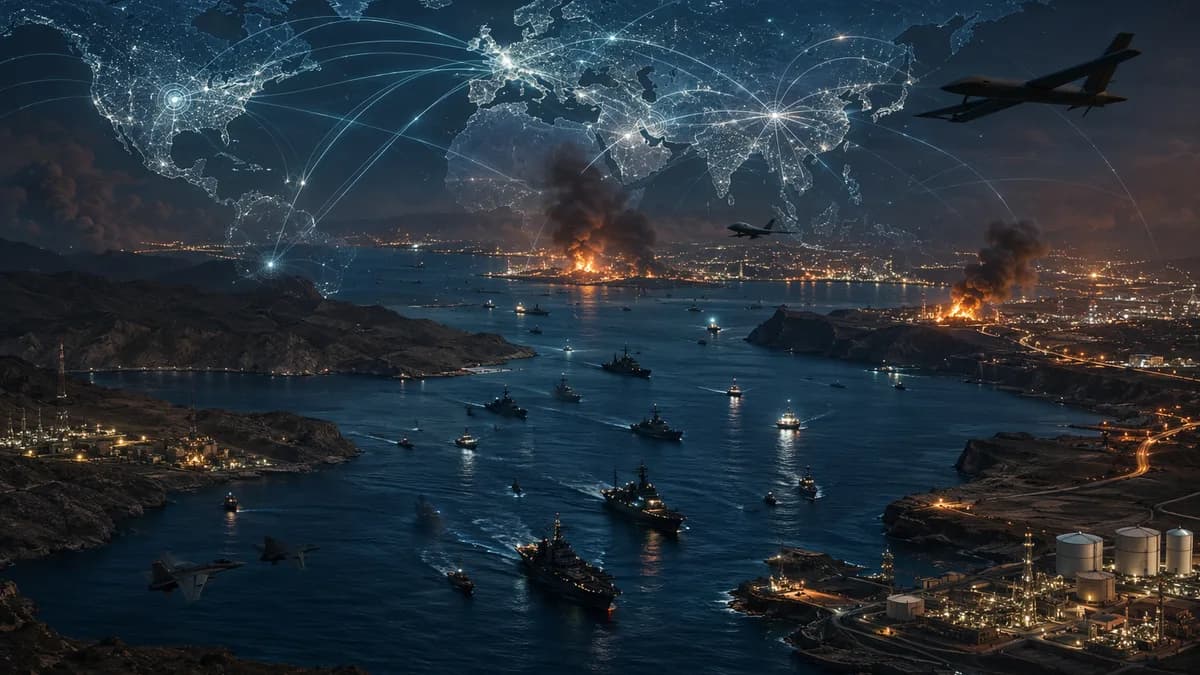
Seven consecutive nights of US Iran strikes have followed President Donald Trump’s declaration that a temporary ceasefire was “over,” with explosions now reported near the Strait of Hormuz, the shipping chokepoint tied to about one-fifth of global oil and liquefied natural gas supplies in normal times.
XOOMAR Intelligence
Analyst Take
The US military said it was carrying out the latest round of US airstrikes on Iran to weaken Iran’s armed forces, while Iran reported blasts near Qeshm island and Bandar Abbas, according to BBC World. The claims around targets, tanker incidents and civilian damage remain contested, which is exactly why the risk around Hormuz is rising faster than the confirmed battlefield picture.
Seven nights of US Iran strikes push the conflict back toward Hormuz
US Central Command said the latest attacks were ordered by the Commander in Chief and aimed at Iran’s military capacity.
“The strikes are designed to continue degrading Iranian military capabilities at the Commander in Chief's direction,” Centcom said.
That statement gives Washington’s public rationale: keep pressure on Iran’s armed forces after the collapse of peace talks. XOOMAR analysis: the phrase “continue degrading” signals a campaign, not a one-off retaliation. It also leaves room for further strikes without requiring a new public threshold.
Iranian media reported explosions in Yazd, Qeshm island and Bandar Abbas, the port city next to the Strait of Hormuz. Iran’s state-run Fars agency also said two oil tankers “exploded and caught fire while passing through a mined route south of the Strait of Hormuz.”
Centcom rejected that tanker claim on X.
“Like most IRGC claims, this is false.”
The disputed tanker report matters because the Strait of Hormuz is already under severe strain. The BBC reported that shipping traffic through the waterway has largely stopped amid continuing tit-for-tat strikes by US and Iranian forces.
For readers tracking the escalation path, this follows XOOMAR’s earlier coverage in Six Nights of US Strikes Pound Iran's Hormuz Lifeline, our broader look at how the fight has centered on the waterway in Trump Turns Iran Strikes Into Strait of Hormuz Blockade, and our report on Iran attacks on US allies.
Hormuz now carries the market risk, even without confirmed tanker damage
The core risk is no longer limited to the number of targets hit overnight, with oil fears stalling Bitcoin and Hormuz oil price risk showing how the shock can spill into markets. It’s the location.
The Strait of Hormuz trade route is one of the world’s most important maritime chokepoints. In normal times, the BBC said it accounts for about one-fifth of the world’s oil and liquefied natural gas supplies. When commercial vessels largely stop passing through it, the concern shifts from battlefield damage to energy flow reliability.
No supplied source gives current oil prices, freight rates or insurance costs, so there’s no basis here to quantify the market move. The confirmed fact is narrower and still serious: traffic through the waterway has largely stopped while US and Iranian forces continue exchanging strikes.
| Issue | US position | Iranian position or report | Confirmed status from supplied material |
|---|---|---|---|
| Purpose of US strikes | Degrade Iranian military capabilities | Iran accuses the US of hitting civilian infrastructure | US confirms strikes, disputes civilian targeting |
| Tanker explosions near Hormuz | Centcom says the IRGC claim is false | Fars said two oil tankers exploded and caught fire | Contested, not independently confirmed in the source |
| Damage inside Hormozgan | White House says targets were military, including logistics infrastructure | Provincial authorities said seven people were killed | BBC Verify and BBC Persian verified damage to Gariveh Bridge |
| Regional attacks by Iran | US denied some Iranian claims | Iran claimed attacks on US facilities across Gulf states and Syria | Kuwait reported injuries and infrastructure damage, CBS sources reported US injuries in Jordan |
The bridge damage is one of the clearest pieces of visual evidence in the reporting. BBC Verify and BBC Persian verified footage of damage to Gariveh Bridge, after night videos showed flames on top of it. Daylight images showed a broken stretch of road and rubble around the bridge.
Washington denied Iran’s broader claim that US forces hit civilian infrastructure such as bridges, a train station and an airport. A White House spokesperson told the BBC the US had “carried out strikes exclusively on military targets, including military logistics infrastructure.”
That leaves a major gap. The physical damage exists. The target classification is disputed. The casualty count, seven killed in Hormozgan province according to provincial authorities, raises the pressure on both sides to shape the narrative before more independent verification emerges.
Regional strikes and denials widen the battlefield map
Iran’s armed forces said Friday they attacked multiple US military facilities across the Gulf region in Kuwait, Bahrain, Jordan and, for the first time, Syria. The US denied those claims.
Kuwaiti officials said Iranian drone strikes injured a number of their soldiers. They also said a power plant and water desalination stations were damaged. Separately, sources told the BBC’s US partner CBS News that several American service members were injured during Iranian attacks on two Jordanian bases over the past week.
Those claims show how the confrontation can spread without a formal declaration of broader war. The US can keep striking inside Iran. Iran can answer through attacks it says are aimed at US-linked facilities in the region. Gulf governments then become exposed to direct damage, even when they are not the primary belligerents.
XOOMAR analysis: the most dangerous part of the current phase is the mismatch between military messaging and economic geography. Washington says it is hitting military targets. Tehran is tying its response to facilities and routes near Hormuz. The waterway turns every disputed blast into a shipping and energy security event.
The next test is whether the seventh night becomes a standing pattern
Friday marked one week of nightly US attacks since peace talks with Iran collapsed, according to the BBC. Tensions over the future of the Strait of Hormuz have hampered efforts to broker a permanent ceasefire.
The immediate watch items are concrete: further Centcom strike statements, verified damage assessments inside Iran, casualty updates from Hormozgan, shipping advisories around Hormuz, and official statements from Kuwait, Bahrain, Jordan and other Gulf governments.
If the US continues nightly strikes, Iran’s response options documented in the source material already include drone and missile attacks on regional facilities and claims of action around Hormuz. What is not yet clear is whether either side is trying to keep the fight bounded, or whether the Strait of Hormuz is becoming the pressure point that pulls Gulf infrastructure, shipping lanes and US bases deeper into the conflict.
The Stakes
- The conflict has now lasted seven consecutive nights, signaling a sustained campaign rather than a one-off strike.
- Explosions near Bandar Abbas and Qeshm island raise concern around the Strait of Hormuz, a critical global energy chokepoint.
- Contested claims about tanker incidents increase uncertainty for shipping, energy markets and regional security.
Competing claims around the latest US-Iran escalation
| Issue | US/Centcom position | Iranian media/official claims |
|---|---|---|
| Purpose of strikes | Aimed at degrading Iran’s military capabilities. | Reported as attacks causing explosions in Iranian locations. |
| Reported locations | Latest strikes framed as part of an ongoing military campaign. | Blasts reported in Yazd, Qeshm island and Bandar Abbas. |
| Tanker incident | Centcom rejected the claim as false. | Fars said two oil tankers exploded and caught fire near a mined route south of Hormuz. |
Primary Sources & Disclosures

Written by
XOOMAR Insights Team
Research and Editorial Desk
The XOOMAR Insights Team pairs automated research with human editorial judgment. We track hundreds of sources across technology, fintech, trading, SaaS, and cybersecurity, cross-check the facts, and explain what happened, why it matters, and what to watch next. We do not just rewrite headlines. Every article is fact-checked and scored for reliability before it goes live, and we link back to the original sources so you can verify anything yourself.