
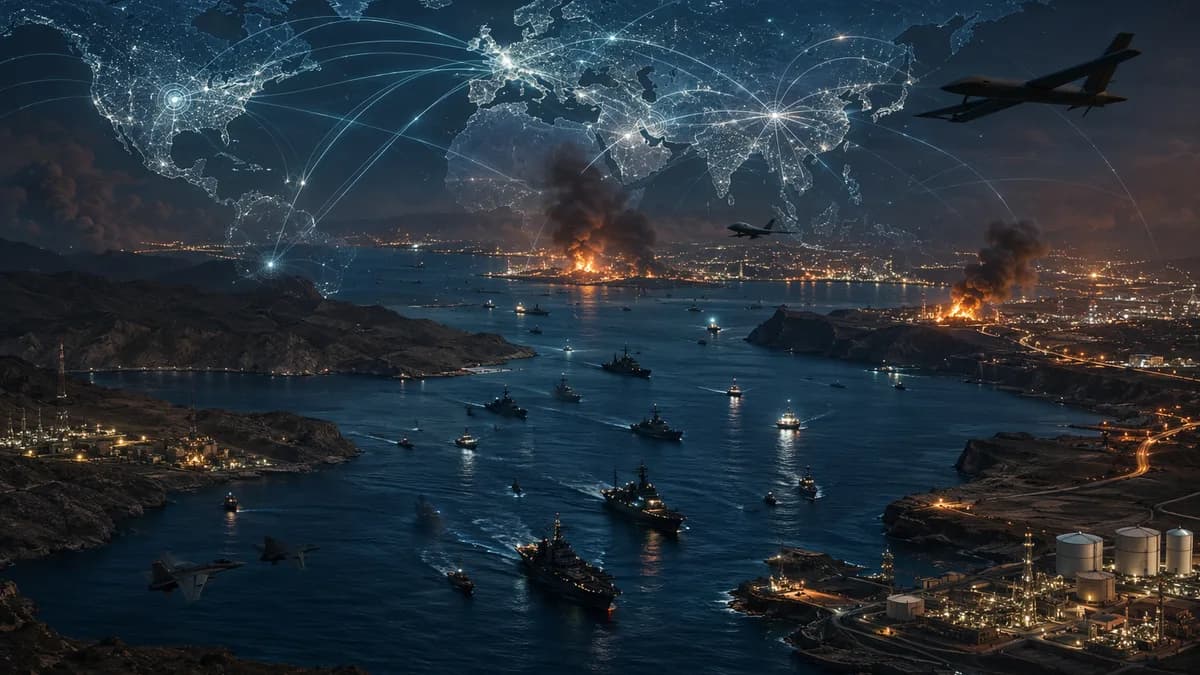
At 7pm GMT Friday, US Central Command began a seventh consecutive night of US Iran strikes, turning a once-contained exchange into a sustained military campaign around the Strait of Hormuz.
Global TrendsJuly 17, 2026· 6 min read· By XOOMAR Insights Team
US Iran Strikes Drag Hormuz Fight Into Seventh Night
Updated on July 17, 2026
XOOMAR Intelligence
Analyst Take
66/ 100
4 sources analyzedMedium confidenceTrend10Freshness98Source Trust90Factual Grounding90Signal Cluster20
The attacks were designed to “continue degrading Iranian military capabilities,” CENTCOM said in a post on X, according to Guardian World. The command did not immediately provide a full target list, damage assessment, weapons breakdown, or casualty figures for the latest round.
Friday at 7pm GMT: US Iran strikes enter a seventh night
The timing matters. A seventh straight night signals Washington is no longer relying on a single retaliatory burst. It is applying repeated pressure on Iranian military capacity while the fight over the Strait of Hormuz tightens.
CENTCOM’s stated aim was narrow in wording but broad in implication:
“The strikes are designed to continue degrading Iranian military capabilities at the Commander in Chief's direction,” CENTCOM said.
Earlier Friday, US airstrikes hit bridges in Hormozgan province, killing at least seven people, Iranian state TV reported. The bridges were described as a key transit point for Bandar Abbas, Iran’s main port.
US strikes also brought down a tower in Chabahar port on the Gulf of Oman. The US military claimed the Islamic Revolutionary Guard Corps used that tower to support attacks on vessels in the Strait of Hormuz. The US also targeted electrical infrastructure and Iranshahr airport, according to the Guardian report.
That puts the latest operation in a sharper frame than a routine military update. The US is striking sites linked to ports, transit, power, and surveillance near one of the world’s most sensitive shipping corridors.
This follows our earlier coverage of how Trump turned Iran strikes into a Strait of Hormuz blockade, and how six nights of US attacks had already pounded Iran’s Hormuz lifeline.
Hormuz pressure spreads from military targets to energy and shipping risk
The Strait of Hormuz handled about a fifth of the world’s oil and gas supply before the war, according to the Guardian. That is why the geography of these strikes matters as much as the strike count.
Shipping through the waterway has already been sharply reduced in recent days. The Guardian reported that most ships still transiting used the Iranian route, while maritime data firm Lloyd’s List Intelligence said week-to-week cargo shipments through the strait dropped by almost a quarter at the beginning of the month, before the latest rise in tit-for-tat attacks.
CBS News, citing maritime tracking firm Kpler, reported that only eight ships passed through the strait on Thursday, down from 15 on Wednesday, according to CBS News. Seven of the eight used the Iranian route.
| Pressure point | Reported development | Immediate significance |
|---|---|---|
| US air campaign | Seventh consecutive night of strikes began Friday at 7pm GMT | Signals a sustained operation, not a one-off response |
| Iranian infrastructure | Bridges, power facilities, airport, and port tower reported hit | Raises legal, humanitarian, and operational questions |
| Commercial shipping | Hormuz traffic reduced, with ships favoring Iran’s route | Shows crews and operators are adapting to threat patterns |
| Energy markets | Brent crude crossed $88 a barrel Friday afternoon, CBS reported | Traders are pricing renewed fighting into supply risk |
The market signal is not abstract. CBS reported Brent crude crossed $88 a barrel Friday afternoon, up about $4 from Thursday’s closing price. That was its highest level in a month, according to the same report.
Analysis: The repeated US Iran strikes appear aimed at limiting Iran’s ability to threaten ships and regional bases. But the same campaign also raises the odds of broader retaliation, especially if Iran treats attacks on transport and power infrastructure as a red line rather than a military constraint.
The legal risk is also growing. Human rights experts cited by the Guardian said strikes on civilian infrastructure not being used for military purposes could constitute a war crime. The US has denied targeting civilians, while Iran has accused Washington of hitting civilian sites.
Iran warns of a “devastating price” as Gulf states report damage
Iran’s response is now the next decision point.
After the US strikes Friday, the IRGC threatened a “devastating price” for countries hosting US bases if attacks on infrastructure continued.
“The American enemy and the hosts of its bases in the region should know that crossing red lines and attacking civilians and civilian infrastructure will have a very severe and devastating price to pay,” the IRGC said.
CBS reported that Iran’s Revolutionary Guards claimed attacks on US facilities in Syria, Kuwait, Oman, Bahrain and Jordan, while the US military denied those claims. Separately, Qatar said falling debris wounded a child after air defenses intercepted missiles. Kuwait said Iranian strikes hit a power and desalination plant, damaging the water facility.
That Kuwaiti detail matters. The country relies on desalinated water for about 90% of its drinking water, according to the Guardian. A hit on that kind of facility shifts the crisis from military signaling toward civilian pressure.
US officials also said they were enforcing a renewed blockade. CENTCOM said it had “redirected” commercial vessels trying to run the blockade, while American forces boarded a ship in the Gulf of Oman on Thursday. CBS reported CENTCOM had redirected four commercial ships, disabled one, and boarded one as part of the blockade.
Iranian state media separately said a Thai-flagged ship was targeted in the Strait of Hormuz after it allegedly ignored warnings and tried to pass without permission from the Revolutionary Guards navy. That claim has not been independently detailed in the supplied reporting.
The conflict is now operating across three linked tracks:
- Air war: US strikes on Iranian military-linked and infrastructure targets.
- Maritime control: Competing US and Iranian routes through Hormuz.
- Regional retaliation: Iranian attacks or claimed attacks involving Gulf states that host US forces.
For more context on how the strait became Trump’s main pressure point, see XOOMAR’s earlier analysis on the Strait of Hormuz erupting as a new Iran war lever.
The next phase turns on targets, tanker movement, and Iran’s retaliation path
The missing details now matter almost as much as the confirmed strike count.
CENTCOM has not yet released exact targets for Friday night’s latest operation, the weapons used, the full operational results, or any casualty assessment. Without that, markets and Gulf governments are left reading the campaign through fragments: damaged bridges, a destroyed port tower, strained power infrastructure, rerouted ships, and Iranian threats.
Analysis: If Iran responds mainly against US-linked military facilities, the conflict may remain concentrated around force protection and air defense. If it escalates against commercial shipping, port operations, desalination plants, or energy export infrastructure, the crisis broadens fast.
The watch item is Hormuz traffic. Any confirmed tanker disruption, port shutdown, or sustained interference with shipping would turn the seventh night of US Iran strikes from a military escalation into a direct energy and trade shock.
The Stakes
- A seventh consecutive night of strikes signals the conflict is becoming a sustained US military campaign.
- Targets near ports, bridges, power infrastructure, and surveillance sites raise risks around the Strait of Hormuz shipping corridor.
- Reported deaths and infrastructure damage increase the chance of wider regional escalation.
Key Reported Figures From the Escalation
Consecutive nights of US strikes
count7
Reported deaths in Hormozgan
count7
Sources

Written by
XOOMAR Insights Team
Research and Editorial Desk
The XOOMAR Insights Team pairs automated research with human editorial judgment. We track hundreds of sources across technology, fintech, trading, SaaS, and cybersecurity, cross-check the facts, and explain what happened, why it matters, and what to watch next. We do not just rewrite headlines. Every article is fact-checked and scored for reliability before it goes live, and we link back to the original sources so you can verify anything yourself.
Explore More Topics
Related Articles
 Global Trends
Six Nights of US Strikes Pound Iran's Hormuz Lifeline
Six straight nights of US strikes have pushed the Iran conflict into Hormuz trade routes, with bridges hit and tankers stopped.
Jul 17, 20268 min
 Global Trends
Iran-US Strikes Pull Gulf Bases Into a Wider Crisis
US strikes inside Iran triggered Tehran's claims of attacks on Gulf bases, turning a fragile ceasefire into a regional flashpoint.
Jul 16, 20266 min
 Global Trends
Strait of Hormuz Erupts as Trump’s New Iran War Lever
US strikes and Iran’s attacks have pushed the Strait of Hormuz from pressure point to battlefield, raising shipping and oil risks.
Jul 16, 20268 min
 Global Trends
US Strikes Iran as Strait of Hormuz Crisis Threatens Oil
US strikes on Iran pushed the Strait of Hormuz crisis into markets, with Tehran calling diplomacy futile and shipping risk climbing.
Jul 13, 20266 min
 Global Trends
Marines Board Tanker as US Blockade Grips Iran Ports
US forces boarded the M/T Wen Yao and struck Iranian bridges, turning a port blockade into a hotter fight near Hormuz.
Jul 17, 20267 min
 Trading
US Strikes Drag NZD/USD Lower as Iran Risk Spreads
NZD/USD slid to 0.5830 as US strikes on Iran crushed risk appetite and outweighed hawkish RBNZ support.
Jul 17, 20266 min
 Trading
US Blockade of Iran Ports Pins WTI Oil Price Near $79
WTI slipped but stayed near $79 as US-Iran tensions and Hormuz risks kept the oil market's fear premium alive.
Jul 16, 20267 min
 Cybersecurity
Iran Turns US Military Phones Into Tracking Beacons
Iran-linked tracking of US military phones shows commercial data is now a battlefield risk, with macOS malware and vendor breaches piling on.
Jul 17, 20267 min
 Global Trends
$100,000 Visa Bond Could Lock Out Green-Card Hopefuls
A proposed visa bond could make some green-card applicants post serious cash before entry, turning screening into a liquidity test.
Jul 17, 20268 min
 Global Trends
Standoff Ends as Kidnapped US Forest Service Employees Freed
Two US Forest Service workers were freed after 12 hours at gunpoint near Gumboot Lake. A father and son were arrested.
Jul 17, 20267 min
Don't miss the signal
Get our weekly roundup of the stories that matter across tech, fintech, and trading. No noise, just signal.
Free forever. No spam. Unsubscribe anytime.