
Five bridges in southern Iran were hit as US Marines boarded the M/T Wen Yao in the Gulf of Oman, tying a sea blockade to a widening US strike campaign around Iran’s ports and the Strait of Hormuz.
Global TrendsJuly 17, 2026· 7 min read· By XOOMAR Insights Team
Marines Board Tanker as US Blockade Grips Iran Ports
Updated on July 17, 2026
XOOMAR Intelligence
Analyst Take
70/ 100
4 sources analyzedMedium confidenceTrend10Freshness97Source Trust90Factual Grounding92Signal Cluster60
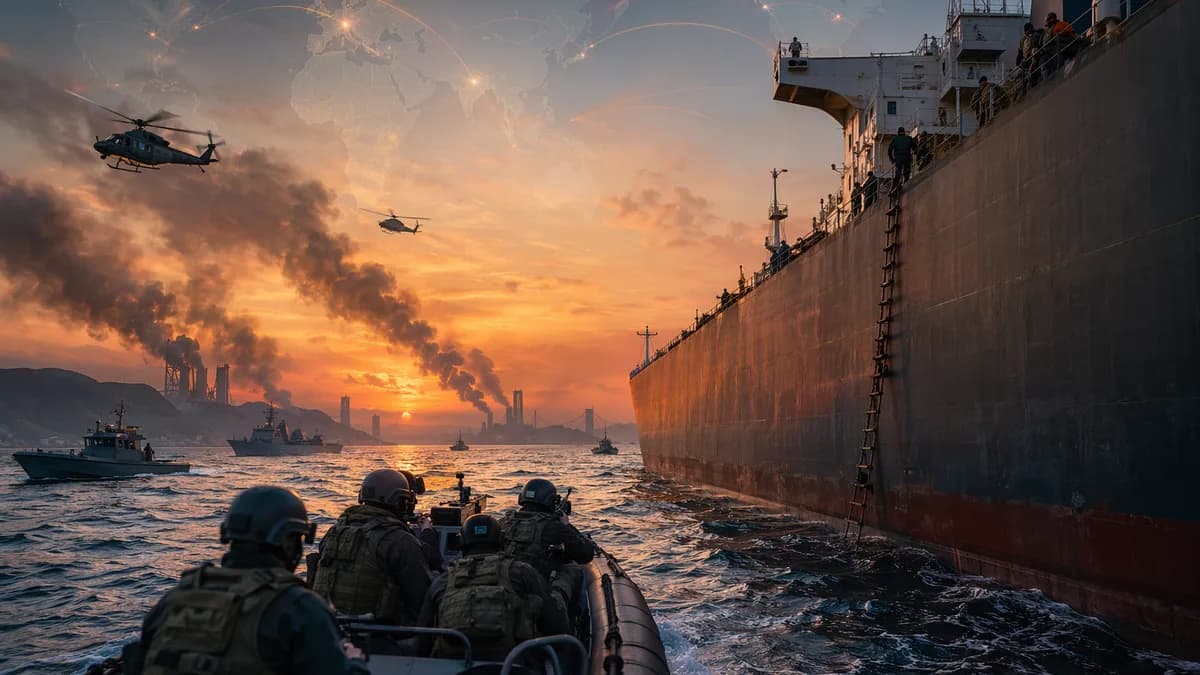
American forces boarded the tanker on Thursday as part of the renewed blockade of Iranian ports that began earlier this week, according to Guardian World. US Central Command said Marines boarded the M/T Wen Yao “to ensure full compliance with the ongoing US naval blockade.”
US Marines board M/T Wen Yao as three vessels are redirected
The M/T Wen Yao boarding is the clearest sign yet that the US blockade is moving from declaration to physical enforcement at sea.
Centcom said the operation took place in the Gulf of Oman, a staging area near the Strait of Hormuz and Iranian port access routes. The command did not, in the supplied reporting, say what flag the vessel was sailing under, what cargo it carried, who owned it, or whether the boarding found any violation.
US Marines boarded the M/T Wen Yao “to ensure full compliance with the ongoing US naval blockade,” Centcom said.
The boarding followed several other enforcement actions. Centcom said it had “redirected” three commercial vessels that were “trying to run the blockade” since the measure took effect at 8pm GMT on Tuesday. The previous day, a US aircraft fired on and disabled an unladen oil tanker that tried to break the blockade, according to the report.
That sequence matters. A blockade is only as real as its enforcement. Boarding the M/T Wen Yao, redirecting ships, and disabling one tanker sends a different message than patrols or warnings alone.
XOOMAR analysis: The US is testing a ladder of coercion at sea: redirect first, board when needed, disable when a vessel does not comply. The risk is that each rung forces Iran, shipowners, and Gulf states to decide whether the blockade is a temporary pressure tool or the new operating condition near Iran’s ports.
This follows the escalation we covered in Trump Turns Iran Strikes Into Strait of Hormuz Blockade, where the maritime campaign shifted from strikes around the chokepoint into a direct attempt to control traffic linked to Iranian ports.
Five bridge strikes widen the campaign beyond ports and ships
The tanker boarding came as the US expanded its air campaign with attacks on five bridges in southern Iran, in line with Donald Trump’s threats to destroy infrastructure.
Iranian state media reported US strikes on Thursday around Tehran and Semnan province, which the Guardian report identifies as home to Iran’s ballistic missile production and space program. State media also reported strikes around Hamedan, Hormozgan, Khuzestan, Lorestan, Markazi, and Sistan and Balochistan, plus Qeshm island, near the Strait of Hormuz.
The most detailed casualty reports came from Bandar Abbas. Iranian state media said seven people were wounded in a US strike on the Allah-Akbar Hill residential neighborhood in the port city. Two others were wounded in a US attack on Bandar Abbas railway junction station.
Just west of Bandar Abbas, witnesses reported two bridges were struck in a US attack, killing three and wounding nine others, Iranian state media said.
| Pressure point | Reported US action | Immediate significance |
|---|---|---|
| M/T Wen Yao | Marines boarded tanker in Gulf of Oman | Tests live enforcement of the blockade |
| Commercial vessels | Three redirected since 8pm GMT Tuesday | Signals wider screening of traffic |
| Unladen tanker | Fired on and disabled after trying to break blockade | Shows force is already being used |
| Five bridges | Struck in southern Iran | Extends campaign into transport infrastructure |
| Bandar Abbas rail junction | Hit in US attack, according to Iranian state media | Raises stakes around port logistics |
XOOMAR analysis: Bridge strikes can disrupt movement, logistics, and access to transport corridors without requiring direct attacks on every port facility. But the available reporting does not yet establish the military value of each bridge, the full damage, whether civilian traffic was using them, or whether follow-on strikes are planned.
The air campaign also overlaps with the Gulf base crisis we examined in Iran-US Strikes Pull Gulf Bases Into a Wider Crisis, as Tehran has responded by firing toward countries that host US forces.
Gulf states come under fire as Trump says US is “winning big in Iran”
The blockade and bridge strikes are unfolding after the interim ceasefire collapsed, leaving the US and Iran in days of back-and-forth attacks as they battle for control of the Strait of Hormuz.
In a Thursday night primetime address, Trump claimed the US was “winning big in Iran” and said Americans “will see the fruits of that labour very, very shortly.”
Iran’s response has already spilled across the Gulf. The Guardian report says Tehran fired on Bahrain, Qatar and Kuwait, all of which host US forces. Early Friday, Kuwait said it was responding to missile and drone attacks after earlier aerial attacks from Iran. Agence France-Presse journalists in Doha reported hearing several blasts early Friday, while Qatari officials warned the security threat level was “elevated.”
In Bahrain, the interior ministry urged citizens to take shelter. Iranian state media said Iran’s army was targeting US helicopters and planes at an airbase in Bahrain “in response to the enemy’s hostile action in targeting urban infrastructure and innocent people.”
The regional spread is the core danger. The Gulf of Oman and the Strait of Hormuz are not abstract map points for markets. They are energy transit arteries, and any boarding, disabling of tankers, or missile exchange near them can force insurers, shipowners, oil traders, and refiners to reassess route risk fast.
Lloyd’s List Intelligence said week-to-week cargo shipments through the Strait of Hormuz dropped by almost a quarter at the beginning of the month, before the latest surge in tit-for-tat attacks. Lloyd’s also said some oil shippers are transiting the strait with location devices turned off, while many are staying put.
Shipping risk now runs from Hormuz to the Red Sea
The shipping risk is no longer confined to the Gulf of Oman.
Reuters reported that Iran has asked its allies in Yemen, the Houthis, to be prepared to close the oil route through the Red Sea if the US targets Iranian energy infrastructure. The Guardian report says that threat, if carried out, could paralyse the global energy market.
The Houthi leader, Abdul Malik al-Houthi, also threatened that all Saudi oil and other critical facilities could be targeted if Riyadh intervened in Yemen. That warning followed Saudi strikes on Sana’a airport and retaliatory Houthi missile strikes on Saudi Arabia.
XOOMAR analysis: The US blockade is meant to pressure Iran at sea, but Iran’s likely counters are distributed across the region: missiles toward Gulf bases, naval harassment, diplomatic protest, and pressure through allied groups. The more the US target list expands beyond ships and port routes, the more Tehran can frame its response as regional rather than bilateral.
This is why the M/T Wen Yao boarding matters beyond one tanker. If it becomes a template, commercial shipping faces a new decision tree: comply, divert, wait, go dark, or test the blockade and risk force.
Four signals will decide whether Wen Yao becomes a blockade template
The next update should come from four places.
Centcom follow-ups: Whether the US says the M/T Wen Yao was released, diverted, detained, searched further, or found compliant will show how aggressive the blockade has become in practice.
Iranian statements: Tehran’s official response to the boarding and bridge strikes will matter more than rhetoric alone if it includes threats against specific Gulf bases, ships, or infrastructure.
Vessel data: Ship-tracking patterns near the Gulf of Oman and Strait of Hormuz will show whether tankers keep moving, go dark, or wait outside the risk zone.
Target selection: More strikes on bridges, ports, rail nodes, or energy infrastructure would mark a wider campaign than the current mix of blockade enforcement and reported infrastructure attacks.
The White House now faces a harder task than announcing pressure. If the confrontation widens, it will have to define the blockade’s legal basis, military objective, and exit path, while markets and shipowners watch whether the M/T Wen Yao was an isolated boarding or the start of routine interdictions near Iran’s ports.
The Stakes
- The boarding shows the US blockade is shifting from warning to direct enforcement at sea.
- Actions near the Strait of Hormuz raise risks for global shipping and energy flows.
- The combined maritime and bridge strikes increase the chance of a broader confrontation with Iran.
US blockade enforcement actions reported near Iran
| Action | Reported count | Purpose or signal |
|---|---|---|
| Commercial vessels redirected | 3 | Prevent ships described by Centcom as trying to run the blockade |
| Tanker boarded | 1 | Check compliance with the US naval blockade |
| Unladen oil tanker disabled | 1 | Escalate enforcement after an attempted blockade breach |
| Bridges hit in southern Iran | 5 | Expand pressure beyond maritime enforcement to infrastructure strikes |
Reported US actions tied to Iran blockade and strikes
Bridges hit
count5
Vessels redirected
count3
Tanker boarded
count1
Tanker disabled
count1
Sources
- [1] Guardian World
- [2] US Marines storm Iranian-linked tanker in dramatic Gulf boarding — 'steel wall' blockade in action
- [3] US reimposes blockade of Iranian ports, launches fresh strikes | Hellenic Shipping News Worldwide
- [4] US reimposes its blockade on Iran after Tehran's attacks on ships in the Strait of Hormuz

Written by
XOOMAR Insights Team
Research and Editorial Desk
The XOOMAR Insights Team pairs automated research with human editorial judgment. We track hundreds of sources across technology, fintech, trading, SaaS, and cybersecurity, cross-check the facts, and explain what happened, why it matters, and what to watch next. We do not just rewrite headlines. Every article is fact-checked and scored for reliability before it goes live, and we link back to the original sources so you can verify anything yourself.
Explore More Topics
Related Articles
 Global Trends
Six Nights of US Strikes Pound Iran's Hormuz Lifeline
Six straight nights of US strikes have pushed the Iran conflict into Hormuz trade routes, with bridges hit and tankers stopped.
Jul 17, 20268 min
 Global Trends
US Strikes Iran as Strait of Hormuz Crisis Threatens Oil
US strikes on Iran pushed the Strait of Hormuz crisis into markets, with Tehran calling diplomacy futile and shipping risk climbing.
Jul 13, 20266 min
Global TrendsHormuz Port Blasts Pull US Strikes Against Iran Into Crisis
New US strikes hit near Hormuz port cities, raising the risk that a military exchange turns into a shipping and oil-market crisis.
Jul 8, 20266 min
 Global Trends
Strait of Hormuz Erupts as Trump’s New Iran War Lever
US strikes and Iran’s attacks have pushed the Strait of Hormuz from pressure point to battlefield, raising shipping and oil risks.
Jul 16, 20268 min
 Global Trends
Iran-US Strikes Pull Gulf Bases Into a Wider Crisis
US strikes inside Iran triggered Tehran's claims of attacks on Gulf bases, turning a fragile ceasefire into a regional flashpoint.
Jul 16, 20266 min
 Trading
US Blockade of Iran Ports Pins WTI Oil Price Near $79
WTI slipped but stayed near $79 as US-Iran tensions and Hormuz risks kept the oil market's fear premium alive.
Jul 16, 20267 min
 Trading
WTI Price Forecast Tests Oil Bulls After Sub-$79 Scare
WTI slipped below $79, but bulls haven't lost control. US-Iran risk and key technical levels still set the next move.
Jul 16, 20267 min
 Technology
US Blocks Force South Korea to Build Security AI Model
US restrictions on Anthropic's Mythos pushed Seoul to build its own security AI, aiming for a bug-hunting model by late 2026.
Jul 17, 202611 min
 Global Trends
20 Pupils Killed, Uganda School Bus Crash Triggers Probe
At least 20 pupils died when a school bus overturned in eastern Uganda, with police probing a suspected mechanical fault.
Jul 17, 20266 min
 Global Trends
Aiko Shut Out as Japan Imperial Succession Bill Passes
Japan's succession bill expands the royal family, but it still blocks Princess Aiko from the throne.
Jul 17, 20268 min
Don't miss the signal
Get our weekly roundup of the stories that matter across tech, fintech, and trading. No noise, just signal.
Free forever. No spam. Unsubscribe anytime.