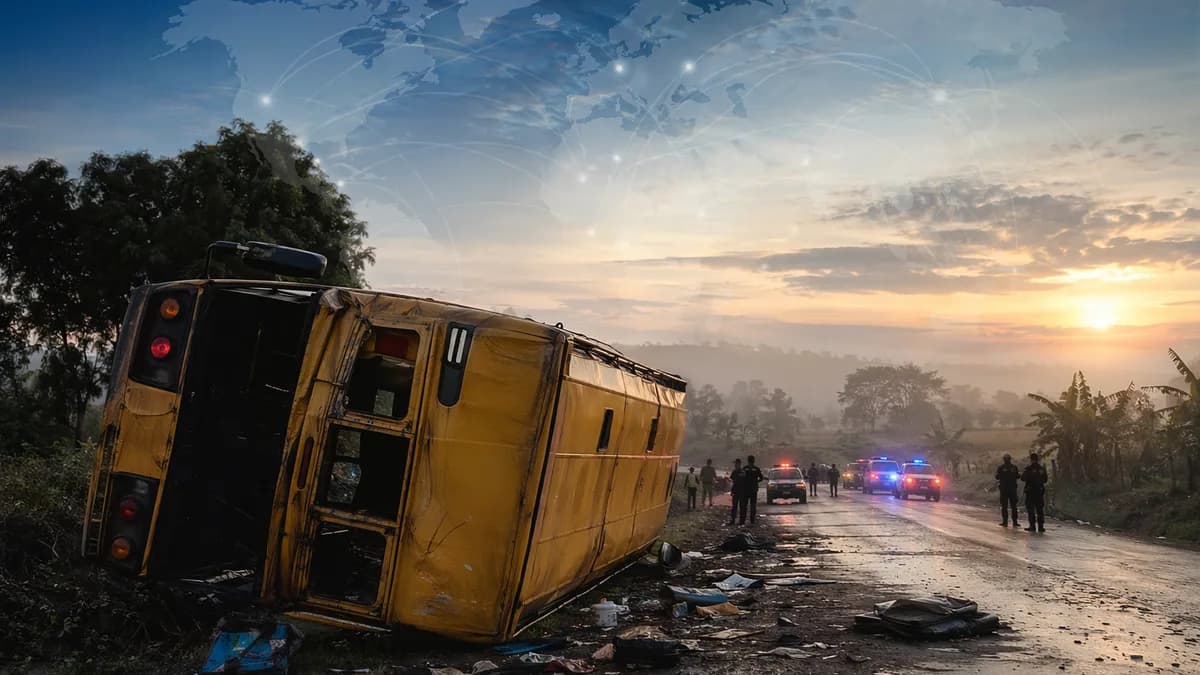
The Uganda school bus crash turned a school study trip into one of the country’s deadliest recent child road disasters: at least 20 pupils and one adult are dead. Dozens more, including pupils and school staff, were injured after the bus crashed in eastern Uganda on Thursday evening, according to BBC World.
XOOMAR Intelligence
Analyst Take
The bus was carrying children from King David Junior School in Ndejje when it crashed at about 20:00 local time (17:00 GMT) at Chekwatit village in the Kawowo area of Kapchorwa, police said. Early accounts from officials point to a suspected mechanical fault before the driver lost control on Chekwatit Hill, a road stretch local officials say has seen several serious crashes.
Uganda school bus crash leaves at least 20 pupils dead
The confirmed toll already makes this a national school transport disaster, even before investigators release a final report. Local officials said at least 20 schoolchildren and one adult were killed after the bus, carrying pupils on a study trip, left the road and overturned.
Police described the sequence in plain terms:
"The driver reportedly lost control of the vehicle, which veered off the road, struck a large stone along the roadside, and overturned," police said.
The adult killed was identified by Minister of Local Government Balaam Ateenyi Barugahara as Mr Tadeo Ssekade, the founder and director of the school. Barugahara posted from the scene on X:
"Sadly, 20 children and 1 adult, who happens to be the founder and director, Mr Tadeo Ssekade, have gone to be with the Lord,"
The strongest caution is that this is still a developing investigation. Police have not yet issued a final cause, and some local reports have carried different early fatality estimates. That uncertainty does not soften the central fact: the Uganda school bus crash has already killed a classroom’s worth of children and left many others needing urgent care.
Local media reported the pupils were returning from a study tour after visiting Sipi Falls, a tourist area. The BBC said eyewitness videos showed the bus badly damaged while residents rushed to help injured children. Those details matter because they show how quickly the first response depended on people near the road, before the full emergency chain could catch up.
| Detail | Current account from supplied reports |
|---|---|
| Confirmed deaths | At least 20 pupils and one adult |
| School | King David Junior School in Ndejje |
| Crash time | About 20:00 local time (17:00 GMT) on Thursday |
| Crash site | Chekwatit village, Kawowo area, Kapchorwa |
| Early suspected cause | A possible mechanical fault, not yet a final finding |
| Injured | Dozens, including pupils and school staff |
Local hospitals mobilize after dozens of pupils and staff are injured
The human toll extends well beyond the death count because the crash created a large casualty load in a district far from the school’s home base. The BBC reported dozens injured, including school staff. Local reports put the number of injured at more than 60, though authorities have not yet released a full official medical breakdown for every victim.
Police officers, residents and emergency responders joined rescue efforts at the scene, according to local reporting. The first accounts describe a chaotic aftermath in which injured children had to be moved quickly from the overturned bus and taken for treatment.
The clearest verified point is the scale of the casualty burden, not yet the full condition of each survivor. Reports confirm that many pupils and staff were hurt, but they do not provide a complete public list of injuries, hospital admissions or long-term prognosis. That means the early medical picture should be read carefully: emergency teams were dealing with many injured children, while families waited for confirmed information.
The counterpoint is that early rescue accounts often capture only the first hours. They don’t yet tell readers how many pupils remain in critical condition, how many families have been notified, or whether the official death toll will change. Those are the numbers that will determine the full scale of the Uganda school bus crash.
Suspected mechanical fault turns attention to Chekwatit Hill and school transport
The preliminary fault line in this case is roadworthiness, but investigators still need evidence before blame can be fixed. Officials said early findings indicate the bus suffered a mechanical fault before the driver lost control on Chekwatit Hill. Local officials also described that stretch as a site of several serious crashes.
A local report attributed to police said the vehicle made several stopovers before the accident, and that investigations into the exact circumstances were continuing. That detail raises questions investigators will need to test, not assumptions they can accept: the bus condition, maintenance records, driver conduct, road conditions and whether the vehicle was carrying passengers within allowed limits.
Uganda records thousands of road deaths every year, with speeding, poorly maintained vehicles and dangerous roads among the leading causes, according to traffic authorities cited in the supplied reports. The latest crash also comes after several serious school bus accidents were reported in the country in recent weeks, according to the BBC.
That broader context matters because this was not a private night drive. It was school transport carrying children on an educational trip. If a mechanical fault is confirmed, scrutiny will fall on checks before departure, operator responsibility and whether schools have enough control over the vehicles they hire for long journeys.
For readers following XOOMAR’s global breaking coverage, recent reports such as Unpaid Staff Turn Congo Ebola Strike Into a Crisis and Fugitive's Gunfire Kills US Marshal in Louisiana Raid show how fast casualty events can shift as officials update initial accounts.
The next hard facts should come from the police investigation, hospital updates and victim identification. The key test is whether the final report confirms mechanical failure and explains why the bus was on that road in that condition. If investigators find a different primary cause, the accountability trail will shift. If they confirm the early account, Uganda’s school transport checks will face the question this crash has already forced into view: who cleared the bus to carry children that night?
Impact Analysis
- The crash is one of Uganda’s deadliest recent school transport disasters, with at least 20 children killed.
- Early reports of a suspected mechanical fault raise urgent questions about school bus safety and vehicle inspections.
- The crash site on Chekwatit Hill has reportedly seen several serious crashes, highlighting broader road safety risks.
Confirmed deaths in Uganda school bus crash
Primary Sources & Disclosures

Written by
XOOMAR Insights Team
Research and Editorial Desk
The XOOMAR Insights Team pairs automated research with human editorial judgment. We track hundreds of sources across technology, fintech, trading, SaaS, and cybersecurity, cross-check the facts, and explain what happened, why it matters, and what to watch next. We do not just rewrite headlines. Every article is fact-checked and scored for reliability before it goes live, and we link back to the original sources so you can verify anything yourself.