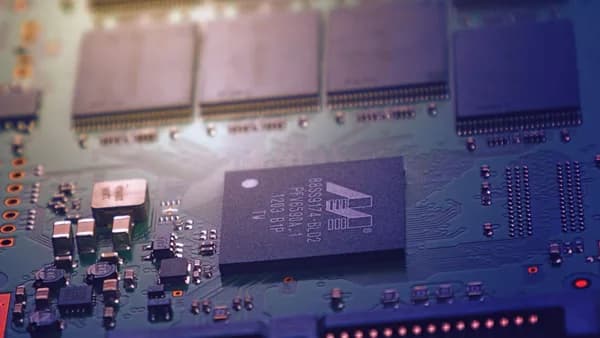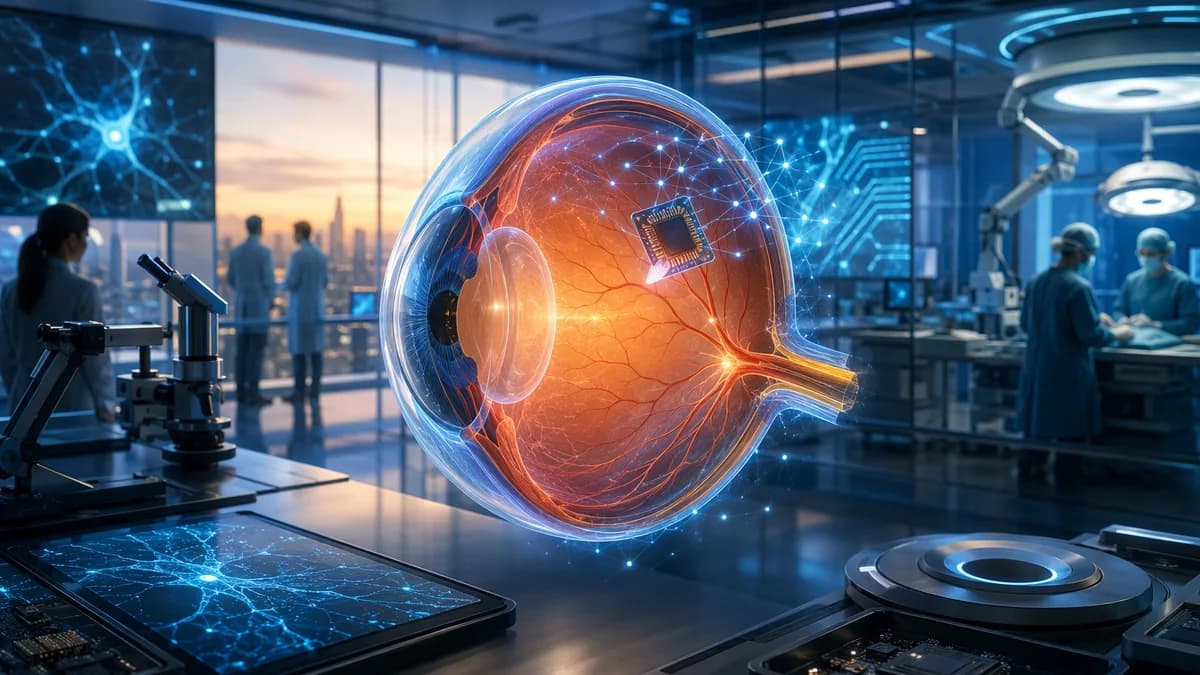
Science Corporation’s vision-restoring chip has crossed from lab promise into regulated medical commerce in Europe, with approval to sell PRIMA, a retinal implant for vision loss tied to age-related macular degeneration.
XOOMAR Intelligence
Analyst Take
The approval gives Science Corp. a chance to prove something harder than a demo: that neurotechnology can become a reimbursed, repeatable medical business, according to TechCrunch. The company also said PRIMA received a US Food and Drug Administration designation that is the first step toward expedited review, with potential use in treating two rare forms of blindness.
For patients, the practical claim is narrower than sci-fi. PRIMA is meant to restore functional vision for people who have lost it, not deliver perfect natural sight overnight.
For investors, the harder question is commercial discipline. Science Corp. CEO Max Hodak put it bluntly:
“The thing that the space needs is a company making $100 million a year of revenue,” Hodak said.
That line is the real frame for this story. EU approval is the medical milestone. Revenue, reimbursement, clinical adoption, and product iteration are the business test.
Why does PRIMA’s EU approval matter now?
Millions of people worldwide suffer from age-related macular degeneration, a disease that damages the light-sensitive cells at the back of the eye and can make it difficult to read or recognize faces. PRIMA targets that problem through an implanted chip and camera-equipped glasses.
Patients undergo an hour-long outpatient procedure to place a small chip in the back of the eye. They then wear glasses with cameras that transmit a view of the world to the chip.
That is the key shift. Science Corp. is no longer only pitching a future brain-computer interface. It has a product cleared for sale in Europe, aimed at a defined medical need, with a pathway into clinics.
Hodak’s credibility in neurotech comes partly from his résumé. He co-founded and previously served as president of Neuralink, Elon Musk’s BCI company, before leaving in 2021 to start Science Corp. His longer-term ambition is a bio-hybrid brain interface based on silicon chips and living cells. PRIMA is the near-term business that could fund that longer road.
As we’ve seen in other hardware-heavy technology bets, the gap between a promising device and a durable business can be brutal. XOOMAR readers tracking that broader capital intensity may recognize the same execution pressure in $10.3B Etched AI Chip Bet Dares the GPU Status Quo and No-Repair Moon Trial Tests Nvidia Moon GPU This Year.
What does Science Corp.’s vision-restoring chip actually do?
PRIMA is a retinal implant system. It is designed for people whose vision loss stems from damage to the eye’s light-detecting cells, rather than a device placed directly into the brain.
That distinction matters. Science Corp. is working separately with Dr. Murat Günel, chair of Yale Medical School’s Department of Neurosurgery, on procedures for human trials of a directly implanted bio-hybrid brain sensor. PRIMA is not that product. It is an eye-based system that uses a chip and external glasses.
TechCrunch reports that Hodak described real patient use cases that are concrete, not abstract.
“One of our patients in France finished a 300-page novel a little while ago, and sent us the book,” Hodak told TechCrunch. “We have a sketch on the wall [that] one of our patients drew of the Sydney Opera House. There are videos of patients playing crossword puzzles and filling in Sudoku.”
Those examples matter because they describe functional gains: reading, drawing, puzzles. They do not prove every patient will see the same results. They do show what Science Corp. wants the product to be judged on: daily utility.
| Product path | Where it acts | What the source says |
|---|---|---|
| PRIMA retinal implant | Back of the eye | Chip implanted during an hour-long outpatient procedure, paired with camera-equipped glasses |
| Bio-hybrid brain sensor | Brain | Science Corp. is working with Dr. Murat Günel on procedures for human trials |
| Science Corp.’s business priority | Commercial vision restoration | Hodak says PRIMA is financing the longer-term bio-hybrid work |
How does the chip-and-glasses system work, based on what Science has disclosed?
The public description is simple. A patient receives a small chip in the back of the eye. The patient wears glasses with cameras. Those glasses transmit a view of the world to the chip.
That is as far as the source material goes on the technical chain. It does not specify the image-processing pipeline, stimulation method, calibration process, training requirements, or how the system translates scenes into what patients perceive. Those details will matter for doctors, patients, and payers, but they are not disclosed in the provided report.
A useful way to read the product claim is this: PRIMA is an assistive visual system built around the eye’s remaining pathway, not a replacement eye and not a direct brain implant. That keeps expectations grounded. Functional vision can still be meaningful if it helps someone read, identify shapes, or complete tasks that were previously out of reach.
The glasses are also not yet in their ideal form. Science Corp. expects to improve both PRIMA’s vision capabilities with a new chip and the form factor of the glasses, which currently require a battery-pack. Hodak said the company wants something closer to Meta’s AR glasses, though PRIMA has more significant power and compute requirements.
The business diagnosis: approval is only the first treatment
EU approval gives Science Corp. permission to begin selling PRIMA, but commercialization now turns on payment and deployment. Each PRIMA device is expected to cost in the hundreds of thousands of dollars, and Science Corp. and its European medical partners are discussing reimbursement with healthcare providers.
The company is preparing to offer PRIMA in Germany, where clinical trials were held. TechCrunch reports the first procedure could happen in September.
Science Corp. did not build PRIMA from scratch. Hodak and his team explored multiple approaches, then concluded that Pixium, a French company that developed PRIMA technology, had the strongest path forward. Science Corp. acquired Pixium in 2024, then used its internal platform to expand the documentation and evolve the product for regulatory approval and commercialization.
That sequence is important. It shows a company choosing a nearer-term regulated medical product over a pure moonshot. Hodak’s own explanation is unusually direct:
“There’s this risk that the whole thing enters a winter, and so we think it’s important to build a sustainable business as we develop these longer-term technologies.”
In plain terms, Science Corp. is trying to avoid becoming a company with impressive demos and no operating base. PRIMA is the revenue engine it wants investors and clinicians to take seriously.
What should patients, clinicians, and investors judge next?
The next test is not whether PRIMA sounds impressive. It is whether Science Corp. can turn EU approval into repeatable procedures, reimbursed care, and real patient benefit outside the trial setting.
The watch list is practical:
- Access: Whether reimbursement talks in Europe translate into patient availability.
- Rollout: Whether Germany sees the first procedure in September, as currently expected.
- Performance: Whether real-world users report functional gains like reading, drawing, or puzzle completion.
- Product iteration: Whether the new chip and improved glasses reduce friction for daily use.
- US pathway: Whether the FDA designation leads to expedited review for the two rare blindness indications cited by the company.
Science Corp. is also building toward a much harder future product: a directly implanted bio-hybrid brain sensor. Hodak made clear that PRIMA is not a side project.
Bringing PRIMA to market is “the most important thing for the company, because we don’t get to do the bio hybrid stuff long term if you don’t have a great vision business. That’s what’s really financing the rest of it,” he added. “That’s the thing that investors know how to build spreadsheets around.”
That is the clearest takeaway. Science Corporation’s vision-restoring chip now has a serious European opening. Its legacy will depend on whether PRIMA becomes a dependable medical service, not just a remarkable implant.
Impact Analysis
- EU approval moves PRIMA from experimental neurotechnology toward commercial medical use in Europe.
- The implant targets age-related macular degeneration, a major cause of vision loss that affects millions worldwide.
- Science Corp. now faces the harder test of reimbursement, clinical adoption, and building a repeatable medical-device business.
Primary Sources & Disclosures

Written by
XOOMAR Insights Team
Research and Editorial Desk
The XOOMAR Insights Team pairs automated research with human editorial judgment. We track hundreds of sources across technology, fintech, trading, SaaS, and cybersecurity, cross-check the facts, and explain what happened, why it matters, and what to watch next. We do not just rewrite headlines. Every article is fact-checked and scored for reliability before it goes live, and we link back to the original sources so you can verify anything yourself.