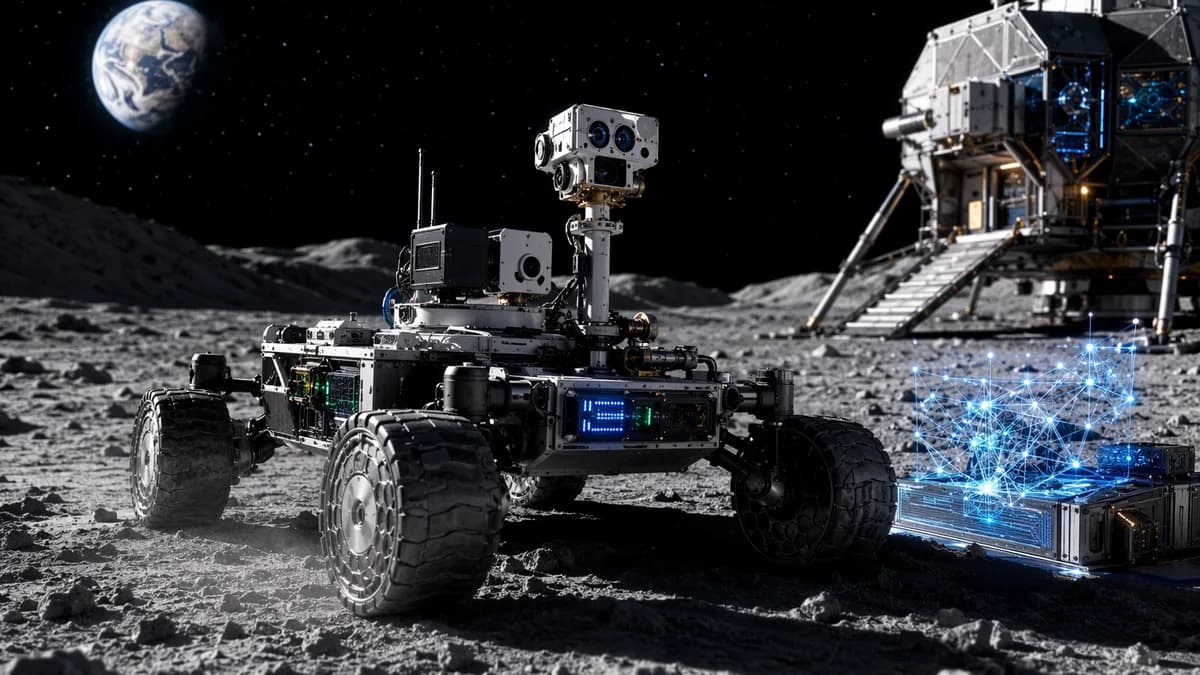
Nvidia’s Jetson may become the first GPU on the lunar surface before the end of the year, turning the Nvidia Moon GPU story from a space oddity into a test of whether commercial AI hardware can survive where repairs are impossible.
XOOMAR Intelligence
Analyst Take
Lunar Outpost, a startup building robotics for space infrastructure, said its next moon rover will use Jetson chips to control its lidar system, according to TechCrunch. The rover is packaged on a lander built by Intuitive Machines, and each Lunar Outpost mission cited by TechCrunch is expected to fly on a Falcon 9 before the end of the year.
That matters because Nvidia is not sending a flagship data-center GPU to the Moon. It is sending an embedded edge-AI platform built for physical systems that need to process sensor data locally. In XOOMAR’s view, that is the real signal: the first useful lunar AI market will be small, power-constrained, and robotic.
Nvidia's Moon GPU Bet Turns the Lunar Surface Into an Edge-Computing Testbed
The Nvidia Moon GPU push is best read as a bid for off-world edge computing, not a branding stunt. Nvidia wants its compute stack inside autonomous systems wherever the sensor data is valuable and the connection to Earth is weak, delayed, or operationally awkward.
Lunar Outpost CEO Justin Cyrus framed the project as a comparison between Jetson and the company’s existing flight compute platform.
“We’re taking the Nvidia Jetson and comparing it to our flight compute platform that has a little bit more spaceflight heritage,” Cyrus said. “[We’re] seeing what the pros are, seeing what the cons are. And we’re really pushing towards trying to adopt these more capable GPU-powered systems in these extreme environments.”
The Moon is a nasty test site. TechCrunch cites cosmic radiation, major temperature swings, lunar night, and very low power as core constraints. Most space-faring GPUs operate close to Earth, where conditions are more forgiving than the lunar surface.
That is exactly why the test is useful. If Jetson can process lidar data and help a rover interpret terrain in that environment, Nvidia gets something better than a demo: proof that its embedded AI hardware can move from warehouses and robots into cislunar infrastructure.
The Numbers Behind Lunar AI Compute: Latency, Power, Radiation, and Launch Costs
The cleanest number in this story is the Moon’s communications delay. Related supplied source material cites about 2.6 seconds for a signal round trip between Earth and the Moon. That may sound small, but autonomy problems are not conference calls. A rover approaching a crater or navigating difficult terrain needs local perception.
TechCrunch says Jetson will control Lunar Outpost’s lidar system, the sensor stack used for mapping and perception. The source does not disclose payload mass, Jetson module version, processing capacity, power draw, or radiation tolerance. That absence matters. Those are the numbers that will decide whether this is a one-off experiment or the start of a repeatable lunar compute architecture.
The contrast with Nvidia’s better-known AI chips is sharp:
| Nvidia platform | Role in this story | Why it matters |
|---|---|---|
| Jetson | Planned for Lunar Outpost rover lidar control and Firefly lunar-orbit imagery processing | Compact, power-efficient, local sensor processing |
| Blackwell | Mentioned by TechCrunch as a better-known AI workhorse | Built for much larger AI workloads, not the reported lunar rover use case |
| Vera Rubin | Also cited as a better-known Nvidia AI platform | Part of Nvidia’s broader AI roadmap, but not the chip TechCrunch says is heading to the lunar surface |
Power is the brutal constraint. Cyrus put it plainly:
“Your system has to survive lunar night and has to do so on very low power.”
XOOMAR analysis: that sentence is the whole business case and the whole risk case. Lunar GPUs will not be judged by benchmark charts. They will be judged by whether they boot, stay stable, process useful data, and avoid draining scarce energy during survival periods.
From Deterministic Rover Logic to Physical AI on the Moon
Lunar Outpost is not throwing out conventional robotics control. It is layering AI onto it.
“Our autonomy stack was a bit more deterministic five years ago, and now it’s a combination of deterministic and physical AI, which is pretty fun,” Cyrus told TechCrunch. “We still run both in parallel, and then it’s our job to figure out where physical AI can actually plug into our stack and help us do things that no one’s done before.”
That is a sober architecture, not moonshot theater. Deterministic systems remain useful because space missions punish ambiguity. Physical AI becomes valuable where perception, terrain classification, and local decision-making need flexibility.
NASA’s role explains why private companies are taking these risks. The agency has launched a campaign to pay companies to explore the lunar surface ahead of plans to return astronauts, perhaps as soon as 2028. TechCrunch says the program is modeled on NASA’s work with SpaceX and asks companies to carry scientific sensors to the Moon to study terrain and search for substances such as water.
The Nvidia Moon GPU effort slots into that broader commercial lunar model. Private landers, rovers, orbiters, and sensors need more onboard intelligence if they are going to inspect craters, map anomalies, and prepare for human operations without waiting on Earth for every decision.
Who Wins if Jetson Survives: Nvidia, Lunar Outpost, NASA, and Firefly
For Nvidia, success would expand the company’s AI hardware story beyond data centers, gaming, and terrestrial robotics. A functioning Jetson on the Moon would tell aerospace customers that Nvidia’s embedded stack can survive harsher missions than factory floors or delivery robots.
For Lunar Outpost, the upside is credibility. Its next rover is designed to carry sensors into craters and other places that are difficult to explore from orbit. A later mission will explore Reiner Gamma, a lunar surface region where a magnetic anomaly has puzzled scientists.
Firefly Aerospace is the other named Nvidia partner. TechCrunch says Firefly, described as the first private company to safely land a robot on the Moon, will use the Jetson platform on a satellite orbiting the Moon to process imagery. That satellite aims to collect mapping data for scientists and track the growing number of robots on the lunar surface.
NASA wins if private companies produce reusable capabilities rather than isolated stunts. But XOOMAR analysis: the agency will care less about the GPU brand than about reliability, mission value, power discipline, and whether the data justifies the payload risk.
Cloud and telecom providers are not named in the TechCrunch source. Their future role remains hypothetical. If lunar compute becomes operational, the logical service layers would include data routing, storage, remote operations, and mission software, but that is a scenario to test, not a reported fact.
What Lunar GPUs Mean for AI, Robotics, and Space Infrastructure on Earth
The practical lesson is not that Moon data centers are around the corner. TechCrunch ends by noting that visions of space data centers and fleets of robots on the Moon are still waiting on a bigger rocket.
The nearer-term takeaway is narrower and more useful: rugged edge AI matters wherever machines work far from easy human support. That includes remote industrial sites, hazardous environments, and robotics that cannot depend on constant cloud connectivity.
XOOMAR has made the same risk point in consumer technology from a different angle: early deployments fail when users treat experimental systems as finished products, as we noted in Download iOS 27 Free Today Without Wrecking Your iPhone. Space just raises the cost of that lesson.
For chipmakers, the prize is specialized: low-power inference, radiation-aware packaging, thermal management, and embedded GPU systems that trade raw power for survivability. The first lunar AI workloads will be mission-critical and expensive. They will look more like sensor processing than science fiction.
Nvidia's Off-World Compute Test Now Depends on Survival, Not Hype
Lunar Outpost has several smaller autonomous rovers scheduled for launch to the Moon in the next few years, plus Pegasus, a larger vehicle intended to carry astronauts. Pegasus is waiting on a rocket from Blue Origin, but TechCrunch reports that the launch vehicle suffered an anomaly this summer and it is unclear when it will return to flight.
Cyrus said, “It does seem like they’re making pretty darn good progress on the pad,” while adding, “I can’t really answer Blue Origin’s timelines or NASA’s timelines on the pad reconstruction, but everything we’ve been told, we’re on the same timeline [for 2028].”
That leaves the Nvidia Moon GPU experiment with a simple scoreboard. Does Jetson operate in lunar conditions? Does it process sensor data locally in a way that improves the mission? Does it survive the power and temperature constraints that Cyrus highlighted?
If the answer is yes, the Moon becomes a showcase for AI at the edge. If the answer is no, the lesson will not be that off-world compute is dead. It will be that space still exposes the gap between terrestrial tech confidence and hardware that can survive without a reset button, a repair shop, or a second chance.
Impact Analysis
- Nvidia’s Jetson could become the first GPU operating on the lunar surface.
- The mission tests whether commercial AI hardware can survive radiation, temperature swings, lunar night, and low power.
- Success would support a future lunar robotics market built around local edge computing instead of constant Earth-based control.
Lunar Outpost Compute Platforms
| Platform | Role | Key Tradeoff |
|---|---|---|
| Nvidia Jetson | Controls the rover’s lidar system with embedded edge-AI processing | More capable GPU-powered system, but less proven in lunar conditions |
| Existing flight compute platform | Lunar Outpost’s current spaceflight compute baseline | More spaceflight heritage, but potentially less AI compute capability |
Primary Sources & Disclosures

Written by
XOOMAR Insights Team
Research and Editorial Desk
The XOOMAR Insights Team pairs automated research with human editorial judgment. We track hundreds of sources across technology, fintech, trading, SaaS, and cybersecurity, cross-check the facts, and explain what happened, why it matters, and what to watch next. We do not just rewrite headlines. Every article is fact-checked and scored for reliability before it goes live, and we link back to the original sources so you can verify anything yourself.