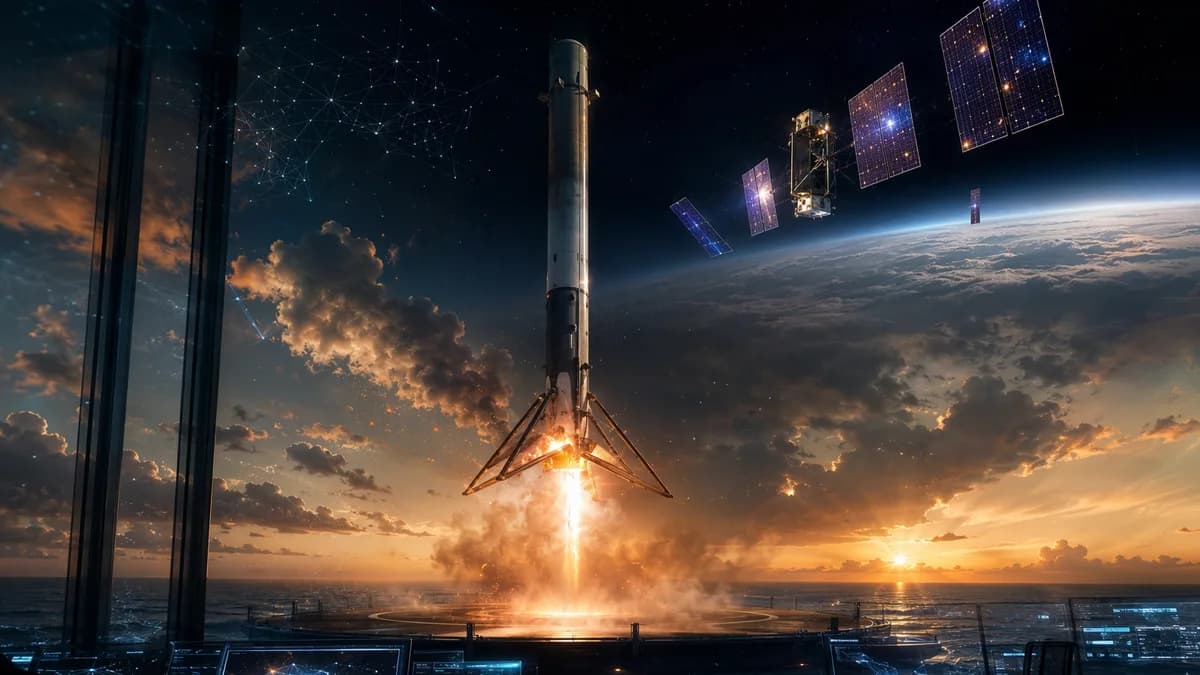
Friday’s SpaceX Starlink V3 launch turned a payload win into a booster warning
On Friday, SpaceX finally deployed its first third-generation Starlink satellites, but the same Starship V3 test exposed a repeat weakness in the Super Heavy booster: it still couldn’t complete the return sequence cleanly.
XOOMAR Intelligence
Analyst Take
That makes the SpaceX Starlink V3 launch a mixed signal. The company checked off a major payload milestone on the 13th Starship test flight, according to TechCrunch, but the booster failed during a planned simulated landing in the Gulf of Mexico after it couldn’t properly fire all engines needed for the landing burn.
The timing matters because it followed a failed launch attempt a little more than a week earlier, when the mission aborted immediately after ignition because of multiple engine failures. SpaceX said it replaced six engines before Friday’s flight.
The central read from XOOMAR: payload progress is real, but the business case still runs through reuse. Starship can keep proving it can throw hardware downrange, but Super Heavy has to come back reliably before the system looks like an operating launch machine rather than a high-velocity test program.
July 24 scorecard: Starlink V3 deployed, upper stage improved, booster hit hard
The strongest result came from the upper stage. SpaceX successfully deployed the first Starlink V3 satellites from the upgraded Starship prototype. That matters because the first V3 flight in May lost a rocket engine on the upper stage. TechCrunch reported that this did not happen on Friday, and Starship encountered no issues on its way to deploying the new satellites.
Preflight reporting from Spaceflight Now said the mission planned to deploy 20 production Starlink V3 satellites on a suborbital path. Those satellites were not expected to remain in space. SpaceX said they were expected to burn up roughly 20 minutes after deployment, because Starship still is not capable of reaching Earth orbit on this test profile.
“As part of this initial test, Starship is planned to deploy 20 satellites which will extend solar arrays and antennas and will attempt to connect with the larger Starlink constellation via high-capacity lasers,” SpaceX wrote prior to launch, according to Spaceflight Now.
The booster result was weaker. It made it further than the previous V3 test, but failed at the moment that matters for recovery. During the simulated landing, the booster could not relight all required engines and exploded after a faster-than-expected water impact.
| Flight milestone | May V3 flight | July 24 Flight 13 |
|---|---|---|
| Vehicle version | Starship V3 | Starship V3 |
| Upper stage issue | Lost a rocket engine | No reported upper-stage engine issue before deployment |
| Starlink V3 deployment | Not the first production V3 deployment | First third-generation Starlink deployment |
| Booster outcome | Booster failed after separation from upper stage | Booster failed during simulated Gulf landing |
| Orbit reached | No | No |
That split is the story. The SpaceX Starlink V3 launch proved more useful on the payload side, while leaving the reuse question unresolved.
The July 16 abort made Friday’s booster failure harder to dismiss
SpaceX had already tried to launch Flight 13 on July 16, but that attempt aborted immediately after ignition. Spaceflight Now reported that on-screen telemetry showed four engines on the Super Heavy booster did not ignite as planned. Elon Musk wrote on X shortly after the abort:
“Some of the engines didn’t start, triggering an automatic launch abort. Next launch attempt hopefully in a few days.”
SpaceX then replaced six engines ahead of Friday’s launch. That repair got the vehicle off the pad, but it did not close the broader engine-start and relight reliability question.
XOOMAR analysis: this is the difference between fixing a launch constraint and fixing an operating constraint. Getting all engines healthy enough for ascent is one gate. Getting the booster to restart the right engines, at the right moment, after ascent and separation, is another. Friday’s flight suggests SpaceX moved past the first gate but still has work on the second.
The company’s own development style accepts this kind of public failure. But repeated booster issues still sharpen scrutiny around whether Starship can move from dramatic test flights to a more dependable operating cadence.
Super Heavy relight is the bridge between a test rocket and a reusable launch system
The booster relight problem matters because Super Heavy is not supposed to be treated as disposable hardware. The long-term logic of Starship depends on returning major vehicle components and flying them again.
A controlled booster descent needs the right engine sequence for the return profile. Friday’s booster made it deeper into the plan than it did in May, but it still failed during the simulated landing burn. That makes the failure narrower, not harmless.
The practical consequence is simple: Starship’s payload story can improve while its economics remain unproven. If the upper stage can deploy Starlink V3 satellites but the booster keeps being lost, SpaceX can still gather data and test payload procedures. It cannot yet demonstrate the repeatable recovery model that makes Starship different from a very large expendable rocket.
This is also why Flight 13 matters beyond Starlink. Spaceflight Now reported that SpaceX President and COO Gwynne Shotwell told CNBC in June that the company may attempt an orbital launch as soon as Flight 14, depending on how the next mission goes, and that a monthly launch cadence is the target. Friday’s result gives SpaceX evidence on upper-stage and payload behavior, but it gives less comfort on booster recovery.
For readers tracking hardware qualification in space environments more broadly, that same pressure to prove systems before operational use shows up in XOOMAR’s coverage of the No-Repair Moon Trial Tests Nvidia Moon GPU This Year. Starship is a different vehicle and mission profile, but the engineering lesson rhymes: failure data is useful only if it closes the risk before the system becomes mission-critical.
Starship’s V3 pattern: each flight adds a success and exposes a weak point
The first Starship V3 flight in May suffered a Super Heavy failure as it separated from the upper stage. It also lost an upper-stage rocket engine. Friday improved on that upper-stage result and achieved the first Starlink V3 deployment, but the booster still failed before completing the simulated landing.
That is progress and fragility moving together. SpaceX’s test campaign keeps converting unknowns into narrower problems. The concern is whether the same category of problem, booster engine behavior during return, keeps reappearing in new forms.
Spaceflight Now reported that SpaceX made hardware modifications to improve relight reliability before Flight 13, plus updates to engine alarms and aborts based on conditions seen in a multi-engine flight environment. Friday’s failure does not prove those changes failed completely, because the booster got further into the mission. It does show they were not enough to finish the landing sequence.
That distinction matters. SpaceX can credibly argue it is learning. Investors and regulators can still ask whether the learning curve is bending fast enough.
The next decision point is whether Flight 14 gets cleaner booster behavior
The most important evidence from the next Starship flights will not be another dramatic liftoff. SpaceX has shown it can launch Starship. The next credibility test is a clean booster relight, a controlled simulated landing, repeatable Starlink V3 deployment, and eventually reuse of major hardware.
If SpaceX resolves the booster return sequence while preserving the upper-stage gains from Friday, the SpaceX Starlink V3 launch will look like a messy but useful step toward operational heavy-lift service. If the same relight issue keeps returning, the payload milestones will start to look less decisive.
For now, the sharp read is this: SpaceX can absorb another failed booster inside a test campaign. It cannot build the Starship business case around boosters it does not get back.
The Bottom Line
- SpaceX achieved a major Starlink V3 deployment milestone on the 13th Starship test flight.
- The failed booster return shows Super Heavy reuse remains a critical unresolved challenge.
- Starship’s commercial promise depends on making launches repeatable, reliable, and reusable.
Starship V3 Test Flight Outcome
| Component | Result | Implication |
|---|---|---|
| Starship upper stage | Successfully deployed first Starlink V3 satellites | Shows payload progress after a prior upper-stage engine issue in May |
| Super Heavy booster | Failed during planned simulated landing burn | Raises continued concerns about reuse reliability |
Key Mission Counts
Primary Sources & Disclosures
- [1]TechCrunch
- [2]Post-ignition anomaly causes abort of SpaceX’s Starship Flight 13 – Spaceflight Now
- [3]SpaceX's Starship V3 Can't Fly Again Until a 'Mishap' Is Addressed, Says FAA - CNET
- [4]SpaceX will now try to launch critical Starship Flight 13 test today after delays. Here

Written by
XOOMAR Insights Team
Research and Editorial Desk
The XOOMAR Insights Team pairs automated research with human editorial judgment. We track hundreds of sources across technology, fintech, trading, SaaS, and cybersecurity, cross-check the facts, and explain what happened, why it matters, and what to watch next. We do not just rewrite headlines. Every article is fact-checked and scored for reliability before it goes live, and we link back to the original sources so you can verify anything yourself.