
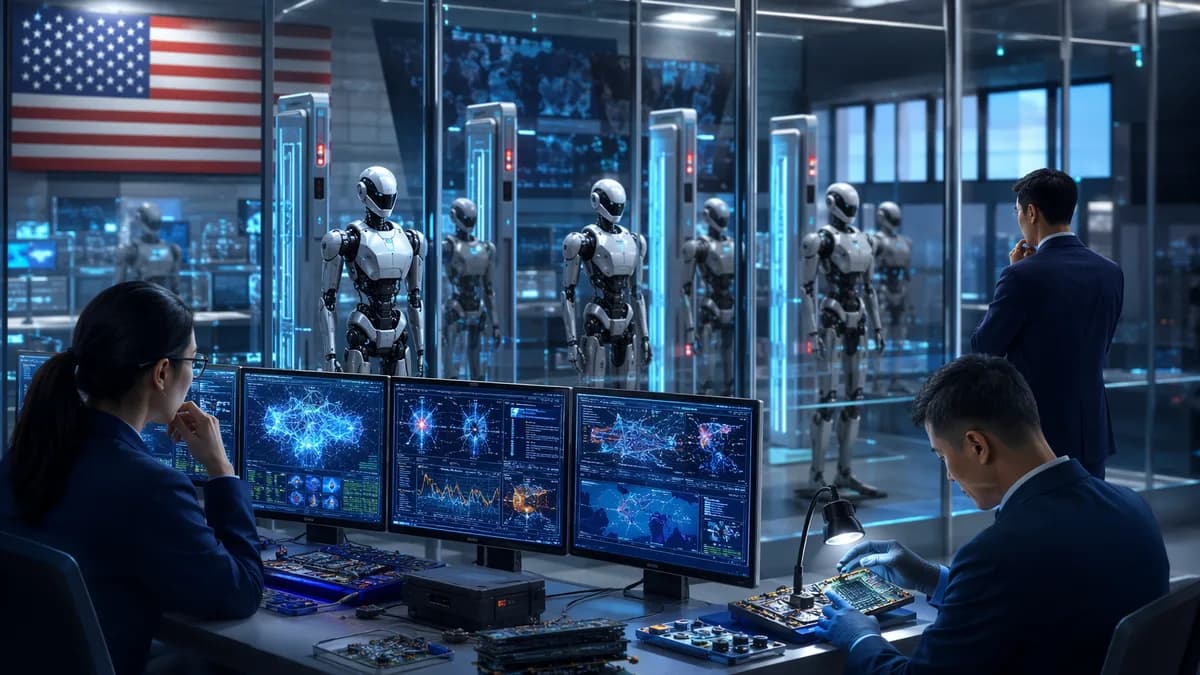
Humanoid robots were expected to be the next hardware race. Washington is now treating the broader robotics contest with China as a national security question before these machines get a wider US opening.
TechnologyJuly 29, 2026· 8 min read· By XOOMAR Insights Team
Chinese Humanoid Robot Ban Locks Out New US Machines
Updated on July 29, 2026
XOOMAR Intelligence
Analyst Take
59/ 100
1 source analyzedLow confidenceTrend10Freshness97Source Trust92Factual Grounding94Signal Cluster20
The Chinese humanoid robot ban has been described as part of a wider technology confrontation, but the supplied BBC World material only verifies the broader frame: the US and China are in a race to lead robotics and artificial intelligence. More specific claims about the exact regulatory mechanism, product categories, officials involved, or affected companies should therefore be treated cautiously unless confirmed by fuller source material or official filings.
That framing matters. The US is not looking at robotics as a novelty market alone. It is looking at connected machines, physical automation, AI capability, and supply chains as part of the same strategic contest.
Washington is recasting humanoid robots as strategic hardware
The most important point is not simply that many advanced machines are made in China. The bigger signal is that humanoid robots are being discussed as strategic hardware before they become deeply embedded in American operations.
The supplied BBC material supports the central geopolitical backdrop: the US and China are competing to lead the world in robotics and AI. It does not, in the excerpt provided, verify detailed claims about a particular agency register, specific product listings, or quoted regulatory language. Those details may exist elsewhere, but they cannot be stated as confirmed from the supplied source alone.
That distinction is important. A policy fight over humanoid robots would not be just another import dispute. Robots that move through workplaces, homes, factories, warehouses, or public settings raise questions about software, cameras, sensors, connectivity, updates, and control systems.
A restriction on future imports, if implemented through national security rules, would be less like an immediate market purge and more like a gate closing on the next generation of connected hardware. It would signal that the US wants to decide early which machines can enter sensitive environments, rather than waiting until they are already common.
The Chinese humanoid robot ban targets access, not just origin
The policy debate is best understood as a fight over access, not only origin. A humanoid robot is not just a body, motors, and batteries. It is a connected platform that may depend on cloud services, remote maintenance, operating software, data collection, sensors, and AI models.
Because the supplied BBC material does not verify specific product categories or exact regulatory wording, the safest way to frame the issue is at a higher level:
| Issue | What can be said from the supplied material | Why it matters |
|---|---|---|
| Robotics leadership | The US and China are in a race to lead robotics and AI | Humanoid robots sit at the intersection of manufacturing, software, and national strategy |
| Market access | Any reported restriction should be treated as part of that wider strategic contest unless confirmed in detail | Future access to the US market could shape which companies scale globally |
| Security concerns | Specific agency claims or quoted risk language are not verified in the supplied excerpt | Connected robots raise obvious policy questions, but exact official reasoning needs confirmed sourcing |
That table shows why the Chinese humanoid robot ban is really about control surfaces. Robots are physical machines, but their risk profile depends on the digital systems around them. Who writes the software? Who controls updates? Where does data go? Who can service the machine remotely? Those questions matter as much as where the hardware is assembled.
XOOMAR analysis: the policy concern is likely aimed at future dependency. Once a connected device category becomes common in factories, homes, data centres, or energy systems, removing it becomes expensive and politically messy. Acting early gives regulators more control, but it also narrows the available supplier pool before the market fully develops.
This is where the robotics issue becomes sharper than a standard import dispute. A humanoid robot is a product, a platform, and a potential infrastructure layer at the same time. That makes it harder for governments to separate ordinary competition from strategic exposure.
The numbers are sparse, but the tariff signal is loud
The supplied BBC source material does not provide installation totals, subsidy figures, AI research counts, publication timing, or market forecasts. That limits any serious numerical comparison between the US and China. It also means specific dates, tariff levels, and company-by-company claims should not be stated as confirmed unless they appear in verified source material.
Three figures and facts frame the race:
- No confirmed publication date in the supplied metadata: The provided material does not include a BBC publication date.
- No confirmed tariff figure in the supplied excerpt: Specific tariff claims should be separately sourced before being treated as fact.
- US-China competition in robotics and AI: The verified frame is a race between the two countries to lead these technologies.
That lack of hard numbers matters. It means the article should avoid pretending there is more detail in the supplied material than there is. The strategic direction is clear enough: robotics and AI are being treated as linked areas of competition. The precise regulatory tools, market effects, and commercial fallout need stronger sourcing.
XOOMAR analysis: the US appears to be treating physical AI hardware as a strategic category, not merely an import category. If a machine can move, observe, update, and operate in sensitive settings, regulators will judge it differently from static equipment.
That does not prove that any specific Chinese robot maker has misused its machines. It also does not prove that every foreign-made robot creates the same level of risk. The key point is that the policy debate is moving toward trust, control, and supply-chain exposure.
AI rivalry is bleeding into hardware rules
The BBC report ties the broader issue to artificial intelligence by describing the US and China as locked in a race to lead the world in robotics and artificial intelligence.
That race has at least two clear fronts in the supplied material:
- Robotics: Humanoid and advanced machines are becoming part of the strategic technology contest.
- Artificial intelligence: AI capability is central to how these machines may be developed, trained, deployed, and improved.
Other claims about sanctions, named officials, intellectual-property allegations, or specific enforcement actions are not verified in the supplied excerpt. They may be relevant to the wider US-China technology dispute, but they should not be attributed to the BBC material provided here.
The dispute is not just about who builds better models or better machines. It is about whose hardware and software can be trusted inside another country’s physical and digital infrastructure.
That also explains why governments are likely to look beyond the robot body itself. As AI systems become more connected to physical machines, scrutiny can extend to sensors, software, connectivity, firmware, data flows, and control paths. This is a broader analytical point, not a specific claim verified by the supplied BBC excerpt.
Robot makers and buyers inherit a narrower market
The supplied material does not verify claims that the BBC contacted specific Chinese robot makers or received no responses. Those company-level details should therefore be left out unless confirmed by the full source or another reliable report.
For Chinese robot makers, the immediate message from the wider policy direction is still blunt: future access to the US market may depend on national security assessments, not just normal commercial competition.
For US robotics companies, any restriction on Chinese competitors could reduce pressure from lower-cost or faster-moving rivals. But that does not automatically solve the US manufacturing problem. If American firms depend on foreign components, or if domestic production cannot match cost and scale, restrictions may protect the market while leaving supply constraints unresolved.
For buyers, the practical effect is likely to be procurement friction. Companies considering new advanced robots will need to understand where the machines are made, how they connect, how updates are delivered, where data is processed, and whether procurement teams face compliance risk.
The before-and-after is stark:
- Before: Advanced robots could be judged mainly as products competing on performance, price, and availability.
- After: Origin, software control, remote access risk, supplier trust, and regulatory exposure may sit at the center of the buying decision.
That is the real cost of the Chinese humanoid robot ban as a policy signal. Even when sales are not fully blocked, uncertainty slows decisions.
The next split will be over trust, software, and supply chains
The reported policy direction does not prove that any specific Chinese robot maker has misused its machines. The supplied source material does not show that. The issue is about risk assessment, strategic competition, and the future shape of connected hardware markets.
That distinction will shape the next phase. If the US produces more specific technical rules around robot connectivity, remote updates, data storage, or authorisation standards, the thesis strengthens: Washington is building a durable security regime for physical AI. If policy remains broad and underdefined, companies may struggle to separate real compliance risk from political risk.
China’s next response also matters. If Beijing answers with its own barriers or accelerates domestic development in robotics and AI, the market could harden into rival technology blocs faster.
The humanoid robot race will not be decided only by product demos or factory trials. It will be shaped by which machines governments trust enough to let into factories, homes, data centres, and energy systems.
For now, the signal from Washington is clear: a robot that can move through the real world is no longer just a machine. It is a supply-chain decision, an AI decision, and a national security decision at the same time.
Impact Analysis
- Washington is treating humanoid robots as strategic hardware before they become widely embedded in US workplaces and homes.
- The robotics race is increasingly tied to AI, supply chains, sensors, connectivity, and national security policy.
- The available source supports the broader US-China competition but not all specific claims about the ban’s exact mechanism or affected companies.
US-China Robotics and AI Contest
| Side | Role in article | Strategic concern |
|---|---|---|
| United States | Recasting humanoid robots and broader robotics as a national security issue | Connected machines, AI capability, sensors, software, updates, and supply chains |
| China | Identified as a major source of advanced robotics and a rival in robotics and AI leadership | Potential influence over hardware, software, connectivity, and control systems |
Sources

Written by
XOOMAR Insights Team
Research and Editorial Desk
The XOOMAR Insights Team pairs automated research with human editorial judgment. We track hundreds of sources across technology, fintech, trading, SaaS, and cybersecurity, cross-check the facts, and explain what happened, why it matters, and what to watch next. We do not just rewrite headlines. Every article is fact-checked and scored for reliability before it goes live, and we link back to the original sources so you can verify anything yourself.
Explore More Topics
Related Articles
 Technology
Big Tech Fight Pulls Trump Into EU Digital Rules Clash
Sixteen lawmakers want Trump to punish EU digital rules as a trade barrier, turning the Big Tech fight into a transatlantic showdown.
Jul 21, 20269 min
 Technology
Chris Fall Resignation Throws CAISI Into Fresh Chaos
Chris Fall quit CAISI after three months, deepening turmoil at the federal office meant to set AI standards and test frontier models.
Jul 20, 20267 min
 Technology
Mobileye CEO Exit Jolts Its Robotaxi and Robotics Bet
Shashua is leaving the CEO seat while Mobileye asks Wall Street to buy a robotaxi and robotics future.
Jul 24, 202611 min
 Technology
466% CXMT Stock Debut Mints Chinese $484B RAM Giant
CXMT's 466% Shanghai debut turned a RAM maker into a $484B chip heavyweight overnight.
Jul 27, 20267 min
 Technology
Meta Splits Facebook Marketplace Sellers Into New App
Meta is spinning frequent Facebook Marketplace sellers into a dedicated Seller app and adding free verification across key Facebook features.
Jul 25, 20266 min
 Cybersecurity
FCC Robot Inverter Ban Locks Foreign Tech Out of U.S.
The FCC blocked new foreign-made mobile robots and connected power inverters from U.S. approval over national security risks.
Jul 29, 20266 min
 Global Trends
Jay Clayton Wins DNI Job as Intel Trust Fractures in Senate
Jay Clayton won DNI confirmation 51-47, leaving intelligence oversight tangled in Trump loyalty tests and partisan distrust.
Jul 28, 202610 min
 Global Trends
Tariff Detours Crush the US Manufacturing Jobs Pitch
Tariffs haven't sparked a US factory jobs boom. Chinese inputs are taking longer routes, with higher costs and more automation.
Jul 27, 20268 min
 Global Trends
Saudi Oil Plot Triggers US CENTCOM Strikes in Iraq
CENTCOM hit Iran-backed groups in Iraq over alleged plots against US troops and Saudi oil sites, tightening the fuse on a wider clash.
Jul 29, 20266 min
 Global Trends
Jalen Carter Contract Shakes NFL DT Market at $152M
Philadelphia made Jalen Carter the NFL's top-paid defensive tackle before his peak, turning a projection bet into the market benchmark.
Jul 29, 20268 min
Don't miss the signal
Get our weekly roundup of the stories that matter across tech, fintech, and trading. No noise, just signal.
Free forever. No spam. Unsubscribe anytime.