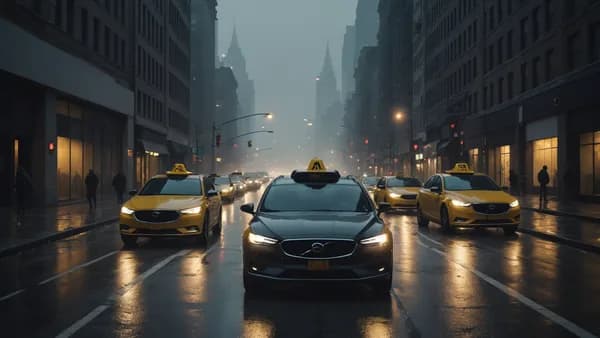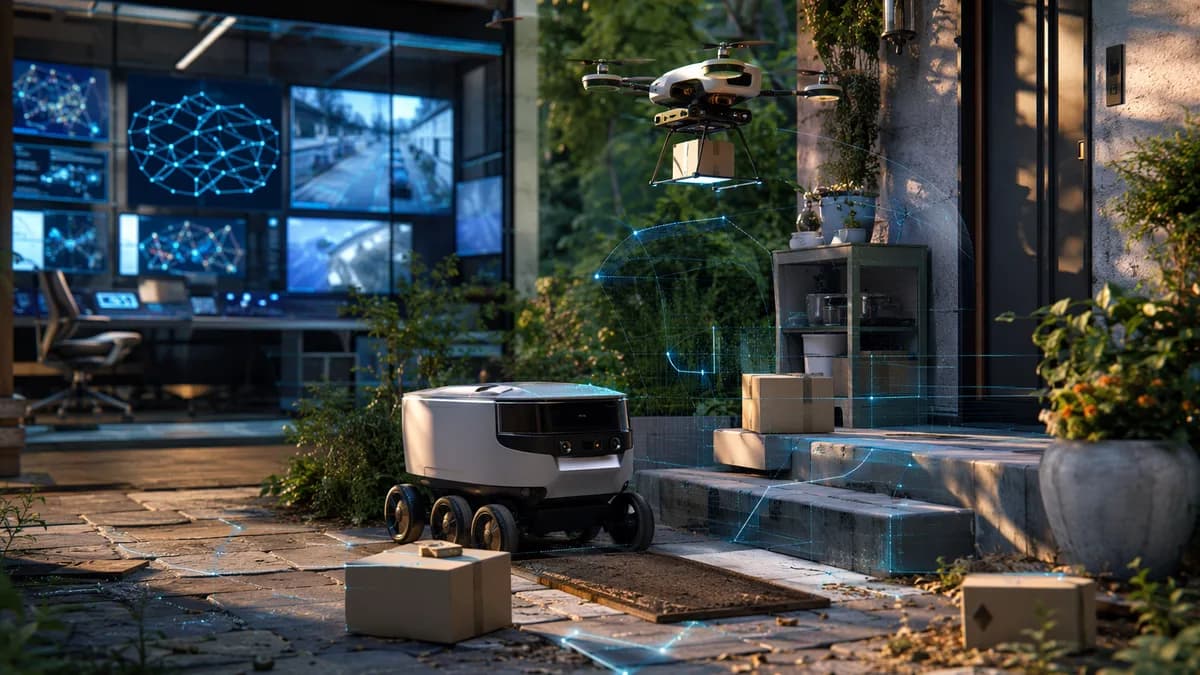
Physical AI delivery robots are running into the least glamorous, most expensive part of logistics: the short walk from the curb to the door. That is the signal beneath the latest push from Boston Dynamics, Amazon, Serve Robotics, and DoorDash. Roads can be mapped. Sidewalks can be constrained. The porch is where automation stops looking clean.
XOOMAR Intelligence
Analyst Take
Last-mile delivery already accounts for more than half of total supply chain costs, and U.S. carriers spend an estimated $90 billion a year on that leg alone, according to PYMNTS, citing industry estimates referenced by Boston Dynamics. The expense is concentrated in a painfully human task: drivers walking packages down driveways, up stairs, and to front doors.
“So much of logistics is already automated, but we believe that the final frontier of logistics automation is that last 50 feet,” Marco da Silva, vice president and general manager for Spot at Boston Dynamics, said.
That framing is right. Carriers don't need another polished demo. They need physical AI delivery robots that can finish the job cheaply, repeatedly, and without turning every exception into a support case.
The last 50 feet turn physical AI into an economics problem
The doorstep is a brutal test because it combines mobility, perception, package handling, weather exposure, and customer-facing reliability in one workflow. Boston Dynamics is testing Spot, its four-legged robot, as a van-riding delivery assistant. A driver loads boxes onto a conveyor payload on Spot’s back, then the robot handles curbs, stairs, gravel, and ice before setting packages down.
That is the right problem to attack. It is also the hard one.
Spot has already delivered a carton of eggs to show precision, and Boston Dynamics has set a pilot goal of Spot working alongside a driver to deliver 200 packages a day, five days a week. But Spot costs roughly $75,000, according to The Next Web, as cited in the source material. For more context on that hardware bet, see XOOMAR’s related coverage, Boston Dynamics Spot Hauls Packages in $75K Delivery Bet.
The strongest counterpoint is that delivery robots already work in narrower conditions. Serve Robotics deployed more than 2,000 autonomous sidewalk delivery robots by the end of 2025, creating what it called the largest sidewalk delivery fleet in the U.S. Its robots operate at Level 4 autonomy and complete 99.8% of deliveries. That is real scale.
But Serve’s robots cannot climb stairs. That limitation is the thesis in miniature. Sidewalk autonomy is not doorstep autonomy.
The $90 billion last-mile bill explains the robot obsession
The appeal of physical AI delivery robots is not novelty. It is cost pressure. If U.S. carriers spend an estimated $90 billion a year on last-mile delivery, even small improvements in the most labor-intensive part of a route can matter. PYMNTS says almost all of that expense comes from human drivers walking packages to doors for hours at a stretch.
The key distinction is between reaching the address and completing the delivery. A van can get to the curb. A sidewalk bot can reach many building edges. The costly handoff is the doorstep, especially when the path is not flat.
Boston Dynamics’ pilot target gives investors and carriers a useful yardstick: 200 packages a day, five days a week, alongside a human driver. That is not a sci-fi benchmark. It is a productivity benchmark. If Spot can hit it safely and consistently, the question becomes whether the incremental labor saved offsets the machine, maintenance, support, and integration burden.
This is where the delivery robot story intersects with a broader AI capital question. Expensive automation has to earn its place in operating margins, the same pressure XOOMAR has tracked in OpenEvidence Funding Doubt Exposes $20B AI Dilemma. The details differ, but the discipline is the same: impressive technology is not enough if the economics do not close.
Serve, Dot, Spot, and Rivr show where the curb-to-porch gap sits
The current market splits into two camps: robots that scale on flat ground, and robots trying to handle stairs.
| Company or robot | Reported capability | Reported limitation or open issue |
|---|---|---|
| Serve Robotics | More than 2,000 sidewalk robots by end of 2025, 99.8% delivery completion | Cannot climb stairs |
| DoorDash Dot | Deployed in Arizona since late 2025, fits through doorframes | Cannot climb stairs |
| Boston Dynamics Spot | Four-legged robot tested on curbs, stairs, gravel, and ice | Hardware cost and delivery volume economics remain unproven at scale |
| Amazon Rivr | Four-legged wheeled robots planned for doorstep delivery tests | Scale economics remain unanswered |
Amazon’s move is especially telling. It acquired Rivr, a Zurich-based robotics startup, in March 2026 and plans to test its four-legged wheeled robots to help delivery associates carry packages to doorsteps, PYMNTS reported, citing CNBC. Rivr’s machines differ from Amazon’s earlier Scout sidewalk robot, which Amazon shut down in 2022, because Rivr’s robots can climb stairs and cross uneven terrain, according to TechCrunch reporting cited by PYMNTS.
Rivr had raised $25 million in total funding and was last valued at about $100 million, TechCrunch reported. Amazon had already invested in Rivr through its $1 billion Industrial Innovation Fund, CNBC reported.
The contrast is sharp. Spot walks on four legs for agility in unstructured terrain. Rivr uses a hybrid of wheels and legs, favoring speed on flat surfaces while keeping stair-climbing capability. The technical approaches differ, but the commercial question is identical: can the robot handle enough stops per day to justify the hardware?
“Companies have tried drones for delivery, but they haven’t been able to get to the porch, and so packages were being left in the middle of the yard,” Paige Miller, Spot’s product manager at Boston Dynamics, said. “We’ve also seen the struggles of various wheeled robots for last-mile delivery.”
Physical AI’s data advantage may start on sidewalks, not porches
Jensen Huang said at CES in January 2026 that the ChatGPT moment for robotics had arrived, PYMNTS reported. The operating thesis is simple: the company that deploys the most robots collects the most operational data, and that data trains better models.
That favors Serve in one narrow sense. Its sidewalk fleet is already gathering data on flat terrain across Los Angeles, Atlanta, Dallas-Fort Worth, Miami, Chicago, and Alexandria, Virginia, through partnerships with Uber Eats and DoorDash. But the data from a sidewalk route does not automatically solve stairs, gravel, ice, and porch placement.
This is the physical AI deployment gap in practical form. Jeff Mahler of Ambi Robotics described a broader version of the problem in Forbes: no robot AI company has yet achieved commercial scale, and enterprise deployments often stumble over economics, integration, security approvals, implementation, adoption, and support. He also wrote that customers and sellers need the economics to work over a reasonably short time frame, about three years.
That matters here because delivery robots are not just models with wheels or legs. They are field operations. If support, charging, maintenance, driver training, or exception handling eats the savings, the robot becomes a moving cost center.
Drivers, retailers, and customers will judge the same robot differently
For carriers, the core metric is cost per completed stop. PYMNTS points directly to the driver walk from curb to doorstep as the expensive friction. A robot that reduces that burden could help only if it does not slow the route, require constant intervention, or add new failure modes.
For retailers and marketplaces, the appeal is delivery completion quality. The source material does not provide refund, theft, or customer satisfaction data, so those cannot be treated as proven benefits. XOOMAR analysis: any commercial deployment will still have to satisfy the customer’s basic expectation that the package ends up at the right door in usable condition.
Workers will read the same technology through a different lens. The current Boston Dynamics model still keeps a driver in the loop, with Spot riding in the van and assisting on the final approach. That suggests augmentation before full replacement. But if robots help raise expected package counts per route, labor concerns will not disappear. They will change shape.
Regulators and residents add another layer. The supplied reporting does not establish how these systems handle privacy, liability, accessibility, or home-adjacent data collection. Those gaps matter because doorstep automation happens in public and semi-private spaces, not just inside company facilities.
The next proof point is boring: 200 packages a day without drama
The company that solves the last 50 feet will not win because its robot looks most human or attracts the best demo video. It will win by making doorstep delivery boring, reliable, and cheap.
The evidence to watch is concrete. Boston Dynamics has named a pilot goal: Spot alongside a driver, 200 packages a day, five days a week. Serve has shown sidewalk scale: 2,000-plus robots and 99.8% completion, but not stair-climbing. Amazon has bought Rivr to test a different hardware design aimed directly at doorstep terrain.
The thesis weakens if flat-ground fleets extend their reach without costly legged hardware, or if human-assisted delivery remains cheaper after robot support costs are counted. It strengthens if Spot, Rivr, or a similar system proves high-volume doorstep delivery with low intervention and a clear payback path.
For now, physical AI delivery robots have crossed the sidewalk faster than they have crossed the porch. The last 50 feet remain the test that separates useful logistics automation from expensive theater.
The Bottom Line
- The hardest delivery problem is shifting from roads and sidewalks to the final trip from curb to doorstep.
- Last-mile delivery already represents more than half of supply chain costs, making automation a major cost target.
- Robots like Boston Dynamics’ Spot must prove they can handle real-world obstacles reliably before they can scale.
Estimated U.S. Carrier Spending on Last-Mile Delivery
Primary Sources & Disclosures

Written by
XOOMAR Insights Team
Research and Editorial Desk
The XOOMAR Insights Team pairs automated research with human editorial judgment. We track hundreds of sources across technology, fintech, trading, SaaS, and cybersecurity, cross-check the facts, and explain what happened, why it matters, and what to watch next. We do not just rewrite headlines. Every article is fact-checked and scored for reliability before it goes live, and we link back to the original sources so you can verify anything yourself.