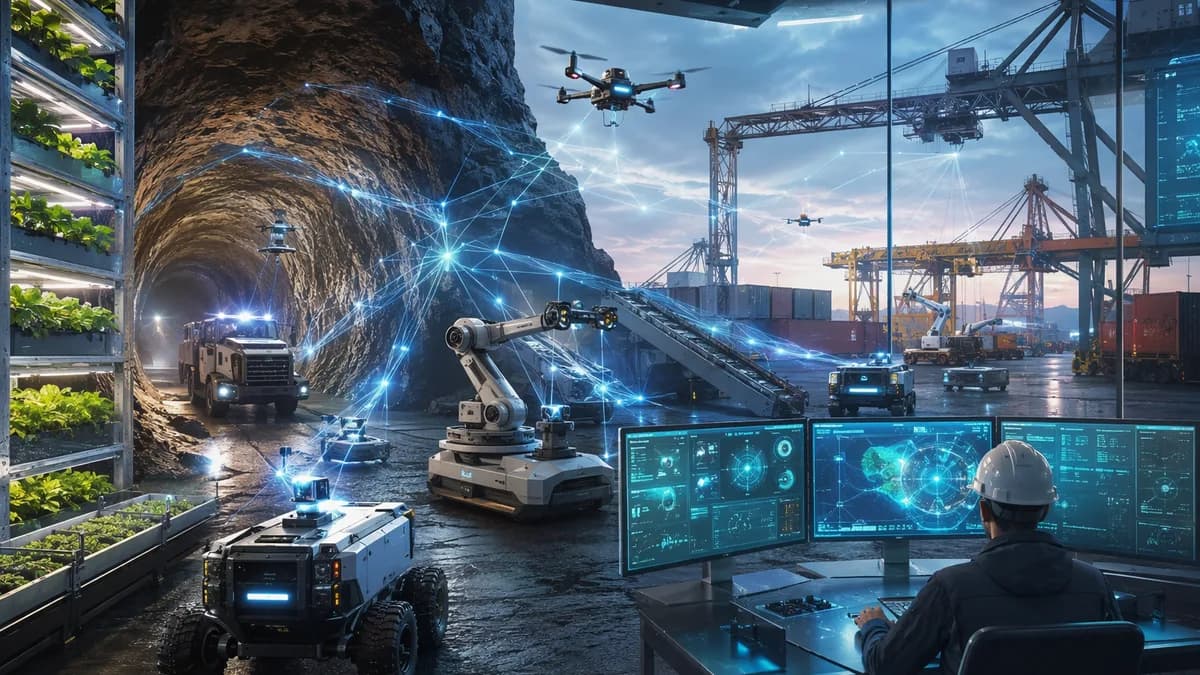
Atoms physical AI just pulled in $1.7 billion because Travis Kalanick is betting the next AI profit pool sits in mines, construction sites, freight yards, and food production lines, not inside another chat box.
XOOMAR Intelligence
Analyst Take
The equity investment in Atoms, led by Andreessen Horowitz, is aimed at developing physical artificial intelligence for major industrial sectors, according to PYMNTS. Ben Horowitz, a16z co-founder and general partner, will join the company’s board.
Kalanick’s pitch is simple and ambitious: software has not finished digesting the physical economy. Uber digitized parts of transportation. CloudKitchens digitized parts of food production and delivery infrastructure. Atoms is now being framed as the next step, a company built to push AI into “atoms-heavy” industries where failure is costlier, deployment is slower, and the prize could be much larger than another office productivity tool.
“Mining, construction, heavy transport, food production are just a few examples of atoms-heavy industries awaiting massive digital transformation,” Kalanick said in an announcement on the company’s website. “Multiple trillion-dollar industries rapidly transforming over the next decade powering an engine of prosperity unparalleled in human history.”
That is the headline promise. The harder question is whether Atoms can turn physical AI from a funding story into a field deployment story.
Travis Kalanick Is Betting $1.7 Billion That AI’s Next Profit Pool Sits Outside the Screen
The $1.7 billion raise signals a sharp expansion of AI spending and ambition. Atoms is not pitching a better search interface, vibe coding tool, or analytics dashboard. It is aiming at sectors where work happens through vehicles, machines, robotics systems, sensors, logistics networks, kitchens, mines, and physical infrastructure.
That makes the bet more interesting and more dangerous.
Software AI can ship quickly, break quietly, and iterate behind a screen. Physical AI has to deal with machines that move, equipment that wears down, workers who operate around it, and industrial customers that measure value in uptime, throughput, safety, and capital efficiency. A model that hallucinates in a document is a problem. A system that misreads a haul road, kitchen process, or construction workflow can create real losses.
Kalanick is clearly framing Atoms as unfinished business from his post-Uber arc. In the company announcement, he said Atoms continues his effort to “digitize the physical world” that began with Uber, continued with CloudKitchens, and now runs through Atoms.
TechCrunch reported that Bain Capital, Fifth Wall, and Uber also participated in the round, reconnecting Kalanick with the company he co-founded and later left as CEO in 2017 after complaints of sexual harassment, discrimination, and a toxic workplace.
XOOMAR analysis: Uber’s participation matters less as nostalgia than as a signal. A company with deep institutional memory of Kalanick still joined the financing. That does not validate Atoms’ technology. It does show that investors are willing to separate governance history from the size of the physical AI opportunity.
Inside the Atoms Physical AI Thesis for Mining, Construction, Freight, and Food Production
Kalanick describes industrial AI as the combination of software, sensors, robotics, and AI used to automate operations. In plain terms, Atoms physical AI means AI systems that perceive conditions in the real world, make decisions, and act through machines, industrial equipment, robotics, vehicles, or automation platforms.
That is a different job than ranking text or generating images. The target is operational control.
Atoms’ chosen sectors share the same basic profile:
- Asset-heavy: Mines, construction sites, transport networks, and food production operations depend on expensive physical infrastructure.
- Operationally messy: Workflows vary by site, shift, weather, equipment mix, and labor availability.
- Digitally uneven: Many decisions still depend on manual coordination, local knowledge, fragmented software, or incomplete visibility.
- High-stakes: Downtime, safety incidents, and poor throughput can hit margins quickly.
Kalanick’s April LinkedIn post said City Storage Systems, the company behind CloudKitchens, Otter, Lab37, Picnic, and ProFood Properties, was transformed into Atoms. He said those businesses would become the foundation of Atoms Food, and that Atoms would expand into robotics, autonomous logistics, mining, and transport infrastructure.
“Food was just the beginning,” Kalanick said in the post. “The deeper opportunity is building systems that digitize the physical world. A future where software, robotics and infrastructure work together to help mine the minerals, manufacture the goods, move them across cities, and deliver them to people everywhere.”
That wording matters. Atoms is not presenting itself as a narrow robotics company with one device and one workflow. It is positioning itself closer to an industrial operating company, with AI control layers, physical infrastructure, sector-specific automation, and potentially acquired capabilities stitched together under one umbrella.
TechCrunch reported that Kalanick acquired Pronto, the heavy industry automation company run by former Uber colleague Anthony Levandowski, after revealing the Atoms name. TechCrunch also reported that Kalanick has said he wants to build a “wheelbase for robots” with Atoms.
XOOMAR analysis: that phrase suggests Atoms may try to own enabling layers for physical automation rather than only end-user applications. If true, the company’s challenge becomes even bigger: build systems that can generalize across equipment, sites, and industries without collapsing under customization.
$1.7 Billion Signals a New Capital Arms Race for AI in the Physical Economy
The funding size is the story’s anchor. $1.7 billion is not ordinary seed-stage experimentation. It is infrastructure-scale capital, and it suggests backers expect Atoms to pursue markets where returns could exceed conventional SaaS growth if the company captures operational control points.
The capital requirements explain the size. Physical AI is expensive before it works and still expensive after it works.
| Dimension | Software AI | Atoms-style physical AI |
|---|---|---|
| Deployment | Cloud rollout, user onboarding | Field installation, integration, testing |
| Iteration speed | Fast updates, digital feedback | Slower cycles tied to equipment and sites |
| Failure cost | Bad output, churn, compliance risk | Downtime, safety risk, damaged assets |
| Sales motion | Teams, developers, enterprises | Industrial operators, infrastructure owners |
| Proof standard | Accuracy, workflow gains | Throughput, uptime, safety, ROI |
Horowitz framed the opportunity around physical productivity, not just digital productivity.
“I think the most valuable thing someone could do with AI and robotics is to repeat the same thing Uber did for transportation, or that computers did for the digital world: to make everything and everyone more productive,” Horowitz said. “There are so many companies out there (and we’ve backed many of them!) working on various digital forms of this. But most of the jobs we do are still in the physical world, whereas the frontier of productivity means physical productivity: making things, moving things, storing things.”
The likely uses of capital follow from that thesis: technical hiring, industrial partnerships, robotics and automation capabilities, operational data systems, and early deployments that may need heavy support before customers scale.
TechCrunch reported that Kalanick did not provide specifics on what Atoms plans to build. That absence is important. Atoms has raised like a company with a broad industrial mandate, but it has not yet given the market a clear product roadmap.
We’ve seen this tension before in AI financing, where capital can arrive before public evidence catches up. XOOMAR covered a similar credibility gap in OpenEvidence Funding Doubt Exposes $20B AI Dilemma, and the same broad issue runs through funding narratives like DeepSeek Funding Round Chases $71B Weeks After $7B Raise: money can intensify expectations faster than it proves execution.
XOOMAR analysis: Atoms’ raise is best read as a mandate, not proof. The money buys time, talent, and optionality. It does not prove that mines, kitchens, construction sites, or transport infrastructure are ready for Atoms’ systems at scale.
Kalanick’s Uber Playbook Faces a Harder Test in Industrial AI
The Uber comparison is useful, but only up to a point.
Uber targeted a fragmented real-world market and used software to coordinate supply and demand. Atoms also targets fragmented physical markets, but it cannot scale by matching buyers and sellers through an app. It has to make machines, sites, and workflows behave differently.
That is a much harder operating problem.
Industrial customers will not adopt physical AI because the demo looks impressive. They will ask whether it reduces downtime, improves safety, lifts throughput, cuts waste, or makes existing capital work harder. They will also ask who is liable when the system fails.
Kalanick’s earlier playbook prized speed, density, and marketplace growth. Atoms will need patience, technical depth, and field credibility. A mine, construction site, logistics yard, or production kitchen cannot be optimized like an urban ride-hailing network. Each site has physical constraints, local procedures, equipment variation, and safety requirements.
The Uber parallel, and where it breaks
| Question | Uber | Atoms |
|---|---|---|
| Core target | Transportation coordination | Industrial physical operations |
| Main interface | Consumer and driver app | Robotics, sensors, machines, automation systems |
| Scaling challenge | Market liquidity and regulation | Integration, safety, uptime, hardware reliability |
| Failure mode | Bad trip, legal exposure, churn | Operational disruption, physical damage, safety incident |
| Data advantage | Trip and location data | Site, machine, workflow, and industrial process data |
This is where Atoms physical AI becomes more than a branding exercise. The company has to prove that AI can control or assist real-world workflows with enough reliability for operators to trust it.
The related challenge is visible even in smaller physical automation markets. As we wrote in Physical AI Delivery Robots Hit the Costly Last 50 Feet, the last stretch of automation often contains the hardest economics because messy real-world environments resist neat software assumptions. Heavy industry raises that difficulty level.
XOOMAR analysis: Atoms is testing whether modern AI, robotics, sensors, and industrial data can push beyond the partial digitization of earlier software efforts. The company’s advantage may be its willingness to own more of the stack. Its risk is that owning more of the stack also means owning more of the failure.
Industrial Customers, Workers, Investors, and Regulators Won’t Judge Atoms by Demo Videos
Atoms has four audiences, and each will judge the company differently.
Customers will care about measurable operating gains. In mining, construction, heavy transport, and food production, vague AI capability will not be enough. Operators will ask whether Atoms can reduce downtime, raise equipment use, improve safety, lower error rates, and produce a return within existing capital plans.
Workers will see a mixed picture. Physical AI could reduce dangerous work and help with labor-intensive tasks. It could also raise concerns about job displacement, surveillance, deskilling, and algorithmic management. The source material does not describe Atoms’ labor strategy, so this remains an open execution issue rather than a confirmed company position.
Investors are buying exposure to huge industrial spending pools, but they are also accepting slower feedback loops. Hardware-heavy, field-deployed systems do not produce clean software metrics early. Failures can be expensive, and pilots can look promising without scaling across sites.
Regulators and insurers will focus on liability, safety validation, cybersecurity, and incident reporting when AI systems move machines, vehicles, or production equipment. The source material does not identify any specific regulatory approvals Atoms needs, but the nature of physical AI makes scrutiny unavoidable once systems affect industrial operations.
That is the difference between model performance and operational trust. A benchmark can win attention. A safe, repeatable field deployment wins budgets.
Kalanick’s statement that “Multiple trillion-dollar industries” are transforming over the next decade gives Atoms a massive canvas. It also raises the burden of proof. The broader the promise, the more important it becomes to show tight, practical use cases first.
What Atoms Means for AI Startups, Industrial Giants, and Companies Still Running on Clipboards
Atoms’ raise points to a shift in where AI competition may move next: from model benchmarks toward control of real-world assets and workflows.
That shift changes who has power. In physical AI, the critical advantage may not be the flashiest interface. It may be access to operational data, permission to integrate with equipment, field teams that can handle deployment, and enough domain expertise to understand why a workflow fails at 2 a.m. on a site nobody modeled properly.
For industrial incumbents, Atoms creates three possible responses:
- Partner: Equipment makers, logistics platforms, industrial software vendors, and operators may work with physical AI firms to speed deployment.
- Compete: Incumbents with customer relationships and installed equipment may build their own AI control layers.
- Acquire: Large players could buy robotics teams, sensor startups, simulation tools, or data assets if physical AI proves valuable.
For business readers in heavy industries, the practical lesson is not to chase the phrase “physical AI.” It is to map where decisions are still manual, where sensor data is collected but underused, and where automation could pay back inside existing capital budgets.
Procurement teams should demand proof before buying into the narrative:
- Pilot metrics: Define uptime, throughput, safety, and cost targets before deployment.
- Integration plan: Identify which machines, software systems, and teams must connect.
- Data rights: Clarify who owns operational data and model feedback.
- Safety case: Require incident protocols and validation standards.
- Scale path: Make vendors prove how one site becomes many sites without endless customization.
XOOMAR analysis: if Atoms succeeds, the defensible asset will not be a single robot. It will be the operating knowledge required to automate complex physical systems repeatedly across customers and sectors.
Atoms’ Next Decade Will Be Decided by Field Deployments, Not Fundraising Headlines
Atoms’ first serious proof points are likely to come from narrow workflows with large operators, not sweeping replacement of human labor across entire sectors. That is where the company can show whether its systems work under real constraints and whether customers will expand after pilots.
The acquisition and consolidation angle also bears watching. TechCrunch reported that Atoms acquired Pronto, and Kalanick has said the company will expand into robotics, autonomous logistics, mining, and transport infrastructure. If Atoms keeps buying capabilities, it may try to shorten development cycles by absorbing teams and technology rather than building every layer internally.
The evidence that would strengthen the Atoms thesis is concrete:
- Named customers in mining, construction, heavy transport, or food production.
- Measured deployment results tied to throughput, uptime, safety, or cost.
- Repeatable use cases that work across more than one site.
- Clear product architecture showing whether Atoms is a platform, operator, robotics company, or some mix of all three.
- Revenue visibility beyond strategic ambition.
The evidence that would weaken it is just as clear: vague demos, long pilots with no expansion, heavy customization at every site, unclear liability, or a product story that keeps shifting across sectors.
The $1.7 billion Atoms physical AI raise is not validation by itself. It is a serious statement of intent from Kalanick, a16z, and other backers that AI’s next frontier may be measured less by typed answers and more by machines that move, produce, store, and transport things in the physical world.
The Bottom Line
- Atoms’ $1.7 billion raise shows investors are shifting attention from chat-based AI toward industrial automation.
- Kalanick is targeting sectors like mining, construction, transport, and food production where AI deployment could reshape core infrastructure.
- The company’s challenge is proving that physical AI can move beyond funding hype into reliable real-world operations.
AI Focus: Screen-Based Tools vs Physical AI
| Category | Screen-Based AI | Physical AI |
|---|---|---|
| Primary arena | Search, coding, analytics, office productivity | Mines, construction sites, freight yards, food production lines |
| Deployment challenge | Mostly software-based rollout | Requires real-world machinery, sensors, logistics, and infrastructure |
| Risk profile | Lower physical failure costs | Higher costs when systems fail in the field |
| Investment thesis | Improves digital workflows | Digitizes atoms-heavy industries |
Atoms Equity Investment
Primary Sources & Disclosures

Written by
XOOMAR Insights Team
Research and Editorial Desk
The XOOMAR Insights Team pairs automated research with human editorial judgment. We track hundreds of sources across technology, fintech, trading, SaaS, and cybersecurity, cross-check the facts, and explain what happened, why it matters, and what to watch next. We do not just rewrite headlines. Every article is fact-checked and scored for reliability before it goes live, and we link back to the original sources so you can verify anything yourself.