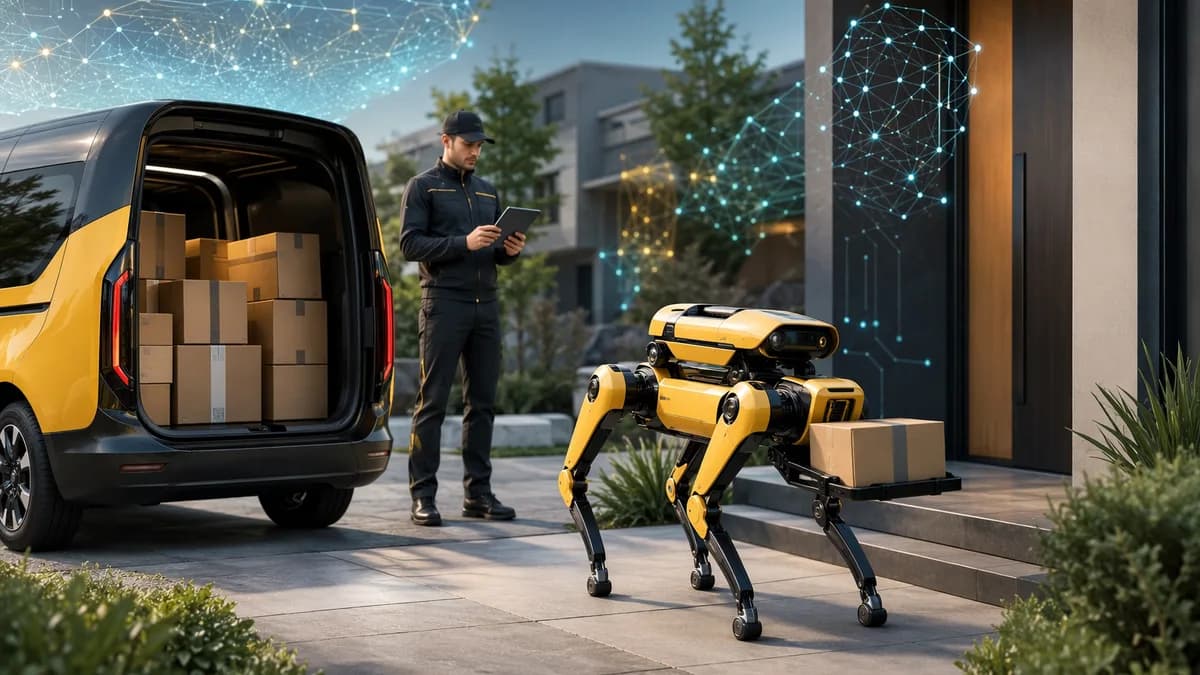
A roughly $75k Boston Dynamics Spot delivery assistant only makes sense if it turns doorstep runs into extra van capacity, not if it merely makes a slick robot video. That is the real test behind Boston Dynamics’ new package-carrying experiment.
XOOMAR Intelligence
Analyst Take
Boston Dynamics is testing a conveyor belt accessory that lets Spot carry packages from a delivery vehicle and unload them at a customer’s doorstep, according to The Verge. The company says it is “already in talks with major logistics companies about testing Spot for a last-mile delivery solution,” with the current goal of moving from demos to a full pilot project.
A $75k Robot Is Chasing the Hardest Part of the Route
Spot isn’t being pitched as a replacement for the van. It isn’t even being pitched, at least in this version, as a replacement for the driver. The target is narrower: the physical handoff from vehicle to front door, where stairs, cluttered pathways, uneven terrain, and suburban layouts still favor humans.
That makes the Boston Dynamics Spot delivery test more practical than it first looks. Spot already works in routine factory inspections and has patrolled the ruins of Pompeii, The Verge notes. Those jobs show the robot can operate outside a lab, but residential delivery is a messier category. A factory route can be mapped. A doorstep changes constantly.
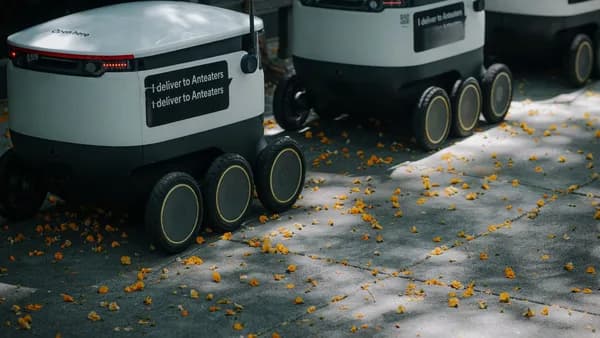
Boston Dynamics’ argument is that legs matter. Wheeled robots and aerial drones have both been tried for delivery, but the company is betting that Spot’s ability to clamber over uneven ground gives it a shot at places where a rolling bot stalls.
“For every three packages delivered via Spot, we think we can add another package to the van,” says Paige Miller, Boston Dynamics’ senior staff product manager for Spot.
That quote is the economic thesis in miniature. Spot has to create enough delivery capacity to justify a machine The Verge frames around a $74,500 price point and describes in the story as a $75k~ bot.
How Spot’s Conveyor Belt Delivery System Works at the Door
The demo flow is simple. A driver pulls up, loads packages onto Spot, and the robot carries them toward the doorstep. A short conveyor belt attachment on Spot’s back then unloads the package at the customer’s door.
The accessory matters because it makes Spot less of a walking platform and more of a delivery assistant. It can carry multiple packages and drop them without requiring the driver to walk each parcel to the door.
Boston Dynamics has also stressed package handling. In related material, Miller said the company had worked on the payload prototype so delivery would be soft, adding:
“We even delivered a carton of eggs to make sure we were demonstrating the necessary level of package care.”
That’s a narrow but important claim. A delivery robot that reaches the porch but damages the item fails the job.
| Delivery approach | Strength in the source material | Constraint highlighted in the source material |
|---|---|---|
| Aerial drones | Can automate part of delivery | Miller says they have struggled to “get to the porch,” with packages left “in the middle of the yard” |
| Wheeled robots | Already attempted for delivery automation | Boston Dynamics points to struggles in last-mile use where human parity has been hard |
| Spot with legs | Can handle uneven terrain and obstacles | Must still navigate “unstructured environments of suburban neighborhoods” |
The autonomy piece deserves caution. The Verge says Spot can autonomously unload packages, but related source material says initial deliveries may use driver control while Boston Dynamics collects routing data for future automation. That distinction matters. A polished video is not the same as a route full of dog walkers, children on bikes, trash bins, stairs, and cluttered pathways.
The Only Hard Economics Disclosed: Three Spot Drops, One Extra Van Package
Boston Dynamics has not disclosed a full cost model for Boston Dynamics Spot delivery. The sources do not give maintenance costs, charging requirements, software pricing, insurance assumptions, accessory pricing, training costs, or expected service life.
That leaves one concrete productivity claim: three packages delivered via Spot could let the driver add one more package to the van, according to Miller. XOOMAR analysis: that means Boston Dynamics is not selling Spot as magic automation. It is selling minutes, reduced physical strain, and better driver parallelization.
The driver can prep the next delivery while Spot handles the current doorstep drop. That is the operational wedge.
The hard question is whether those saved minutes compound enough across a route. A logistics company will compare Spot against cheaper fixes that are not discussed in the source material: better sequencing, simpler driver tools, modified van layouts, or different handoff procedures. Boston Dynamics has to prove the robot is not just capable, but operationally boring. Boring wins procurement.
This is where the story overlaps with broader workplace automation questions XOOMAR has covered in Approval Fail Sinks ChatGPT Work, Claude Cowork Wins: tools succeed when they fit the actual work loop. The demo matters less than the approval chain, the handoff, and the human operator’s trust.
Drone Hype Ran Into the Porch, Spot Is Aiming Straight at It
Boston Dynamics is positioning Spot against a specific weakness in earlier delivery automation: getting from curb to porch.
Miller was blunt about drones, saying:
“They haven't been able to get to the porch, and so packages were being left in the middle of the yard.”
She also pointed to the struggles of wheeled robots for last-mile delivery, arguing that Spot’s legs and ability to handle unstructured terrain give it advantages where other robots have fallen short of human parity.
That does not mean Spot solves the whole last-mile problem. It narrows the target. The robot does not need to drive across town. It needs to leave the van, carry the payload, reach the door, unload softly, and return.
XOOMAR analysis: that focus is smarter than trying to automate the entire delivery chain at once. The porch is where neat systems break. It is also where labor strain concentrates. If Spot can do that part repeatedly, Boston Dynamics has a cleaner argument for logistics partners.
For adjacent concerns about automation entering real-world operations before oversight catches up, see XOOMAR’s Police AI Creeps Into Case Files With No One Watching. Spot delivery is a different domain, but the shared lesson is simple: deployment details matter more than the headline capability.
Drivers and Customers Will Judge the Same Robot Differently
Drivers may see two possible versions of Spot. One version reduces repetitive walking, lifting, and doorstep runs. The other becomes a productivity tool that raises expectations for how many packages can be handled in a shift.
The supplied sources do not cite union reactions, worker group statements, or customer polling. That silence is important. Boston Dynamics has shown a technical concept and disclosed talks with logistics companies, but the human response remains untested in the material provided.
Customers will judge the system by narrower standards:
- Placement: Did the package land where expected?
- Care: Did the conveyor belt unload without damaging it?
- Safety: Did the robot behave predictably around children on bikes, dog walkers, and porch clutter?
- Reliability: Did it complete the drop without forcing the driver to intervene?
Retailers and logistics partners will care about the same questions, but with claims, route time, and fleet fit layered on top. A robot that creates new exceptions may cost more than it saves.
Spot’s Doorstep Future Depends on Pilots, Not Viral Clips
Boston Dynamics says it is already talking with major logistics companies and wants to move toward a full pilot project. That is the next real threshold for Boston Dynamics Spot delivery.
The evidence that would strengthen the case is specific: repeated successful drops on routes with stairs, uneven paths, trash bins, dog walkers, and children on bikes, with clear data showing reduced driver strain or higher route capacity. The evidence that would weaken it is just as clear: frequent driver intervention, poor package placement, slow loading, or routes where Spot saves too little time to justify the cost.
For now, Spot looks less like the future of all parcel delivery and more like a test of one stubborn physical task. The winning delivery robot won’t be the one that looks most futuristic. It’ll be the one that saves minutes, avoids injuries, and doesn’t annoy the person waiting at the door.
The Bottom Line
- Boston Dynamics is testing whether Spot can solve the difficult doorstep handoff in last-mile delivery.
- The roughly $75k robot must create measurable delivery efficiency, not just demonstrate technical capability.
- Major logistics-company pilots could determine whether legged robots have a real role beyond factories and demos.
Last-mile delivery approaches in the article
| Approach | Role | Key issue |
|---|---|---|
| Boston Dynamics Spot | Carries packages from vehicle to doorstep using a conveyor belt accessory | Must justify its roughly $75k cost by adding van capacity |
| Delivery van and driver | Remain central to the route | Still needed for transport and likely oversight |
| Wheeled robots and aerial drones | Previously tried for delivery | Can struggle where terrain, stairs, or access conditions are difficult |
Boston Dynamics' delivery capacity thesis
Primary Sources & Disclosures

Written by
XOOMAR Insights Team
Research and Editorial Desk
The XOOMAR Insights Team pairs automated research with human editorial judgment. We track hundreds of sources across technology, fintech, trading, SaaS, and cybersecurity, cross-check the facts, and explain what happened, why it matters, and what to watch next. We do not just rewrite headlines. Every article is fact-checked and scored for reliability before it goes live, and we link back to the original sources so you can verify anything yourself.