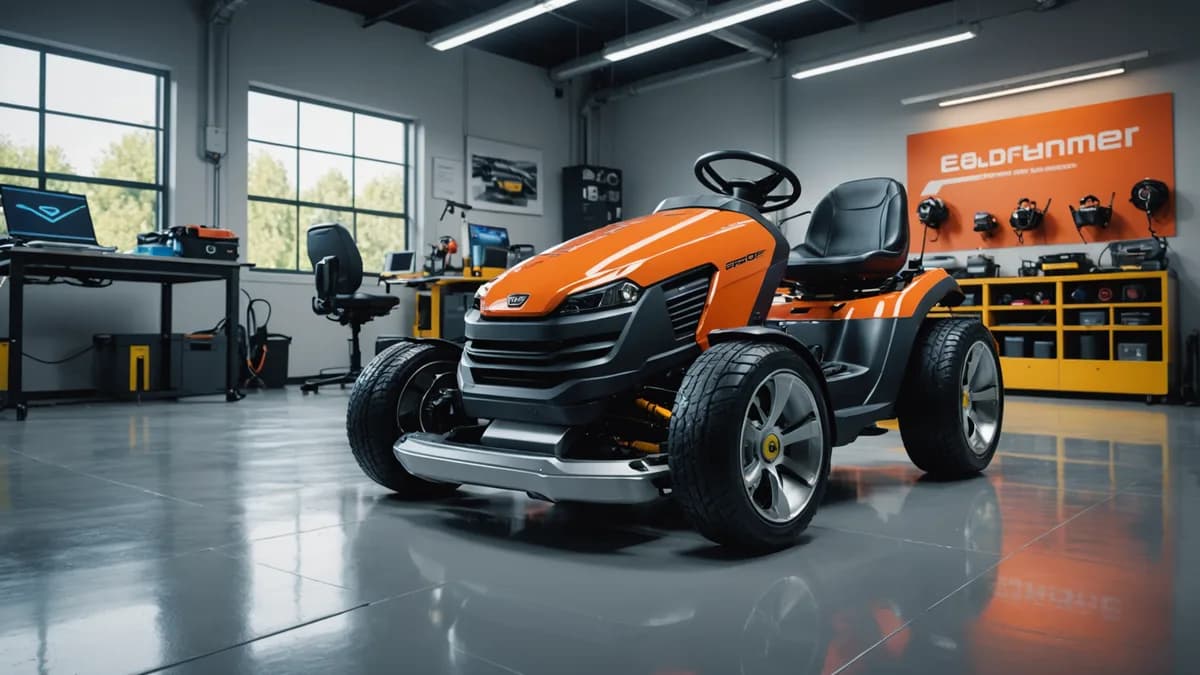
It’s not a car. It’s a 767-pound, battery-powered statement on the future of lawn care. The new Greenworks MaximusZ electric riding mower is a five-motor machine that costs $8,799, positioning itself not just as a tool but as a property command center. According to a review on The Verge, this appliance reveals how electric power is moving from a simple gas alternative to a source of premium, if sometimes overengineered, capability in the most unlikely of places.
XOOMAR Intelligence
Analyst Take
"It’s more than a mower, which it had better be, given the price."
The Drivetrain of a Hypercar for the Needs of a Homeowner
The marketing around electric vehicles has trained us to count motors as a shorthand for performance. The Greenworks MaximusZ takes this logic to its suburban extreme.
Two motors power the rear wheels independently, enabling a tight, zero-turn radius. This allows it to pivot on its own axis, an agility feature borrowed from high-end commercial mowers. Three additional motors are dedicated solely to spinning the three blades on its 54-inch cutting deck.
This architecture has clear functional benefits. Independent wheel control provides superior maneuverability for navigating around trees and garden beds. Dedicated cutting motors promise a consistent blade speed, which should mean a cleaner cut, even when traversing uneven terrain at higher speeds.
But the core compromise is immediate and physical. The combined weight of five electric motors and a massive 56Ah battery pack (composed of four 6.0Ah and two 16Ah batteries) results in a machine that tips the scales at 767 pounds. This is where the electric mower's script flips. A gas mower gets heavier as you use up fuel; the MaximusZ carries its entire energy supply from start to finish. As we reported in Apple's First Foldable iPhone Starring Ternus Debuts, pushing hardware limits often involves significant trade-offs.
Testing the Limits of Battery-Powered Lawn Care
The Verge's reviewer put the MaximusZ through its paces on 1.5 acres of mixed terrain, providing hard data on where its promises hold up and where they fall short.
| Performance Metric | Claimed by Greenworks | Real-World Test Result |
|---|---|---|
| Cutting Width | 54 inches | Confirmed |
| Max Speed | 8 mph | Confirmed |
| Acreage per Charge | 4 acres | ~2 acres (at max speed) |
| Charge Time | 3.5 hours | Under 3 hours |
| Noise at Full Operation | N/A | Measured at 85dB |
Real-World Range vs. Promise: Mowing at top speed consumed about 75% of the battery for 1.5 acres. This extrapolates to roughly two acres per charge, far short of the advertised four. The reviewer notes that slower, more efficient mowing on a single large pasture might yield closer to three acres. The advertised figure remains "optimistic."
The Annoying Quirks: Several flaws disrupt the premium experience. The 4.0-inch LCD display is dim and scratches easily. The control handles can be misaligned from the factory with no recalibration option. Most critically, the battery management system prioritizes draining the four smaller packs before touching the two large ones. This likely means the smaller batteries will endure more charge cycles and degrade faster.
Practical Advantages: The machine is quiet compared to its gas rivals, measuring 85dB versus 90-100dB for commercial mowers. It also functions as a mini utility vehicle, featuring a 300-pound towing capacity, a small dump bed with a 200-pound limit, and a front hitch. This versatility is a key part of its value argument.
The Value Equation of a Nearly $9,000 Electric Mower
At $8,799, the MaximusZ enters a rarefied price tier. Greenworks justifies this by comparing it to commercial-grade zero-turn mowers like the $9,499 Stihl RZ 552. In raw power, it’s competitive. Where it diverges is in total cost of ownership and function.
The Financial Calculus:
- Upfront Cost: High, but positioned as competitive within the commercial mower segment.
- "Fuel" Cost: Electricity is cheaper than gasoline. A full charge for a 56Ah, 80V system (~4.5 kWh) costs pennies compared to a gallon of gas.
- Maintenance: No gas, oil, spark plugs, or carburetor cleanings. The lack of a complex internal combustion engine points to potentially lower long-term maintenance, though electric motor and battery longevity are the new unknowns.
The reviewer’s advice is telling: do not pay full price. Greenworks frequently offers deep discounts, and waiting could save "thousands." This suggests the MSRP is an ambitious anchor point in a market still assessing electric mower value.
How a Five-Motor Mower Changes the Homeowner's Baseline
The MaximusZ’s true impact may be as a market catalyst, not a mass-market product. It redefines the upper limit of what consumers can expect from electric yard equipment.
- Performance as a Premium: It makes the case that electric power can mean more capability, not just less noise and emissions. The next battleground for brands will be motor count, torque figures, and smart features.
- The Robot Mower Counterpoint: This machine represents one extreme: a powerful, human-operated command center. It stands in stark contrast to the other major trend, fully autonomous robot mowers that handle the chore silently and daily. The future of lawn care may be a choice between command and convenience.
- A Test for Reliability: The biggest remaining question is long-term durability. The reviewer notes the machine’s four-year warranty is a safety net, but its real-world endurance over hundreds of charging cycles and seasons of use is unproven. The industry’s credibility hinges on these early high-end products not becoming high-cost liabilities.
As for what comes next, watch battery technology and software. A smarter battery management system that evenly cycles all cells is an obvious software fix. More accessories leveraging its "Electric Take-Off" port could expand its utility. The MaximusZ is a fascinating, flawed prototype of a fully electric property tool, a first-generation idea that makes lesser electric mowers seem more sensible and forces gas-powered incumbents to accelerate their own roadmaps. Its legacy won't be determined by its sales figures, but by how quickly its innovations trickle down to the models people actually buy, similar to the path seen in Flipkart Triples Orders to Invade Rivals' Quick Commerce Lead where aggressive moves force a reaction.
Key Takeaways
- The high cost and advanced features showcase the premium shift in electric outdoor equipment, moving beyond simple gas replacements.
- Its 767-pound weight highlights a key engineering compromise between battery power and practical usability for homeowners.
- Features like a zero-turn radius and consistent blade speed demonstrate how electric technology is improving performance in unexpected consumer categories.
Primary Sources & Disclosures

Written by
XOOMAR Insights Team
Research and Editorial Desk
The XOOMAR Insights Team pairs automated research with human editorial judgment. We track hundreds of sources across technology, fintech, trading, SaaS, and cybersecurity, cross-check the facts, and explain what happened, why it matters, and what to watch next. We do not just rewrite headlines. Every article is fact-checked and scored for reliability before it goes live, and we link back to the original sources so you can verify anything yourself.