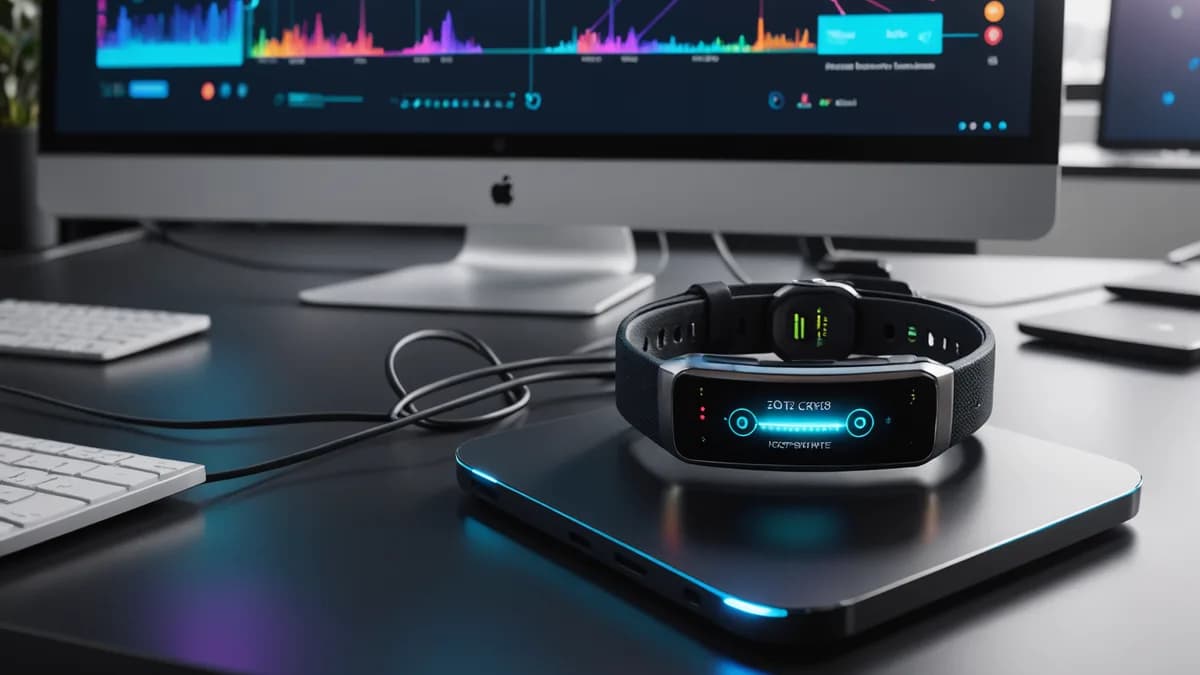
A new wearable from the founders of Fitbit puts the emergency phone line directly on your wrist, and it never needs a smartphone nearby to work. The Luffu Link, launching today, swaps the gamified screens of modern trackers for a simple button and a built-in cellular connection, targeting a market most tech companies have overlooked: the family caregiver who spends 27 hours a week managing loved ones' health.
XOOMAR Intelligence
Analyst Take
According to TechCrunch, the $250 band from James Park and Eric Friedman's new startup, Luffu, combines location tracking, voice logging, and continuous health sensing into what they call an "intelligent family care system." It's a direct response to the fragmented, time-consuming reality of caring for aging parents or independent family members, a problem that Park says current "tools to help them are pretty fragmented."
So what makes the Luffu Link more than just a subscription gadget? It's designed to be useful the moment you're alone and something goes wrong.
The 27-Hour Weekly Burden Luffu Link Aims to Reduce
Most wearables are built for self-improvement. They track your steps, monitor your sleep, and nudge you to move. Their utility vanishes the instant you're separated from your paired smartphone, which is precisely when a true safety device is needed most. The Luffu Link starts with a different premise: health is a family matter, and the technology supporting it should work for the whole network, not just the individual.
Co-founders Park and Friedman built Luffu after their own experiences as caregivers. The core problem they identified was inefficiency and anxiety.
“When you become a family caregiver, or the CEO of the family, these people are spending an enormous amount of time doing it,” Park said. “Research shows over 27 hours a week on average, which is a crazy amount of time…I think technology can play a big role in helping reduce this load.”
Traditional solutions force a trade-off. A medical alert pendant offers emergency help but feels clinical and offers no daily wellness context. A smartwatch offers rich data but is useless without its phone. The Luffu Link attempts to sit in the middle, functioning as a discreet, jewelry-inspired band that acts as a daily wellness tracker and a standalone emergency tether.
Breaking Down the Link's Always-On LTE and GPS Safety Net
The technical heart of the Luffu Link's value proposition is its independence. It has built-in LTE and GPS, and critically, the LTE service is included in the subscription. There's no need to add it to a carrier plan.
Here’s how the safety features work in practice:
- Untethered Communication: A wearer can press the button to send a voice request for help. The device transmits that voice message, along with real-time location, battery level, and recent health data like heart rate, directly to pre-selected trusted contacts.
- Passive Location Awareness: The GPS allows family members to see a wearer's location history and be notified when they enter or leave defined areas (like home). A simple double-press of the button sends a quick location check-in without a call or text.
- Battery Life for Always-On: The device is rated for up to five days on a charge, a critical specification for a device meant to be a reliable guardian. A dead wearable is worse than no wearable at all in an emergency.
The architecture is clear. It's not waiting for a Bluetooth signal from a phone that could be lost, broken, or out of battery. It has a direct, always-available line to its network. This follows a broader trend of decoupling essential safety tech from the smartphone, a principle we've seen in other sectors, such as the urgent recalls of faulty over-the-counter health products where standalone safety failures became apparent.
From Voice Logs to Heart Rate: How Link Tracks a Full Health Narrative
If the LTE is the emergency brake, the health and voice features are the continuous monitoring system designed to prevent minor issues from becoming crises. This is where the Fitbit founders' expertise in biometric sensing merges with a new focus on contextual, shareable data.
| Health Sensing | Voice & Context Logging |
|---|---|
| Tracks activity, sleep, resting heart rate, HRV, and breathing rate. | Users press-and-hold to log medications, symptoms, meals, mood, and reminders by voice. |
| AI looks for patterns and deviations from a personal baseline (e.g., unusually low activity). | AI transcribes and organizes voice notes into the shared family timeline in the Luffu app. |
| Data provides a wellness backdrop that can give context to an emergency alert. | Creates a searchable, verbal record of daily health events beyond what sensors can capture. |
Park is explicit that this isn't about building another dashboard.
“Link does a lot of what a typical health tracker would do, but it's not just about tracking,” Park said. “It's about what Luffu does with that data... it's to help answer some key questions like ‘what changed? Does it matter? Does somebody need to know?’”
The privacy model is "guardian, not surveillance." The microphone only records when the wearer actively presses and holds the button, and families control what information is shared and with whom. This balance is crucial for adoption among users, like independent older adults, who may resist feeling monitored. This challenge of balancing powerful data collection with user trust is a recurring theme in AI wearables, much like the lessons learned from ‘Coin Flip’ Sleep Data Exposed as Oura Ring Sparks Lawsuit.
A Real-World Scenario: A Hiker's Fall Smashes Her Phone, Not Her Safety Net
Imagine a 68-year-old woman who enjoys solo morning hikes. She wears her Luffu Link, partly for the gentle activity reminders, partly for the peace of mind it gives her daughter. On a remote trail, she slips on loose gravel, tumbles down an embankment, and lands hard on her wrist. Her smartphone, in her pocket, is shattered. She's shaken, her wrist is throbbing, and she's alone.
Here’s how the scenario changes with the Luffu Link on her wrist:
- She assesses the situation. She can't walk out easily. Instead of hoping another hiker comes by, she presses and holds the single button on her band.
- She speaks clearly: “I fell and hurt my wrist. I'm on the north side of the canyon trail. I think it's sprained. Can someone come get me?”
- She releases the button. The Link, using its built-in LTE, immediately packages that voice recording and sends it, along with her precise GPS coordinates, current heart rate, and recent activity data, directly to her daughter and husband.
- Her family receives a notification on their phones with her location on a map, her voice message, and her vital signs. They can see she's alert but immobile. They call for help and navigate directly to her location, relaying her exact condition to emergency services. The integration of location and AI here mirrors advancements in other fields, such as Nvidia Building an AI Traffic System.
Contrast this with a standard smartwatch. Unless it's a cellular Apple Watch paired to its own plan, it would be frantically trying and failing to connect to a shattered phone. Even if it had cell service, it would lack the simple, one-button voice-logging feature to convey nuanced details. The Luffu Link's whole value is integrated in this moment: standalone connectivity, actionable location data, and voice context, all triggered without looking at a screen.
Is a $250 Band Plus a $20 Monthly Plan Your Family's Missing Link?
The Luffu Link isn't for everyone. Its target audience is specific:
- Family Caregivers managing the health of aging parents who value independence.
- Independent Older Adults who want a discreet safety net without a medical stigma.
- Safety-Conscious Individuals who frequently hike, run, or travel alone.
- Families coordinating care for a member with a chronic condition who needs to log daily symptoms.
The commitment is real. The device is $249.99 for pre-order ($50 off its planned $299.99 retail price) and requires a Luffu Family Plan subscription, costing $19.99 per month or $199.99 annually. That plan covers up to four family members in the shared app hub. For a couple who both wear a Link, that's nearly $700 in first-year costs before any discounts.
The forward-looking question isn't just about this device, but the ecosystem. Luffu has already launched its AI-powered family care app and teased a home device to extend its system. The Link is the first piece of hardware in a planned suite. For it to succeed, the software's AI must deliver on its promise of reducing that 27-hour weekly burden by spotting meaningful patterns and filtering out noise. This need to prove AI's practical business value is a major benchmark for startups today, similar to the challenge faced by AI Agents Took $21 Million to Prove They Can Sell. If it becomes just another stream of uncurated data, it will have failed its core mission.
For the right user, the calculus is simple. If the peace of mind of having a permanent, voice-enabled, location-aware lifeline that works from anywhere is worth a monthly subscription, then the Luffu Link represents a significant evolution beyond the fitness tracker. It’s not counting your steps. It’s ensuring you can keep taking them.
Key Takeaways
- It addresses the 27-hour-per-week time burden family caregivers face by streamlining health oversight.
- The built-in LTE enables emergency use without a smartphone, providing critical safety for isolated family members. This approach of moving essential tech off the phone aligns with the philosophy behind devices like Legato's $12 Million Bet to Erase Hearing Aid Stigma.
- It targets a large, underserved market (family caregivers) that most fitness wearables have overlooked.
Luffu Link vs. Traditional Wearables
| Feature | Luffu Link | Typical Fitness Tracker |
|---|---|---|
| Primary Focus | Family caregiving & safety | Self-improvement & fitness |
| Connectivity | Built-in LTE (no smartphone needed) | Requires paired smartphone |
| Key Interface | Simple emergency button | Gamified screens & apps |
Primary Sources & Disclosures

Written by
XOOMAR Insights Team
Research and Editorial Desk
The XOOMAR Insights Team pairs automated research with human editorial judgment. We track hundreds of sources across technology, fintech, trading, SaaS, and cybersecurity, cross-check the facts, and explain what happened, why it matters, and what to watch next. We do not just rewrite headlines. Every article is fact-checked and scored for reliability before it goes live, and we link back to the original sources so you can verify anything yourself.