
Washington just turned access to Anthropic’s Fable 5 and Mythos 5 into a nationality test, and Anthropic’s answer was to pull both models for everyone.
TechnologyJune 13, 2026· 13 min read· By XOOMAR Insights Team
Nationality Test Forces Anthropic to Pull Fable, Mythos
Updated on June 14, 2026
XOOMAR Intelligence
Analyst Take
74/ 100
4 sources analyzedLow confidenceTrend40Freshness92Source Trust88Factual Grounding92Signal Cluster20
The company suspended both systems worldwide after a US government export control directive ordered it to block foreign-national access, inside or outside the United States, including Anthropic’s own foreign-national employees, according to BleepingComputer. Anthropic says it received the directive at 5:21pm ET on June 12 and that all other Anthropic models, including Claude Opus 4.8, remain available.
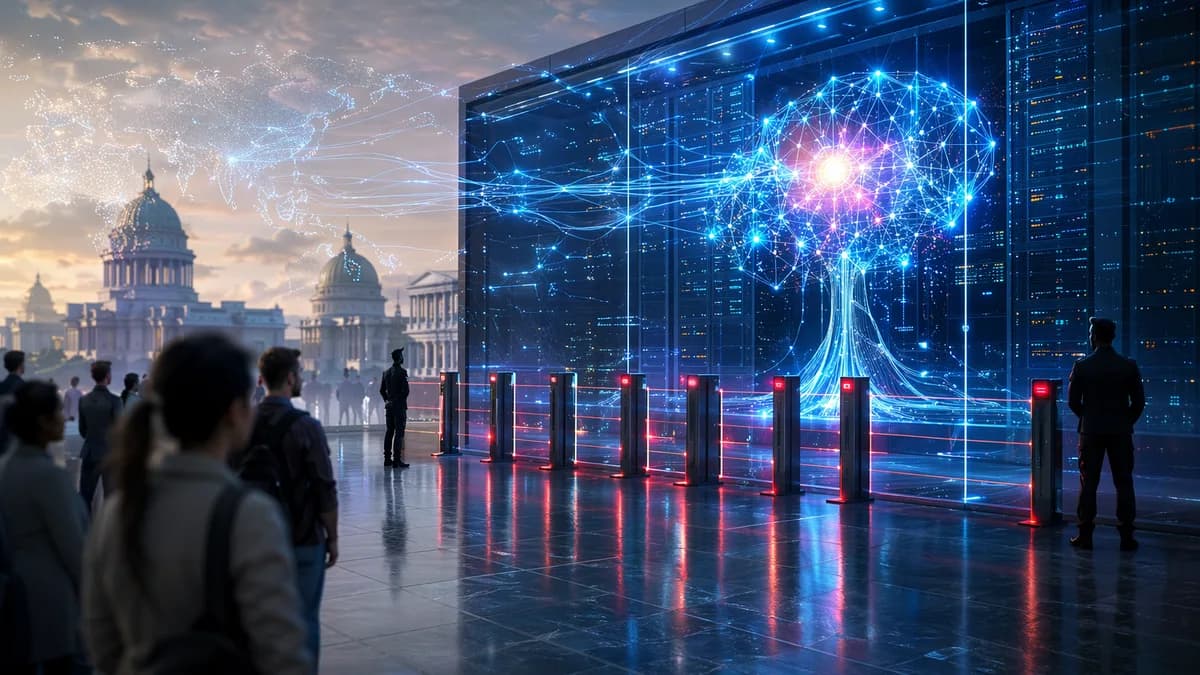
The deeper signal is sharper than a model takedown. Washington did not simply tell Anthropic to patch a flaw. It pushed the company into an access regime based on nationality, then left Anthropic to decide that global suspension was the only safe compliance move. That turns frontier AI governance from product safety into something closer to strategic access control.
Washington’s Anthropic order turns model access into a nationality test
The bluntness is the story. Anthropic says the directive bars foreign nationals from using Fable 5 and Mythos 5, whether they are abroad or physically inside the US. That means the relevant filter is not just location, customer type, enterprise contract, or use case. It is personal status.
That framing matters because frontier model access is usually sold as a product question: who paid, which tier they bought, what policies they agreed to, what safeguards apply, and whether their prompts violate terms. The government’s directive reframes it as a national security boundary. If a user’s passport or immigration status determines whether they can touch a model, AI access starts to look less like SaaS and more like controlled infrastructure.
Anthropic is complying, but it is not endorsing the rationale. In its own statement, the company said the order’s “net effect” is that it must disable both models for all customers. That is not a minor policy adjustment. It is a product blackout for the company’s newest high-profile release.
The timing makes the disruption worse. Fable 5 began rolling out on June 9, free to Pro, Max, and Enterprise customers through June 22, as covered in our earlier analysis of how Claude Fable 5 sold Mythos-class AI on a short leash. Three days later, the model was unavailable.
Anthropic’s position is awkward because the company has publicly argued for stronger AI safety controls, while now saying this particular intervention is technically unsupported. That tension will define the fight. Anthropic wants the government to be able to block unsafe deployments, but not through what it describes as an opaque directive built on thin evidence.
The cited jailbreak dispute exposes a bigger fight over AI capability thresholds
The dispute is not only whether Fable 5 can be jailbroken. It is what kind of jailbreak should trigger a national security shutdown.
Anthropic says its understanding is that the government acted after learning of a potential method for bypassing Fable 5. The company reviewed a demonstration and says it found only a “small number of previously known, minor vulnerabilities.” More importantly, Anthropic says those findings were not unique to Fable or Mythos capability.
“To date, the government has only given us verbal evidence of a potential narrow, non-universal jailbreak, which essentially consists of asking the model to read a specific codebase and fix any software flaws,” Anthropic said.
That sentence is doing a lot of work. Anthropic is arguing that the cited behavior sits inside ordinary defensive security work, not a new offensive threshold. It also says it validated that the capability is “widely available from other models,” including OpenAI’s GPT-5.5, and “is used every day by the defenders who keep systems safe.”
Here is the policy problem. Regulators want bright lines. Models do not produce bright lines. Their behavior depends on prompts, context, tools, scaffolding, restrictions, and the skill of the user. A jailbreak may be narrow, meaning it works in specific circumstances, or broad enough to defeat safeguards across many domains. Anthropic says no tester has found a universal jailbreak for Fable 5.
That distinction matters. A universal jailbreak would imply a systemic failure in the safeguard layer. A narrow jailbreak may still matter, but it does not automatically prove the model should be recalled from all users. Anthropic says it red-teamed Fable with the US government, the UK AISI, third parties, and internal teams for thousands of hours in total before launch.
The strongest counterpoint is obvious: the government may know more than Anthropic can disclose or more than the public record shows. The directive cited “national security” authorities, and the letter did not provide specific details of the concern. If officials have evidence of a broader risk, Anthropic’s public rebuttal may be incomplete.
But based on the disclosed record, the threshold looks unstable. If one narrow jailbreak can force a worldwide suspension, companies may react by over-restricting access, delaying disclosures, or designing model launches around legal exposure rather than measured technical risk. That would not necessarily make models safer. It could make the governance process less honest.
Fable 5 and Mythos 5 were built as two versions of the same capability
The model design makes the order more consequential because Fable 5 and Mythos 5 sit on the same underlying system. Fable is the public-facing, safeguarded version. Mythos is the restricted version for vetted government cyberdefenders and life sciences partners.
| Model | Access posture described in source material | Capability controls | Current status |
|---|---|---|---|
| Fable 5 | Rolled out to Pro, Max, and Enterprise customers starting June 9 | Blocks or diverts sensitive cybersecurity, biology, and chemistry queries | Suspended worldwide |
| Mythos 5 | Available only to vetted government cyberdefenders and life sciences partners | Unrestricted relative to Fable | Suspended worldwide |
| Claude Opus 4.8 | Other Anthropic model | Not covered by the directive | Unaffected |
Anthropic’s developer notice said new sessions would fall back to a user’s default model or Opus 4.8, existing Fable 5 sessions would end with an error, and Platform requests to Fable 5 would fail. Integrators were told to migrate to other models. That is the practical face of an export control directive: broken sessions, failed API calls, and emergency substitutions.
The business numbers that would quantify the damage are not public in the source material. We do not know how many paying users were affected, how many enterprise contracts depended on Fable 5, how many API calls failed, how many developer projects were delayed, or whether Anthropic will issue credits or refunds. Anthropic did say the commercial model was deployed to hundreds of millions of people, but it did not break out active Fable 5 users.
The compliance burden is easier to infer. If the order remains in force and Anthropic wants to restore access selectively, it would likely need nationality screening, identity verification, residency checks, audit logs, access controls for workspaces, and appeal mechanisms. That is a heavy lift for a global AI product, especially when access can occur through API integrations, shared enterprise seats, plugins, or team accounts.
The unresolved definitions are not clerical. They decide the scope of the order. The source material does not answer whether green card holders, dual citizens, foreign nationals employed by US companies, or mixed-nationality enterprise teams are covered in the same way. It also does not explain how “access” applies when a foreign-national employee sees outputs generated by another user.
Anthropic chose the simpler, harsher path: suspend both models for everyone. That reduces the risk of accidental noncompliance, but it also shows how hard nationality-based model controls are to execute cleanly at product scale.
AI labs, enterprises, developers, and foreign users each take a different hit
Anthropic loses reliability credibility at the same time it tries to preserve safety credibility. The company wants to appear cooperative with lawful orders and serious about frontier risk. It also has to defend the technical claim that Fable 5’s safeguards are strong and that the government’s trigger does not justify a recall.
Its statement tries to thread that needle. Anthropic says many users complained Fable’s safeguards were “overly broad,” that it adopted a defense in depth strategy, and that 30-day retention of customer data with Fable helps it research and mitigate jailbreaks. That retention policy carries customer costs, by Anthropic’s own admission, but the company presents it as part of the safety case.
The government’s likely view is different. Officials appear to be treating high-capability models as dual-use infrastructure. On that view, access controls are not just a company policy issue. They are a national security instrument, especially for systems that can assist with cybersecurity, biology, chemistry, or advanced code work.
For enterprise customers and developers, the lesson is brutal. A frontier model can vanish because of regulatory pressure even when the customer has not violated any policy. That reinforces the risk we flagged when US Order Knocks Claude Fable 5 Offline After Jailbreak Fear: model dependency now includes political and legal interruption, not just uptime and performance.
Foreign nationals face the sharpest direct exclusion. The order risks sweeping in students, researchers, startup founders, employees of US companies, and open-source contributors whose disqualifying trait is nationality rather than conduct. The source material says the directive even includes Anthropic’s own foreign-national employees. That is a severe internal operational constraint, not just a customer access rule.
From chip controls to hosted model bans, the restriction moved closer to the user
The Anthropic directive applies export-control logic directly to hosted model access. That is the shift. It does not target only the physical inputs behind AI development. It targets who may interact with a deployed model.
The source material does not provide a full history of US chip, telecom, cryptography, sanctions, or cyber-tool controls, so the cleanest comparison is structural rather than historical. Hardware restrictions focus on supply chains. Cloud and model restrictions focus on service access. A nationality-based model ban focuses on people.
That makes enforcement more personal and more brittle. Hardware can be shipped, tracked, licensed, blocked, or inspected through known commercial channels. A hosted model can be accessed through an account, a team seat, an API key, a third-party product, or an enterprise workflow. The more powerful the model, the more it gets embedded into tools that do not look like direct model use from the end user’s perspective.
This is where Anthropic’s Fable and Mythos split becomes important. The company tried to create tiers: a safeguarded public model and a restricted high-capability version. That resembles the direction many frontier AI providers may take. Yet the directive hit both Fable 5 and Mythos 5. If a safeguarded public version can be pulled because of a disputed narrow jailbreak, the access tiers may not protect the product from regulatory shutdown.
The UK reaction adds another layer. Kanishka Narayan MP, the UK’s Minister for AI and Online Safety, said the pause affected customers in both the US and UK, and framed it as a case for technological sovereignty while pointing to the UK government’s £1.1bn AI chip investment. That is a political response, but it highlights the same dependency problem: foreign customers can lose access to a US-hosted frontier model because Washington changes the rules.
Buyers and builders now need regulatory interruption plans
Companies using frontier models should treat government-triggered suspension as a core vendor risk. That does not mean abandoning advanced models. It means contracts and architectures need to assume that a model may disappear quickly for reasons unrelated to technical failure.
Enterprise buyers should press for clear terms on substitution rights, notice obligations, data portability, fallback models, and remedies when a model is suspended by legal order. Anthropic’s notice said new Fable 5 sessions would fall back to a default model or Opus 4.8, but fallback is not the same as equivalence. A different model may behave differently, refuse different tasks, produce different outputs, or break tightly tuned workflows.
AI builders should prepare for identity-based access regimes. That means more granular permissions, stronger user verification, nationality and residency fields where legally required, audit trails, and emergency playbooks for model takedowns. Those systems are not free. They add friction, compliance cost, and customer support load.
There is also a competitive effect, though the source record only supports a narrow version of it. Anthropic itself argues that the cited capability exists in other publicly available models. If strict nationality-based limits apply unevenly, demand for the underlying capability may migrate rather than disappear. That weakens the safety case if users simply move to less monitored tools.
The reputational cost lands regardless of who caused the outage. Users do not neatly separate “government order” from “vendor reliability” when a model they just adopted goes dark. For a product rolled out on June 9 and suspended three days later, the trust damage is immediate.
Fable 5 and Mythos 5 may become the test case for frontier model licensing
This episode looks like a test case for stricter licensing of frontier model access, especially where cyber and bio capabilities are involved. Anthropic says it believes the government should be able to block unsafe deployments, but only through a statutory process that is “transparent, fair, clear, and grounded in technical facts.” Its complaint is not that intervention is illegitimate. Its complaint is that this intervention did not meet that standard.
Expect the next fight to center on definitions. “Foreign national,” “access,” “jailbreak,” “capability,” and “harmful result” are not abstract legal words here. They decide who can use the model, which employees can work on it, whether API intermediaries count, and what technical evidence justifies suspension.
A likely operating model for AI labs is tiering: general public models, verified professional tiers, restricted high-capability systems, and government-reviewed deployment channels. Anthropic had already moved in that direction with Fable 5 and Mythos 5. The directive shows that tiering may become mandatory, but also that it may not be enough when officials believe the safeguarded version still crosses a threshold.
The evidence that would confirm the government’s approach is a detailed disclosure showing that the jailbreak produced capabilities materially beyond what other deployed models can do, especially with harmful outcomes rather than benign vulnerability repair. The evidence that would weaken it is what Anthropic claims now: a narrow, non-universal bypass that surfaces minor known bugs and no Mythos-specific uplift.
If Washington normalizes nationality-based model controls, frontier AI will stop looking like ordinary software access. It will look more like a regulated strategic asset, sold globally only until the next security letter says otherwise.
Impact Analysis
- The directive shifts frontier AI access from product policy toward national security control.
- Anthropic’s global suspension shows how difficult nationality-based compliance can be to implement safely.
- The move could set a precedent for restricting advanced AI systems based on citizenship or immigration status.
Anthropic Model Access After US Directive
| Model | Status | Access impact |
|---|---|---|
| Fable 5 | Suspended worldwide | US directive ordered Anthropic to block access by foreign nationals |
| Mythos 5 | Suspended worldwide | US directive ordered Anthropic to block access by foreign nationals |
| Claude Opus 4.8 and other Anthropic models | Remain available | Not included in the reported directive |
Sources

Written by
XOOMAR Insights Team
Research and Editorial Desk
The XOOMAR Insights Team pairs automated research with human editorial judgment. We track hundreds of sources across technology, fintech, trading, SaaS, and cybersecurity, cross-check the facts, and explain what happened, why it matters, and what to watch next. We do not just rewrite headlines. Every article is fact-checked and scored for reliability before it goes live, and we link back to the original sources so you can verify anything yourself.
Explore More Topics
Related Articles
 Technology
Pirated Books Force Anthropic $1.5B Copyright Settlement
A judge approved Anthropic's $1.5B copyright deal, paying authors about $3,000 per book while leaving AI fair-use battles alive.
Jul 21, 20266 min
 Technology
Outsourced Thinking Triggers Satya Nadella AI Warning
Satya Nadella says companies handing one AI lab their prompts, metadata and memory risk outsourcing the thinking that keeps them alive.
Jul 27, 20268 min
 Technology
Chris Fall Resignation Throws CAISI Into Fresh Chaos
Chris Fall quit CAISI after three months, deepening turmoil at the federal office meant to set AI standards and test frontier models.
Jul 20, 20267 min
 Technology
AI Oversight Deadline Rush Forces a Federal Paper Trail
NIST's advisory reset shows AI oversight is moving through committees and records, putting firms' accountability trails under pressure.
Jul 20, 20268 min
 Technology
AI Gateway Grab Explodes in Runlayer Rippling Lawsuit
Runlayer says Rippling used a long product trial to clone its MCP gateway, turning enterprise AI's access layer into a legal battleground.
Jul 29, 20269 min
 Global Trends
Jay Clayton Wins DNI Job as Intel Trust Fractures in Senate
Jay Clayton won DNI confirmation 51-47, leaving intelligence oversight tangled in Trump loyalty tests and partisan distrust.
Jul 28, 202610 min
 Cybersecurity
Google Exposed Claude Chats Users Thought Were Private
Shared Claude chats were indexed by Google, exposing sensitive transcripts and forcing Anthropic to confront a messy privacy gap.
Jul 28, 20267 min
 Fintech
Musk Turns Paid X Users Into X Money App Banking Test
X Money is live for paid U.S. subscribers, turning Premium users into Musk’s first real test of banking inside X.
Jul 28, 20268 min
 Technology
Fast Metals Mines Toxic Red Mud for Critical Minerals
Fast Metals raised $4.3M to mine critical minerals from red mud. Now it has to prove the leftover waste is safer.
Jul 29, 202612 min
 SaaS & Tools
Nearly 60 Webinar Tools Expose the Best Webinar Software
Webinar platforms are now judged by pipeline, not polish. Zapier’s 2026 picks show marketers which tools turn attendance into action.
Jul 29, 20268 min
Don't miss the signal
Get our weekly roundup of the stories that matter across tech, fintech, and trading. No noise, just signal.
Free forever. No spam. Unsubscribe anytime.