
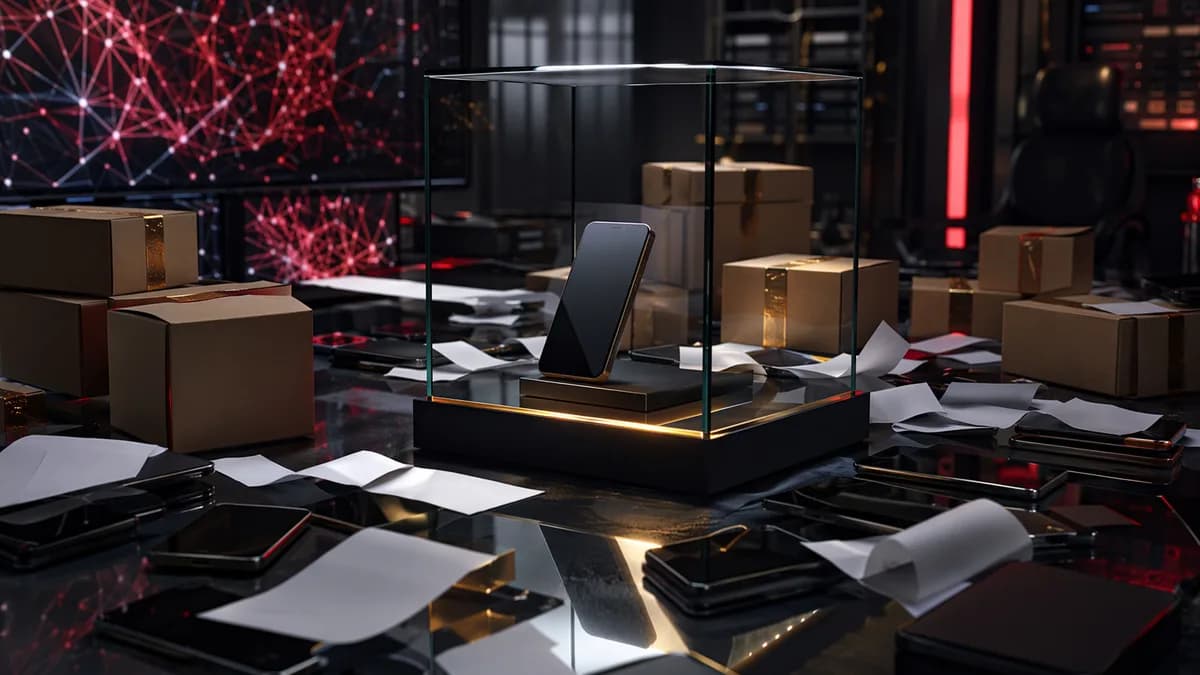
The Trump phone is one year old, and the strongest evidence still points to a branding business trying to look like a hardware manufacturer. That matters most for buyers who put down a $100 deposit on a $499 device that still hasn’t become a normal, broadly verified consumer launch.
TechnologyJune 15, 2026· 8 min read· By XOOMAR Insights Team
$100 Deposits Haunt Trump Phone After a Year of Doubt
Updated on June 15, 2026
XOOMAR Intelligence
Analyst Take
68/ 100
1 source analyzedMedium confidenceTrend10Freshness96Source Trust88Factual Grounding91Signal Cluster20
The T1 Phone 8002 (gold version) was announced on June 16th, 2025, with contradictory specs, product images that did not appear to show a real photographed phone, and a promise that it would be “designed and built in the United States,” according to The Verge. One year later, the story is less about whether a gold Trump-branded Android phone can exist. It’s about whether political loyalty can make buyers accept signals they’d reject from any ordinary gadget startup.
Buyers face the same Trump phone problem they faced on day one: proof is thin
The launch pitch asked consumers to treat the Trump phone as a patriotic hardware project before Trump Mobile had shown the kind of evidence that usually supports a phone launch.
The clearest warning sign was the deposit structure: $100 to secure a preorder of a $499 phone with no firm release date. The Verge reported that Trump Mobile’s website pointed to September 2025, while a Trump Organization press release claimed August. Those dates came and went.
The phone has not been entirely invisible. The Verge says Trump Mobile later sent media samples and paid orders to NBC, CNET, and YouTuber Quinn Nelson, and that the T1 received certification from the FCC and Google for Play Store access. But that is not the same as a clean retail rollout to ordinary preorder customers.
The practical buyer question is blunt: if a phone is not broadly shipping, not independently reviewed at scale, and not clearly tied to a stable hardware identity, what exactly did the preorder buy?
XOOMAR analysis
The deposit is the tell. A political brand can turn a purchase into a statement. That changes buyer psychology. In a normal phone launch, consumers compare hardware, software support, carrier behavior, repair options, and delivery timing. Here, the brand promise carried more weight than the product proof.
Hardware makers know why “built in the United States” was the hardest claim
The most aggressive claim was not the gold finish. It was domestic manufacturing.
“designed and built in the United States.”
That line appeared in the Trump Organization press release, The Verge reported. Trump Mobile later changed the site language to say the device is “proudly American” and has “American hands behind every device.”
That retreat matters because the FTC standard for marketing a product as made in the USA requires “all or virtually all” of the product’s components to be American-made. Smartphones are a brutal test for that standard. The Verge notes that the US has next to no phone manufacturing infrastructure, few engineers with the required expertise, and little of the flexible mass labor used in phone production across China, India, and southeast Asia.
Only one company currently makes a phone in the US, according to The Verge: the Purism Liberty Phone, priced at $1,999. Trump Mobile’s pitch was a $499 phone.
| Claim or signal | What The Verge reported | Why it matters |
|---|---|---|
| Original positioning | “designed and built in the United States” | Strong domestic manufacturing claim |
| Later wording | “proudly American” and “American hands behind every device” | Softer language after scrutiny |
| Price | $499 | Far below the cited US-made Purism phone |
| Deposit | $100 | Buyer cash collected before a normal launch |
| Current assembly claim | “assembled” in the US, reportedly in Miami | Still depends on what “assembly” means |
Trump Mobile executives Don Hendrickson and Eric Thomas later told The Verge the company had only described US manufacturing as a “goal.” The Verge calls that false because the press release remains live with the stronger wording.
The next hard question for builders is simple: if the device reaches Miami in “10 or so parts,” does that meet the FTC’s “substantial transformation” standard for assembled-in-USA claims?
The spec sheet looked less like a finished product than a moving target
The original T1 spec sheet raised questions a $499 phone should not raise.
The Verge reported that early images looked more like production renders than a finished device, the chipset was not disclosed, and the spec sheet described a “5,000mAh long life camera,” which mixed a battery metric into a camera claim. Two weeks later, after the US-made language changed, the display shifted from 6.78 inches to 6.25.
That kind of movement does not prove fraud. It does show instability. A phone can change before launch, but when the public hardware identity keeps shifting while deposits are open, buyers have less basis to judge what they’re ordering.
The most important hardware clue came later. Thomas briefly showed The Verge a near-production T1 over Google Meet in February. The Verge compared it to the HTC U24 Pro, launched in 2024 for €549 (around $600 at the time), and found the two phones shared nearly identical spec sheets, similar shape, matching unusual features including a 3.5mm headphone jack and microSD slot, and similar internals based on iFixit teardowns.
HTC told The Verge it “does not design or manufacture phones for third parties.” The Verge also reported that the U24 Pro was made in China. For more on the hardware-identity question, see XOOMAR’s related piece, Teardown Catches Trump Mobile T1 in HTC Clone Pitch.
Trump Mobile looks more like an MVNO play than a phone company
The phone may not be the real business.
Trump Mobile launched with a $47.45 monthly plan and runs on T-Mobile’s cell service, according to The Verge. Hendrickson told The Verge:
“We’re in the razor blade business, we’re not in the razor business.”
That line reframes the T1. If the phone is not the “profit center,” then the gold handset functions as acquisition bait for a branded mobile service.
The Verge reported that Hendrickson, Thomas, and Trump Mobile CEO Pat O’Brien also run Liberty Mobile, a patriotic-themed MVNO. Hendrickson said Liberty Mobile is “umbilically connected to Trump [Mobile]” and is the entity registered with each state, paying taxes and fees, and staffing the engineering needed to run the service.
That creates a different question for competitors and operators: is the Trump phone really competing in hardware, or is it a political customer-acquisition wrapper around an existing MVNO structure?
Regulators and watchdogs have three pressure points
The areas most likely to draw scrutiny are already visible in the source material.
Marketing language: The shift from “designed and built in the United States” to softer American branding is not cosmetic. The FTC standard is specific, and smartphones make that standard hard to satisfy.
Preorder deposits: Trump Mobile has collected $100 deposits, but The Verge says the number of paid preorder customers remains unclear. Viral claims of 600,000 orders lacked evidence. A website breach reportedly suggested 27,224 possible preorders, though one security researcher said entries could be created even when someone reached the final order stage without paying.
Delivery claims: Trump Mobile missed the original August and September windows, later moved to “later this year,” then let 2025 pass. In February, The Verge was told the phone might ship in March. In May, the company said it was ready to ship and would fulfill every preorder within the next several weeks. The Verge’s two orders still had not arrived.
XOOMAR analysis: this is where political commerce gets risky. When buyers feel they are supporting a cause, a preorder can start to resemble a donation in everything but name. That is exactly when disclosure standards need to be tighter, not looser.
We use the same evidence-first lens in other speculative tech stories, including First Human Dose Throws ER-100 Age-Reversal Bet Into Peril, because the lesson is identical: claims need proof before money changes hands.
By its next birthday, the T1 is likely to be a rebadged phone, a slow rollout, or a warning label
The most plausible path is a lightly customized Android phone sourced through an overseas manufacturing chain, with US-related language narrowed to branding, packaging, support, configuration, or some form of final assembly. That would fit the evidence better than the original “designed and built in the United States” claim.
A second path is continued drift: changing specs, uneven communication, limited shipments, and delivery windows that keep sliding. The source already supports that pattern.
A third path is a small shipment that satisfies enough early orders to blunt criticism, while leaving harder questions around updates, repairs, and long-term support unresolved.
The Trump phone probably won’t reshape smartphone manufacturing. The evidence points to something narrower and more revealing: a political brand testing how much consumer tech skepticism can be suspended before the hardware is actually in buyers’ hands. The next evidence to watch is not another slogan. It’s broad customer delivery, clear manufacturing disclosure, and third-party reviews of the final retail unit.
The Bottom Line
- Buyers who paid a $100 deposit still lack evidence of a normal mass-market phone launch.
- The story highlights how political branding can lower consumer skepticism around unfinished products.
- FCC and Google certifications show some progress, but they do not prove broad shipping or reliable retail availability.
Trump Phone Promises vs. Current Evidence
| Launch Claim or Signal | Reported Reality |
|---|---|
| $100 preorder deposit for a $499 phone | No normal, broadly verified consumer launch one year later |
| Promised as “designed and built in the United States” | Initial specs and product images raised doubts about hardware readiness |
| Website pointed to September 2025 release; press release claimed August | Those dates passed without a clean retail rollout |
| Phone not entirely invisible | Media samples, paid orders, FCC certification, and Google Play access were reported |
Trump Phone Preorder Cost vs. Full Price
Deposit
$100
Phone Price
$499
Sources

Written by
XOOMAR Insights Team
Research and Editorial Desk
The XOOMAR Insights Team pairs automated research with human editorial judgment. We track hundreds of sources across technology, fintech, trading, SaaS, and cybersecurity, cross-check the facts, and explain what happened, why it matters, and what to watch next. We do not just rewrite headlines. Every article is fact-checked and scored for reliability before it goes live, and we link back to the original sources so you can verify anything yourself.
Explore More Topics
Related Articles
 Technology
Teardown Catches Trump Mobile T1 in HTC Clone Pitch
The $499 Trump phone appears to be a lightly changed HTC U24 Pro, making its American-made pitch look shaky.
Jun 11, 20267 min
 Technology
7-Year Updates Make These Budget Phones the Smart Buy
The best cheap phone isn't always the cheapest. Long software support can decide what stays secure, useful, and worth resale.
Jun 9, 202620 min
 Technology
$4.99 Google AI Plus Cracks ChatGPT's $20 Wall With 400GB
Google’s $4.99 AI Plus plan makes Gemini a budget bundle, forcing ChatGPT and Claude to defend pricier subscriptions.
Jun 10, 20268 min
 Technology
Smartwatch Health Data Slips Past Medical Privacy Laws
Wearables turn health perks into a privacy trade: your most sensitive data may not get the legal shield you expect.
Jun 14, 20268 min
 Technology
JAWBONE Act Turns FCC Threats Into Kimmel’s Payday
The JAWBONE Act turns government pressure into lawsuit risk, even if platforms ignore it. Kimmel and Carr are the flashpoint.
Jun 12, 20267 min
 Global Trends
Trump Plants UFC Cage on White House Lawn for Power Play
Trump made the White House the center of a UFC spectacle, mixing birthday politics, military pageantry, and a $60m fight-night production.
Jun 15, 20268 min
 Global Trends
JD Vance Freezes 2028 Race as Trump World Reads the Signal
Vance is using the 2026 midterms as cover, delaying 2028 talk while staying Trump's most obvious heir.
Jun 14, 20268 min
 Fintech
$10B FTX Fraud Pushes Bankman-Fried to Trump Pardon
Bankman-Fried wants a Trump pardon while his FTX appeal is still alive, a political gamble against a 25-year fraud sentence.
Jun 14, 20266 min
 Fintech
Fiserv CEO Exit Throws Payments Turnaround Into Doubt
Michael Lyons' abrupt exit puts Fiserv's turnaround on trial, with Takis Georgakopoulos now racing to protect client and investor trust.
Jun 15, 202611 min
 Cybersecurity
ShinyHunters Breach Claim Jolts Council of Europe
ShinyHunters claims it stole 429,000 Council of Europe files. Officials are investigating and haven't confirmed a breach.
Jun 15, 20265 min
Don't miss the signal
Get our weekly roundup of the stories that matter across tech, fintech, and trading. No noise, just signal.
Free forever. No spam. Unsubscribe anytime.