
The JAWBONE Act would turn an official’s coercive takedown demand into a damages claim even if the platform never removes the post.
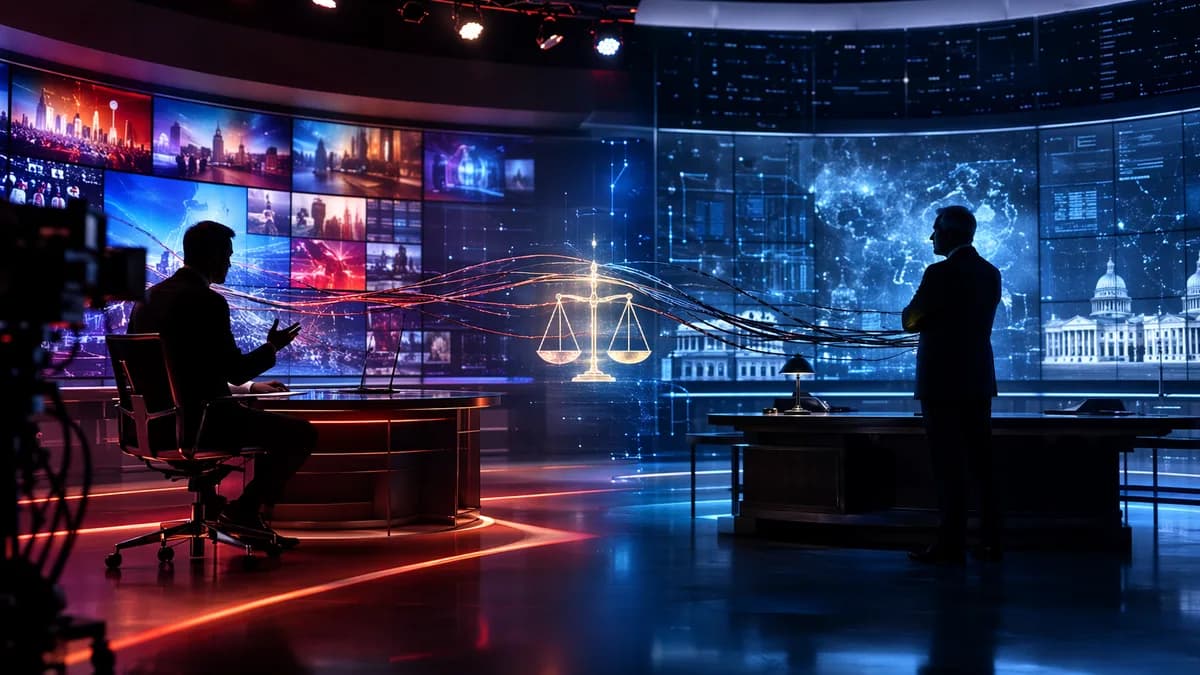
TechnologyJune 12, 2026· 7 min read· By XOOMAR Insights Team
JAWBONE Act Turns FCC Threats Into Kimmel’s Payday
Updated on June 14, 2026
XOOMAR Intelligence
Analyst Take
72/ 100
4 sources analyzedMedium confidenceTrend10Freshness97Source Trust88Factual Grounding92Signal Cluster20
That shift matters most for speakers whose content sits between politics and private intermediaries: creators, journalists, social media users, broadcasters, and now AI companies. Senate Commerce Committee Chair Ted Cruz (R-TX) and Sen. Ron Wyden (D-OR) introduced the bipartisan bill on Thursday, according to The Verge, aiming to create both a private right to sue and new disclosure rules for government communications with social media, AI, and broadcast companies.
Cruz and Wyden aim at the pressure campaign, not just the takedown
The bill’s sharpest move is procedural. A person would not need to show that a platform obeyed the government official. The alleged illegal coercion itself could create a path to damages.
That’s the core of the JAWBONE Act: make informal state pressure legally risky before it produces a visible removal.
Why Kimmel is the obvious test case
The Verge frames the bill around a possible example: Jimmy Kimmel suing FCC Chair Brendan Carr after Carr threatened TV stations’ broadcast licenses following a Kimmel joke he disliked in the aftermath of Charlie Kirk’s killing. Carr has denied that his comments were threats.
Could a public warning from a regulator become actionable coercion? That’s the fight the bill invites.
Cruz had already teased the legislation after Carr’s Kimmel comments, which he described as:
“right out of Goodfellas.”
Cruz also said he had worked on the bill before that incident. That matters because the proposal is not only a reaction to one media controversy. It also plugs into Cruz’s long-running criticism of Biden administration contacts with social media companies over medical misinformation during the pandemic.
Social media, AI firms, and broadcasters all get pulled into one speech fight
The bill covers social media companies, AI companies, and broadcasting companies. That scope is the tell.
For years, the public fight over government pressure and content moderation focused on social platforms. The JAWBONE Act treats broadcasters and AI providers as part of the same conflict over intermediated speech. If officials can’t reach the speaker directly, they can pressure the company that distributes, hosts, moderates, or amplifies the speaker.
Which companies face the most immediate concern?
| Covered group | Why the bill matters |
|---|---|
| Social media companies | Government contacts about user posts could become part of future damages litigation and disclosure fights. |
| AI companies | The bill explicitly includes AI firms, signaling that speech disputes may extend beyond feeds and into model-mediated content. |
| Broadcasters | FCC-linked pressure carries a different weight because licensing and regulatory scrutiny sit in the background. |
For AI teams, the source does not spell out how the bill would apply to prompts, outputs, accounts, or model rules. That remains unclear. But the inclusion of AI companies is still meaningful because Congress is not limiting the bill to traditional posts on traditional platforms.
XOOMAR has covered a separate compliance risk around AI tools in AI Writing Tools Can Leak Data. These Pass Compliance. The JAWBONE Act points to a different pressure point: government communications about speech, not private data leakage.
Users and creators would get a new path when pressure targets the middleman
The bill could help lesser-known users, not just a famous late-night host.
The Verge notes it could empower social media users whose posts about medical misinformation or criticism of Charlie Kirk were removed or targeted, if they believe the action stemmed from government coercion. That distinction is important. The claim would focus on the government official’s pressure, not merely the platform’s moderation choice.
What would a plaintiff still need to prove? The source does not provide the bill text’s full legal standard, so the threshold for “illegal” coercion remains a key unknown.
The existing litigation backdrop helps explain the bill’s design. The Supreme Court already handled a case tied to Biden administration messages to social media companies about medical misinformation. The Court determined the plaintiffs lacked grounds to sue, and its ruling found a lack of clear evidence that platforms moderated because of government coercion.
The JAWBONE Act appears aimed at that gap. If passed, it could make standing and causation less punishing for plaintiffs where the alleged injury is coercive government pressure itself.
For creators and newsroom operators, the Kimmel example cuts through the abstraction. A politician or regulator does not need to order a host off the air to chill speech. Pressure on stations, platforms, or distributors can do the work indirectly. For teams managing posts across many local accounts, that same recordkeeping problem already shows up in operational form, as discussed in XOOMAR’s guide to Best Social Media Tools to Stop Multi-Location Brand Chaos.
Civil-liberties groups give the bill more than partisan branding
The Cruz-Wyden pairing is the political story beneath the legal one.
Cruz and Wyden are pointing at different villains. Cruz’s statement targets the Biden administration:
“The Biden administration weaponized the Cybersecurity and Infrastructure Security Agency to pressure Big Tech into ‘canceling’ Americans who spoke out against vaccine mandates and election fraud,”
Wyden points in the other direction:
“The most blatant example is Trump threatening cable companies because he doesn’t like their late-night shows, but jawboning isn’t partisan, and it isn’t new,”
That symmetry is why the bill has a shot at being taken seriously outside normal party trenches. The Verge reports support from the American Civil Liberties Union (ACLU), Foundation for Individual Rights and Expression (FIRE), and Knight First Amendment Institute at Columbia University.
Can a bill survive when each sponsor thinks the other party’s administration proves the need for it? In this case, that tension may be the selling point.
The proposal says the abuse pattern matters more than the party using it. Government jawboning, informal pressure by officials to influence private companies without a direct legal order, becomes dangerous when a public official can credibly connect speech decisions to regulatory pain.
The disclosure rules may matter as much as the lawsuits
The JAWBONE Act would also create transparency requirements for government communications with covered companies. The Verge does not list specific disclosure deadlines, statutory damages, compliance windows, or penalties for noncompliance.
That absence matters. The bill’s force will depend on details not included in the available report:
- Who discloses: Agencies, officials, companies, or some combination.
- What gets logged: Emails, meetings, calls, informal messages, or only written correspondence.
- When disclosures happen: Real time, periodic reporting, or after request.
- Which exceptions apply: The source does not specify carveouts.
- How damages work: The report confirms damages claims, but not amounts or formulas.
Those details will decide whether the JAWBONE Act becomes a real sunlight law or a litigation trigger with limited public visibility.
The strongest version would force officials to own pressure campaigns in daylight. A weaker version would produce selective disclosures and leave the most sensitive contacts hidden behind exceptions.
The next fight is the definition of coercion
The JAWBONE Act won’t settle America’s speech wars. It would move them into a sharper forum: damages lawsuits and disclosure fights over government contacts with platforms, AI companies, and broadcasters.
The key test will be where lawmakers draw the line between political pressure and illegal coercion. The Verge’s reporting supports only the broad mechanism, not the bill’s full legal boundaries. That is the next document to read.
If the bill advances, watch for three signals: whether damages levels are specified, whether disclosure rules cover informal communications, and whether exceptions swallow the transparency mandate. If those provisions are tight, the bill changes incentives. If they’re vague, it becomes another symbolic fight over censorship with less bite than its sponsors suggest.
Impact Analysis
- The bill would give creators, journalists, broadcasters, social media users, and AI companies a clearer path to sue over alleged government coercion.
- It targets informal pressure campaigns by officials, not just completed content removals by platforms.
- The proposal could reshape how regulators and government agencies communicate with media, social platforms, and AI firms.
How the JAWBONE Act Would Change Coercion Claims
| Current hurdle | Under the JAWBONE Act |
|---|---|
| A speaker may need to show that a platform acted on government pressure, such as removing content. | The alleged coercive demand itself could support a damages claim, even if no takedown occurs. |
| Focus often falls on the final platform action. | Focus would shift to government pressure before it produces a visible removal. |
| Informal communications with platforms can be harder to challenge. | Government communications with social media, AI, and broadcast companies would face new disclosure rules. |
Sources
- [1] The Verge
- [2] The bill that would let Jimmy Kimmel sue Brendan Carr is here - AIVAnet
- [3] The legislation allowing Jimmy Kimmel to sue Brendan Carr has arrived.
- [4] EXCLUSIVE: Explosive Lawsuit Aims to Expose FCC Chair Brendan Carr's Private Texts Over Jimmy Kimmel's Charlie Kirk Monologue Controversy

Written by
XOOMAR Insights Team
Research and Editorial Desk
The XOOMAR Insights Team pairs automated research with human editorial judgment. We track hundreds of sources across technology, fintech, trading, SaaS, and cybersecurity, cross-check the facts, and explain what happened, why it matters, and what to watch next. We do not just rewrite headlines. Every article is fact-checked and scored for reliability before it goes live, and we link back to the original sources so you can verify anything yourself.
Explore More Topics
Related Articles
 Technology
15M Users Force a Rethink of Yope Private Social Network
Yope has 15M users and $12.3M to test whether private, ad-free social circles can beat the public feed.
Jul 26, 20268 min
 Technology
Substack AI Detector Turns Every Writer Into a Suspect
Substack's AI detector gives readers a scan button for posts and comments, putting writer trust under a microscope.
Jul 21, 20269 min
 Technology
Avoiding AI Workshops Turn Libraries Into Big Tech Revolt
Public libraries are becoming AI opt-out clinics as users push back against forced defaults from Apple, Google, and Big Tech.
Jul 25, 202613 min
 Technology
950M Google Gemini Users Force AI Race Into a Habit War
Gemini has passed 950 million monthly users, proving Google's AI edge may be distribution as much as model quality.
Jul 23, 20267 min
 Technology
Kalanick's $1.7B Atoms Bet Pulls Physical AI Into Industry
Atoms raised $1.7B to push AI into mines, freight yards and food production. Kalanick's hardest challenge starts after the check clears.
Jul 23, 202613 min
 Global Trends
Logo Revolt Haunts Cracker Barrel CEO Masino's Exit
Julie Masino is leaving after Cracker Barrel's logo revolt became a culture-war test. David Deno inherits the bruised brand.
Jul 27, 20266 min
 Global Trends
53 Years Later, Chile Jails Víctor Jara Murder Fugitive
Chile jailed Nelson Haase Mazzei, the last fugitive in the Víctor Jara murder case, 53 years after the singer was killed.
Jul 27, 20268 min
 Technology
A $9 Autonomous Key Turns App Addiction Into Real Work
Autonomous Key uses a $9 NFC fob to make addictive apps harder to reopen, betting tiny friction can beat reflexive scrolling.
Jul 27, 20268 min
 Global Trends
Years on Run End As Police Catch Victor Jara Murder Fugitive
Nelson Haase, convicted in Victor Jara’s murder, was captured after fleeing a 25-year sentence in a landmark Pinochet-era case.
Jul 27, 20265 min
 Global Trends
Tariff Detours Crush the US Manufacturing Jobs Pitch
Tariffs haven't sparked a US factory jobs boom. Chinese inputs are taking longer routes, with higher costs and more automation.
Jul 27, 20268 min
Don't miss the signal
Get our weekly roundup of the stories that matter across tech, fintech, and trading. No noise, just signal.
Free forever. No spam. Unsubscribe anytime.