The Last Gravity Holiday
A Mars-born folklorist must decide what parts of Earth to carry onto humanity’s first generation ship—and what to let become myth.
1. The Museum of Things People Actually Miss
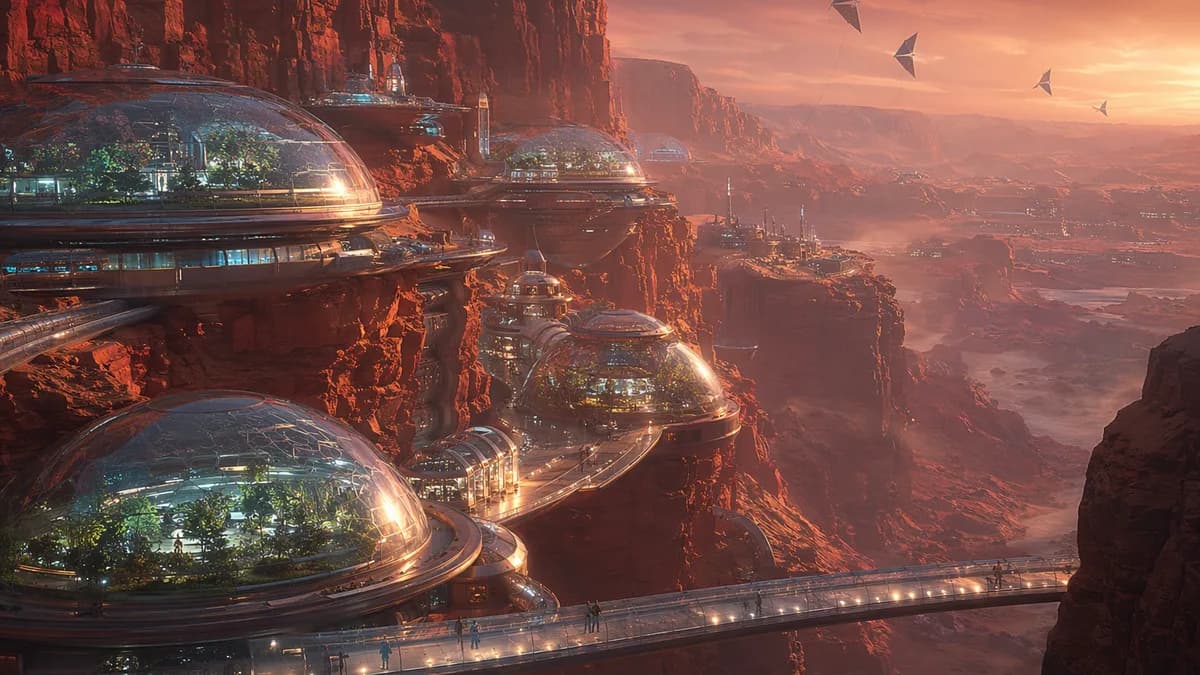
Anika Vale keeps the museum in a maintenance cavern under Sector Twelve, beneath Valles Marineris, where the walls sweat frost when the air recyclers hiccup and the floor hums with old pumps. No tourist signs point to it. No brass plaque announces human greatness. People find it because someone’s aunt tells them, or because grief makes them wander.
Inside, shelves curve with the tunnel. They hold patched gloves, cracked toys, festival masks made from filter mesh, a pressure-mug with a broken handle and the words FIRST SCHOOL STRIKE, 2068 scratched into its side. There is a lullaby recorded by a woman from Nairobi who learned to sing in short breaths after the first dome leak. There is a packet of Earth soil sealed in six layers of illegal plastic, brown and useless and beloved.
Anika lifts the soil packet with gloved fingers when the message from the Halcyon Trust arrives.
The Trust’s logo blooms in her retinal display, blue planet, white star, gold ring. A woman with perfect Earth diction appears over the workbench.
“Dr. Vale, we admire your contributions to vernacular memory,” she says. “Halcyon requires a cultural seed-bank worthy of humanity’s first interstellar voyage.”
Anika looks past the projection at a child’s boot melted at the toe from a battery fire. “Worthy,” she says.
“We’re assembling music, languages, rituals, representative objects, conflict resolution models, educational mythologies. The ship departs Mars orbit in nineteen months. We need someone who understands both continuity and adaptation.”
“You need a museum,” Anika says.
“We need a civilization kit.”
That makes her laugh, a short sound that fogs the inside of her mask. Around her, the museum smells faintly of dust, metal, and old fabric warmed by LEDs.
“Civilizations don’t come in kits,” she says.
The woman smiles as if this objection has been focus-tested. “That is why we are contacting you.”
Later, Anika plays the attached brief on the cavern wall. Children in ship uniforms float through bright corridors. Elders plant apple trees under artificial suns. A narrator speaks of Earth heritage, human unity, the unbroken chain.
Anika watches a boy in the video kneel before a holographic oak tree. His face is solemn, reverent, empty of mischief.
On her bench, the school-strike mug leans against a jar of red dust from the first illegal rooftop garden. Beside it, someone has donated a recipe for birthday noodles that only works if gravity is weak and everyone eats fast.
“Unbroken chain,” Anika murmurs.
The museum’s old pumps answer with a groan. It sounds very much like doubt.
2. A Childhood Without Weather
Anika begins with children because they are terrible liars. They sit cross-legged in a classroom dome in New Shanghai Trench, knees tucked under silver thermal cloth, faces glowing in the soft amber of dust-filtered daylight. Beyond the glass, Mars stretches rust-red and still. The sky is the color of dried blood.
“What is rain?” Anika asks.
A boy named Ilyas raises his hand. “Sky leak.”
The class laughs.
“A shower malfunction,” says a girl with beads braided into her hair.
“Earth people standing under recycled water because they are emotionally confused,” another offers, and the teacher hides a smile behind her tablet.
Anika records their answers. “Would you want to feel it?”
The laughter thins. A small child in the front row rubs his thumb along the seam of his sleeve.
“Outside?” he asks.
“On Earth, yes.”
He thinks about this with grave suspicion. “No helmet?”
“No helmet.”
He shakes his head. “That’s not safe.”
Later, in the elder ward, Anika interviews people who still remember weather in their bones. They sit under heat lamps with blankets over their knees, Earth-born colonists with thin skin and thick accents. A woman named Pilar closes her eyes when Anika asks about the sea.
“It hits you before you see it,” Pilar says. “Salt in your nose. Wind pushing your clothes. Noise everywhere, water talking over itself.” Her hands rise, trembling, shaping waves in the dry Martian air. “I still dream I am young and the ocean is trying to drag me home.”
“Do you want that on Halcyon?” Anika asks.
Pilar opens her eyes. They are wet. “I want them to know we were not always afraid of open sky.”
In the weeks that follow, Anika gathers what the Trust’s questionnaire does not ask for. She records airlock apologies, the ritual phrases spoken when someone forgets to check another person’s seals. She notes water debt ceremonies, where families pour one measured cup into a common basin after a birth or a harvest. She films low-gravity dancers springing from wall to wall, scarves streaming like colored smoke.
On Sol 312, she stands with thousands in the main concourse for the annual silence. Every dome light dims. Every pump lowers to a whisper. For three minutes, Mars remembers those who died outside.
No one speaks. Babies are hushed against shoulders. Anika feels the pressure of all that held breath, a whole city listening to itself survive.
Earth has rain, she thinks. Mars has silence.
When the lights rise again, nobody applauds. People simply touch the nearest wall, the nearest hand, the nearest proof that air remains.
3. The Belt’s Moving Villages
The cycler to the Belt smells of ginger paste, machine oil, and unwashed socks. Anika sleeps in a sling beside a cargo net of algae bricks while the ship ticks and shudders around her. For eleven weeks, Mars shrinks behind them and the Sun becomes a hard white coin.
The Belt is not empty. It is crowded in the way a desert is crowded, if you know where to look.
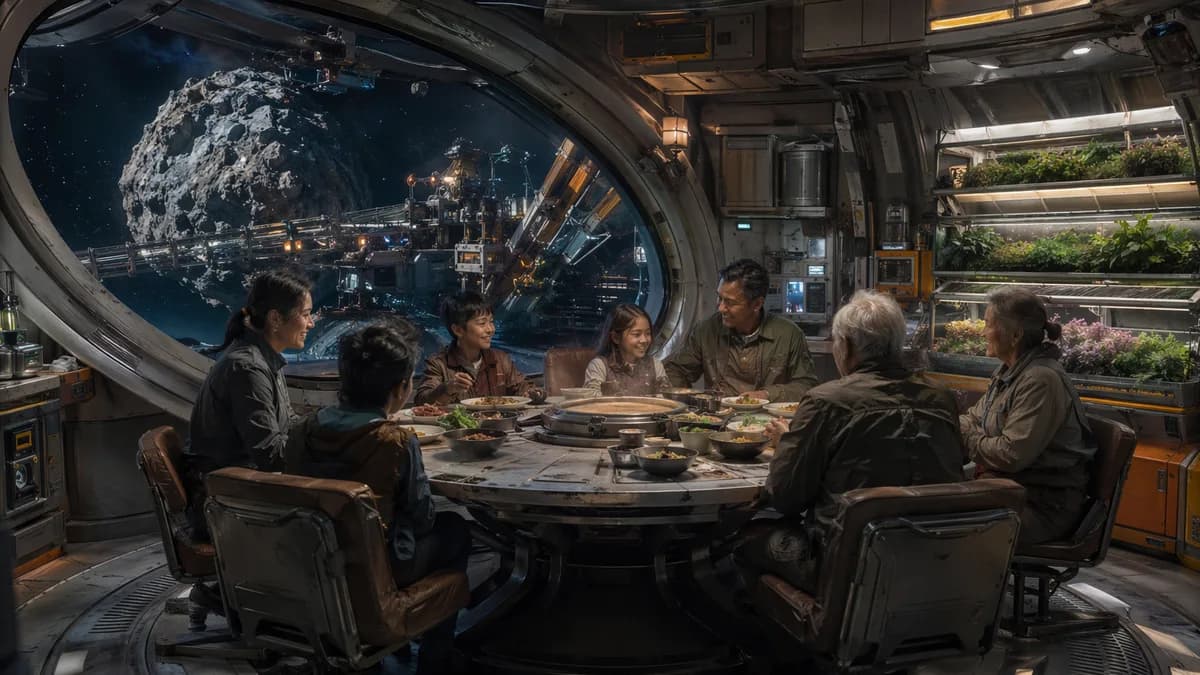
Her destination is Kestrel Array, a string of rotating habitats clamped to a dark nickel-iron asteroid named Merrow-6. The rock turns slowly outside the windows, scarred by drills and glittering with anchor lights. Children chase one another along curved corridors where the floor always seems to be reconsidering itself. Laundry hangs in loops. Someone fries yeast cakes in a galley, and the smell makes Anika suddenly hungry.
“Birthplace?” says the registry clerk when she arrives. He laughs before she answers. “Sorry. Martian habit. Here we ask route.”
He shows her a family wall painted with colored lines. Each line is a ship path, Ceres to Vesta, Vesta to Pallas, Pallas to nowhere official. Names cluster at crossings like knots in thread.
Anika meets Tomas Reef in the refinery chapel, where miners have hung old helmet lamps above a shrine to lost tools. He is broad-shouldered, black-bearded, and missing two fingers on his left hand. His poems are scratched into metal panels and traded as audio files with background static left in on purpose.
“My daughter got accepted,” he says, walking Anika along a corridor that smells of hot stone. “Halcyon schooling track. Full berth. They call it an honor.”
“And you don’t?”
He stops at a viewport. Beyond it, machines crawl across the asteroid like silver insects.
“I call it putting a child in a jar and labeling her Future,” he says.
Anika lets the recorder hang silent between them.
Tomas taps the glass with his shortened hand. “We move. We change shifts, rocks, partners, songs. My grandmother’s people lived on freighters. My son might live in a comet net. That’s culture. Motion. Mess. Not some committee deciding which lullaby survives.”
“The ship will change too,” Anika says.
“Will it be allowed to?” His voice is not angry now, which makes it worse. “Or will every child be told, eat this, sing this, mourn this way, because Earth did, because Mars did, because the Trust approved it?”
In the family canteen, his daughter Lio recites a counting rhyme used for timing explosive charges. She is eleven, with quick eyes and a burn scar under her chin. She wants to see the big ship. She also wants to stay where her cousins are.
“Can both be true?” she asks Anika.
Anika thinks of the packet of banned soil beneath Mars, and Pilar dreaming of oceans she will never touch again.
“Yes,” Anika says. “Most true things are crowded.”
4. The Ship That Must Invent Its Own Ancestors
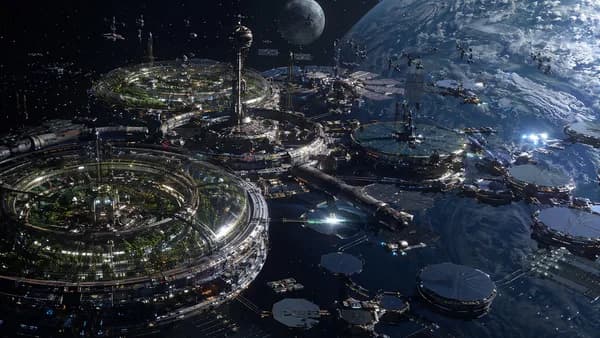
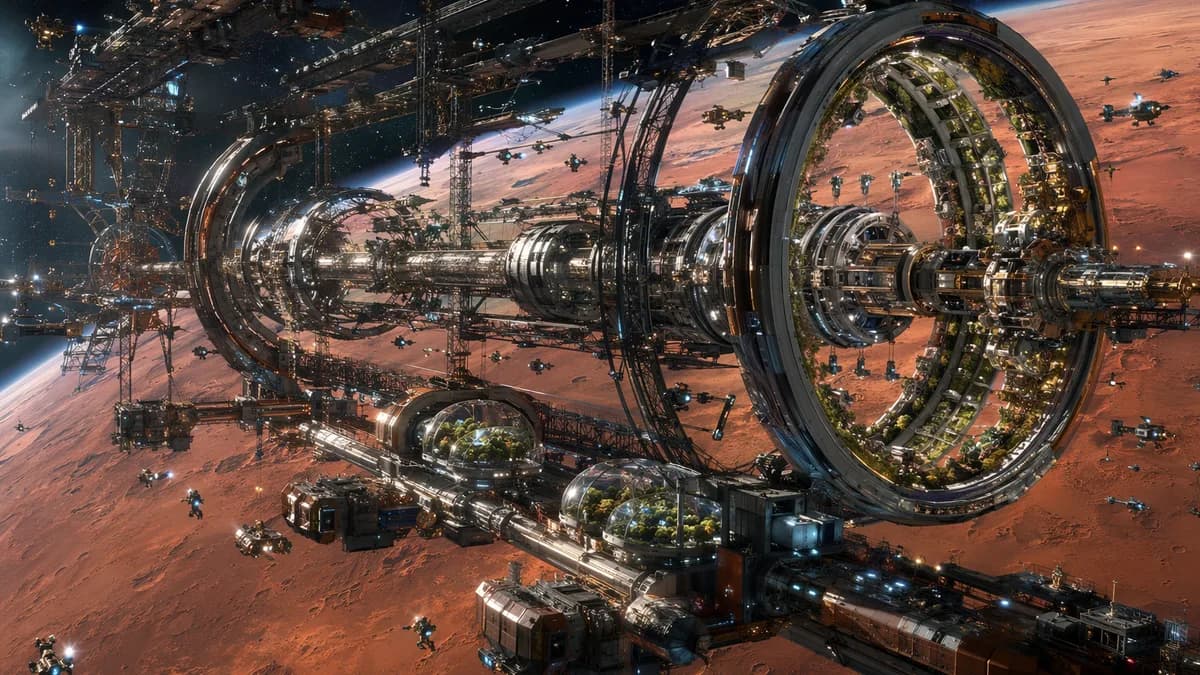
Halcyon hangs above Mars like a half-built moon, bright ribs of habitat rings turning slowly inside a web of cranes. Shuttle windows darken as they approach, but Anika still squints. Welders flash blue-white along the spine. Tankers drift nearby, fat with water lifted from polar ice.
Inside, everything smells new. Polymer walls, warm circuitry, hydroponic nutrient mist. The first orchard is already planted in Ring Two, rows of dwarf apple and fig trees under spectral lamps. Their leaves tremble in ventilation currents, green and almost indecent.
A planner named Sayeed walks beside her, shoes whispering on clean flooring. “We need resilient traditions,” he says. “Low conflict, high cohesion, easy transmission.”
“That sounds like mold,” Anika says.
He blinks. Then, to his credit, he laughs.
They pass classrooms with walls that can become any landscape. Savannah, glacier, coral reef, Olympus Mons, asteroid tunnel. Tiny chairs are bolted to the floor in neat arcs.
“These students’ grandparents will die before arrival,” Sayeed says quietly. “Their great-grandchildren may be the first to see Tau Ceti. We have to give them roots.”
“Roots strangle if they can’t grow.”
The AI mediator waits in a circular chamber lined with soft fabric. It calls itself Haru, and its voice shifts gently between accents as it greets her.
“I am trained on twelve thousand conflict rituals,” Haru says. “Restorative circles, clan councils, labor arbitration, sibling negotiation games, mourning disputes, water ration appeals.”
“Do you know how people sulk?” Anika asks.
A pause. “I have models of passive refusal.”
“Not the same thing.”
“No,” Haru says. “I would appreciate examples.”
That answer stays with her.
At the final design meeting, the Trust displays categories in the air. Approved festivals. Representative cuisines. Foundational myths. Ethical narratives. Earth canon. Mars canon. Belt supplements.
Anika stands before their glowing order and smells, impossibly, the refinery chapel of Kestrel Array, hot metal and yeast cakes.
“You keep asking me what to preserve,” she says. “You should ask what conditions culture needs in order to keep becoming.”
A board member frowns. “Becoming what?”
“Unpredictable.”
Silence gathers around the table.
She sends them her counterproposal that night. Include jokes with no explanation. Include recipes that fail in one gravity and thrive in another. Include arguments about which holidays matter. Include children mocking sacred stories. Include bad songs people love anyway. Include instructions for inventing rituals after disasters no one can foresee.
At the end she adds one clause, and knows it may cost her the contract.
The archive must tell future generations they have permission to reject the archive.
Haru receives an early copy. At 03:11 ship time, it sends her a message.
I have modeled possible objections. I also have a question. Is rejection a form of inheritance?
Anika looks out her cabin window at Mars, red and bruised and shining.
“Yes,” she says aloud. “Sometimes the truest one.”
5. The Gravity Holiday
The idea comes to Anika in the gymnasium ring, watching passengers train under Earth gravity. They move like people wearing invisible armor. Sweat shines on their faces. A boy tries to jump, barely leaves the floor, and curses with theatrical despair.
“This is what Earth felt like?” he gasps.
“More humidity,” his grandmother says from a bench. “And mosquitoes.”
He looks horrified. “Why does anyone miss it?”
The Gravity Holiday begins as a footnote in Anika’s revised archive. Then Haru circulates it through planning channels. Then Lio Reef records a challenge from Kestrel Array, standing upside down relative to her father and grinning.
“Eight minutes,” she says to the camera. “If Belt kids can handle it, Mars kids can stop whining.”
By launch month, it is no longer a proposal. It is scheduled.
Across Mars, gyms, schools, dance halls, and civic chambers adjust their spin or load their resistance fields. In the Belt, habitats nudge rotation rates with thruster sighs. Orbital workers strap mugs to tables and warn one another not to be heroes. On Halcyon, passengers gather in orchards, corridors, classrooms, machine bays.
Eight minutes, the time sunlight takes to travel from Earth to the places that have stopped belonging to it.
Anika stands in the Sector Twelve concourse with Pilar, several schoolchildren, and a maintenance crew still smelling of coolant. A countdown pulses blue on the wall.
“Is it going to hurt?” asks Ilyas, older now by months and trying not to show fear.
“Only your pride,” Anika says.
The number reaches zero.
Weight arrives.
It is not dramatic at first. It is merely rude. Anika’s knees complain. Her spine compresses. The air seems thicker, though it is not. Around her, people gasp and stagger. A dancer who has spent her life floating between walls takes one step and sits down hard, laughing so violently she cannot stand.
A cup drops. The sound is sharp, final, astonishing.
Pilar grips Anika’s arm. Tears roll down her cheeks, but she is smiling.
“Yes,” she whispers. “That old bully.”
In Kestrel Array, transmitted on the concourse wall, Tomas Reef bends under the pull and pretends to collapse. Lio tries to haul him up, fails, and calls him a tragic asteroid. Around them, miners howl with laughter.
On Halcyon, the orchard trees shiver. Apples tug downward on their stems. A little girl presses both palms to the soil and says, “Earth is heavy.”
For eight minutes, humanity stumbles together. People curse, giggle, weep, lean on strangers. Some hate it. Some close their eyes as if hearing an old song through a wall. Children discover that sacred origins can make your ankles ache.
Then the systems ease back.
Anika feels herself lighten. The concourse exhales. Someone starts clapping, not formal applause, but the messy kind that spreads because bodies need something to do after wonder.
Ilyas looks at her, flushed and offended. “Earth people lived like that all the time?”
“Yes.”
He considers this. “Strong legs. Bad judgment.”
Pilar laughs so hard she has to sit down.
Above them all, unseen, Earth pulls on every human body with memory, distance, and light. But for the first time in Anika’s life, it feels less like a throne and more like one note in a song still finding its scale.
6. What Leaves, What Stays
Anika does not board Halcyon.
People keep assuming she will. The Trust offers a berth twice, then a consulting cabin, then a ceremonial role with no duties except presence. Sayeed tells her the ship could use someone who knows when systems are lying about people.
“My museum is here,” she says.
“Museums can move.”
“Not this one.”
On launch day, she stands in the observation gallery above Utopia Planitia with half of Mars pressed shoulder to shoulder around her. The air smells of wool, skin, dust tracked in from pressure suits, and the pepper sweets vendors sell at departures. Far overhead, Halcyon catches sunlight. Its habitat rings turn slowly, orchards and classrooms and sleeping children folded inside metal.
Her archive leaves with it, but not as a sealed monument. It is a quarrelsome thing. It asks questions. It offers three versions of the same story and invites a fourth. It contains Tomas Reef’s warning, Pilar’s ocean, Ilyas defining rain as a sky leak, Haru’s uncertainty about sulking, the banned soil, the cracked mug, the silence for the dead, the laughter of the Gravity Holiday.
It also contains blank spaces labeled: For what you need that we failed to imagine.
When Halcyon’s engines ignite, there is no roar in the gallery, only vibration through the structure, a deep pressure in Anika’s feet and teeth. On the screens, blue-white fire opens behind the ship. People raise hands. Some sing. Some say names. Some record themselves crying for descendants who will never know their faces.
Anika touches the glass.
“Go badly,” she whispers. “Go beautifully.”
Years pass.
Mars grows more domes, then tunnels, then mistakes. The museum moves twice after floods in the lower caverns. Anika’s hair silvering at the temples becomes an event her students pretend not to notice. Messages from Halcyon arrive in long, delayed bundles, each one older than grief by the time it reaches her.
One winter, a file comes tagged CHILD COMPOSITION, INFORMAL, AGE 9. Anika opens it after midnight while the pumps mutter in the walls.
A child’s voice begins alone, singing the thin-air lullaby from her archive. The melody is familiar, breath-spaced, Martian. Then another rhythm enters beneath it, a Belt mining chant used to time charges against stone. The child has clapped it on tabletops, softened it, bent it into sleep. Halfway through, a classroom joins in. Their accents slide into one another. Someone giggles. Someone misses a beat. The song keeps going.
Anika sits very still.
Outside the museum, Mars is cold and dark and full of buried noise. Somewhere between stars, children who have never seen a planet’s horizon are making ancestors out of fragments.
The file includes a note from Haru.
They call it “Rockaby for Falling Forward.” They argue about the third verse.
Anika plays the song again. In the last line, the children change one word of the old lullaby. Not home. Not Earth. Not Mars. They sing elsewhere, tenderly, as if it is a promise and a question at once.
She does not correct them.