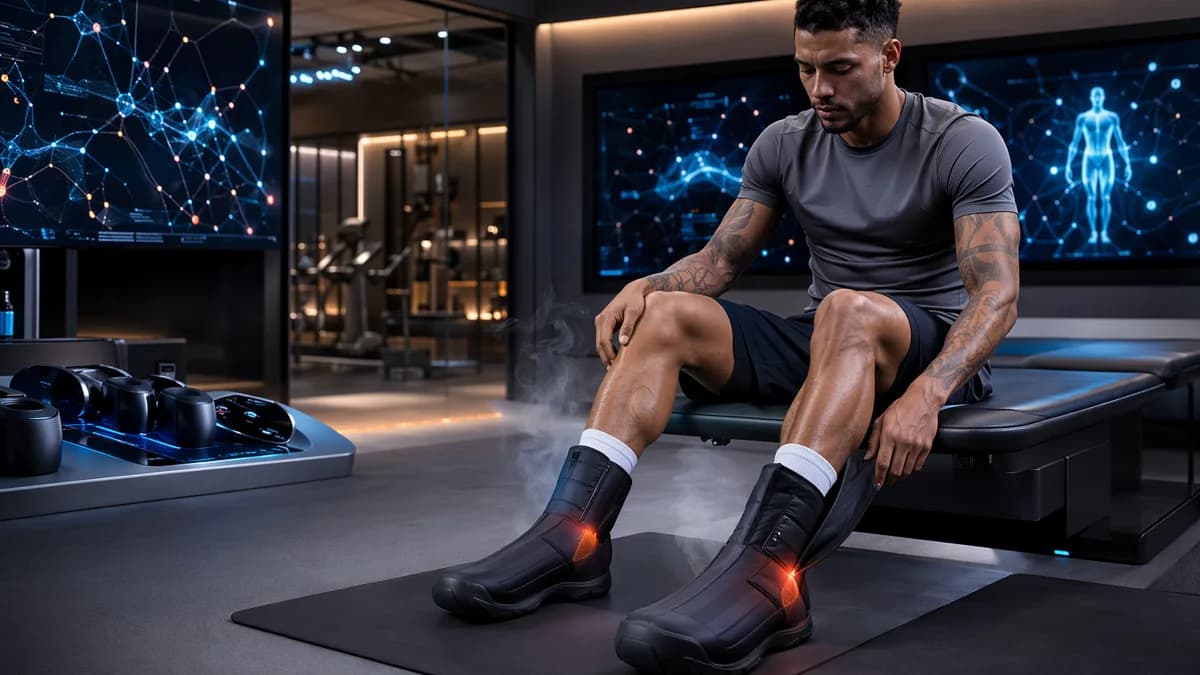
The Hyperice x Nike Hyperboot solves a real recovery problem, cold, stiff lower legs before training and sore feet after, but its $799 / £699 price keeps it in the category of serious athlete gear rather than everyday kit.
XOOMAR Intelligence
Analyst Take
That’s my read after weighing the test from Tom's Guide, where fitness editor Sam Hopes tried the Nike x Hyperice Hyperboot used by Virgil Van Dijk before training and after games. The boots impressed her with strong heat, serious compression, and easy wearability. They also exposed two classic problems with premium recovery tech: intensity control and fit.
My thesis is simple: this is one of the rare athlete recovery gadgets that sounds gimmicky but behaves like a useful tool. The catch is that useful doesn’t always mean sensible.
The Hyperice x Nike Hyperboot makes recovery footwear credible, but still too niche
The Hyperboot combines heat therapy and compression in a boot that targets the feet, ankles, lower leg, and Achilles area. That matters because most recovery tools force a tradeoff: sit still and get treatment, or move around and skip it. Tom’s Guide found the Hyperboot allowed walking around, unlike compression leg sleeves that keep users rooted in one place.
That’s the product’s strongest argument. Recovery gear fails when it becomes another chore. The Hyperboot works because it lowers the friction.
Still, this isn’t a casual purchase. At $799 / £699, it has to clear a higher bar than “feels nice.” It has to earn a place next to training shoes, hot-weather running gear, coaching, gym fees, physio, and all the other things athletes already pay for.
For context, XOOMAR often applies the same practicality test to technical products, whether that’s infrastructure in Ship PyTorch on Ray Serve Before Traffic Breaks It or risk controls in Best Forex Copy Trading Platforms That Don't Hide Risk. Impressive engineering only matters if people can use it under pressure.
Virgil Van Dijk’s routine is the perfect sales pitch, but not proof
Virgil Van Dijk is almost too good a face for this product. A footballer at that level lives with repeated impact, quick direction changes, heavy minutes, and constant stress through the feet and ankles. If a recovery boot is going to make sense anywhere, it makes sense around elite football.
Tom’s Guide says Van Dijk uses the boots as part of his warm-up and recovery routine before and after games. That gives the Hyperboot credibility. It doesn’t settle the case.
Pro use is a signal, not a verdict. Elite athletes also have structured recovery time, staff, and a reason to chase marginal comfort gains. Everyday athletes have jobs, commutes, shared living rooms, and limited tolerance for gear that needs charging, storing, and remembering.
The Hyperboot has to stand on its own. In the Tom’s Guide test, it largely does.
Like one: heat and compression make stiff ankles feel ready faster
The first win is the simplest: the boots feel powerful. Tom’s Guide reports three settings on the sides of the boots, with separate adjustment for heat and compression. On the highest heat setting, Hopes had to turn it down because it felt so strong.
That’s a good problem, within reason. Too many recovery devices feel underpowered, especially when they promise heat but deliver warmth so mild it barely registers. The Hyperboot appears to avoid that.
The compression also covered her feet, ankles, and lower leg up to roughly halfway along the shins and calves. That coverage is where the product starts to feel more practical than cosmetic.
Best use cases from the test:
- Pre-training: warming stiff feet and ankles before movement
- Post-session: easing soreness after running, lifting, Pilates, or yoga
- Cold days: delivering heat directly to joints and muscles
- At home: using recovery time without staying locked in one spot
The key point is sensory proof. Recovery tech often sells vague promises. Here, the tester felt less ankle stiffness after running and better prep before yoga and weightlifting.
Like two: ankle coverage feels secure, but don’t confuse that with treatment
The second positive is the way the boot wraps the ankle and Achilles area. Tom’s Guide describes strong compression around the feet, ankles, and lower leg, plus heat that helped improve the tester’s immediate sense of range of motion.
That can make the lower leg feel more ready. It can also make the product feel reassuring in a way loose recovery tools don’t.
But this is where the marketing line has to stay honest. The supplied test supports comfort, warmth, compression, relaxation, and short-term stiffness relief. It does not prove the Hyperboot treats ankle injuries, prevents sprains, or replaces rehab.
That distinction matters. If your ankle pain persists, a high-tech boot is not a diagnosis. It’s a recovery aid.
Here’s the clean comparison:
| Claim | Supported by the source? | How to read it |
|---|---|---|
| Strong heat | Yes | Highest setting may feel intense |
| Strong compression | Yes | Tester praised coverage and pressure |
| Less stiffness after running | Yes | Tester reported short-term benefit |
| Better ankle stability | Not proven | Secure feel is not clinical support |
| Injury treatment | Not proven | Don’t treat it as medical care |
Like three: Nike and Hyperice made recovery easy enough to repeat
The third win is convenience. The Hyperboot looks like a bulky high-top recovery shoe, attaches with a wraparound Velcro strap, and can be worn while walking around lightly. That matters more than it sounds.
Recovery tools usually fail for boring reasons. They’re awkward. They take setup. They trap you on the couch. They feel like a task at the exact moment you’re tired enough to skip tasks.
Tom’s Guide found the Hyperboot easy to put on and secure. Hopes also liked that she could move around while wearing it, unlike compression sleeves.
That’s the real innovation here. Not the heat. Not the compression. Those ideas are already familiar in recovery gear. The better idea is packaging them in a form people might actually use before training, after a match, or while winding down at home.
Convenience is a performance feature. If the tool gets used more often, it has a better shot at mattering.
The first drawback: the price makes “excellent” hard to justify
The biggest problem is the price. The Nike x Hyperice Hyperboot retails globally for $799 / £699, including a USB charging cable, according to Tom’s Guide.
That number changes the audience. A runner with occasional stiffness may love the sensation and still make the rational decision to pass. A weekend footballer may be better served by basics first: consistent mobility work, sensible loading, recovery time, and professional advice when pain doesn’t settle.
That’s not an argument against the Hyperboot. It’s an argument against pretending every impressive product is a smart purchase.
The product looks strongest for people who already train frequently and already spend money on recovery. For everyone else, the question is harsher: will you use this enough to justify the cost?
The second drawback: fit and intensity still need refinement
The heat is powerful, maybe too powerful for some users. Tom’s Guide’s tester said the highest setting was “incredibly intense” and advised starting on one bar before increasing the level. That’s useful advice, and Nike and Hyperice should make that caution obvious.
Sizing is the other issue. Hopes is a UK size 3 and found the boots hard to secure close to her feet. The available sizing listed in the source ranges from S (UK size 5) to XXL (UK size 15). Compression still felt strong enough for her on the highest setting, but she wanted more pressure around the midfoot and forefoot.
That’s a real limitation. A recovery boot can have great technology and still miss if the fit leaves smaller-footed users improvising.
The product also carries the usual practical baggage of recovery electronics: charging, storage, and remembering to use it. Elite athletes have recovery blocks. Normal people have dinner plans.
Most athletes don’t need Van Dijk-level recovery gear, and that’s the point
The strongest counterargument is obvious: most people don’t need recovery boots used by Virgil Van Dijk. They need better habits.
That criticism lands. Heat and compression can feel great, but they don’t replace progressive training, rest, footwear that works for your body, strength work, or medical input when pain sticks around. A premium device should sit on top of fundamentals, not distract from them.
Still, dismissing the Hyperboot as celebrity gear would be lazy. Tom’s Guide found immediate, practical benefits: less stiffness, strong compression, serious heat, easy use, and mobility while wearing the boots.
For athletes who train often, struggle with cold starts, or already value recovery enough to spend on it, the Hyperboot has a clear role. For casual users, it remains a luxury.
Nike and Hyperice need a cheaper, lighter Hyperboot that’s harder to dismiss
The Hyperice x Nike Hyperboot points in the right direction for recovery tech: make it wearable, make it quick, make it powerful enough to feel, and let athletes move while using it.
The next version needs sharper execution. Better sizing for smaller feet. Clearer heat warnings. A lighter feel. More portable charging. A price that doesn’t instantly narrow the audience to pros, serious amateurs, and gear obsessives.
The first Hyperboot proves the concept. The next one has to prove the category.
If recovery footwear is going mainstream, it can’t just look futuristic. It has to become practical enough that athletes reach for it without thinking.
Key Takeaways
- The Hyperboot makes recovery tech more practical by combining heat, compression, and mobility in one wearable product.
- Its $799 / £699 price positions it as serious athlete gear rather than casual wellness kit.
- Fit and intensity control remain key concerns for premium recovery devices aimed at everyday training use.
Hyperboot vs traditional compression leg sleeves
| Feature | Hyperice x Nike Hyperboot | Compression leg sleeves |
|---|---|---|
| Therapy approach | Combines heat therapy and compression | Primarily compression-focused |
| Mobility during use | Allows users to walk around | Keeps users more rooted in one place |
| Target areas | Feet, ankles, lower leg, and Achilles area | Lower legs |
| Main drawback | Premium price and fit/intensity concerns | Less convenient for moving around during recovery |
Hyperice x Nike Hyperboot price
Primary Sources & Disclosures

Written by
XOOMAR Insights Team
Research and Editorial Desk
The XOOMAR Insights Team pairs automated research with human editorial judgment. We track hundreds of sources across technology, fintech, trading, SaaS, and cybersecurity, cross-check the facts, and explain what happened, why it matters, and what to watch next. We do not just rewrite headlines. Every article is fact-checked and scored for reliability before it goes live, and we link back to the original sources so you can verify anything yourself.