The Dividend of Small Weather
A climate mechanic in Lagos joins a borderless digital nation where citizenship is measured in care, not capital.
1. The Day the Price of Bread Became Weather
By seven in the morning, the mist towers are already coughing.
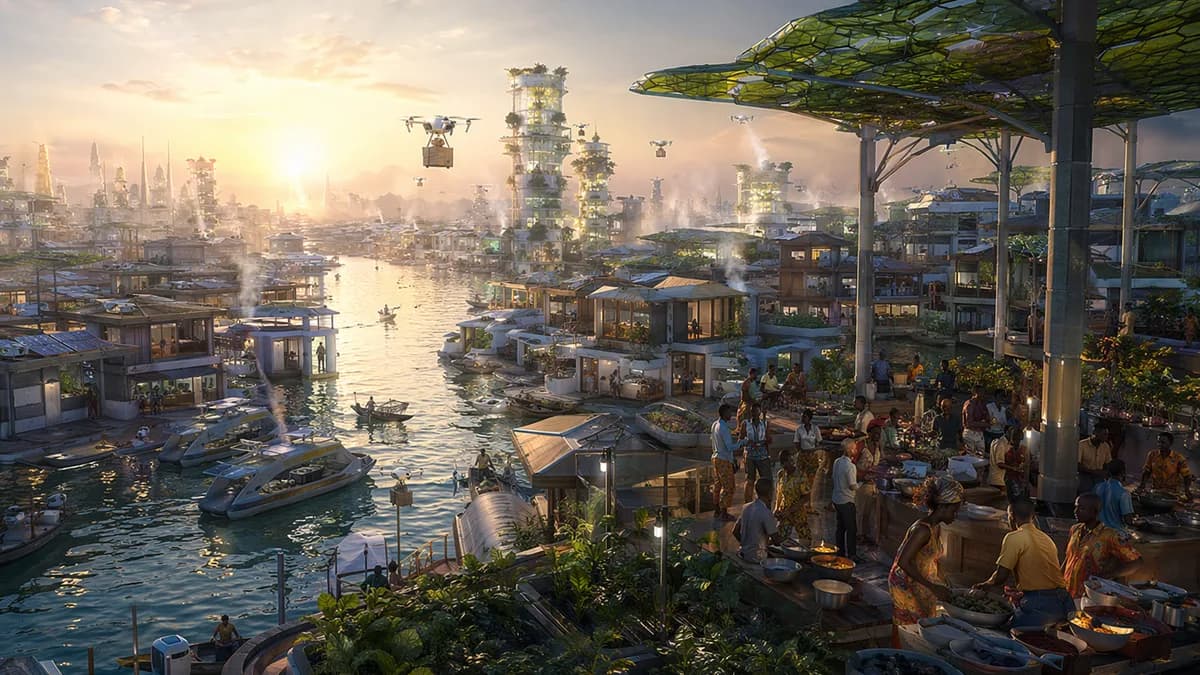
Amara Okonkwo stands knee-deep in warm brown water beside Tower Six, one hand inside its service hatch, the other shielding her eyes from the glare bouncing off the lagoon. Makoko-Brightwater floats around her in stacked terraces of bamboo composite, recycled plastic, and white ceramic roofs. The district creaks softly with the tide. Laundry snaps above narrow bridges. Children in orange school skins chase a delivery crab carrying breakfast packs.
The air smells of salt, engine algae, frying pepper, and the wet metal tang that comes before heat failure.
“Tower Six is wheezing again,” calls Timi from the walkway above. He is nine, maybe ten, all elbows and curiosity. “My grandma says if the mist stops, bread gets expensive.”
Amara laughs without looking up. “Your grandma remembers when bread had a price.”
“It still has a price,” he says. “Three weather points.”
“That is not bread. That is cooling credit.”
“Same thing if you are hungry.”
He is not wrong.
In 2047, nobody in Makoko-Brightwater pays for basic breakfast. The municipal fabs produce cassava loaves, algae eggs, protein stew, and clean water every hour, humming beneath the floating market like patient whales. Housing is guaranteed through adaptive raft modules. Power comes from tidal hinges, solar skins, and methane digesters that turn waste into blue flame.
Survival is cheap now. Belonging is not.
Money still moves through the district, but not the way Amara’s mother knew it. People spend naira-lites and global commons credits on silence hours, private rooms, priority clinic slots, school mentors, governance stakes, encrypted memories, reputation repairs. A good meal arrives whether your wallet is empty. A good life still needs witnesses.
Amara pulls out the tower’s clogged intake mesh. It is furred with gray dust from the Harmattan drift, trapped microplastic, and a green film of algae bloom from the lagoon. The tower shudders, then releases a thin spray. The droplets hit her face, cool and mineral-sweet.
Around her, people turn their heads as if someone has opened a window in the sky.
On the public wall by the ferry dock, the district dashboard flickers. CLIMATE COMMONS ATTENTION MARKET, LAGOS COASTAL ZONE. Maintenance bounty fulfillment, 61 percent. Heat stress risk, rising. External repair bids, low. Global attention index, falling.
A woman buying pepper paste mutters, “They funded the Dubai snow gardens again.”
A fisherman snorts. “Snow has better branding.”
Amara wipes her hands on her shorts and watches the numbers pulse red. The towers, algae canopies, and shade drones keep Makoko-Brightwater breathable. They do not fail all at once. They fail like trust, slowly, invisibly, then everywhere.
Her wristband buzzes with another repair ticket. Tower Nine reports salt crystallization. Canopy Row C requests manual pollination. A housing raft complains of mold in three languages.
She looks up at the mist, glittering in the hard morning sun, and thinks of bread becoming weather, weather becoming politics, politics becoming the difference between a grandmother sleeping and a child sweating through the night.
“Bring me the ceramic wrench,” she tells Timi.
He grins. “Will I get a maintenance badge?”
“You will get yelled at if you drop it.”
“That is also a kind of badge.”
Amara smiles, but the dashboard keeps blinking. Somewhere, in markets she cannot see, strangers are deciding whether her neighborhood is worth cooling today.
2. An Invitation From a Nation With No Land
The invitation arrives during the afternoon storm, when the lagoon turns black and the sky lowers like a hand over the district.
Amara is strapped to the side of an algae canopy, rain slapping her cheeks so hard it stings. The canopy’s leaves, broad translucent sheets stretched over Makoko-Brightwater, are supposed to drink sunlight and exhale shade. Now they thrash in the wind, their nutrient veins flashing error-blue. Below, boats knock against mooring posts. Mothers shout for children. The mist towers fold into storm mode, thin and trembling.
Her wristband pulses against her skin.
NOTIFICATION: CIVIC RECOGNITION EVENT.
“Not now,” she growls, tightening a cable with her teeth clenched.
The notification insists, blossoming across her contact lens in gold letters.
THE MANY INVITES AMARA CHIOMA OKONKWO TO BEGIN CITIZENSHIP.
She blinks rain from her eyes. For a second she thinks lightning has scrambled the interface. The Many is not a platform people simply join. It is a nation with no soil, no flag except the shifting constellation of its citizens, no passport except the pattern of what you have done for others when no one could force you.
Some call it a cult of accountants. Some call it the first honest country. Her uncle calls it “that app where foreigners argue about kindness until money falls out.”
Amara finishes securing the cable and climbs down into the service boat. The storm roars on the canopy above her like fists on a drum.
At home, after the rain thins to a silver curtain, she opens the invitation properly. Her room is small, clean, and warm, with a fold-down bed, a wall of tool hooks, and a plant that keeps surviving despite her neglect. The invitation projects itself above her table as a breathing sphere of text and images.
No border asks for her birthplace. No form asks for her bank balance.
Instead, it shows her life as a chain of witnessed repairs. Tower Four during the 2042 heat dome. The school roof after the methane fire. The night she swam through floating sewage to restart the clinic filters. Dozens of small interventions, each signed by neighbors, sensors, and other mechanics. Encrypted life history, not exposed but proved. Reputation without spectacle.
A voice speaks in her preferred cadence, soft Lagos English with Igbo vowels.
“Amara Okonkwo, your care record qualifies you for stewardship citizenship. If accepted, you may receive a universal dividend from The Many treasury and participate in allocation rituals. Your wealth is not the basis of invitation. Your demonstrated obligation is.”
She laughs once, sharp and unbelieving. “Demonstrated obligation. That is a fancy way to say I cannot mind my business.”
The sphere warms.
“Citizens of The Many govern shared funds through quadratic commitments, reputation proofs, and reciprocal bonds. You may decline.”
Her mother’s face appears in a side window, calling from the mainland clinic. “Amara, did you get it?”
“You knew?”
“I attested for you.”
“Mama.”
“You think citizenship should be for people who know how to hide money? Let them try people who fix things.”
Outside, the district drips and steams. A child shouts as power returns to a block of homes, and cheers ripple over the water.
Amara looks at the invitation, at the glowing record of her own tired hands. For the first time in years, someone far away has noticed not her need, but her usefulness.
She presses accept.
3. The Vote That Feels Like a Family Argument
Entering The Many feels less like opening an app than stepping into a room already full of voices.
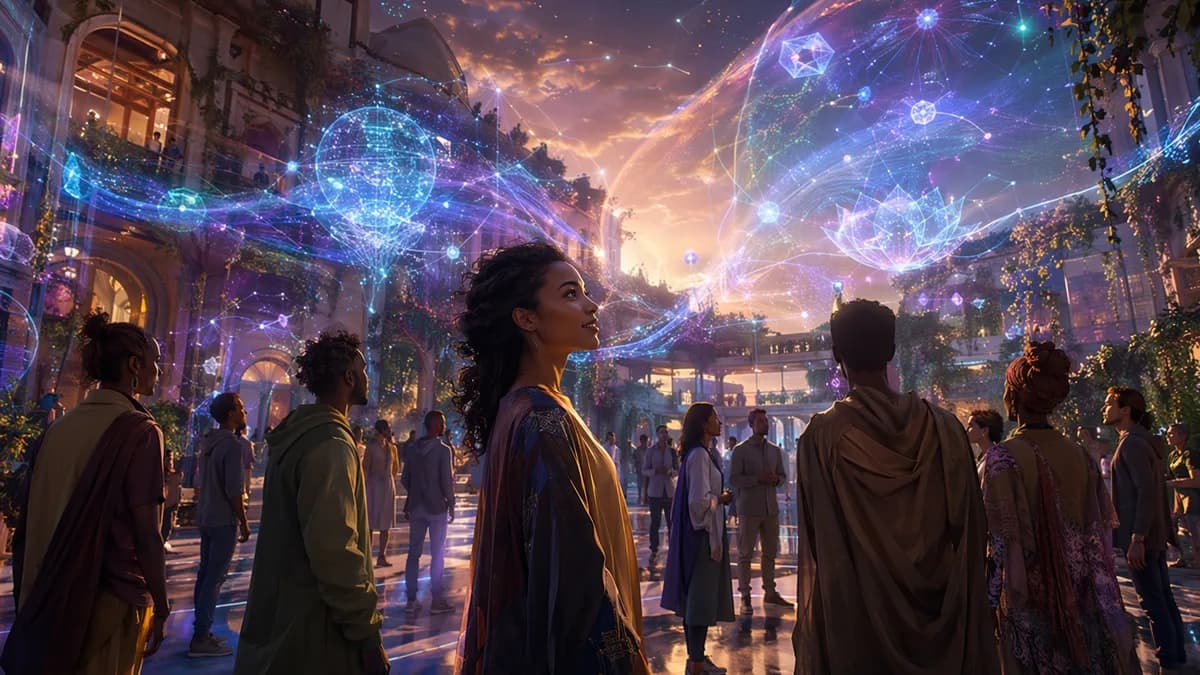
Amara sits on her bed with a cup of ginger tea going cold beside her. Her walls fade. Around her unfolds a circular hall made of light, water, paper, smoke, and whatever memory each citizen brings to the shared space. Some people appear as faces. Some as symbols. Some as old hands, tree roots, blue silhouettes, clusters of sound. Translation runs beneath everything like a clear stream.
Tonight’s ritual concerns three urgent claims on the treasury.
A Pacific island coalition needs coral-printing fleets to rebuild reefs before the next cyclone season. Their delegate appears as a woman with sun-creased skin and a necklace of shells that click when she moves. Behind her, Amara sees ghostly footage of pale reef bones and children stacking sandbags.
“Our fish do not wait for your perfect consensus,” the woman says. “The reef is our wall, our school, our pantry.”
The second claim comes from São Paulo, where an elder-care network is collapsing under success. People live longer now, but apartments remain full of the lonely old, their bodies monitored by cheap sensors, their hearts less easily maintained. A nurse named João speaks from a kitchen crowded with pill dispensers and hanging herbs.
“We have robots for lifting,” he says. “We need humans for staying.”
The third claim is quieter. A memory archive for stateless refugees, people whose countries sank, burned, fragmented, or simply denied them. Their delegate does not show a face, only thousands of small lights.
“When records vanish,” the voice says, “people become rumors. We ask for storage, legal witnesses, and memory stewards.”
Amara expects a vote. She expects buttons, percentages, winners.
Instead, The Many asks what she is willing to bind.
A panel opens before her. She can stake time, expertise, future dividends, or an obligation that may be called later. Her influence grows not by spending tokens but by making promises that cost something if broken. Quadratic weight bends around sacrifice. Reputation proofs prevent easy theater. Citizens cannot simply shout care into the room. They must attach it to their lives.
“This is madness,” Amara whispers.
A man beside her, appearing as a flickering sketch in charcoal, chuckles. “Yes. We call it governance.”
The debate swells. An Indonesian engineer offers six months of reef drone maintenance if the coral fleets pass. A retired teacher in Montreal stakes a portion of her dividend to the refugee archive because her grandmother’s name was once misspelled at a border and nearly erased. Three São Paulo teenagers promise weekly visits to elders and immediately get scolded by João.
“Not visits,” he says. “Relationships. Do not gamify my aunties.”
Someone snaps back, “Then do not sentimentalize labor.”
It feels, Amara thinks, exactly like a family argument after a funeral, when everyone is grieving, everyone is right, and the rice is burning in the kitchen.
She studies the coral fleet. She knows pumps, salt, biofilm, weather damage. Her hands itch at the diagrams. She cannot go to the Pacific, but she can diagnose remotely. She stakes forty hours of technical review and two percent of her first-year dividend to the reef claim.
Then she surprises herself and adds a callable obligation to the memory archive.
If summoned, she will witness one life history per month for a year. Sit with a stranger’s record. Verify that someone existed.
The hall registers her promise with a low bell.
In Makoko-Brightwater, rain begins again, tapping on her roof. In the hall of The Many, distant people lean closer, becoming less distant by the cost of being believed.
4. The Market for Things That Should Not Be Sold
Amara discovers the failure-bets on a Tuesday that already tastes bad.
The lagoon is slick with diesel from an illegal generator barge. Tower Three has a cracked rotor. A shipment of shade-mesh clips arrives in the wrong size, each one printed with cheerful apology text. By noon, her shirt sticks to her spine, and the heat index climbs high enough that the school cancels outdoor play.
She is checking the climate commons dashboard when a new layer appears in the analytics feed.
DISTRICT DEGRADATION DERIVATIVES, LAGOS COASTAL MICROCLIMATES.
At first she thinks it is a risk forecast. Then she opens the contract.
Investors are buying positions that pay out if maintenance levels in districts like hers fall below safe thresholds. If Makoko-Brightwater’s mist coverage drops for three consecutive days, someone profits. If algae canopy productivity dips under 70 percent, someone profits. If heat stress admissions rise, someone profits.
Amara stares so long the screen dims.
“No,” she says.
Timi, now taller and still impossible to discourage, leans over her shoulder. “What is it?”
“People making money if we suffer.”
He squints. “Is that legal?”
“That is not the question making me angry.”
She sends the contract to three mechanics, two local councilors, and The Many’s ethics channel. Within minutes, replies swarm in. Some are furious. Some are tired. Some are worse, thoughtful.
A climate economist from Nairobi appears in her lens, standing in what looks like a greenhouse full of tomatoes. “These instruments are ugly,” she says, “but they reveal neglect in real time. Agencies hide slow failure. Politicians delay bad news. Markets smell rot early.”
“Markets also feed on rot,” Amara says.
“Yes.”
“You are saying let vultures run the clinic because they find bodies fast.”
“I am saying if vultures are circling, perhaps we should map where they fly.”
Amara almost closes the channel. Outside, the tower coughs again, a dry metallic rattle. The mist thins. On the walkway, an old man presses a wet cloth to his neck.
The contracts are not secret. They are tagged as resilience discovery tools. Legal. Audited. Some pension funds hold them. Some disaster-prevention charities, too, because the payouts can finance emergency response. The cruelty is braided with usefulness so tightly she cannot pull one strand free.
That night, she sits with her mother on a video call. The clinic lights behind Mama flicker every few seconds.
“Betting on failure is evil,” Amara says.
Mama peels an orange with a small knife. “Sometimes evil is lazy good wearing bad perfume.”
“That makes no sense.”
“It means, what does the thing do that we need? Keep that. Break the rest.”
Amara lies awake after the call, listening to rain tick against the roof and water slap the floats below. She thinks of a signal sharp enough to cut through denial. She thinks of knives, scalpels, taxes, debts. She thinks of all the things humans invent because they do not trust themselves to care in time.
By morning, anger has not cooled. It has condensed into design.
5. The First Tax Paid in Forgiveness
She calls it the Care Spread because nobody funds a proposal named Punish the Parasites, no matter how accurate it feels at midnight.
The upgrade is simple enough for a child to resent and complicated enough for lawyers to fear. Any financial instrument that profits from public-service degradation must automatically route a percentage of gains into repair bounties for the affected community. The worse the predicted failure, the higher the pre-funded maintenance pool. Speculators can still bet, but every bet becomes a flare and a tool crate. To profit from suffering, they must first make suffering less likely.
The Many opens deliberation for seven days.

It becomes war.
A Singapore risk designer argues that forced spreads will reduce liquidity. A Bolivian water guardian replies, “Good. Let some money be too ashamed to move.”
A pension representative says retirees depend on diversified climate hedges. João from São Paulo asks whether his aunties should send thank-you cards when their loneliness becomes an asset class.
Amara presents from the Makoko-Brightwater repair dock. Behind her, mechanics weld a tower brace, sparks falling like orange rain. She does not dress formally. Her hair is tied in a scarf. Grease marks one cheek.
“I am not asking The Many to ban bad thoughts,” she says. “Prediction has value. Even cruel prediction. But a signal about harm must owe something to the harmed. If you can afford to be right about our failure, you can afford to help us prove you wrong.”
Questions come like thrown stones.
Who defines harm? Who receives funds in contested districts? Will governments offload duties onto Care Spread pools? Can communities manipulate degradation metrics to trigger bounties?
Amara answers what she can and admits what she cannot. Her proposal gains support, then stalls. The ritual requires not only approval but binding trust. Citizens want to know what she will risk.
On the final night, the hall of The Many fills until it feels hot with attention. The Pacific delegate is there. The refugee archive lights shimmer in the upper dark. Timi watches from Amara’s room, silent for once.
The system asks for initiating stake.
Amara’s mouth goes dry. She has calculated this twelve times. It is foolish every time.
She pledges ten percent of her lifetime universal dividend into the first Care Spread pools, reserved for districts outside Nigeria where she has no family, no language, no memory. Flood alleys in Jakarta. Fire corridors in Athens. Heat shelters in Karachi. Places she knows only as names and risk maps.
Her mother calls immediately. Amara declines.
Then Mama sends one message: Your father would call this stubborn. I call it tax.
Amara laughs, and her eyes burn.
In the hall, someone asks, “Why should your dividend repair strangers?”
Amara looks at the faces, symbols, lights, roots, ghosts.
“Because strangers already repair me,” she says. “Every day. In code I did not write. In reefs I will never see. In memory records that keep war from lying. In nurses holding hands I cannot hold. I am only making the debt visible.”
The vote lands just after dawn.
The Care Spread passes by a margin too narrow for celebration. The first automatic transfer triggers nine seconds later, from a degradation bet against a heat district in Manila. The speculator still profits. So does a repair crew that has been waiting three months for condenser parts.
Timi exhales. “So the bad money becomes less bad?”
Amara watches the bounty board bloom with new work.
“No,” she says. “It becomes answerable.”
6. Citizenship After Money
Years later, Amara teaches citizenship beneath a canopy that no longer wheezes.
Makoko-Brightwater has grown outward, not like a city conquering water, but like a conversation learning new replies. The walkways are wider now. The algae leaves above them glow deep green, veined with gold where sunlight collects. Mist towers rise from the lagoon in white spirals, breathing cool vapor that smells faintly of rain on stone. Children run through it shrieking, their skins glittering with droplets.
Amara’s knees ache when storms come. A silver line cuts through her hair. Timi, now a certified climate mechanic with opinions even larger than his tool bag, teaches the younger apprentices how to listen to pumps by touch.
“Machines lie through dashboards,” he tells them, pressing a girl’s palm to a humming pipe. “But vibration gossips.”
The new citizens gather in the shade, some local, some projected from other time zones. A farmer from a vertical wheat cooperative in Ukraine. A caregiver in Manila. A poet who maintains memory archives for people whose countries exist mostly in court filings. A quiet boy from a desert settlement where fog nets sing all morning.
They expect Amara to explain The Many as if it is a bank, an app, a country, a charity, a game.
She refuses every word.
“The Many is an agreement with teeth,” she says. “It bites when we pretend not to need each other.”
A woman in the front raises her hand. “But the dividend. Is that income?”
“Yes,” Amara says.
“Is it payment for citizenship?”
“No.”
“Is it welfare?”
“Sometimes.”
The group laughs, uncertain.
Amara smiles. “Listen. Machines made many things cheap. Food. Light. Walls. Medicine, at least more than before. But attention did not become cheap. Trust did not. Repair did not. The dignity of being counted did not.”
Behind her, the public dashboard scrolls through Care Spread flows. Bets against monsoon drainage in Dhaka have funded pump crews before the flood. Wildfire risk contracts in Chile have filled volunteer respirator banks. Coral fleet maintenance has become a permanent ritual, half science, half prayer. The system is imperfect, gamed, patched, argued over, cursed at, improved. Like any living thing.
A boy from the desert settlement asks, “What do we vote with?”
Amara crouches so her face is level with his projection. “With what you can honestly risk. Time. Skill. Comfort. Future income. Being called later when you are tired. Sometimes forgiveness.”
He frowns. “Forgiveness is money?”
“No,” she says. “That is why it is expensive.”
The lagoon wind moves through the canopy. The leaves rustle like paper ballots, like rain, like distant applause that may only be machinery.
Amara looks at the students and sees the old hunger in them, not for bread, but for a place in the moral weather. She remembers when price meant scarcity, when citizenship meant a stamp, when strangers were mostly background noise behind the urgent needs of one’s own street.
Now a failing pump in Manila can tug at a pension in Oslo. A reef in Kiribati can claim the hands of a mechanic in Lagos. A forgotten name can demand storage from people who will never learn to pronounce it.
This is not unity. She knows better than that. It is friction with receipts. It is care made inconvenient enough to count.
The mist thickens as afternoon heat rises. Children vanish inside the white spray, laughing, then emerge again, wet and bright, as if the air itself keeps returning them.
Amara lifts her wrist and opens the day’s first governance ritual. The question hovering there is small, almost boring, a maintenance dispute between two coastal districts over shared sensor calibration.
She feels the weight of it anyway.
“Begin,” she says, and somewhere, thousands of citizens lean closer to decide what cannot be owned, and what must still be owed.