Trump's Versailles Iran peace deal exposes Washington's retreat from its own red lines
The Iran peace deal has 14 clauses, was signed at Versailles, and reads less like a victory document than a formal admission that Washington could not force Tehran to accept its terms through war.
XOOMAR Intelligence
Analyst Take
That is the central point in Patrick Wintour’s analysis for Guardian World: the ceremony matters, but the substance matters more. Donald Trump did not merely accept compromise. He accepted a framework that retreats from the demands the US had put on the table in 2025, before Israel, with US support, began the 12-day war that culminated in strikes on Iran’s nuclear sites.
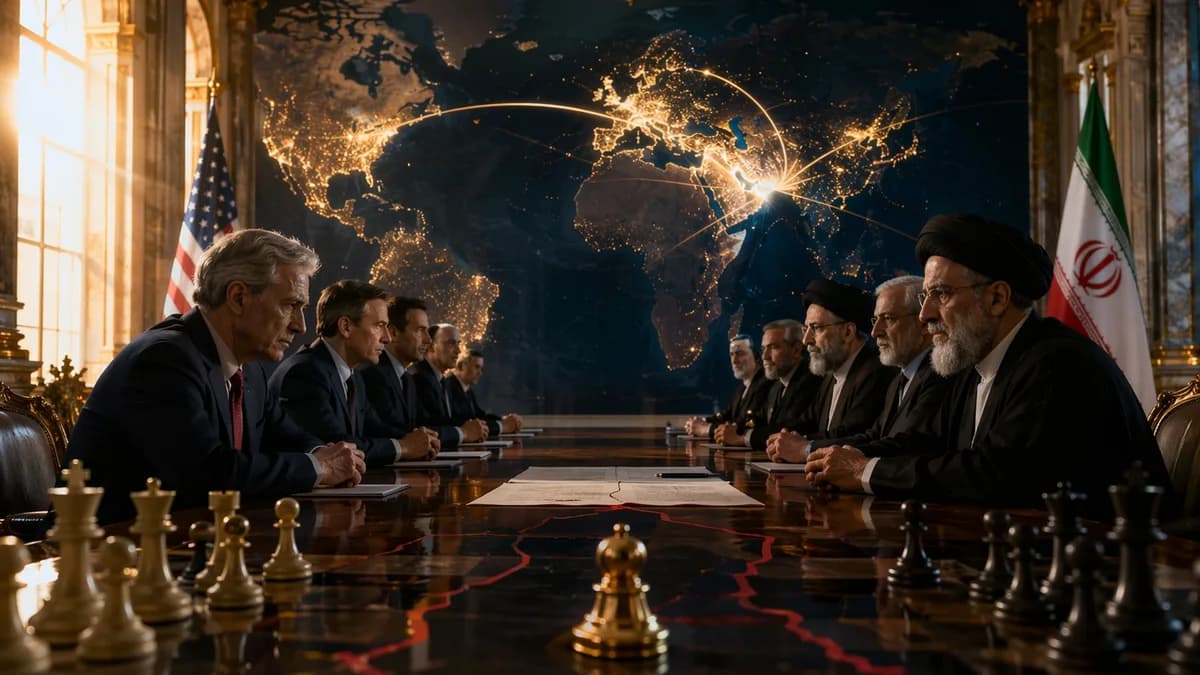
The setting made the retreat harder to miss. Versailles is not neutral décor. It carries the smell of imposed settlement and wounded national pride. For a president who prizes spectacle, signatures and the language of domination, that was politically brutal symbolism.
The historical echo is almost too neat. Versailles had 14 points. This memorandum has 14 clauses. The comparison should not be pushed too far, since this is not a surrender treaty. But the optics point in the same direction as the text: red line after red line has been rubbed out.
The erased red lines show Iran survived the pressure campaign
The US position in 2025 was sweeping. Iran was to have no domestic enrichment beyond limited medical and agricultural needs. Nuclear supply would be imported. Enriched uranium stockpiles would be shipped out immediately. Enriched material would be downblended to 3.67%. Iran would build no new enrichment facilities. It would dismantle programmes capable of uranium conversion.
That was coercive transformation. The new memorandum is containment, face-saving and crisis management.
| Issue | US position in 2025 | What the memorandum now accepts |
|---|---|---|
| Domestic enrichment | No domestic enrichment beyond limited medical and agricultural needs | Trump conceded Iran had a right to continue enrichment |
| Uranium stockpile | Stockpiles shipped out immediately | US officials acknowledged dilution could happen inside Iran under IAEA watch |
| Enrichment level | Downblending to 3.67% | Dilution to 3.67% remains, but not necessarily outside Iran |
| Future facilities | No new enrichment facilities | Final nuclear scope left open |
| Sanctions pressure | Maximum economic pressure preserved | Oil waivers and wider sanctions relief are built into the process |
Each softened condition tells the same story. Washington still speaks in the grammar of pressure, but the deal accepts Iranian capacity that the US once said had to disappear.
The strongest example is enrichment. At the G7 meeting in Évian, where a Trump-Meloni G7 photo claim also drew attention, Trump said Iran could not be excluded from enrichment because other countries in the region had nuclear programmes. That is not a minor adjustment. It changes the frame from denial to management.
The sanctions side carries the same message. For an immediate waiver on oil exports to work, associated services such as banking transactions, insurance and transportation would need waivers too. Miad Maleki, a former US Treasury official and senior fellow at the Foundation for Defense of Democracies, warned that broadening authorisation to financial transactions would crack the core architecture of US oil and financial sanctions against Iran.
That is the cost of retreat. Once a red line becomes a bargaining chip, it stops being a red line.
War gave Washington battlefield headlines but no durable Iran strategy
The war punished Iran. The source material refers to damage to Iranian nuclear sites, including the Isfahan nuclear enrichment facility, after US strikes in June 2025. But damage is not the same as political submission.
Military force can degrade assets without changing a state’s strategic calculus. That distinction matters here because the deal does not show Iran accepting the original US terms. It shows Iran surviving long enough for Washington to accept less.
Trump himself explained why the deal happened. He did not frame it as the triumphant completion of a strategy. He framed it as a move to avoid economic disaster.
“The one president I did not want to be was the late, great Herbert Hoover,” Trump said. “I didn’t want to see economic catastrophe. If you kept this going, that could have happened.”
That line is more revealing than the ceremony at Versailles. The administration’s public posture was toughness. Its actual constraint was fear of a broader economic shock, with Trump citing the risk of a worldwide recession and oil reserves running out in a matter of weeks.
The Strait of Hormuz exposes the gap between rhetoric and results. The memorandum may reopen navigation for now, but the text shows free passage could end after 60 days, when Iran is set to discuss future administration and maritime services with Oman and other Gulf states. So Washington made major concessions to restore something that was open before the war, and even that may be temporary.
This is why the Iran peace deal lands as a strategic come-down. It does not prove force was useless. It proves force, used without a realistic political end state, hit its ceiling.
Macron's Versailles stagecraft turned Trump's victory script against him
Emmanuel Macron suggesting Versailles as the venue was either diplomatic mischief or exquisite stagecraft. Maybe both.
Trump is unusually vulnerable to political theater because he treats visual dominance as proof of success. Grand rooms, flags, long tables and televised signatures are part of his operating system. Versailles turned that instinct against him.
The room told a harsher story than the talking points. A US president who had promised pressure accepted a memorandum that left the hardest questions unresolved. A deal advertised as peace deferred the future of Iran’s nuclear programme to later talks. A supposed victory over Tehran granted Iran room to keep enrichment alive.
That does not mean Trump is Count Ulrich von Brockdorff-Rantzau, the German diplomat associated with Versailles humiliation after the first world war. The analogy has limits. The United States has not been defeated in the way Germany was defeated.
But diplomacy is partly theater, and this theater mattered. Versailles gave critics a frame they did not have to invent. The document already showed retreat. The venue underlined it in gold leaf.
As XOOMAR has tracked, the diplomatic path has already looked fragile, including in JD Vance Scraps Swiss Trip as Iran Talks Drift Off Course. The symbolism would matter less if the process looked locked in. It doesn’t.
The strongest defense of the Iran agreement is that retreat can be responsible
There is a serious counterargument, and it deserves respect: accepting a flawed peace may be wiser than prolonging a war with no achievable end state.
If the memorandum reduces the risk of a wider regional war, restores monitoring channels and keeps oil moving through the Gulf, those are real gains. Great powers often call compromise victory because the alternative is admitting failure in public. That does not make the compromise irrational.
The deal also contains potential economic relief for Iran, including the possible unfreezing of $24bn in Iranian assets abroad and a proposed $350bn Iran reconstruction fund that the US says it will create but not contribute to. That fund, according to the Guardian analysis, would require Gulf states to be deeply forgiving toward a country that has recently inflicted damage on them.
The nuclear comparison with Barack Obama’s 2015 nuclear deal also complicates the easy attack line. People involved in the talks told the Guardian it is like comparing apples and oranges. The 2015 agreement was a fully fledged arms control document. This memorandum mostly sets up another negotiation.
That is exactly the problem. The memorandum’s nuclear language is weaker than the 2015 formulation, where Iran reaffirmed that “under no circumstances will Iran ever seek, develop or acquire nuclear weapons”. A denial of intent is cheap. Verification is the hard part. On that, the US is no further forward.
Responsible de-escalation should not be confused with strategic success. The former may be necessary. The latter has not been earned.
America needs an Iran policy built on limits, not fantasies of surrender
The lesson of the Iran peace deal is not that diplomacy is weak. The lesson is that threats become self-defeating when they outrun what a country is willing or able to enforce.
US leaders should stop promising total capitulation from adversaries they are not prepared to occupy, transform or permanently contain by force. That kind of language feels strong at a rally and collapses at the negotiating table.
A durable Iran policy would start from limits. It would prioritize enforceable inspections, regional diplomacy, calibrated sanctions and clear military thresholds that Washington actually intends to defend. It would also admit that nuclear verification matters more than theatrical declarations of intent.
The unresolved tension is already visible. Final nuclear negotiations can still stall. The Strait of Hormuz arrangement may not last beyond 60 days. Israel is not neatly folded into the US-Iran framework, and Lebanon remains part of the wider regional equation. As we wrote in Scrapped US-Iran Talks Trap Trump Between Iran, Israel, Trump’s room for maneuver narrows when Tehran and Israeli hardliners pull in opposite directions.
The Versailles memorandum may reduce immediate danger. Good. But it also exposes the price of confusing threats with strategy.
If America wants its red lines to matter again, it has to draw fewer of them and defend the ones it draws.
The Stakes
- The deal signals a major retreat from Washington’s 2025 nuclear red lines.
- Iran appears to have survived the military and diplomatic pressure campaign without accepting full US terms.
- The Versailles setting amplifies the political symbolism of compromise rather than victory.
US 2025 Iran Demands vs Versailles Memorandum
| Issue | US position in 2025 | What changed in the memorandum |
|---|---|---|
| Overall strategy | Coercive transformation through sweeping nuclear restrictions | Containment, face-saving and crisis management |
| Domestic enrichment | No domestic enrichment beyond limited medical and agricultural needs | Washington accepted a framework that retreats from that demand |
| Nuclear supply | Iran’s nuclear supply would be imported | The deal reflects that the US could not force Tehran to accept its earlier terms |
| Enriched uranium stockpiles | Stockpiles would be shipped out immediately and downblended to 3.67% | Earlier red lines were softened or erased in the final framework |
| Enrichment facilities | Iran would build no new enrichment facilities | The memorandum is presented as a compromise rather than an imposed settlement |
Primary Sources & Disclosures

Written by
XOOMAR
Data desk
XOOMAR is a capital markets software and data company. Every brief on this site starts from a dataset the company collects itself from primary sources (CFTC, SEC EDGAR, FINRA, the Federal Reserve, exchange APIs) and names the numbers it is built on, with a link to the data page so you can check them. Briefs are reviewed before they go out and corrected in place when the data is revised.