
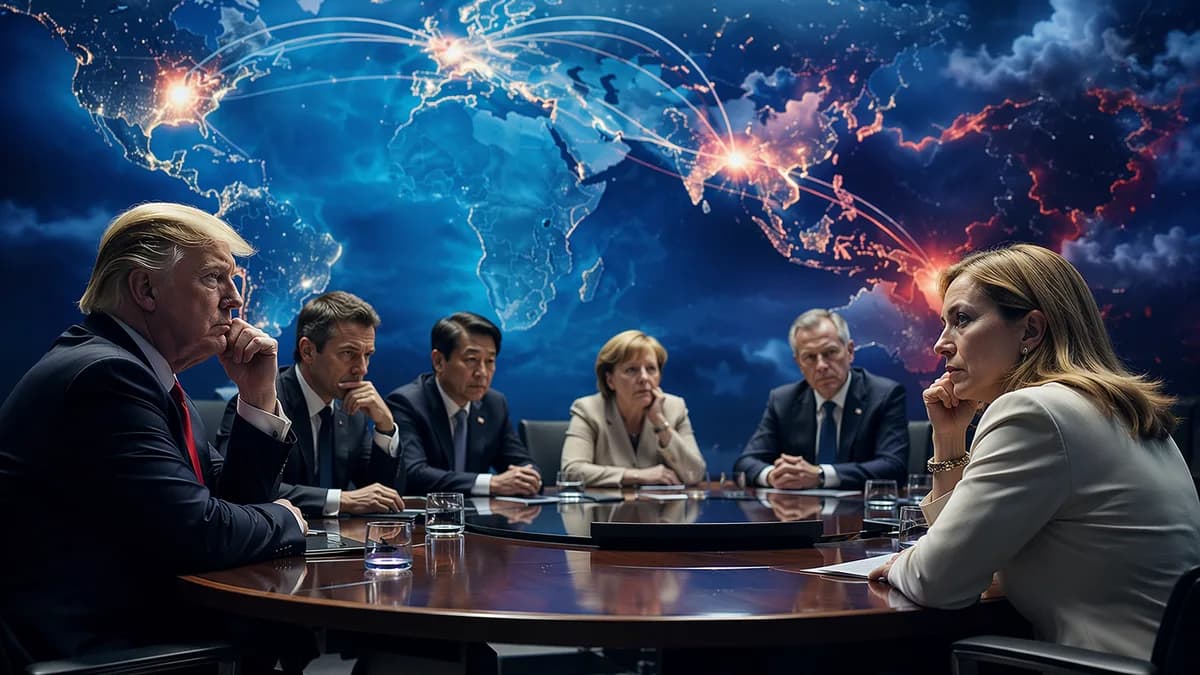
The Trump Meloni G7 photo claim has become a diplomatic stress test because it moved from a personal boast to a public argument over status, Iran policy, and alliance discipline in less than a week.
Global TrendsJune 20, 2026· 8 min read· By XOOMAR Insights Team
Trump Meloni G7 Photo Claim Erupts Into Alliance Fight
Updated on June 22, 2026
XOOMAR Intelligence
Analyst Take
72/ 100
4 sources analyzedLow confidenceTrend10Freshness98Source Trust92Factual Grounding88Signal Cluster100
US President Donald Trump repeated on Truth Social that Italian Prime Minister Giorgia Meloni asked “over and over” for a picture with him at the G7 summit in France, according to BBC World. Meloni had already rejected his earlier claim that she “begged” for a photo, saying she was “frankly stunned” and that “neither I nor Italy ever beg.”
That sentence is why this story has legs. A photo dispute is usually trivial. A head of government publicly denying that she sought personal validation from a US president is not.
Trump Meloni G7 photo claim turns into a test of deference
Trump’s escalation did more than revive an argument over who wanted a photograph. It reframed a summit interaction as proof of hierarchy.
In his Truth Social post, Trump said Meloni was “doing poorly in Italy with her level of popularity” and added:
“Now, after the United States defeated Iran militarily, she wants to be friends again in order to get her "numbers up." No thanks!!!”
That is Trump’s claim, not an independently verified account of Meloni’s motives. The distinction matters. He tied a personal anecdote to political weakness, then connected both to Italy’s position on US military operations involving Iran.
The BBC reports that Trump also accused Meloni of not supporting US efforts to “[deny] Iran from obtaining or developing a nuclear weapon” and said she caused “a great logistical inconvenience” by barring the US from using Italian air facilities for American military operations in Iran. The source also says Italy reportedly denied US military aircraft from landing at Sigonella air base in Sicily in March for operations against Iran.
XOOMAR analysis: Trump is using the photo as a proxy for a bigger complaint. The surface dispute is about access to a camera moment. The underlying grievance is about whether an ally acted like an ally when Washington wanted operational support.
That’s why the exchange landed harder than a normal summit spat. Meloni didn’t just say Trump misremembered. She said the story was false and personally degrading.
Seven leaders, one photo claim, global amplification
The G7 is built for choreographed visibility. Leaders talk policy behind closed doors, but cameras capture the ranking rituals: arrivals, group photos, side conversations, seating, smiles, tension.
This dispute followed a simple chain:
- First claim: Trump told Italy’s La7 TV that Meloni “begged” him to take a photo with her.
- Public denial: Meloni responded in an Instagram video, saying she was “frankly stunned.”
- Escalation: Trump posted that she asked “over and over” for the picture.
- Policy spillover: He then folded Iran, Italian air facilities, and Meloni’s domestic popularity into the same attack.
- Diplomatic consequence: Italian Foreign Minister Antonio Tajani cancelled a planned trip to the US.
The speed is the story. One quote from a TV interview, one rebuttal video, one social post, and suddenly a summit image competes with the policy agenda.
AP’s account of the summit placed Meloni at working sessions and group photos in Evian-les-Bains, France, including images with Trump and other leaders. The BBC also reports that Trump and Meloni were pictured in close conversation at the summit, after which Meloni told reporters their relationship was unchanged and there had been “no recriminations.”
That makes the later dispute more revealing. The public optics suggested calm. The post-summit messaging exposed friction.
Meloni’s denial protects her image without burning the bridge
Meloni had a narrow political problem. She has had reasons to keep a cordial line with Trump. The BBC notes that she was the sole European leader to attend his inauguration in January 2025. But Trump’s “begged” claim put her in a subordinate role.
For a leader who speaks in terms of national pride, “begged” is toxic language. It suggests neediness. It turns a normal summit exchange into a scene of dependency.
Meloni’s response was direct:
“I don't know why the US president behaves this way towards allies.”
She then sharpened the point:
“I can only say it is regrettable he does not show the same determination towards the enemies of the West and towards the enemies of the US - [enemies] whose leaders he instead appears to be far more accommodating with.”
She did not announce a break with Washington. She did not broaden the dispute into a full attack on US policy. She corrected the personal claim, defended Italy’s dignity, and signaled that Trump’s treatment of allies is the issue.
XOOMAR analysis: that restraint matters. Meloni’s aim appears to be damage control, not rupture. She needed to reject the image of deference while avoiding a broader diplomatic firestorm. Tajani’s cancelled US trip shows the Italian government wanted the objection to carry institutional weight, but the response still stopped short of a formal policy break.
For readers following the Iran track, this episode sits alongside wider uncertainty over Trump’s approach to Tehran, including our coverage of Scrapped US-Iran Talks Trap Trump Between Iran, Israel and Trump's Iran Peace Deal Erases US Red Lines at Versailles.
Trump, Meloni, and the G7 audience read the same scene differently
The same moment now has competing interpretations. None can be treated as established fact beyond what each side said, but the split is clear.
| Actor | How the moment is framed | Evidence from the source |
|---|---|---|
| Trump | Meloni sought proximity and later wanted renewed friendliness | He said she asked “over and over” for a picture and wanted to get her “numbers up” |
| Meloni | Trump invented a humiliating story about an ally | She said she was “frankly stunned” and that “neither I nor Italy ever beg” |
| Italian government | The remarks crossed from personal insult into national offense | Tajani cancelled a planned US trip |
| G7 observers | Summit optics can overwhelm policy messaging | The dispute grew from a photo claim into an Iran-linked diplomatic row |
The voter and media readings are harder to verify from the supplied material, so they should be treated as inference. Supporters of either leader may see defiance. Critics may see unseriousness. Neutral observers get a cleaner lesson: summit diplomacy now includes rapid response to personal narratives, not just negotiation over communiques.
From photo lines to Pope comments, the pattern is public scorekeeping
The available source material does not support a detailed comparison to handshake battles, seating fights, or camera-angle disputes. It does support a narrower pattern: Trump has recently used public comments to pressure or insult figures tied to Meloni’s political and national sphere.
The BBC reports that the leaders also clashed earlier this year after Trump accused Pope Leo XIV of being “WEAK on Crime and terrible for Foreign Policy” in a Truth Social post, later saying he was “not a big fan.” Meloni called those comments “unacceptable.”
That earlier clash matters because it reduces the photo dispute’s innocence. Meloni herself said of Trump’s behavior toward allies that “it was not the first time it had happened.”
XOOMAR analysis: Trump’s method here is public scorekeeping. Praise and insult are not side effects. They are tools. A leader is “a big fan” until she withholds support, criticizes a remark, or rejects the desired narrative. Then the relationship gets recast in personal terms.
Traditional G7 messaging tries to suppress that kind of volatility. Trump’s style does the opposite. It drags the informal backstage into public view and dares allies to answer.
The next risk is not the photo, it’s the operational fallout
For allies, the practical lesson is blunt: personal claims can now become diplomatic incidents fast enough to affect schedules, public posture, and possibly the tone of future talks. Tajani cancelling his US trip is the clearest concrete consequence in the supplied record.
For investors and geopolitical risk watchers, the relevant signal is not that a photo argument moves markets. The source does not show that. The signal is that alliance coordination around Iran, military access, and summit messaging can be complicated by personal friction at the leader level.
The evidence to watch is specific:
- Trip rescheduling: Whether Tajani’s cancelled US visit is quietly restored or remains frozen.
- Italy-US military access: Whether the dispute over Sigonella and Iran operations resurfaces in official channels.
- Meloni’s tone: Whether she keeps the rebuttal narrow or broadens it into policy criticism.
- Trump’s messaging: Whether he drops the photo claim or continues tying Meloni’s conduct to popularity and Iran.
The thesis weakens if both governments return quickly to routine engagement and stop amplifying the insult. It strengthens if personal slights keep bleeding into operational questions, especially around Iran. The next flashpoint may not involve a camera, but the mechanism is now visible: a private summit moment becomes a public loyalty test, and an ally has to decide whether silence costs more than confrontation.
Impact Analysis
- The dispute turns a personal photo claim into a public test of respect between allied leaders.
- Trump’s comments link summit optics to deeper tensions over Iran policy and military access.
- Meloni’s pushback signals that European leaders may resist being portrayed as deferential to Washington.
Trump vs. Meloni on the G7 Photo Dispute
| Issue | Trump's Claim | Meloni/Italy's Position |
|---|---|---|
| G7 photo request | Meloni asked “over and over” for a picture with him. | Meloni rejected the claim, saying “neither I nor Italy ever beg.” |
| Political motive | Trump said Meloni wanted to be friends again to improve her “numbers.” | Meloni framed the claim as an affront to Italy’s dignity. |
| Iran policy | Trump accused Meloni of not supporting US efforts against Iran’s nuclear ambitions. | Italy reportedly denied US aircraft use of Sigonella air base for Iran-related operations. |
Sources

Written by
XOOMAR Insights Team
Research and Editorial Desk
The XOOMAR Insights Team pairs automated research with human editorial judgment. We track hundreds of sources across technology, fintech, trading, SaaS, and cybersecurity, cross-check the facts, and explain what happened, why it matters, and what to watch next. We do not just rewrite headlines. Every article is fact-checked and scored for reliability before it goes live, and we link back to the original sources so you can verify anything yourself.
Explore More Topics
Related Articles
 Global Trends
Trump Shelves Iran Strikes Unless a Deal Lands Fast
Trump says Iran strikes are shelved only if a rapid deal opens Hormuz and ends the nuclear threat. The pressure hasn't vanished.
Aug 2, 20265 min
 Global Trends
Trump Iran Talks Turn Paused U.S. Strike Into Leverage
Trump paused U.S. strikes to force Iran back to talks, but the threat could deepen the Hormuz and nuclear standoff.
Aug 3, 20267 min
 Global Trends
US-Escorted Tankers Hit as Strait of Hormuz Shuts Down
Iran says it struck two US-escorted tankers, nearly closing Hormuz and forcing Trump to weigh war strategy as energy prices jump.
Jul 31, 20267 min
 Global Trends
Cockroach Protests Crack Modi’s BJP Fortress in Delhi
Cockroach protests forced a minister out and exposed fresh weakness in Modi’s BJP after years of dominance.
Jul 27, 20268 min
 Global Trends
Iran Seizes Control Over Strait of Hormuz Via Secret Oman Deal
Iran formalized a temporary shipping route with Oman, cementing Tehran's administrative control over the Strait of Hormuz while keeping blame for insecurity on
Aug 5, 20266 min
 Trading
Iran Demands Shipping Toll To Reopen Oil Chokepoint
Global markets rallied on news of the Strait of Hormuz reopening, but the deal would grant Iran unprecedented control to collect transit tolls.
Aug 6, 20266 min
 Trading
WTI Crude Paralyzed at $74 Amid Hormuz Showdown
WTI crude prices are stuck near three-week lows, not due to calm but to paralysis as traders await a binary outcome for the Strait of Hormuz that could detonate
Aug 6, 20267 min
 Fintech
Google Wallet Turns Kids' Phones Into Allowance Trackers
Google Wallet now lets U.S. parents fund and control a child's spending balance, locking it down instantly and setting daily limits on their device.
Aug 6, 20266 min
 Trading
Gold's Lockstep Surge Hints at Dollar Replay
Gold is rallying alongside oil, breaking its traditional inverse relationship. This reveals a market shift—bullion is pricing a tangible inflation premium from
Aug 6, 20266 min
 Technology
New Dating Apps Bet Swiping Is a Broken Business
Startups like Ditto are replacing swipe fatigue with AI-powered, blind-date scheduling, betting that Gen Z will pay for outcomes, not endless browsing.
Aug 6, 20268 min
Don't miss the signal
Get our weekly roundup of the stories that matter across tech, fintech, and trading. No noise, just signal.
Free forever. No spam. Unsubscribe anytime.