
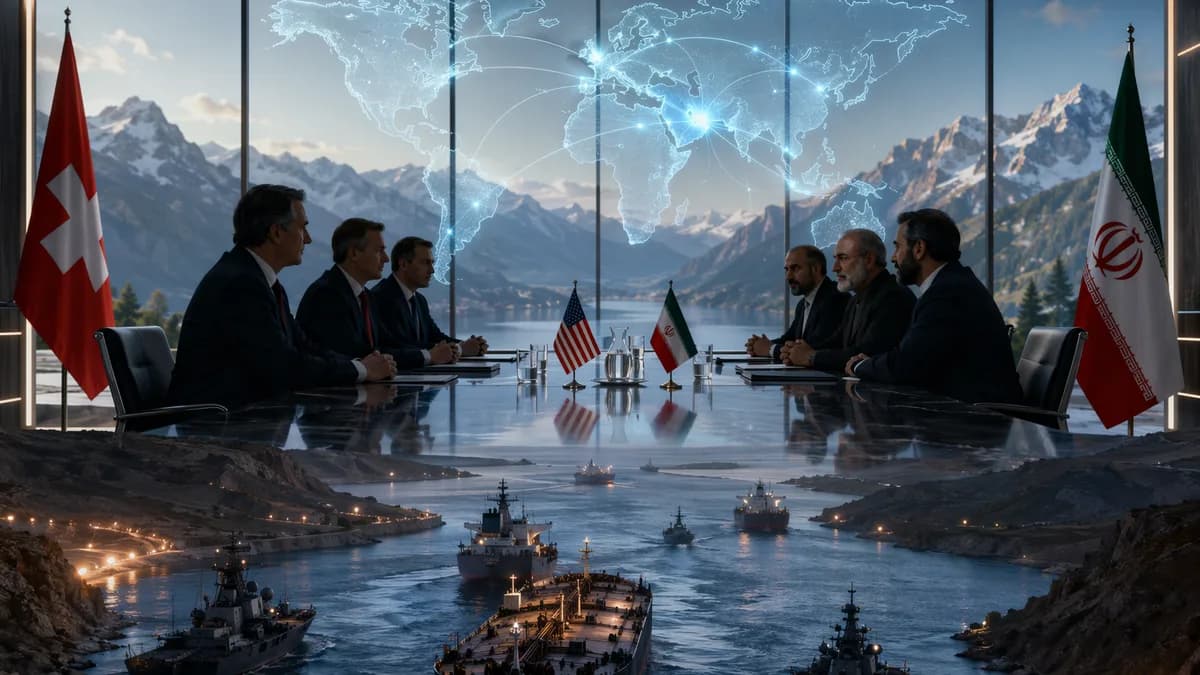
Roughly 20% of the world’s oil passes through the Strait of Hormuz, and that is the hard number hanging over the JD Vance Iran talks in Switzerland as President Donald Trump threatens to turn maritime security into a U.S.-priced bargaining chip.
Global TrendsJune 21, 2026· 12 min read· By XOOMAR Insights Team
Trump Toll Threat Jolts Strait of Hormuz Iran Talks
Updated on June 23, 2026
XOOMAR Intelligence
Analyst Take
73/ 100
4 sources analyzedLow confidenceTrend20Freshness96Source Trust85Factual Grounding88Signal Cluster80
Vice President JD Vance landed in Switzerland early Sunday to join Trump envoy Steve Witkoff and Jared Kushner for talks with senior Iranian officials, according to NBC World. The negotiations are meant to fill in the technical details of a memorandum of understanding signed last week by Trump in Paris. They now begin under immediate strain: renewed fighting in Lebanon, Iran’s claimed closure of Hormuz, and Trump’s public threat that any tolls on the strait should be American.
The core signal is blunt. Washington is trying to keep diplomacy alive while raising the cost of failure. XOOMAR analysis: Trump’s “Guardian Angel” toll language looks less like a finished maritime policy than a pressure device aimed at Tehran, regional partners, and energy customers. But pressure devices can still move behavior. In Hormuz, rhetoric itself becomes regional energy risk.
Trump turns Strait of Hormuz security into a bargaining chip before Vance meets Iran
Trump wrote Saturday that there would be “NO TOLLS” on the Strait of Hormuz during or after the current 60-day ceasefire, “unless they are imposed by and for the United States of America”. He also described the U.S. as the “Guardian Angel” of the Middle East.
Trump added that the U.S. could charge tolls for ships passing through the Strait of Hormuz, referring to the U.S. as the “Guardian Angel” of the Middle East.
That phrasing is designed to dominate the talks before they start. It reframes the strait from a shared shipping lane into a service Washington says it protects, and might charge for.
The timing matters. Iran said Saturday it had once again closed the Strait of Hormuz, accusing Israel of ceasefire violations. The U.S. military denied Iran’s claim to control the strait. The Islamic Revolutionary Guard Corps Navy warned ships not to approach the waterway, even though Iran had committed to reopening it under the interim peace deal.
The contradiction is the story. Vance is arriving to de-escalate the nuclear file and the Lebanon file, while Trump is escalating the maritime cost narrative in the world’s most sensitive oil chokepoint.
XOOMAR analysis: the toll idea gives Trump a public threat short of direct military escalation. It also risks confusing allies and commercial operators, because shipping markets do not wait for policy memos. They price uncertainty first.
This follows the same pressure-diplomacy tension we flagged when scrapped U.S.-Iran talks trapped Trump between Iran and Israel. The Switzerland round is now the test of whether that tension can be contained.
The Hormuz math is simple: one waterway, one-fifth of world oil, no room for ambiguity
The supplied record gives one hard market number: 20% of the world’s oil passes through the Strait of Hormuz. That alone explains why Trump’s toll threat landed harder than a normal social-media broadside.
A strait that carries one-fifth of global oil does not need to close fully to matter. A warning from the IRGC Navy, a disputed claim of closure, or uncertainty over whether commercial ships can move safely can force counterparties to reassess route risk, contract timing, and exposure.
The current agreement establishes toll-free travel through the strait for 60 days. That provision now sits beside Trump’s statement that any tolls should be imposed by and for the United States. Iran, for its part, has argued that failure to implement the first clause of the MOU means there is no agreement in effect.
The immediate problem is not a clean legal question. It is competing claims of authority.
| Actor | Current position in the source record | Practical pressure point |
|---|---|---|
| Iran | Says it closed Hormuz and warned ships not to approach | Uses maritime access as leverage over ceasefire terms |
| U.S. military | Denies Iran’s claim to control the strait | Signals continued contest over actual access |
| Trump | Says no tolls unless imposed by and for the U.S. | Converts security protection into bargaining pressure |
| Shippers | Not directly quoted in supplied sources | Must judge risk before official clarity arrives |
The prompt asks about LNG cargoes and country-by-country exporter exposure, but the supplied sources do not provide verified LNG figures or a list of exporters using Hormuz. XOOMAR won’t invent them. The market takeaway still stands on the oil number alone: 20% is enough to make ambiguity expensive.
A toll structure would also be different from the existing risk stack around maritime movement. The source record supports a comparison at the conceptual level only: today’s dispute is over ceasefire compliance, access, and claimed control. A U.S.-imposed toll would add a political price to passage, not just a security risk around it.
The JD Vance Iran talks now carry Trump’s personal signature
Vance’s presence changes the level of the talks. This is no longer only a technical follow-up handled by staff. The JD Vance Iran talks put the vice president, Trump’s special envoy, and Trump’s son-in-law in the same negotiating frame.
Vance said before boarding the plane to Switzerland:
“I think we’re going to hopefully make progress on the nuclear issue, hopefully make progress on the Lebanon ceasefire issue. Those are the two big things that I think we’re going to be focused on.”
That is a narrow agenda with high stakes. The nuclear file is the long-term strategic question. Lebanon is the immediate stress test.
Steve Witkoff and Jared Kushner also matter because they signal Trump’s preferred style: personal channels, deal structure, and direct pressure. NBC identifies Witkoff as Trump’s special envoy and Kushner as Trump’s son-in-law. XOOMAR analysis: that setup can move quickly because authority appears close to the president. It can also create risk if counterparties are unsure which promises survive the next public threat.
The Iranian side is led by Parliament Speaker Mohammad Bagher Ghalibaf and Foreign Minister Abbas Araghchi, with mediators from Qatar and Pakistan joining the talks. Pakistan Prime Minister Muhammad Shehbaz Sharif arrived in Zurich on Sunday with his delegation.
Switzerland gives the process a controlled stage, away from the public pressure of Washington, Tehran, Tel Aviv, or Beirut. But the setting cannot neutralize the facts outside the room: Iran says implementation has failed, Israel and Hezbollah are trading accusations, and Trump has put Hormuz tolls into the conversation.
As we wrote in Trump’s Iran Peace Deal Erases US Red Lines at Versailles, the structure of this deal already gave Trump ownership of both the breakthrough and the concessions. Vance’s trip deepens that ownership.
Lebanon, not just uranium, is testing the memorandum first
Iranian state TV reported that Tehran’s “key and primary demand” is ending the war on all fronts, including Lebanon. Iranian foreign ministry spokesman Esmail Baghaei said a violation of Article 1, which specified that fighting must end on all fronts, including Lebanon, “calls the entire agreement into question.”
Baghaei also described the Switzerland trip as a “mission to demand the fulfillment of the other side’s obligations”, adding that “negotiations for a final agreement” will begin when those obligations are implemented.
The violence data in the source is stark. Lebanon’s health ministry said at least 16 people were killed by Israeli strikes in Lebanon on Saturday, after strikes Friday killed 83. The Israel Defense Forces said Hezbollah breached the ceasefire and “launched more than 50 projectiles toward IDF soldiers operating in southern Lebanon” overnight. Israel said it struck Hezbollah targets in response.
Hezbollah denied breaking the ceasefire and accused Israel of making false claims to justify attacks in an effort to “sabotage the agreement” between Iran and the U.S.
That creates a negotiation problem with no clean symmetry. Israel and Hezbollah are not described as parties sitting at the Switzerland table, but their actions are already shaping whether Iran treats the MOU as alive.
U.S. spy agencies believe Israel will likely continue to launch attacks against Hezbollah in Lebanon, according to a source with knowledge of the intelligence assessments cited by NBC. If that assessment holds, the ceasefire architecture faces pressure from the start.
This is where the nuclear file becomes harder, not easier. Iran has reaffirmed a promise not to develop nuclear weapons under the MOU, echoing the commitment it made under Obama’s 2015 nuclear deal. But Tehran is tying final negotiations to performance on the first ceasefire clause. That means uranium talks may depend on whether Lebanon quiets down.
Hormuz threats carry memory, but this file centers on today’s trigger
The outline for this piece raises the 1980s Tanker War, earlier sanctions strategies, and the maximum pressure era. Those are relevant context for many Hormuz stories, but the supplied source material does not establish those historical comparisons in detail. XOOMAR won’t treat them as sourced facts here.
The verified pattern in this file is narrower and still powerful: Iran links maritime access to alleged ceasefire violations, the U.S. disputes Iran’s control claim, and Trump threatens to monetize security through American tolls.
That is enough to explain why allies and markets react quickly to Hormuz language. The danger is not only a deliberate blockade. It is a chain of tactical decisions: a warning to ships, a misread naval movement, a disputed transit, a retaliatory strike, or a political post that hardens positions before diplomats can soften them.
The MOU was supposed to create a 60-day runway. Hormuz compresses that runway. Every day of disputed access burns diplomatic time.
Iran, Gulf states, shippers, and Asian buyers won’t read the toll threat the same way
Iran’s likely reading is straightforward. XOOMAR analysis: Trump’s toll language looks coercive, but it also signals that Washington wants a deal enough to keep bargaining over the terms of access. Tehran can use that to argue that implementation failures, especially in Lebanon, invalidate the broader framework.
For Gulf governments, the source record does not provide direct reactions. The likely concern, based strictly on the facts at hand, is exposure. A U.S. toll concept could put regional partners in the middle of a political fight over who pays for protection and who appears to accept American pricing power over a shared waterway.
Shippers and insurers are not quoted in the supplied material, so there is no verified industry response. Still, the operational logic is clear: they will care less about slogans and more about whether the IRGC Navy issues warnings, whether the U.S. military adjusts its posture, and whether passage is actually safe.
Asian buyers are also not named in the NBC source. The prompt asks specifically about China, India, Japan, and South Korea, but the supplied reporting does not document their positions. The only sourced commercial point is the scale of oil flowing through Hormuz. That means the watch item is not diplomatic rhetoric from capitals, it is whether contract terms, advisories, or voyage behavior start changing.
Oil traders, defense firms, and consumers get a volatility signal, not a settled policy
For oil traders, the Switzerland talks are not a binary event. They are a probability engine. If Hormuz stays physically open but politically disputed, markets can still react to the chance of disruption rather than confirmed lost barrels.
No source in the file gives current Brent prices, tanker rates, insurance premiums, gasoline prices, or inflation data. The honest market read is narrower: a chokepoint carrying 20% of world oil has entered a negotiation where both sides are questioning enforcement. That can raise volatility even before it raises measured supply losses.
Defense and maritime security firms are not named in the source material. But if Washington keeps floating a more commercialized Gulf security model, the sector would watch for practical signs: patrol commitments, escort arrangements, surveillance spending, or allied contributions. None of those are confirmed in the supplied record.
For ordinary consumers, the connection is indirect but real. Fuel costs, airline operating expenses, and freight costs can be affected if oil movement or risk pricing changes. The source does not show that this has happened yet. It shows why the risk channel is now open.
The clearest pressure point may be political rather than operational. Trump’s toll threat could push allies to contribute more to maritime security, whether through money, patrols, basing support, or public alignment. But until those commitments appear, the toll idea remains a coercive message, not a built system.
Three paths after Switzerland: a quiet channel, a harder squeeze, or a Hormuz scare
The first scenario is the least dramatic and probably the most useful for both sides: Vance, Witkoff, Kushner, and the Iranian delegation keep the channel alive, while each side claims strength in public. Iran can say it forced Lebanon onto the agenda. Trump can say he protected Hormuz from tolls unless America imposes them. That would not solve the deal. It would preserve the 60-day runway.
The second path is a stall. If Iran continues to argue that Article 1 failures void the MOU, and if fighting in Lebanon persists, Trump could keep the “Guardian Angel” toll idea alive as public pressure. The source does not establish a sanctions move tied to these talks, so the evidence to watch would be formal U.S. measures, not just Truth Social posts.
The third path is the dangerous one: a smaller maritime incident that forces everyone into crisis mode. Not a formal blockade. Something messier. A ship warning, a disputed passage, a naval encounter, or a claim that commercial traffic has been blocked when the other side says it has not.
That scenario would test the MOU faster than negotiators can draft technical language. It would also test whether Vance’s political-level involvement clarifies authority or creates more room for improvisation.
The next signal is practical, not rhetorical. Watch for shipping advisories, insurance pricing language, naval posture, and whether Iran’s delegation treats Lebanon as a precondition or a parallel track. If vessels keep moving and the Switzerland teams keep meeting, the thesis holds: Trump’s toll threat is coercive theater attached to real diplomacy. If movement through Hormuz becomes operationally disputed, the theater becomes the crisis.
The Stakes
- Roughly 20% of the world’s oil moves through the Strait of Hormuz, making any disruption a global energy risk.
- Trump’s toll threat could raise tensions by turning maritime security into a negotiating weapon.
- Vance’s Switzerland talks may determine whether diplomacy can hold amid renewed regional fighting and Iran’s claimed closure of Hormuz.
World Oil Passing Through the Strait of Hormuz
Strait of Hormuz
%20
Sources

Written by
XOOMAR Insights Team
Research and Editorial Desk
The XOOMAR Insights Team pairs automated research with human editorial judgment. We track hundreds of sources across technology, fintech, trading, SaaS, and cybersecurity, cross-check the facts, and explain what happened, why it matters, and what to watch next. We do not just rewrite headlines. Every article is fact-checked and scored for reliability before it goes live, and we link back to the original sources so you can verify anything yourself.
Explore More Topics
Related Articles
 Global Trends
Trump Shelves Iran Strikes Unless a Deal Lands Fast
Trump says Iran strikes are shelved only if a rapid deal opens Hormuz and ends the nuclear threat. The pressure hasn't vanished.
Aug 2, 20265 min
 Global Trends
Trump Iran Talks Turn Paused U.S. Strike Into Leverage
Trump paused U.S. strikes to force Iran back to talks, but the threat could deepen the Hormuz and nuclear standoff.
Aug 3, 20267 min
 Global Trends
US-Escorted Tankers Hit as Strait of Hormuz Shuts Down
Iran says it struck two US-escorted tankers, nearly closing Hormuz and forcing Trump to weigh war strategy as energy prices jump.
Jul 31, 20267 min
 Global Trends
Oil Shock Exposes Germany Energy Drag Behind Ifo Jump
Germany’s Ifo jump may be stale. Commerzbank sees oil costs capping 2026 growth at just 0.6%.
Jul 28, 20267 min
 Global Trends
Iran Seizes Control Over Strait of Hormuz Via Secret Oman Deal
Iran formalized a temporary shipping route with Oman, cementing Tehran's administrative control over the Strait of Hormuz while keeping blame for insecurity on
Aug 5, 20266 min
 Trading
Iran Demands Shipping Toll To Reopen Oil Chokepoint
Global markets rallied on news of the Strait of Hormuz reopening, but the deal would grant Iran unprecedented control to collect transit tolls.
Aug 6, 20266 min
 Trading
WTI Crude Paralyzed at $74 Amid Hormuz Showdown
WTI crude prices are stuck near three-week lows, not due to calm but to paralysis as traders await a binary outcome for the Strait of Hormuz that could detonate
Aug 6, 20267 min
 Trading
Gold's Lockstep Surge Hints at Dollar Replay
Gold is rallying alongside oil, breaking its traditional inverse relationship. This reveals a market shift—bullion is pricing a tangible inflation premium from
Aug 6, 20266 min
 Global Trends
Ukraine's 'Deep Strike' Strategy Cripples Russia's Oil Revenue
Ukraine has shifted to a strategy of 'deep strikes', using drones to attack oil refineries and military hubs inside Russia, aiming to cripple the economic engin
Aug 6, 20267 min
 Trading
Dollar Flips Its Script As Silver Rally Collapses
Silver's rally is collapsing under pressure from a rebounding U.S. Dollar and shifting Fed rate expectations ahead of key employment data.
Aug 6, 20268 min
Don't miss the signal
Get our weekly roundup of the stories that matter across tech, fintech, and trading. No noise, just signal.
Free forever. No spam. Unsubscribe anytime.