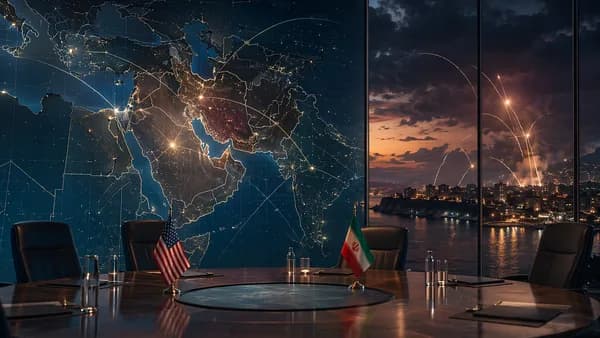
The Switzerland talks were supposed to turn an interim US-Iran deal into working terms, but the Strait of Hormuz dispute has turned them into a test of whether Washington can restrain a war it does not fully control.
XOOMAR Intelligence
Analyst Take
The US-Iran talks in Switzerland are due to begin at the Bürgenstock resort with JD Vance leading the US delegation and Mohammad Bagher Ghalibaf leading Iran’s side, according to Guardian World. The headline issue is no longer just maritime access or sanctions. Vance has put Lebanon on the table.
That changes the negotiation. Iran is not treating the Strait of Hormuz as a standalone file. It is tying reopening to Israel’s conduct in Lebanon, where fighting between Israel and Hezbollah has continued despite ceasefire claims. Washington can offer sanctions relief and access to frozen assets. Iran is signaling that those offers won’t settle the crisis unless the US can also deliver movement on Lebanon.
“I think we’re going to hopefully make progress on the nuclear issue, make progress on the Lebanon ceasefire issue. Those are the two big things that I think we’re to be focused on,” Vance said.
Hormuz closure turns Swiss diplomacy into a test of US leverage over Israel
The expected agenda was narrow: reopen the Strait of Hormuz, lift US sanctions on Iranian oil exports, and unfreeze Iranian assets held overseas. That was already difficult. Now the agenda has widened into a regional bargain.
The first clause of the memorandum of understanding published last week requires a ceasefire “on all fronts,” including Lebanon. Iran says continued Israeli operations there breach that understanding. Washington announced a renewed ceasefire in Lebanon on Friday, but the Guardian reported that Israeli troops again clashed with Hezbollah fighters the following day, with both sides accusing the other of breaking the truce.
That gap matters. It makes the US-Iran talks in Switzerland less about drafting language and more about proving control.
Before and after Lebanon entered the room:
- Before: Hormuz access, Iranian oil sanctions, frozen assets, nuclear limits.
- After: All of the above, plus whether Washington can make a Lebanon ceasefire credible.
- Pressure point: Iran can delay maritime normalization while blaming the US for failing to enforce the interim deal.
- US problem: Vance needs progress without making it look as if Washington is rewarding coercion.
This follows the same pressure line we flagged in Scrapped US-Iran Talks Trap Trump Between Iran, Israel, where the 60-day clock threatening talks was already colliding with military events outside the negotiating room.
The Switzerland agenda links oil sanctions, frozen assets, nuclear limits and Lebanon
Iran’s delegation shows where Tehran wanted the talks to go. The Guardian reports that the presence of the deputy oil minister and the governor of Iran’s central bank indicates Iran had aimed to focus on sanctions relief terms. That fits the original package: oil exports, frozen overseas assets, and reopening Hormuz.
Vance’s revised agenda pulls the negotiation into a more unstable frame. Nuclear restraint is now being discussed alongside Lebanon ceasefire enforcement. Those are different problems. A nuclear deal can be written between Washington and Tehran. A Lebanon ceasefire depends on Israel and Hezbollah, neither of which is described in the source material as a signatory to the US-Iran deal.
That makes the trade space fragile.
| File | Iran’s apparent focus | US focus | Weak point |
|---|---|---|---|
| Hormuz | Use closure threat as leverage | Restore passage | US disputes Iran’s control |
| Oil sanctions | Lift restrictions on exports | Secure broader deal terms | US domestic backlash |
| Frozen assets | Recover overseas funds | Tie relief to commitments | Iranian hardliners distrust US |
| Nuclear issue | Frame bomb ban as already acceptable | Get written restraint | Verification details unclear |
| Lebanon | Protect Hezbollah-linked interests | Stabilize ceasefire | Israel-Hezbollah clashes continue |
Iranian president Masoud Pezeshkian tried to sell the deal domestically, saying: “All the provisions of the memorandum of understanding signed between Iran and the United States are in our favour.” He also said: “Our $6bn in money will be returned from Qatar.”
The problem is that not everyone in Tehran agrees. Mahmoud Nabavian, a critic of the negotiations, claimed the talks were “fundamentally different” from the conditions approved by the new supreme leader, Mojtaba Khamenei. His state TV appearance was cut short, and legal action was reportedly announced against him.
The hard numbers show why Hormuz still dominates the room
The supplied reporting does not provide the usual global oil-share figures often cited in Hormuz coverage. The hard numbers here are narrower, but still revealing.
Donald Trump said last week that the world was four weeks from running out of sufficient refined oil and claimed there would have been worldwide recession if he had not agreed to reopen the strait by lifting the US blockade on Iranian oil ports. That is Trump’s claim, not an independently verified market estimate in the supplied material.
The US military also disputed Iran’s claim that the Strait of Hormuz was closed. AP reported that Capt. Tim Hawkins, a spokesperson for US Central Command, said:
“Iran does not control the Strait of Hormuz. Traffic continues to flow, and U.S. forces are monitoring the situation to ensure this remains the case.”
AP also reported that 55 merchant ships transited Saturday with more than 17 million barrels of oil.
That contradiction is the market-sensitive part, even without adding outside pricing claims. Iran says it has closed the strait. The US says traffic is flowing. Both statements can’t define the operating reality for long. Ships, governments and oil buyers need more than dueling press lines. They need predictable passage.
We covered the adjacent pressure tactic in Trump Toll Threat Jolts Strait of Hormuz Iran Talks, where the waterway became both a bargaining chip and a political weapon.
Tehran’s internal fight may be as dangerous as the US-Iran split
The most important fracture may be inside Iran. Pezeshkian is arguing that the memorandum favors Iran. Hardliners are warning that Washington cannot be trusted and that negotiators may have exceeded approved limits.
Khamenei’s reported position is especially sensitive. The Guardian says he published a letter opposing the talks but allowing them to proceed in deference to Pezeshkian, so long as the interests of the “axis of resistance,” a reference to Hezbollah, were protected.
That explains why Lebanon can’t be treated as a side issue. For Tehran’s hardliners, Lebanon is the test of whether negotiations are protecting Iran’s regional position or trading it away for sanctions relief.
Mohsen Rezaei, a military adviser to Khamenei, posted on X: “The enemy has shown itself to be a promise-breaker.” He added: “One should be cautious; any optimism will be exploited by the enemy.”
The US faces its own political squeeze. The Guardian reports Trump is under fierce attack from US supporters of Israel angry at personal attacks on Benjamin Netanyahu by Trump and Vance. That makes any Lebanon concession politically loaded, especially if Iran continues claiming leverage through Hormuz.
The next break point is whether Lebanon can be separated from Hormuz
The cleanest path from Switzerland would be a narrow de-escalation package: Iran eases its Hormuz position, Washington advances limited sanctions or asset steps, and both sides create a timetable for nuclear and Lebanon talks. That would not solve the conflict. It would buy space.
A messier outcome is more likely if negotiators produce vague language that lets everyone claim partial success while leaving enforcement unresolved. The Strait of Hormuz may appear open in practice while Iran preserves the right to say restrictions remain. Lebanon may get another ceasefire announcement while clashes continue.
The dangerous path is a stalled meeting. If Hormuz remains contested and Lebanon fighting continues, Washington faces pressure to respond with tougher sanctions, naval measures, or both. Iran would then have to decide whether its closure claim is symbolic pressure or something it is prepared to enforce.
The evidence to watch is concrete, not rhetorical: whether vessels keep transiting, whether Iran’s central bank and oil officials leave Switzerland with asset or export terms, whether Vance extends his stay beyond “a day or two,” and whether Israel-Hezbollah fighting actually stops. If those signals move together, the interim deal has a chance. If they split, the US-Iran talks in Switzerland will have exposed the central weakness of the bargain: Washington and Tehran can sign terms, but Lebanon may decide whether they hold.
The Stakes
- The Strait of Hormuz closure has turned a sanctions and maritime dispute into a wider regional crisis.
- Iran is tying any deal to Lebanon, raising pressure on Washington to influence events beyond its direct control.
- The talks will test whether the interim US-Iran understanding can survive renewed Israel-Hezbollah fighting.
How the Swiss talks agenda has shifted
| Original focus | Expanded focus |
|---|---|
| Reopen the Strait of Hormuz | Link Hormuz reopening to a broader regional ceasefire |
| Lift US sanctions on Iranian oil exports | Address Iran’s demand for movement on Lebanon |
| Unfreeze Iranian assets held overseas | Test whether Washington can influence Israel’s actions in Lebanon |
Primary Sources & Disclosures

Written by
XOOMAR
Data desk
XOOMAR is a capital markets software and data company. Every brief on this site starts from a dataset the company collects itself from primary sources (CFTC, SEC EDGAR, FINRA, the Federal Reserve, exchange APIs) and names the numbers it is built on, with a link to the data page so you can check them. Briefs are reviewed before they go out and corrected in place when the data is revised.