
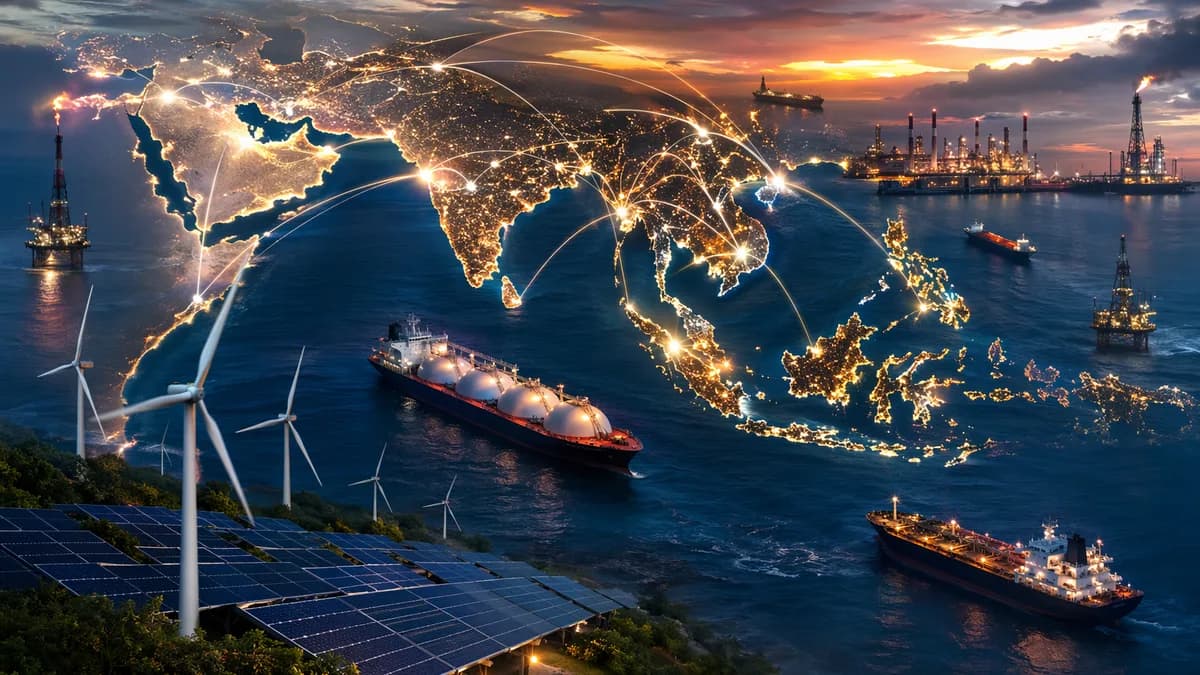
Southeast Asia assumed imported fuel could keep growth affordable, but the Iran war has turned that bargain into a Southeast Asia energy security liability. The International Energy Agency says the region’s reliance on oil and gas moving through the Strait of Hormuz has left it exposed to shocks that could cost “many billions of dollars” without faster diversification, according to ABC International.
Global TrendsJune 21, 2026· 8 min read· By XOOMAR Insights Team
Iran War Jolts Southeast Asia Energy Security Gamble
Updated on June 23, 2026
XOOMAR Intelligence
Analyst Take
67/ 100
4 sources analyzedLow confidenceTrend10Freshness99Source Trust85Factual Grounding90Signal Cluster60
The warning is blunt because the numbers are blunt. Southeast Asia’s energy import bill could rise to $245 billion by 2035, tripling from $80 billion in 2024, the IEA said. That is the core story beneath the headline: this isn’t just a wartime fuel-price scare. It is a stress test of an energy model built around imported fossil fuels, narrow supplier bases, and power systems that still need more domestic clean generation, better grids, and regional coordination.
“Diversification of energy sources and supply routes is now a central priority,” said Fatih Birol, the IEA executive director.
The Iran war scare exposes Southeast Asia’s fragile energy bargain
The old assumption was simple: imported oil and gas were risky in theory, but workable in practice. Ships arrived. Power plants ran. Consumers paid the bill, often with governments and utilities absorbing part of the volatility.
The Iran war has cracked that comfort. The IEA called it a “stark wake-up call” for Southeast Asia energy security because the region depends on oil and gas transported through the Strait of Hormuz, a route suddenly tied to Hormuz oil risk.
The source material points to a region already reacting. Electric vehicle sales are rising. Rooftop solar is booming in the Philippines. Governments are looking again at nuclear power. Laos has banned imports of fuel-powered vehicles for the rest of 2026 to cut oil imports and push EV adoption.
But the IEA’s message is that scattered responses won’t be enough. The deeper issue is structural: Southeast Asia still needs imported fossil fuels to keep power, transport, and industry moving. When a Middle East conflict disrupts confidence in those supplies, energy security, inflation, and climate policy collide.
A useful way to frame the shift:
- Before the shock: Imported fuel looked like a manageable cost of growth.
- After the shock: Imported fuel looks like a channel for inflation and crisis management.
- Before the shock: Clean power was mainly a decarbonization tool.
- After the shock: Clean power is also a hedge against fuel-route risk.
Southeast Asia’s oil and gas import risk is now visible in the bill
The IEA’s most important figure is the projected jump in the region’s energy import bill, from $80 billion in 2024 to $245 billion by 2035 if reforms lag. That projection turns energy security from a policy phrase into a balance-sheet problem.
The war has already pushed the region into what the report described as energy triage, with higher energy bills and rising inflation. The mechanism is straightforward. If imported oil and gas become more expensive or harder to secure, power generation costs rise. Transport costs can rise. Household electricity bills come under pressure. Governments face the choice of letting consumers absorb the pain or intervening to cushion the blow.
The IEA also said the crisis has reinforced reliance on coal during emergencies, a setback for efforts to phase down fossil-fuel dependence. That is the uncomfortable trade-off. In a crunch, governments may prioritize dispatchable power and price stability over transition goals.
This is where the Iran war connects directly to Southeast Asia energy security. The problem isn’t only whether prices spike today. It is whether power systems remain dependent on imported fuels whose supply routes can be rattled by events far outside the region.
Hormuz risk can reach households through power bills, not just fuel pumps
The source does not provide a country-by-country fuel exposure breakdown for Vietnam, Thailand, Singapore, or the Philippines, so the strongest supported conclusion is regional rather than granular: Southeast Asia’s power sector is too exposed to imported oil and gas from a limited number of suppliers.
Still, the IEA and AP reporting show how the shock is already moving through real economies. The Philippines declared a national energy emergency, and consumers have turned to rooftop solar at record rates as a quick response to rising utility bills.
“This is the first time I’ve seen a demand shock of this magnitude,” said Ivan Cano of Manila-based EcoSolutions.
The Philippines also became the second-largest destination for Chinese solar exports in the first quarter of 2026, with imports around three times higher than the same period last year, the IEA found.
That matters because it shows the transition is not only being driven by ministries or climate targets. Consumers are reacting to bills. They are buying panels. They are changing transport choices. The IEA said EV sales more than doubled in 2025 to around half a million units, and one in five cars sold regionally is electric.
For broader political context around the Iran war, XOOMAR has also covered the conflict’s cost debate in Obama Says Iran War Burned Billions and Left US Worse Off and the diplomacy surrounding a tentative end to the conflict in Trump's Iran Peace Deal Erases US Red Lines at Versailles.
Coal gets a crisis reprieve while nuclear gets a second look
The IEA report cuts against a clean, linear transition story. The war is spurring more renewables and EV adoption, but it is also strengthening coal’s role as emergency backup.
That contradiction is the point. When imported fuel systems wobble, governments reach for whatever keeps the lights on. The IEA said the conflict reinforced the need to rely on coal during energy crises. That does not mean coal solves Southeast Asia energy security. It means coal remains politically hard to abandon when reliability and affordability are under pressure.
Nuclear power is also back in the conversation. The report said the war is furthering nuclear plans in Southeast Asia, with Indonesia, Vietnam, and the Philippines possibly furthest along. But the IEA also flagged the obvious constraint: years-long construction and regulatory processes, with uncertain timelines.
That makes nuclear more of a medium-term option than a crisis response. Rooftop solar can appear on a home quickly. An EV purchase can cut fuel exposure immediately for a household. Nuclear power cannot be switched on as an emergency measure, especially in markets still working through construction, rules, and politics.
The winners from this shock are the technologies that cut imported fuel demand
The IEA’s prescription is not subtle. Southeast Asia needs to reduce overall demand for imported fossil fuels, make national grids more efficient, and invest more in solar, wind, hydro, and geothermal power. It also recommends regional energy sharing initiatives such as the Association of Southeast Asian Nations Power Grid.
That last point matters. Domestic renewables can reduce import exposure, but regional power sharing can spread resilience across borders if governments can overcome political barriers. Birol said the crisis could help neighboring nations move past barriers that have slowed the project.
Here is the practical split for stakeholders, based on the source and XOOMAR analysis:
| Stakeholder | Likely reading of the IEA warning |
|---|---|
| Governments | Energy diversification is now tied to inflation control and public stability, not only climate policy. |
| Utilities | Fuel volatility makes planning harder, especially when power systems still depend on imported fossil fuels. |
| Consumers | Rooftop solar and EVs become personal hedges against higher utility and fuel costs. |
| Clean-energy developers | The security case for renewables is stronger after the Iran shock. |
| Coal and gas operators | Crisis conditions may preserve demand, even as the IEA argues for reducing fossil-fuel imports. |
Sam Reynolds of the Institute for Energy Economics and Financial Analysis framed the moment sharply:
“The IEA report clearly highlights that Southeast Asia is at a crossroads.”
He also said that despite a tentative deal to end the Iran war, fossil fuel prices will likely remain high, meaning “we will see a push towards more ambitious clean energy deployment.”
By 2035, the gap will be between reformers and crisis managers
The IEA’s forecast gives policymakers a hard test: either reduce imported fossil-fuel exposure, or risk a $245 billion import bill by 2035.
The strongest scenario for Southeast Asia is not one technology winning everything. It is a mix: faster rooftop and utility-scale renewables, more efficient grids, wider EV adoption, regional power trading, and careful planning for technologies such as nuclear where timelines are long. The weakest scenario is familiar: emergency coal use, delayed reforms, and repeated exposure to fuel shocks whenever geopolitics turns hostile.
The evidence to watch is concrete. Does rooftop solar growth in the Philippines continue after the immediate shock? Do Indonesia, Vietnam, and the Philippines turn nuclear interest into credible timelines? Does Laos’ fuel-powered vehicle import ban become an outlier, or a signal of tougher transport policy? Does ASEAN power-grid cooperation move from aspiration to execution?
The Iran war has already answered one question. Southeast Asia’s imported-fuel model is not as safe as it looked. The next question is whether governments treat this as a temporary price problem, or as the energy-security warning the IEA says it is.
Impact Analysis
- Southeast Asia’s dependence on imported oil and gas leaves it vulnerable to war-related supply shocks through the Strait of Hormuz.
- The IEA warns the region’s energy import bill could triple by 2035 without faster diversification.
- Rising EV adoption, rooftop solar, nuclear reviews, and regional coordination are becoming central to energy security.
Southeast Asia Energy Import Bill Outlook
| Year | Energy import bill | Context |
|---|---|---|
| 2024 | $80 billion | Current level cited by the IEA |
| 2035 | $245 billion | Projected level if reliance on imported fuels persists |
Projected Rise in Southeast Asia's Energy Import Bill
2024
$ billion80
2035
$ billion245
Sources

Written by
XOOMAR Insights Team
Research and Editorial Desk
The XOOMAR Insights Team pairs automated research with human editorial judgment. We track hundreds of sources across technology, fintech, trading, SaaS, and cybersecurity, cross-check the facts, and explain what happened, why it matters, and what to watch next. We do not just rewrite headlines. Every article is fact-checked and scored for reliability before it goes live, and we link back to the original sources so you can verify anything yourself.
Explore More Topics
Related Articles
 Global Trends
Oil Shock Exposes Germany Energy Drag Behind Ifo Jump
Germany’s Ifo jump may be stale. Commerzbank sees oil costs capping 2026 growth at just 0.6%.
Jul 28, 20267 min
 Global Trends
Iran Seizes Control Over Strait of Hormuz Via Secret Oman Deal
Iran formalized a temporary shipping route with Oman, cementing Tehran's administrative control over the Strait of Hormuz while keeping blame for insecurity on
Aug 5, 20266 min
 Global Trends
Trump Iran Talks Turn Paused U.S. Strike Into Leverage
Trump paused U.S. strikes to force Iran back to talks, but the threat could deepen the Hormuz and nuclear standoff.
Aug 3, 20267 min
 Global Trends
Trump Shelves Iran Strikes Unless a Deal Lands Fast
Trump says Iran strikes are shelved only if a rapid deal opens Hormuz and ends the nuclear threat. The pressure hasn't vanished.
Aug 2, 20265 min
 Global Trends
US-Escorted Tankers Hit as Strait of Hormuz Shuts Down
Iran says it struck two US-escorted tankers, nearly closing Hormuz and forcing Trump to weigh war strategy as energy prices jump.
Jul 31, 20267 min
 Trading
Iran Demands Shipping Toll To Reopen Oil Chokepoint
Global markets rallied on news of the Strait of Hormuz reopening, but the deal would grant Iran unprecedented control to collect transit tolls.
Aug 6, 20266 min
 Trading
Gold's Lockstep Surge Hints at Dollar Replay
Gold is rallying alongside oil, breaking its traditional inverse relationship. This reveals a market shift—bullion is pricing a tangible inflation premium from
Aug 6, 20266 min
 Trading
WTI Crude Paralyzed at $74 Amid Hormuz Showdown
WTI crude prices are stuck near three-week lows, not due to calm but to paralysis as traders await a binary outcome for the Strait of Hormuz that could detonate
Aug 6, 20267 min
 Global Trends
Senators Hold Fauci in Contempt as COVID Probe Collapses
A Senate committee voted to hold Dr. Anthony Fauci in contempt of Congress, a partisan act his lawyer denounced as political theater that blocks real pandemic a
Aug 6, 20267 min
 Trading
Apollo Wins $5.7B EasyJet Takeover With Founder Backing
US private equity giant Apollo Global Management will acquire EasyJet for £5.7 billion (£7.15 per share), backed by the airline's founder, taking the iconic low
Aug 6, 20265 min
Don't miss the signal
Get our weekly roundup of the stories that matter across tech, fintech, and trading. No noise, just signal.
Free forever. No spam. Unsubscribe anytime.