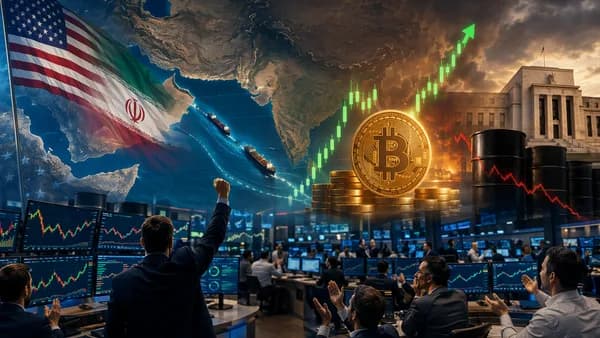
If WTI Oil can drop 2.54% while US-Iran talks are still fragile, how much of the recent rally was fear rather than supply?
XOOMAR
Summary
That is the real question behind Monday’s selloff. West Texas Intermediate traded around $74.50 at the time of writing after testing highs near $78.00 earlier in the day, according to FXStreet. The move suggests traders are not declaring the Middle East risk over. They’re simply refusing to keep paying peak prices for the worst-case scenario.
Why did WTI Oil fall so hard if no final Iran deal exists?
Because oil markets don’t wait for signed agreements when the risk they were pricing starts to look less immediate.
WTI Oil had been supported by a geopolitical premium tied to fears that US-Iran tensions could spill into physical supply. The key pressure point is the Strait of Hormuz, where roughly 20% of global energy supplies pass through the strategic waterway, according to the source material. A credible threat to that route can lift crude even before any barrels are actually disrupted.
Monday’s price action shows that premium getting cut back. WTI gave up earlier gains after testing near $78.00, then slid to around $74.50. That is not the same as a demand collapse. It is a repricing of disruption odds.
The trigger was diplomatic. Reports of progress in US-Iran discussions opened the door to further negotiations, even without a final agreement in place. For traders who had bought crude as protection against escalation, that was enough to take money off the table.
XOOMAR analysis: the market is not saying Iran risk has vanished. It is saying the probability of an immediate Hormuz-linked supply shock has fallen enough to make expensive fear trades harder to justify.
Why do Hormuz assurances move crude before any signed agreement?
Because the Strait of Hormuz is not a symbolic issue for energy markets. It is a physical chokepoint.
Reports that diplomatic efforts were aimed at keeping the strait open gave traders another reason to reduce risk exposure. The market did not need a signed agreement to react. It needed a lower perceived chance that the chokepoint would become the next point of escalation.
Those assurances hit the exact part of the oil market that had been carrying the most anxiety: whether energy flows could be interrupted. If investors believe shipping stays open, the case for a large geopolitical premium weakens quickly.
This is the same negotiation dynamic XOOMAR has tracked in earlier Hormuz coverage, where the timing of any framework mattered as much as the diplomatic language. A clearer negotiating path gives traders something more concrete than vague optimism, but it still leaves plenty of room for failure.
Fast-money positioning can amplify the move. When a feared supply shock looks less likely, traders who bought crude for protection or momentum may exit at the same time. That can make WTI Oil fall faster than the underlying diplomatic process is actually moving.
The danger is obvious. If talks stall, or if military rhetoric returns, the same risk premium can come back just as quickly.
What do the $74.50 level and 2.54% drop say about the risk premium?
The cleanest read is that traders are separating immediate headline risk from actual supply loss.
| Market signal | What it suggests |
|---|---|
| WTI near $74.50 | Traders are discounting a lower near-term disruption risk |
| Down 2.54% on the day | The move is sharp enough to show risk premium unwind, not routine drift |
| Highs near $78.00 earlier | Intraday sentiment flipped as diplomacy headlines gained weight |
| Hormuz still central | The market remains sensitive because roughly 20% of global energy supplies pass through the route |
The source does not establish that inventories, refinery demand, US production, the US Dollar, or global growth caused Monday’s move. Those factors matter structurally for WTI Oil, but the immediate driver here is clearer: investors reassessed the chance that Middle East tensions would interrupt flows.
That distinction matters. If crude falls because supply fears fade, the selloff can reverse if the fear returns. If crude falls because demand weakens or inventories swell, the pressure is usually harder to unwind with a single diplomatic headline.
The low-to-mid $70s now become the market’s proving ground. XOOMAR analysis: if WTI holds there while talks continue, traders may treat the risk premium as reduced but not erased. If it breaks lower without fresh demand or inventory data, that would suggest the fear trade had been more crowded than the fundamentals justified.
Who should treat this as signal, and who should treat it as noise?
Short-term traders should treat it as a signal. Everyone else should treat it as conditional.
For crude traders, the message is direct: diplomacy is now a price driver, not background noise. The oil market is reacting to the perceived probability of uninterrupted Hormuz flows. That puts every comment from Washington, Tehran, and mediators into the pricing machine.
For producers and exporters, the signal is more mixed. Lower escalation risk is positive because it reduces the chance of a regional shock. But lower crude prices can also pressure revenue assumptions if the decline persists. The supplied source does not give company-level or country-level budget data, so the analysis should stop there.
For consumers and businesses, the source supports only a limited inference. If crude weakness persists, it can reduce pressure in downstream fuel markets, but the pass-through depends on factors not provided in the source. A one-day WTI Oil drop tied to diplomacy is not enough to make a firm claim about pump prices, freight costs, or inflation.
For policymakers, the same caution applies. Softer oil can help reduce headline price pressure, but officials would need evidence that the move is durable. One diplomatic opening does not prove an energy trend.
This is why Hormuz Closure Turns US-Iran Talks Into Leverage Test remains relevant context. The market is not only pricing barrels. It is pricing leverage, credibility, and the possibility that threats around a chokepoint become bargaining tools again.
Which evidence would prove this WTI Oil selloff has further to run?
The next phase depends on whether the diplomatic track produces durable signals or another shock.
The de-escalation path is straightforward: US-Iran talks keep advancing, Hormuz remains open, and technical negotiations continue. In that scenario, WTI Oil could keep shedding the premium tied to immediate disruption fears.
A choppier path is also plausible. Talks improve, but uncertainty lingers. Traders then keep WTI in a low-to-mid $70s range while waiting for harder evidence: formal commitments, stable shipping conditions, and fewer threats from either side.
The shock path is still alive. Diplomatic optimism can fade quickly if negotiations stall, rhetoric hardens, or shipping risk around the Strait of Hormuz rises again. That is the fragility inside Monday’s selloff: the market is favoring, for now, a scenario where oil flows remain uninterrupted and relations gradually normalize. But it has not priced in certainty.
XOOMAR analysis: the strongest confirmation of this move would be continued talks, no disruption around Hormuz, and WTI failing to recover even when rhetoric flares. The clearest warning sign would be a breakdown in negotiations or renewed threats to shipping. Until physical supply is threatened, traders are likely to fade fear-driven rallies faster than they did when the Hormuz risk looked less contained.
Disclaimer: This XOOMAR analysis is for informational and educational purposes only. It is not financial, investment, legal, tax, or professional advice. It does not provide buy, sell, hold, price-target, portfolio, or personalized recommendations. Verify information independently and consult qualified professionals before making decisions.
The Bottom Line
- WTI’s 2.54% drop shows traders are cutting the geopolitical risk premium rather than pricing in a supply collapse.
- Progress in US-Iran talks reduced fears of an immediate Strait of Hormuz disruption, where roughly 20% of global energy supplies pass through.
- Oil remains sensitive to diplomacy because even partial assurances can quickly unwind fear-driven price gains.
WTI Oil Price Move
Primary Sources & Disclosures
This article was written with AI tools. It's information, not investment, legal or tax advice. Editorial policy

Written by
XOOMAR
Data desk
XOOMAR publishes free market data from primary sources, with an open API. When something we publish is wrong, it's corrected in place.