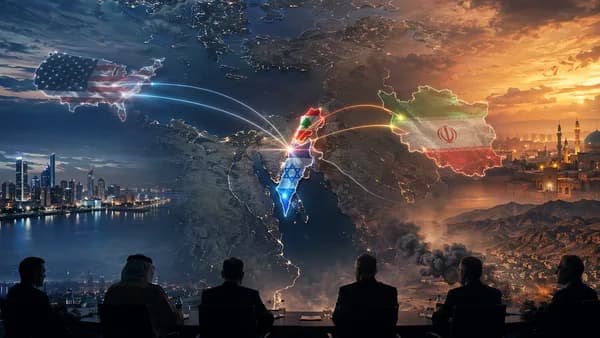
Vance Iran talks in Switzerland produced the first concrete architecture for ending the Iran war: a 60-day negotiating window, tentative mechanisms for the Strait of Hormuz, and a Lebanon deconfliction track that neither Israel nor Hezbollah has formally signed onto.
XOOMAR
Summary
Vice President JD Vance said the talks with senior Iranian officials created a “good foundation for a successful final deal,” according to Independent World. That phrase matters. It’s optimistic enough to signal progress, but careful enough to avoid claiming a breakthrough while technical teams are still negotiating.
XOOMAR analysis: the Switzerland track is less a peace deal than a pressure test. Washington is trying to convert wartime leverage, sanctions pressure, and energy market stress into a structured settlement before the interim agreement’s clock runs out. Iran is testing whether it can get sanctions relief, reopen trade channels, and keep control over key regional questions without looking like it surrendered.
“We haven’t built the house, but we’ve laid a successful foundation to get to a good place for the American people,” Vance told reporters.
That is the right metaphor for where this stands. Foundation, not house. Process, not peace.
Vance Iran talks turn Hormuz from battlefield leverage into the first test of a deal
The most immediate test is not Tehran’s nuclear program. It’s whether ships can move through the Strait of Hormuz without treating every transit as a wartime calculation.
The strait has become one of the most sensitive pieces of the diplomacy because any disruption there would carry consequences far beyond the region. The talks are aimed at reducing Hormuz risk and turning a potential flashpoint into a monitored channel for de-escalation.
That is why the Vance Iran talks matter for markets before they matter for diplomats. Even without a final settlement, the prospect of a mechanism around Hormuz can shift expectations about risk, shipping, and escalation.
As we noted in Hormuz Closure Turns US-Iran Talks Into Leverage Test, the strait gives Iran a pressure point that reaches well beyond the battlefield. The new talks are an attempt to turn that pressure point into a structured test of whether de-escalation can hold.
The 60-day clock is the deal’s strongest discipline and its biggest danger
The interim agreement sets a 60-day period for negotiations on core issues, including the future of Tehran’s nuclear program. The U.S. and its partners remain concerned Iran wants to use the program for military purposes. Iran denies that claim.
The measurable pieces now matter more than diplomatic tone:
| Issue | Reported status | Why it matters |
|---|---|---|
| Negotiation window | 60 days | Creates urgency, but compresses hard sequencing fights |
| Hormuz track | Central to de-escalation talks | Tests whether battlefield leverage can become a monitored channel |
| Shipping confidence | Still dependent on implementation | Sets the benchmark for real recovery |
| Sanctions relief | Under discussion in the wider process | Links economic incentives to diplomatic progress |
| Market reaction | Risk expectations remain sensitive | Traders are pricing probability, not certainty |
| Lebanon ceasefire | Appeared to be holding Monday evening | Tests whether a U.S.-Iran mechanism can influence non-signatories |
XOOMAR analysis: sanctions relief is not just an economic question. It is a sequencing tool. Washington can offer limited, conditional relief while keeping the larger sanctions question tied to technical progress. Iran gets a visible benefit. The U.S. keeps a lever.
Nuclear access is already becoming a dispute inside the Switzerland track
The nuclear file remains the hardest piece because even the reported progress is contested.
NBC News reported that Vance said Iran had agreed to allow International Atomic Energy Agency inspectors back into the country. But Iranian Foreign Ministry spokesman Esmail Baghaei said Iran’s cooperation with the IAEA would continue “according to its normal procedure” and that Iran had “not accepted any new commitments.”
That gap is not semantic. It goes to the center of any Iran war deal.
If Washington believes inspectors are returning under expanded or restored access, while Tehran describes only routine cooperation, the Switzerland track will hit verification friction fast. As we reported in Iran Nuclear Inspectors Claim Throws Vance Into Access Fight, inspection access is where diplomatic optimism becomes enforceable detail.
Vance’s own language acknowledged the risk.
“Letting in the inspectors is a big deal, but, again, we’re going to see what they actually let the inspectors do once they’re in the country,” Vance said.
That is the real test. Not whether inspectors enter. What they can inspect, when they can inspect it, and what happens if access is blocked.
Lebanon is the first proof point because Israel and Hezbollah are outside the deal
Iran has insisted that fighting in Lebanon must be addressed as part of any wider settlement. That makes the Israel-Hezbollah front a live test of whether U.S.-Iran diplomacy can affect actors not formally bound by the agreement.
Foreign Minister Abbas Araghchi wrote on X that mediators delivered “major progress to end the Lebanon War.” He also said the first “real test” would be whether the mechanism stops the fighting between Israel and Hezbollah.
The source material is clear on the fragility. Neither Israel nor Hezbollah is a signatory to the U.S.-Iran deal. Still, as of Monday evening in the Middle East, the ceasefire appeared to be holding. Tilak Pokharel, a spokesperson for UNIFIL, said:
“We have not detected trajectories from either side since yesterday.”
He also said airspace violations and Israeli military movements continued. Hezbollah had not announced attacks on Israeli forces since Saturday. The lull was the longest since the latest Israel-Hezbollah war began on March 2.
XOOMAR analysis: Lebanon is where the deal’s indirect power gets measured. If fighting stays paused, the Switzerland mechanism gains credibility. If it breaks, the 60-day clock keeps ticking while trust collapses.
Trump’s food-for-assets idea turns sanctions relief into a political transaction
President Donald Trump did not attend the “Lake Lucerne Summit,” but the source says his presence loomed over the talks. His comments offended the Iranians, and Vance said Iran had threatened to walk out over Trump’s remarks, according to the additional source material.
Still, Trump framed the issue around “respect” from Iran.
“As long as they respect us, I don’t want to use the word fear because that’s an inappropriate word, but as long as they respect us, we’re not going to have any trouble,” Trump said from the Oval Office.
Vance also floated a sanctions-relief structure tied to food purchases. He said Jared Kushner, Trump’s son-in-law and one of the lead U.S. negotiators, developed the idea with officials from Qatar. Under the proposal, unfrozen Iranian assets would be used to buy U.S. soy, corn and wheat, with Qatar approving the process.
Iran has not commented on the idea, according to the source material.
XOOMAR analysis: this is an attempt to make sanctions relief sellable at home. Instead of presenting asset access as a concession to Tehran, the administration can frame it as Iranian money buying American agricultural products “for the benefit of the Iranian people,” as Vance put it. Whether Iran accepts that structure is another matter.
The next phase has three paths: partial pause, phased deal, or renewed escalation
The most realistic near-term outcome is a partial, conditional pause rather than a sweeping peace deal. The source material supports that reading: Hormuz remains a central concern, Lebanon is quieter but not fully settled, nuclear inspection claims are disputed, and technical teams are still negotiating.
Three scenarios now define the Vance Iran talks:
- Fragile pause: shipping confidence improves, the Lebanon ceasefire holds, and negotiators postpone the hardest nuclear questions while preserving the 60-day process.
- Phased framework: sanctions relief, inspection access, shipping guarantees, and Lebanon deconfliction are tied together in enforceable steps.
- Breakdown: talks stall over verification, sanctions sequencing, or non-signatory actors, and energy markets rebuild risk premiums around the Gulf.
The evidence to watch is concrete. Safer and more predictable movement through the Strait of Hormuz. Public Iranian acceptance of inspection terms beyond routine cooperation. Continued absence of Israel-Hezbollah fire. Clarity on how sanctions relief would be structured.
If those indicators improve together, Vance’s “foundation” starts to look real. If they split apart, Switzerland becomes another venue where the architecture looked better than the ground underneath it.
Impact Analysis
- The 60-day negotiating window creates a limited timeframe for turning wartime diplomacy into a possible settlement.
- Stability in the Strait of Hormuz matters because disruption there could affect global energy markets.
- The lack of formal buy-in from Israel and Hezbollah leaves a major regional deconfliction track unresolved.
Key Positions in the Switzerland Track
| Actor | Main Objective | Status |
|---|---|---|
| Washington | Convert wartime leverage, sanctions pressure, and energy market stress into a structured settlement | Pushing a 60-day negotiating window |
| Iran | Seek sanctions relief, reopened trade channels, and influence over regional questions | Testing terms without appearing to surrender |
| Israel and Hezbollah | Central to the Lebanon deconfliction track | Neither has formally signed on |
Primary Sources & Disclosures

Written by
XOOMAR
Data desk
XOOMAR publishes free market data from primary sources, with an open API. When something we publish is wrong, it's corrected in place.