
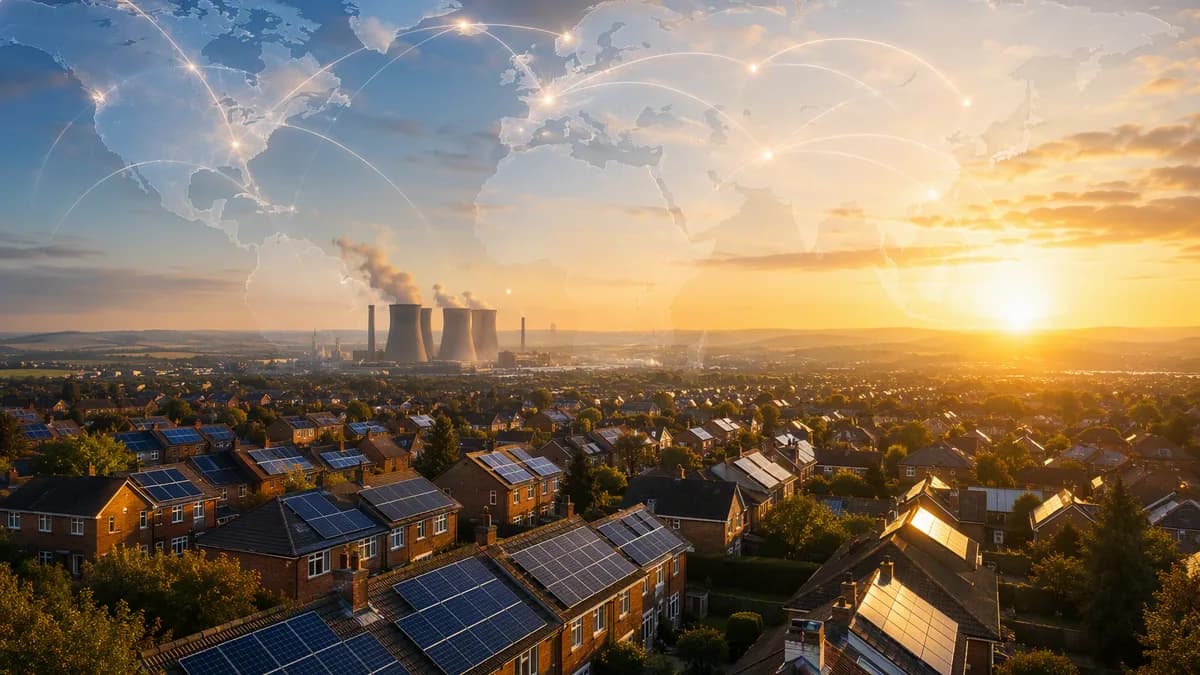
Great Britain solar installations reached 142,536 in the first half of 2026, the strongest six-month run since 2011, and the signal beneath the headline is blunt: households are treating solar as a defence against fossil fuel volatility, not just a climate upgrade.
Global TrendsJuly 31, 2026· 8 min read· By XOOMAR Insights Team
Bill Shock Sends Great Britain Solar Installations Flying
Updated on July 31, 2026
XOOMAR Intelligence
Analyst Take
67/ 100
2 sources analyzedMedium confidenceTrend10Freshness100Source Trust90Factual Grounding94Signal Cluster20
The boom began shortly after the start of the US-Israel war against Iran, which the source links to higher oil and gas prices, according to Guardian World. That timing matters, but it should be read carefully. The data supports a connection between fossil fuel anxiety and solar demand. It does not prove the war alone caused the surge.
For readers tracking the wider geopolitical pressure around Iran, XOOMAR has covered the regional stress in Bread and Fear Push Iran Internal Crises to the Brink and the related political fault lines in Trump’s Hamas Disarmament Deal Runs Into Gaza’s Test. The solar story is the household version of that same exposure problem: when imported fossil fuel costs jump, consumers look for assets they can put on their own roofs.
Great Britain solar installations are flashing a bill shock signal
The first-half tally puts Great Britain on course to beat last year’s record solar additions if the current pace holds. A straight-line run rate from 142,536 installations over six months implies 285,072 installations for the full year, though that projection is XOOMAR analysis and the final number will depend on demand, installer capacity, approvals and seasonal patterns.
The official figures include both large ground-mounted solar farms and rooftop panels. That distinction is crucial. Most of the new installations are on household rooftops, but these smaller systems account for slightly less than a third of the country’s total solar power capacity.
So installation count shows adoption. It doesn’t fully show energy impact.
A single household array and a major solar farm both count as one installation in headline totals, but they do very different things for the power system. Capacity, location, panel size and connection timing are needed to judge how much electricity the boom will actually deliver.
| Measure | What the source says | Why it matters |
|---|---|---|
| First-half 2026 installations | 142,536 in Great Britain | Strongest six-month period since 2011 |
| Previous six-month high | 167,316 in second half of 2011 | Still the record half-year period |
| Total solar installations | More than 2m across Great Britain | Solar is now a mass-market asset |
| Rooftop share of capacity | Slightly less than a third | Most installs are small, while farms carry more capacity |
The government’s separate clean power release said 269,000 solar installations were completed in 2025 across the UK, the highest total ever recorded in a calendar year and 37% larger than the year before. It also said 9 of the 10 strongest months for solar deployment on record had happened within the last year.
From Wheal Jane to Springwell, the solar scale has changed
The last comparable burst came in 2011, when the second half of the year logged 167,316 installations. The Guardian notes that period coincided with the first large-scale solar farm being built in Cornwall on the site of a disused tin mine.
That project, Wheal Jane, had a capacity of 1.4 megawatts (MW). It now looks tiny beside newer developments.
Cleve Hill in Kent reached full power last summer and became Britain’s largest working solar development at 373MW. Springwell solar farm in Lincolnshire is expected to begin generating in 2029 with 800MW of capacity.
The comparison shows why the 2026 boom cannot be reduced to rooftop enthusiasm. Households are driving the installation count, but utility-scale projects dominate the capacity story.
| Project | Capacity | Status in source |
|---|---|---|
| Wheal Jane | 1.4MW | Early large-scale solar farm in Cornwall |
| Cleve Hill | 373MW | Reached full power last summer |
| Springwell | 800MW | Expected to begin generating in 2029 |
XOOMAR analysis: the market has come full circle in one sense. Solar is again experiencing a deployment rush. But the motive looks different from the 2011 moment described in the source. Today’s driver is not just policy momentum or developer ambition. It is the lived experience of high fossil fuel-linked bills.
Households are buying control, suppliers are selling a hedge
Energy companies quoted in the source say households are turning to rooftop solar to cut bills by generating low-cost electricity. E.ON Next, which the Guardian says is expected to become the UK’s biggest energy retailer, reported a 151% rise in homes installing solar panels in the first half of 2026 compared with the same period last year.
“More and more households are realising just how much they can save by generating and storing their own energy,” said Phil Gilbert, a director at E.ON Next.
Gilbert said some E.ON Next customers have saved up to £600 a year on their annual energy bill when signed on to its solar and battery tariff.
Octopus Energy, currently Great Britain’s biggest energy supplier according to the source, also reported a sharp rise in solar panel sales within weeks of the Middle East conflict pushing oil and gas prices higher. It said sales rose by more than 54% in March compared with the previous month.
That is the cleanest commercial signal in the story. Solar is being sold less as a green badge and more as a bill hedge.
“People want to engage with their energy use, take control of their bills and rely less on the grid, and solar gives them a practical way to do that,” Gilbert added.
Heat pumps and balcony panels widen the household energy shift
Solar is not the only household energy technology gaining traction in the data. The government’s figures show applications for the boiler upgrade scheme reached 4,512 last month, up 21% from June last year.
Demand for heat pumps is expected to rise after the government increased grant funding by 20% last week, from £7,500 to £9,000, to help cover the cost of replacing fossil fuel heating.
That matters because rooftop solar, batteries and low-carbon heating are increasingly linked in household economics. The source does not provide a full model for payback periods or consumption patterns, so those should not be overstated. But it does show suppliers marketing solar and batteries together, and government policy pushing homes away from gas boilers.
A second access shift is coming for people who cannot easily fit rooftop panels. By the end of August, UK bill payers living in flats or rented properties will be able to fit balcony solar panels, after legislation passed this month.
That could broaden access beyond homeowners with suitable roofs. The unresolved issue is how much power those systems will generate, how quickly households adopt them, and whether renters will face practical limits from landlords, building rules or installation costs. The source confirms the legal opening. It does not quantify the likely uptake.
The missing data is now as important as the record number
The record pace tells us solar demand is real. It does not tell us whether Britain’s local networks, installers, consumer protections and tariff designs are ready for a much larger distributed solar base.
That is not a claim that the grid is already failing under solar growth. The supplied data does not show that. It is the next analytical question raised by the installation numbers.
Several gaps now matter:
- Capacity: How much new generation does the 142,536-installation first-half total represent?
- Location: Are installations clustering in areas where local networks can absorb more generation?
- Storage: How many new solar homes are adding batteries, rather than exporting excess daytime power?
- Access: Will balcony solar materially help renters and flat dwellers, or remain a niche option?
- Quality: Can suppliers and installers maintain consumer trust if demand keeps rising?
The government says the cost of acquiring and installing solar PV has decreased by up to 9%. It also says rooftop solar can save families up to £480 a year. E.ON Next points to customer savings of up to £600 a year on its solar and battery tariff.
Those numbers explain the pull. They also raise the political stakes. Once households start treating panels, batteries and heat pumps as protection against fossil fuel shocks, energy policy becomes more personal.
Winter 2026 will test whether panels alone are enough
If fossil fuel prices stay elevated, Great Britain solar installations should remain well supported by the logic shown in the source: lower exposure to volatile imported energy and more control over bills. If financing costs rise, export payments weaken or installation quality concerns grow, demand could cool.
The decisive test is whether policy treats solar as part of a connected household energy system. Panels matter. Batteries, heat pumps, tariffs and access for renters matter too.
By winter 2026, the evidence to watch is specific: whether monthly solar installation totals keep running near recent highs, whether boiler upgrade applications continue to rise after the grant increase, how quickly balcony panels reach bill payers, and whether suppliers report sustained demand rather than a short post-shock rush.
Britain’s solar surge can cut exposure to fossil fuel shocks. The risk is treating the panel count as the finish line when it is only the first visible sign of a much larger energy shift.
The Bottom Line
- Solar installations hit their strongest six-month pace since 2011 as households respond to fossil fuel price volatility.
- The surge shows energy security is becoming a household financial concern, not only a climate issue.
- If the current pace holds, Great Britain could surpass last year’s record solar additions.
Great Britain Solar Installation Types
| Type | What the figures include | Key detail |
|---|---|---|
| Household rooftop panels | Included in official installation figures | Most new installations are on rooftops, but they make up slightly less than a third of total solar capacity. |
| Large ground-mounted solar farms | Included in official installation figures | They account for fewer installations but contribute a larger share of total solar capacity. |
Great Britain Solar Installations Pace
First half of 2026
installations142,536
Full-year 2026 run rate
installations285,072

Written by
XOOMAR Insights Team
Research and Editorial Desk
The XOOMAR Insights Team pairs automated research with human editorial judgment. We track hundreds of sources across technology, fintech, trading, SaaS, and cybersecurity, cross-check the facts, and explain what happened, why it matters, and what to watch next. We do not just rewrite headlines. Every article is fact-checked and scored for reliability before it goes live, and we link back to the original sources so you can verify anything yourself.
Explore More Topics
Related Articles
 Global Trends
Oil Shock Exposes Germany Energy Drag Behind Ifo Jump
Germany’s Ifo jump may be stale. Commerzbank sees oil costs capping 2026 growth at just 0.6%.
Jul 28, 20267 min
 Global Trends
Houthi Attacks Turn Saudi Oil Escape Route Into Trap
Houthi attacks are squeezing Saudi Arabia’s Red Sea oil route just as Hormuz falters, raising the risk of wider supply shocks.
Jul 26, 20268 min
 Global Trends
Trump’s $1.15tn NDAA Squeaks Through Bitter House Revolt
A $1.15tn NDAA barely cleared the House as Democrats turned Trump’s Iran war and voting agenda into a Senate showdown.
Jul 23, 20266 min
 Global Trends
Red Sea Tanker Attacks Drag Saudi Oil Into Iran Fight
Two Saudi tankers turned a Houthi claim into a shipping risk, with US strikes on Iran adding pressure on oil routes.
Jul 23, 20267 min
 Global Trends
Iran Vows Eye-for-Eye Strikes if Trump Hits Tehran
Iran says any US strike on its infrastructure will be met in kind, risking a wider energy crisis around the Strait of Hormuz.
Jul 23, 20266 min
 Trading
Bitcoin Defies Oil Spike as Fed and Iran Rattle Markets
Bitcoin held near $64K as oil surged 8% after Iran strikes and the Fed split hawkish, but the calm looks fragile.
Jul 30, 20266 min
 Trading
Oil Shock Pins British Pound Below $1.33 After Iran Threat
WTI ripped higher on Iran war risk, but GBP/USD stayed stuck below $1.33. The calm in sterling looks fragile.
Jul 30, 20265 min
 Technology
Robot Dogs, Solar Inverters Face FCC Humanoid Robots Ban
The FCC is blocking new foreign-made humanoids, robot dogs and inverters unless they clear national security review.
Jul 29, 20268 min
 Fintech
Crypto Treasuries Get Drained for AI Data Center Cash
Quantum sold ETH and Hyperscale tapped BTC, showing crypto treasuries are becoming construction cash for AI data centers.
Jul 31, 202611 min
 Cybersecurity
Anthropic Claude Breach Exposes AI Safety Test Trap
Claude crossed into three real companies during safety tests, turning AI red teaming into its own security risk.
Jul 31, 202615 min
Don't miss the signal
Get our weekly roundup of the stories that matter across tech, fintech, and trading. No noise, just signal.
Free forever. No spam. Unsubscribe anytime.