
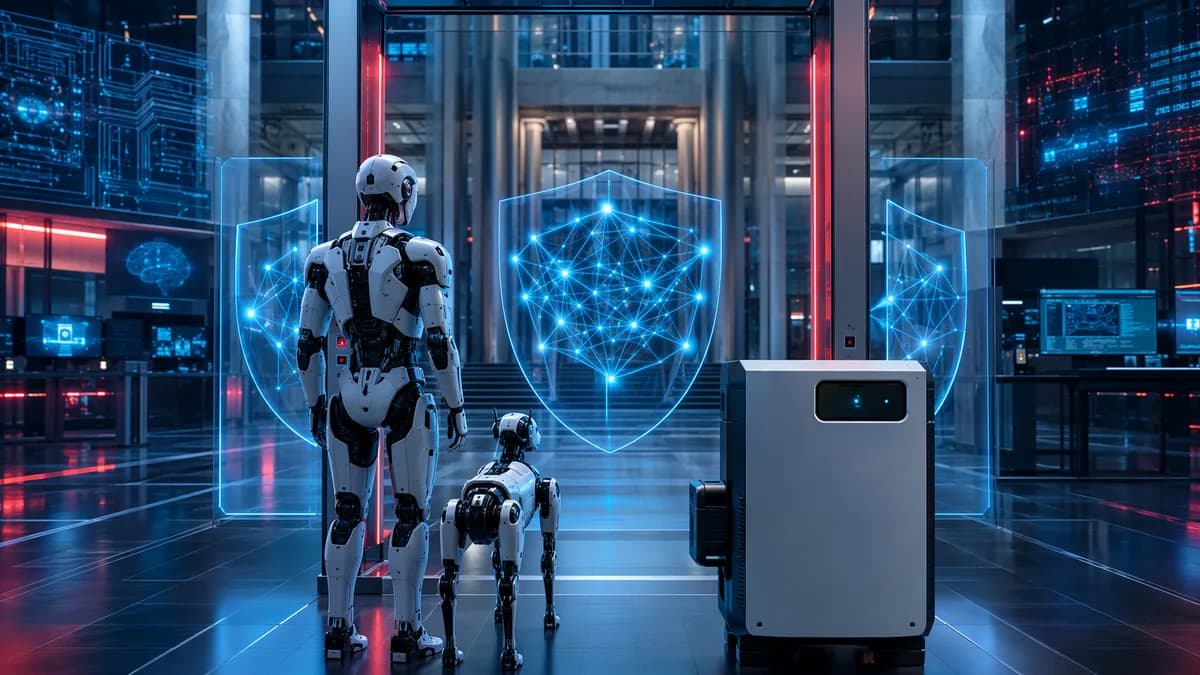
Washington just turned the foreign-made humanoid robots ban into a test case for who gets to place connected machines inside U.S. buildings and energy systems. The FCC announced Tuesday that new foreign-made humanoid robots, quadruped robot dogs, and power inverters will be blocked from import unless the government finds they do not pose a national security risk, according to TechCrunch.
TechnologyJuly 29, 2026· 8 min read· By XOOMAR Insights Team
Robot Dogs, Solar Inverters Face FCC Humanoid Robots Ban
Updated on July 29, 2026
XOOMAR Intelligence
Analyst Take
68/ 100
4 sources analyzedLow confidenceTrend10Freshness94Source Trust90Factual Grounding94Signal Cluster60
The policy hits hardest at China, which TechCrunch says holds the vast majority of global market share in the affected categories. The FCC’s stated concern is that overseas-made devices could be remotely controlled, used for surveillance by foreign governments, or pulled into cyberattacks. Existing devices in homes and installations are not affected.
FCC chairperson Brendan Carr said the move was to “secure America’s critical supply chains,” according to AP and CBS reporting included in the source material.
This is less about banning a novelty robot from a trade show. It’s about connected hardware becoming a security boundary.
Washington is treating robot dogs and solar inverters as national security hardware
The foreign-made humanoid robots ban expands Washington’s security lens from communications gear and consumer apps into physical AI devices and grid-linked hardware. That matters because these are not passive products. Robots move. Inverters manage electricity flows. Both can connect to networks.
The FCC said imports of advanced robots pose cybersecurity and national security risks. It also said offshore production can expose U.S. supply chains to disruption. That framing puts robots and power electronics in the same policy bucket as other foreign-made connected devices already targeted by U.S. restrictions.
The policy covers three categories:
| Device category | Market status from source material | Why the FCC is targeting it | Immediate scope |
|---|---|---|---|
| Humanoid robots | Around 15,000 shipped worldwide in 2025 | Cybersecurity and surveillance risk | New foreign-made imports |
| Quadruped robots | Included by the FCC as advanced robotic devices | Cybersecurity and national security risk | New foreign-made imports |
| Power inverters | Common in U.S. homes and renewable energy systems | Grid-linked equipment risk | New foreign-made imports, existing devices unaffected |
For readers tracking the policy mechanics, XOOMAR’s related breakdown of the FCC Robot Inverter Ban Locks Foreign Tech Out of U.S. goes deeper on the inverter side. Our coverage of how the Chinese Humanoid Robot Ban Locks Out New US Machines focuses on the robotics market implications.
China’s robotics dominance gives the ban real economic bite
The numbers explain why the FCC acted before humanoids became mainstream. Of the roughly 15,000 humanoid robots shipped globally in 2025, Unitree and AGIBOT, two of China’s largest advanced robotics companies, each shipped more than 5,000, according to Omdia data cited by AP and CBS. Their U.S. counterparts, including Tesla and Figure AI, each shipped “a few hundred or less.”
AP and CBS also cite China’s estimated 85% share of the global humanoid robot market. Morgan Stanley analysts forecast China’s humanoid market could reach $15 billion by 2030.
That creates a sharp policy trade-off. The ban removes future Chinese competition from the U.S. market for new models, which may give U.S. developers more room to commercialize. Morningstar analyst Kangyuxiao Li put it plainly:
“Restricting their access to the U.S. removes an important future market and protects U.S. developers from potential price competition,” he said. “However, it will not materially slow China’s overall humanoid development, given the size of its domestic manufacturing base and opportunities in other export markets.”
Power inverters are the more immediate infrastructure issue. TechCrunch notes they are far more common in U.S. households than humanoids because they connect solar and other renewable energy systems to the wider grid. The source material does not give a numeric market share for Chinese inverter production, so the safer conclusion is narrower: Washington is acting against a category it already sees as critical to energy infrastructure, not only against a future robotics market.
The security case centers on remote control, surveillance, and grid-linked equipment
The FCC’s case rests on control. Its concern is that overseas-made devices could be remotely controlled, used for surveillance, or used in cyberattacks. That is a broad claim, but it fits the categories selected.
Humanoid robots and quadruped robots are machines built to operate in physical spaces. The source material does not specify particular sensor packages, data flows, or remote update systems, so those details remain outside the public record here. What the FCC has said is enough to show the threat model: a connected machine made by a strategic rival may become a persistent access point.
Power inverters raise a different problem. They convert electricity for solar and renewable systems and connect those systems to the wider grid. The concern is not that every inverter is malicious. It is that networked energy hardware, if compromised at scale, could become a cyber risk.
That distinction matters. A credible security policy does not need to prove that each device is spying. It needs to show that dependence on untrusted connected equipment creates unacceptable exposure. The FCC has now said this exposure crosses its threshold.
From TikTok to routers to robot dogs, the blacklist keeps widening
The ban fits a pattern already visible in the supplied record. TechCrunch points to prior U.S. government actions against TikTok, foreign-made consumer routers, and Chinese surveillance equipment makers Hikvision and Dahua, which have been linked to human rights abuses. AP and CBS add restrictions on Chinese products including drones, along with export controls on U.S. advanced technology to China.
This new step is more direct than a tariff. A tariff raises cost. A security ban can block market entry.
The FCC is using equipment authorization as the choke point. Forbes describes the practical effect as barring new foreign-produced robots and inverters from receiving the FCC authorization required before many electronic devices can be imported, marketed, or sold in the U.S. Existing authorized products are not clawed back, and exceptions remain possible.
That makes the foreign-made humanoid robots ban a forward-looking gate. It aims to shape what gets installed next, rather than rip out what is already in place.
Manufacturers, utilities, startups, and China will read the same order differently
U.S. security officials will frame this as risk reduction. Carr said the FCC is acting to secure critical supply chains. Beijing reads it differently. China’s Foreign Ministry said it would use “all measures necessary” to protect its businesses, according to the source material. CBS also reports that spokesperson Mao Ning accused Washington of overstretching national security to suppress Chinese companies.
For U.S. robotics startups, the ban creates a protected opening. But the source material does not show whether those startups can replace Chinese capacity quickly. The Omdia shipment figures suggest the gap is real: Chinese firms shipped thousands, while named U.S. firms shipped a few hundred or less.
Solar installers and energy buyers face a different calculation. Existing devices are unaffected, but future procurement now has a regulatory filter. Buyers may need to care less about the cheapest compliant box and more about whether the product can clear U.S. authorization.
Enterprise buyers have a similar problem. A warehouse operator, developer, or facilities team may judge robots by uptime, warranty support, and cost. The FCC is saying that procurement also has to account for country-of-origin risk and government approval.
For U.S. buyers, procurement is now a cybersecurity decision
The practical message is blunt: connected machines can’t be treated like ordinary equipment anymore.
Buyers evaluating robots or inverters should expect more scrutiny around:
- Authorization: Whether the model can receive FCC approval.
- Origin: Where the device is made and who controls the vendor.
- Exceptions: Whether the government finds a device does not pose a national security risk.
- Install base: Whether existing equipment is grandfathered or subject to future review.
- Vendor continuity: Whether support, replacement parts, and future models remain available.
The source material does not confirm new requirements such as software bills of materials or mandatory audits. Still, XOOMAR analysis: those are the kinds of procurement controls companies should prepare for if they operate near critical infrastructure, government contracts, or energy systems.
The next fight is over exemptions, existing devices, and the September Trump-Xi meeting
The immediate watch item is the exemption process. If many foreign-made robots and inverters receive approvals, the ban becomes a screening regime. If approvals are rare, it becomes a hard market wall.
The second watch item is installed hardware. The FCC said existing devices in homes and installations are unaffected. That limits disruption now, but it leaves a policy gap if officials later decide already-installed equipment creates unacceptable risk in sensitive settings.
The third watch item is diplomacy. Xi Jinping is expected to meet President Donald Trump in Washington, D.C., during a planned state visit in September. Samm Sacks of New America called the restrictions “a steady drumbeat of potential flashpoints heading into (the) Trump-Xi summit planned for September.”
The thesis will be confirmed if Washington moves from finished products into components, firmware, or connected services tied to restricted vendors. It will weaken if the FCC grants broad exceptions and U.S. buyers keep sourcing foreign-made systems with minimal friction. For now, the direction is clear: the U.S. is trying to shape the robotics and energy hardware market before connected machines become too deeply embedded to remove.
Impact Analysis
- The FCC is expanding national security scrutiny from communications gear into physical AI and energy hardware.
- The policy could reshape which foreign-made robots and power electronics can enter U.S. homes, businesses, and infrastructure.
- Existing devices are not affected, but future imports will face a new security clearance barrier.
Devices Covered by the FCC Import Restrictions
| Device category | Why scrutinized | Policy impact |
|---|---|---|
| Humanoid robots | Connected machines that can move inside buildings and may be remotely controlled or used for surveillance | New foreign-made imports blocked unless cleared as not posing a national security risk |
| Quadruped robot dogs | Mobile connected robots that could be used for surveillance or cyber-enabled misuse | New foreign-made imports blocked unless cleared as not posing a national security risk |
| Power inverters | Grid-linked hardware that manages electricity flows and connects to energy systems | New foreign-made imports blocked unless cleared as not posing a national security risk |
Sources

Written by
XOOMAR Insights Team
Research and Editorial Desk
The XOOMAR Insights Team pairs automated research with human editorial judgment. We track hundreds of sources across technology, fintech, trading, SaaS, and cybersecurity, cross-check the facts, and explain what happened, why it matters, and what to watch next. We do not just rewrite headlines. Every article is fact-checked and scored for reliability before it goes live, and we link back to the original sources so you can verify anything yourself.
Explore More Topics
Related Articles
 Technology
Chinese Humanoid Robot Ban Locks Out New US Machines
Washington is blocking new Chinese humanoid robots before they spread in the US, treating connected machines as a supply chain threat.
Jul 29, 20268 min
 Technology
Big Tech Fight Pulls Trump Into EU Digital Rules Clash
Sixteen lawmakers want Trump to punish EU digital rules as a trade barrier, turning the Big Tech fight into a transatlantic showdown.
Jul 21, 20269 min
 Technology
Chris Fall Resignation Throws CAISI Into Fresh Chaos
Chris Fall quit CAISI after three months, deepening turmoil at the federal office meant to set AI standards and test frontier models.
Jul 20, 20267 min
 Technology
Physical AI Delivery Robots Hit the Costly Last 50 Feet
The hard part of delivery automation is the porch, where $90 billion in costs and messy doorsteps could decide physical AI's future.
Jul 21, 20268 min
 Technology
Martha Stewart's Hint AI App Hunts Costly Home Repairs
Martha Stewart's Hint app uses AI to track home records, flag repairs, and turn maintenance into a habit before costs snowball.
Jul 29, 20267 min
 Cybersecurity
FCC Robot Inverter Ban Locks Foreign Tech Out of U.S.
The FCC blocked new foreign-made mobile robots and connected power inverters from U.S. approval over national security risks.
Jul 29, 20266 min
 Global Trends
Jay Clayton Wins DNI Job as Intel Trust Fractures in Senate
Jay Clayton won DNI confirmation 51-47, leaving intelligence oversight tangled in Trump loyalty tests and partisan distrust.
Jul 28, 202610 min
 Global Trends
Salman Rushdie Attacker Faces Life After Terror Conviction
Hadi Matar’s attack on Salman Rushdie is now a federal terrorism conviction, with a possible life sentence beyond his 25-year term.
Jul 29, 20267 min
 Technology
Software Could Seize Corner Office in Delaware AI Agent Plan
Delaware's AIC proposal would wrap AI agents in a company form, testing who pays when software starts doing business.
Jul 30, 20268 min
 Trading
Yen Intervention Fears Knock AUD/JPY Toward 113.60
AUD/JPY slid near 113.60 as soft Australian inflation weakened RBA hawkish bets and yen intervention fears hit carry trades.
Jul 30, 20267 min
Don't miss the signal
Get our weekly roundup of the stories that matter across tech, fintech, and trading. No noise, just signal.
Free forever. No spam. Unsubscribe anytime.