
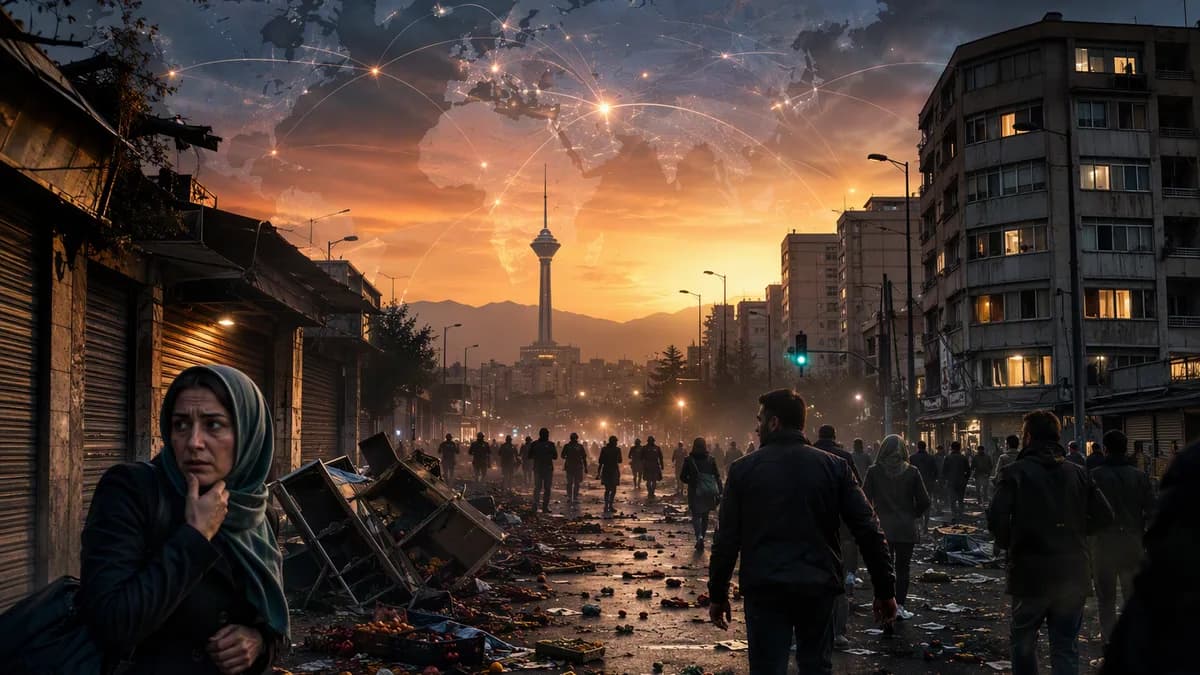
Iran internal crises are becoming the more dangerous front for Tehran: the state may absorb missiles, but it cannot indefinitely absorb a public that sees daily life as unlivable. The war with the US is now five months old, but the pressure points inside Iran are multiplying faster than any official narrative of unity can contain.
Global TrendsJuly 30, 2026· 11 min read· By XOOMAR Insights Team
Bread and Fear Push Iran Internal Crises to the Brink
Updated on July 30, 2026
XOOMAR Intelligence
Analyst Take
79/ 100
2 sources analyzedMedium confidenceTrend10Freshness98Source Trust90Factual Grounding92Signal Cluster60
That is the core signal from Patrick Wintour’s analysis for Guardian World: Iran’s external war is colliding with inflation, public executions, factional censorship battles, collapsing trust, and visible urban defiance. The regime’s most sensitive battlefield is not only missile sites or regional fronts. It is bread, wages, and fear.
Tehran's real battlefield is bread, wages, and fear at home
President Masoud Pezeshkian has said the quiet part out loud: economic discontent can destroy the social capital the state claims to have built during wartime. At a recent meeting of the supreme judicial council, he framed Iran’s conflict as wider than missiles.
“Iran is engaged in a full-scale war. Today’s war is not just a war of missiles; the enemy has come to the conclusion that it cannot force the Iranian nation to surrender through military attacks. The most important battlefield today is the economy and livelihood of the people.”
That warning matters because Iran internal crises now cut across the divisions the state usually tries to manage separately. Inflation hits wage earners. Public executions anger rights activists and families. State broadcaster bias angers reformists and parts of the government. The destruction of pavements outside liberal-leaning Tehran cafes looks small beside war, but it carries a political message: even informal urban spaces are contested.
The regime’s strongest counterpoint is that war can still rally nationalist sentiment. The Guardian describes visible public mourning and official efforts to project social cohesion during wartime. But the same report stresses that this showed only one side of the public mood.
XOOMAR analysis: wartime unity is real when foreign attacks occur, but it’s brittle when the same citizens face power cuts, water stoppages, food inflation, secret trials, and public gallows. What would weaken this thesis is sustained evidence that economic pain is producing compliance rather than anger. The source points the other way.
Five months of US-Iran war are colliding with Iran's unresolved domestic crises
The war is no longer just a bilateral US-Iran confrontation, and that expansion gives hardliners more room to dominate internal politics. According to the Guardian, the conflict has broadened into Yemen, Iraq, and now Egypt, while diplomatic deadlock is hardening because neither side trusts the other to honor an agreement.
That deadlock benefits escalation advocates. The logic is blunt: if compromise is framed as surrender, the political cost of negotiation rises. Reformists then become easier to attack. Hardliners can claim that wartime discipline is necessary, that dissent helps the enemy, and that cultural spaces outside state control are suspect.
The internal signs are already visible. Citizens have protested in Isfahan against public executions. Critics ask why punishments happen in public gallows while trials are held in secret courts. The Nation’s Union party warned on Monday that ignoring protests over executions could have “devastating consequences.”
There is a counterpoint: external pressure can make any government more security-focused, and Iran does face real military threats. But the pattern in the source is not just defensive mobilization. It includes attacks on cafes, broadcaster censorship, factional campaigns against negotiators, and public punishment.
XOOMAR analysis: the risk is convergence. Foreign escalation, economic stress, and anti-state dissent stop being separate crises. They start reinforcing each other. A strike abroad can justify repression at home. Repression at home can fuel more dissent. More dissent can strengthen hardliners who argue that only confrontation preserves the system.
The numbers behind Iran's pressure cooker: inflation, war damage, jobs, and public anger
The economic data in the Guardian report makes Pezeshkian’s warning concrete. This is not vague hardship. It is a measurable squeeze on food, work, transport, tourism, infrastructure, and trust in public finance.
| Pressure point | Figure or claim from source | Political meaning |
|---|---|---|
| Food inflation | 134% year-on-year in July | Diet changes are becoming forced rationing by price |
| Overall inflation | 84% | Household planning breaks down |
| Jobs | More than a million jobs lost due to war, according to deputy labour minister Gholamhossein Mohammadi | War costs are reaching workers directly |
| Food rationing risk | Possible in the next six months, warned Majid-Reza Hariri | The state may face visible scarcity politics |
| Kish Island hotels | All 400 hotels shut | War damage has reached tourism and services |
| Medical strain | As many as 30,000 Iranians visited medical centres during the two wars in 2025 and 2026 | Civilian burden is no longer abstract |
| Trust scandal | One trust received $200m (£149m) and did not return it | Corruption claims strike the sanctions-evasion core |
| Debt to state | 229 individuals owed €23.5bn (£20.2bn) | Elite accountability becomes a social flashpoint |
The inflation figures are the most politically explosive. The Guardian reports that food price rises have already forced Iranians to change diets because of the cost of fruit, eggs, and chicken. That kind of pressure travels faster than ideology. It reaches pensioners, students, shopkeepers, families, and wage earners.
Azadeh Mokhtari captured the social fatigue in one line:
“Society has reached a point where ‘I don’t have the patience’ and ‘I don’t have the energy’ have become everyday phrases. No one asks ‘how are you?’ any more because everyone knows the answer.”
The counterpoint is that Iranian data is politically loaded and incomplete, especially during war. But the source does not rely on one number. It shows a cluster: inflation, job losses, hotel closures, damaged bridges, damaged tunnel openings, destroyed or unusable civilian facilities, and corruption claims involving sanctions-related trusts.
XOOMAR analysis: when war damages infrastructure and inflation damages the kitchen table, the state loses the ability to isolate anger by class or region. That is why Iran internal crises now matter to anyone tracking the war itself.
Hardliners, reformists, the street, and the diaspora are not fighting the same political war
Iran’s factions are reading the same crisis in opposite ways. Hardliners see escalation as resistance, deterrence, and survival. Pragmatists and reformists see the same course as economic exhaustion, diplomatic isolation, and a gift to Iran’s enemies.
Azar Mansouri, once close to Pezeshkian, warned at the annual meeting of the Iranian reformist front that a vocal group was portraying negotiated agreements with the US as defeat. Her warning was not only moral. It was economic and demographic.
War “is not just a confrontation between military forces and armies. It is the destruction of the economy, the erosion of social capital, the spread of despair, the emigration of elites, the increase in poverty and the loss of opportunities for development. Ultimately, it threatens the future of the nation.”
The Guardian also cites a “we do not want war” statement signed by 268 political activists, and another letter from 1,000 activists linked with former president Mohammad Khatami warning that “the contemporary experience of Iran is that war has no winners. Those who advocate negotiations should not be slandered.”
Ordinary Iranians are harder to map. The source supports a more nuanced reading than simple pro-regime or anti-regime labels. Many may oppose foreign attacks and still reject domestic repression. They may resent US pressure while also resenting public executions, water outages, broadcaster bias, and elite corruption.
The diaspora and opposition add another layer. The Guardian notes that parts of the Trump administration and Iranian opposition figures, including Reza Pahlavi, have not abandoned the belief that the government is near collapse. That view has influence abroad, but the source also shows why collapse narratives can oversimplify the domestic picture. Visible displays of unity can coexist with deep public anger. Both can be true.
From the Iran-Iraq war playbook to today's state of exception
Tehran has long tried to turn siege into control, but today’s society is harder to discipline through old wartime scripts. The related analysis from Iran News Update argues that the Iran-Iraq war in the 1980s was framed by the ruling religious establishment as “sacred defense,” a narrative used to consolidate power and suppress dissent.
The Guardian’s current reporting shows a similar mechanism under today’s conditions. War creates a language of loyalty tests. Negotiators can be accused of weakness. Critics can be painted as divisive. Cafes can be framed as anti-Islamic spaces rather than social venues. Public executions can be justified as order.
The dispute over IRIB, the publicly funded national broadcaster, shows the mechanism inside the state itself. The Guardian reports that interventions by Pezeshkian and Mohammad Bagher Ghalibaf, described as the chief negotiator, were censored. The government responded with unusually direct language.
“The national media should be the voice of Iranian unity, not a platform for destroying the government and disrupting national understanding.”
The counterpoint is that state media factionalism is not new. But the timing changes the stakes. When surveys cited by the Guardian suggest less than 12% of the country watches IRIB, the broadcaster’s hardline tilt may not persuade the public. It may push audiences toward hostile foreign satellite channels instead.
XOOMAR analysis: control tools that once helped manage dissent can now advertise weakness. Censorship of the president during a war signals not unity, but rivalry inside the command structure.
Markets should read Iran's domestic strain as geopolitical risk
For investors, policymakers, and energy executives, Iran’s internal strain is no longer a domestic sidebar. It is part of the geopolitical risk premium. A state under pressure at home can become more cautious abroad if elites fear social rupture. It can also become more aggressive if hardliners decide escalation is the best way to suppress dissent and force cohesion.
The Guardian reports that the war has already spread into Yemen, Iraq, and Egypt. That matters because each new front expands the number of actors, assets, and possible miscalculations. It also raises the burden on Iran’s economy at the moment when food inflation, job losses, and infrastructure damage are already severe.
XOOMAR has tracked how quickly markets reprice the conflict narrative, including in Brent Crude Sinks 7.5% on US-Iran De-Escalation Bet and US Dollar Index Sheds War Premium After Iran Pause. Those market moves are not separate from the domestic story. If Tehran’s internal crisis makes policy less predictable, then oil, shipping, insurance, sanctions assumptions, and military planning all become harder to model.
Iraq is a particular pressure point in the source and in prior XOOMAR coverage of Saudi Oil Plot Triggers US CENTCOM Strikes in Iraq. The Guardian’s point that the war is drawing in Iraq reinforces the market concern: regional theaters are not isolated compartments when Iran’s domestic politics reward escalation.
The strongest counterpoint is that authoritarian systems can remain stable under immense stress. Iran has endured long pressure cycles before. But the current evidence is not just stress. It is stress plus factional conflict, open criticism of state media, public protest against executions, massive inflation, and a corruption scandal tied to sanctions-evasion entities.
A brittle Iran faces escalation abroad and a harder public mood at home
The next phase will test whether escalation still buys Tehran leverage, or whether every added front makes the home front harder to hold. The source points to three plausible paths.
Controlled escalation with no deal is the hardliner path. Iran keeps resisting compromise, revolutionary messaging grows louder, and internal coercion tightens. This path holds if the state can contain food pressure, labor anger, and factional dissent without triggering a broader backlash.
A limited diplomatic pause becomes more likely if economic pain starts threatening elite stability. The warning signs would be rationing within the next six months, further job losses, deeper anger over wages, or a trust scandal that visibly implicates powerful insiders.
A dangerous spiral emerges if regional fronts keep expanding and a major strike forces retaliation. The Guardian already describes a war spreading into Yemen, Iraq, and Egypt. A wider conflict would deepen the same domestic pressures Pezeshkian called the “most important battlefield.”
The triggers are clear enough to monitor: a currency shock, mass labor unrest, a high-profile execution, a major US strike, a regional attack that forces retaliation, or new evidence that the sanctions-evasion trust scandal reaches Iran’s elite.
What would weaken the thesis? A credible diplomatic opening, lower food inflation, visible restraint by hardliners, and evidence that public anger is fragmenting rather than converging. Until then, Iran internal crises are not secondary to the war with the US. They are becoming one of the forces that will shape how the war is fought.
The Stakes
- Iran’s domestic pressures may become more destabilizing than its external war with the US.
- Economic pain and public repression are weakening the regime’s ability to sustain wartime unity.
- Visible dissent in cities suggests ordinary life has become a central political battlefield.
Iran’s Two Fronts of Pressure
| External War | Internal Crises |
|---|---|
| US conflict and missile attacks | Inflation, wages, and daily livelihood pressures |
| Can rally nationalist sentiment | Risks eroding public trust and social capital |
| Managed through military and official unity narratives | Exposed through dissent, censorship disputes, executions, and urban defiance |
Sources

Written by
XOOMAR Insights Team
Research and Editorial Desk
The XOOMAR Insights Team pairs automated research with human editorial judgment. We track hundreds of sources across technology, fintech, trading, SaaS, and cybersecurity, cross-check the facts, and explain what happened, why it matters, and what to watch next. We do not just rewrite headlines. Every article is fact-checked and scored for reliability before it goes live, and we link back to the original sources so you can verify anything yourself.
Explore More Topics
Related Articles
 Global Trends
Iran Vows Eye-for-Eye Strikes if Trump Hits Tehran
Iran says any US strike on its infrastructure will be met in kind, risking a wider energy crisis around the Strait of Hormuz.
Jul 23, 20266 min
 Global Trends
Saudi Oil Plot Triggers US CENTCOM Strikes in Iraq
CENTCOM hit Iran-backed groups in Iraq over alleged plots against US troops and Saudi oil sites, tightening the fuse on a wider clash.
Jul 29, 20266 min
 Global Trends
Red Sea Tanker Attacks Drag Saudi Oil Into Iran Fight
Two Saudi tankers turned a Houthi claim into a shipping risk, with US strikes on Iran adding pressure on oil routes.
Jul 23, 20267 min
 Global Trends
Saudi Arabia Uranium Enrichment Puts Trump in a Bind
A new U.S.-Saudi nuclear pact could open the door to Saudi uranium enrichment, complicating Trump's hard line on Iran.
Jul 22, 20267 min
 Global Trends
$37.5B Iran War Cost Corners Pentagon on $67B Ask
Hegseth says the Iran war has cost $37.5B, but the Pentagon wants $67B more, putting its shifting math under fire in Congress.
Jul 22, 20267 min
 Trading
Bitcoin Defies Oil Spike as Fed and Iran Rattle Markets
Bitcoin held near $64K as oil surged 8% after Iran strikes and the Fed split hawkish, but the calm looks fragile.
Jul 30, 20266 min
 Trading
Oil Shock Pins British Pound Below $1.33 After Iran Threat
WTI ripped higher on Iran war risk, but GBP/USD stayed stuck below $1.33. The calm in sterling looks fragile.
Jul 30, 20265 min
 Trading
Gold Price Risks $4,000 Breakdown Before Fed Decision
Gold is slipping near $4,000 as traders wait for the Fed's rate signal, with yields and dollar strength threatening support.
Jul 29, 20268 min
 Technology
Chrome Dynamic Patching Targets the Relaunch Button
Google wants Chrome patches to run without restart, cutting the risky gap between shipped fixes and users who haven't clicked Relaunch.
Jul 30, 20267 min
 Global Trends
Ceuta Migrants Breach Spain’s Fortress Border by Sea
Hundreds, possibly thousands, swam from Morocco into Ceuta, turning Spain’s fortified enclave into a test of Europe’s border capacity.
Jul 30, 20268 min
Don't miss the signal
Get our weekly roundup of the stories that matter across tech, fintech, and trading. No noise, just signal.
Free forever. No spam. Unsubscribe anytime.