
At least eight people were killed in Gaza just days after Hamas accepted a Hamas disarmament deal, putting the agreement’s credibility under pressure before its core terms have even been implemented.
Global TrendsAugust 2, 2026· 8 min read· By XOOMAR Insights Team
Israeli Strikes Rattle Hamas Disarmament Deal as 8 Die
Updated on August 2, 2026
XOOMAR Intelligence
Analyst Take
58/ 100
4 sources analyzedLow confidenceTrend10Freshness96Source Trust92Factual Grounding88Signal Cluster20
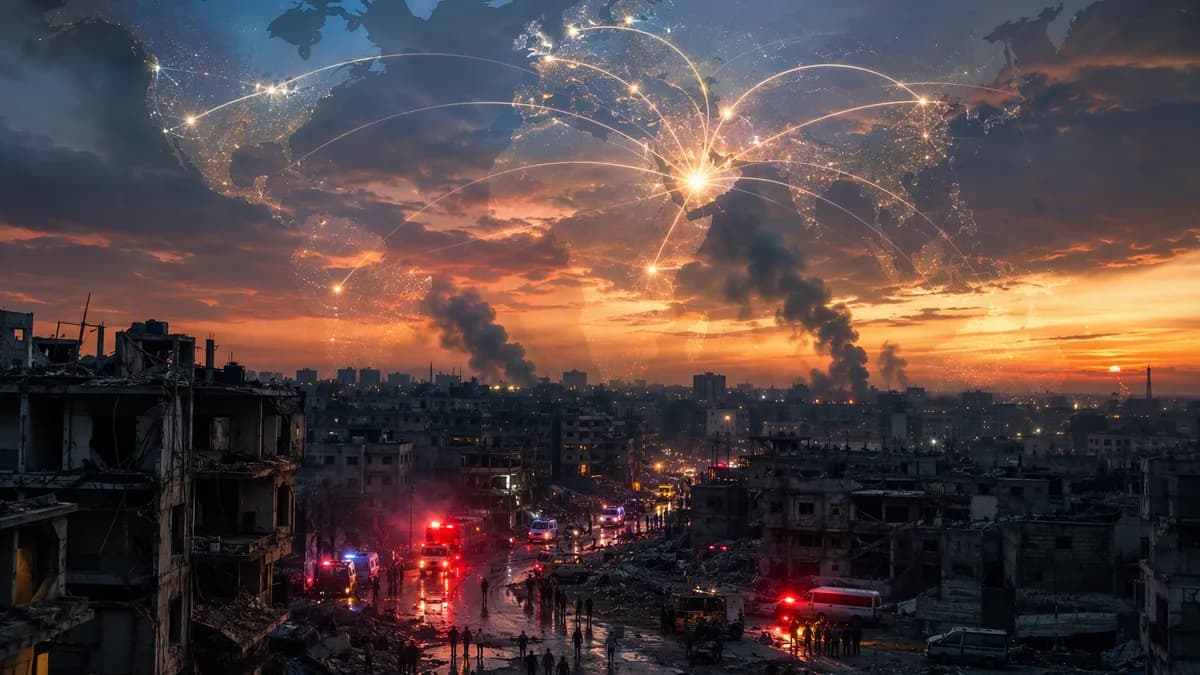
The overnight Israeli strikes hit Gaza City, Khan Younis and Deir el-Balah, Palestinian officials said, while Israel said it was targeting military operatives and had killed two Hamas militants, according to BBC World. For Gaza residents, the immediate signal is blunt: a plan meant to move the war toward disarmament and withdrawal is arriving alongside another night of fire.
Gaza residents face the first hard test of the Hamas disarmament deal
The Hamas disarmament deal is supposed to move Gaza toward a second phase of a US-brokered ceasefire plan. The BBC reports that Hamas accepted a plan under which it would hand over weapons to US President Donald Trump’s Board of Peace. Yet the strikes show the gap between political text and battlefield reality.
Israel’s position is that military operations remain aimed at Hamas operatives. The Israel Defense Forces said it killed two Hamas commanders, one from the elite Nukbha force and one from the Maghazi Battalion. Palestinian officials, however, described strikes on residential buildings and reported civilian deaths, including a child and a family in Khan Younis.
So does a disarmament pledge mean less violence, or does it simply create a new argument over which operations count as violations?
XOOMAR analysis: The deal’s first stress point is not the wording of the roadmap. It’s whether either side behaves as if the agreement already constrains them. These strikes suggest Israel does not see the plan as a halt to operations, while Hamas will have an opening to argue that concessions are not producing safety for civilians.
For more context on the agreement’s political fragility, see XOOMAR’s analysis of Trump Bets on Hamas Disarmament Deal No One Has Confirmed and Trump’s Hamas Disarmament Deal Runs Into Gaza’s Test.
The casualty figures turn diplomacy into a political clock
The reported toll is specific and grim. Palestinian health officials said two people, including a child, were killed in a strike on a residential building in Gaza City. Another person was killed near Jabalia in northern Gaza. A father, mother and their nine-year-old son were killed after a strike on a house in Khan Younis. A man and woman died after an apartment block was struck in Deir el-Balah.
The geography matters. This was not reported as a single isolated strike in one area. It covered northern, central and southern Gaza. That spread makes the security picture harder to contain and makes any claim of de-escalation harder for civilians to feel.
The broader figures sharpen the stakes:
- More than 1,100 Palestinians have been killed since a supposed ceasefire came into effect last October, according to the BBC.
- Israel controls 70% of the Gaza Strip, Israeli Energy Minister Eli Cohen said, according to Reuters as cited by the BBC.
- More than 1,500 buildings have been destroyed in areas of Gaza that remained under Israeli control since the ceasefire, BBC Verify satellite imagery showed last November.
- Around 60 million tonnes of debris has been generated since October 2023, according to UN estimates cited by the BBC.
What does a weapons handover mean if the places where civilians live remain active strike zones?
The answer will shape whether the Hamas disarmament deal becomes a real mechanism or another fragile framework whose credibility is measured in casualty reports.
Israel’s security cabinet faces pressure to keep striking
Israel has not treated the disarmament plan as a reason to stop attacks. Cohen said on Sunday that no deal had been reached to stop attacks on the Gaza Strip. He also said he saw a need for Gaza to be placed under full Israeli control if Hamas did not disarm, despite the Board of Peace plan calling for Israel to pull out of the territory.
That position explains the military logic Israel appears to be applying. If Hamas commanders or weapons networks remain active, Israel argues it can still strike them. The IDF’s statement that it killed two commanders fits that view.
But the strategic risk is clear. Each strike after Hamas accepts a disarmament framework makes the agreement look less like an off-ramp and more like a contested pause with no enforceable boundary.
President Trump said the Board of Peace had reached an agreement for the "complete disarmament" of Hamas and other armed groups in Gaza.
Trump also said Israel was "very happy" with the proposed agreement, calling it a "big step for the Middle East". Yet Israeli scepticism is explicit in the source material. Far-right National Security Minister Itamar Ben Gvir dismissed the draft as "not acceptable".
Can Israel maintain military pressure without convincing Gazans, mediators and Hamas factions that the deal offers no practical relief?
XOOMAR analysis: Israel’s current posture keeps pressure on Hamas, but it also raises the cost of selling the agreement as a path toward calm. The more civilian deaths are reported during the disarmament phase, the more the process becomes politically vulnerable.
Hamas, civilians and mediators are reading different meanings into the same strikes
For Israel, the strikes are counter-militant operations. For Hamas, they can be presented as evidence that Israel will not honor a path toward de-escalation. For civilians, the distinction is colder and simpler: residential buildings were hit, and people died.
That matters because Hamas’s acceptance of disarmament can be framed in competing ways. It can be sold as realism, a concession to end the war and transfer authority. It can also be attacked as surrender, especially if Israeli fire continues.
The roadmap says the next phase includes inventorying and storing weapons, production sites, depots and tunnels.
"A process shall begin to inventory and store heavy weapons, military production sites, weapons depots, and tunnels".
The BBC reports that this is conditional on Israel meeting its commitments under the initial ceasefire agreement. It is still unclear how weapons would be handed over to the Board of Peace. The expected mechanism involves heavy weapons and military hardware moving into storage and being managed by the Palestinian National Committee, a group of independent technocrats to which Hamas has agreed to hand over power. That committee has been working from Cairo and has not entered Gaza.
Who enforces the sequence if one side says disarmament comes first and the other says Israeli commitments must be met first?
That is now the central mediator problem. The US-backed plan has text, but implementation depends on verification, timing and trust. The source material shows all three remain unsettled.
For a deeper look at the trade-off embedded in the plan, see Hamas Disarmament Plan Forces Gaza’s Hardest Trade.
The roadmap’s weak point is sequencing, not ambition
The 20-point plan, unveiled in September last year, includes the Board of Peace, Hamas disarmament, Israeli troop withdrawal and Gaza reconstruction. A 15-point roadmap was published on Friday to set out final steps for implementation.
Those ambitions are broad. The weak point is operational. The roadmap has not yet been implemented. The handover process remains unclear. Israel remains sceptical of Hamas’s willingness to give up weapons or control. Hamas has governed Gaza since 2007 and is proscribed by the UK government as a terror organisation.
Can a disarmament process survive before the institutions meant to manage it are physically operating in Gaza?
XOOMAR analysis: Disarmament plans rarely fail because the word "disarmament" is vague. They fail when sequencing breaks. If Hamas is expected to surrender military assets before it sees Israeli withdrawal or relief on the ground, compliance becomes politically costly. If Israel is expected to pull back before it sees verifiable weapons storage, the plan collides with Israeli security demands.
That is why casualty reports now carry diplomatic weight. They are not only humanitarian data. They become evidence used by each side to argue whether the other is acting in bad faith.
Three paths now for Gaza after the latest Israeli strikes
The most likely near-term path is a strained framework: the Hamas disarmament deal survives on paper, while Israeli operations continue and both sides dispute what counts as a breach. That would keep mediators engaged, but it would not give Gaza residents the immediate proof they need that the war is actually winding down.
A darker path is also visible. If Hamas or affiliated armed groups retaliate, Israel could expand strikes, and the disarmament pledge could collapse before inventorying, storage or outside oversight begins.
The narrow success path requires clearer sequencing. Mediators would need a verified reduction in strikes, a practical weapons storage mechanism, movement by the Palestinian National Committee from Cairo into Gaza, and visible humanitarian relief tied to implementation.
What evidence would confirm the deal is becoming real?
Watch for three signals: whether the strikes stop or narrow sharply, whether the weapons inventory process begins under a credible mechanism, and whether Israel publicly accepts a withdrawal sequence tied to verified Hamas compliance. If those pieces do not appear, the latest Gaza strikes will look less like noise around a peace process and more like an early warning that the process has not yet reached the ground.
The Stakes
- The strikes put early pressure on the credibility of the Hamas disarmament deal.
- Civilian deaths could harden opposition to concessions before the plan is implemented.
- The gap between diplomatic commitments and military action may determine whether the ceasefire roadmap survives.
Competing accounts of the Gaza strikes
| Israeli account | Palestinian officials' account |
|---|---|
| Israel said it targeted military operatives and killed two Hamas militants. | Palestinian officials said strikes hit Gaza City, Khan Younis and Deir el-Balah. |
| The IDF said the dead included commanders from the Nukbha force and Maghazi Battalion. | Officials reported civilian deaths, including a child and a family in Khan Younis. |
| Israel appears to view operations as continuing despite the disarmament plan. | The strikes raise doubts over whether the deal will bring immediate safety for civilians. |
Reported deaths in Gaza strikes
At least killed in Gaza
people8
Hamas militants Israel says it killed
people2
Sources

Written by
XOOMAR Insights Team
Research and Editorial Desk
The XOOMAR Insights Team pairs automated research with human editorial judgment. We track hundreds of sources across technology, fintech, trading, SaaS, and cybersecurity, cross-check the facts, and explain what happened, why it matters, and what to watch next. We do not just rewrite headlines. Every article is fact-checked and scored for reliability before it goes live, and we link back to the original sources so you can verify anything yourself.
Explore More Topics
Related Articles
 Global Trends
Hamas Disarmament Plan Forces Gaza’s Hardest Trade
Hamas disarmament offers rare hope for Gaza, but sequencing, trust and enforcement could break the deal fast.
Jul 31, 20268 min
 Global Trends
Trump Bets on Hamas Disarmament Deal No One Has Confirmed
Trump claims a Hamas disarmament deal exists, but Hamas and Israel haven't backed it. Gaza talks now hinge on a glaring confirmation gap.
Jul 31, 20267 min
 Global Trends
Trump’s Hamas Disarmament Deal Runs Into Gaza’s Test
Trump says Hamas agreed to disarm, but Gaza still lacks a clear enforcement plan, Israeli signoff and trusted security force.
Jul 31, 20268 min
 Global Trends
Netanyahu Says Mamdani Is Stoking Hate as ICC Fight Hits UN
Netanyahu's UN trip has become a legal and political showdown over Gaza, the ICC warrant, and Mamdani's power to challenge him.
Jul 26, 20268 min
 Global Trends
Trump Shelves Iran Strikes Unless a Deal Lands Fast
Trump says Iran strikes are shelved only if a rapid deal opens Hormuz and ends the nuclear threat. The pressure hasn't vanished.
Aug 2, 20265 min
 Trading
WTI Crude Snaps Back 5% as Iran Conflict Jolts Oil
WTI’s 5% rebound shows traders are pricing a pause in the Iran conflict, not peace. One headline can reload the oil premium.
Aug 1, 20268 min
 Technology
$14B AMD AI Deal Pulls Core Scientific From Bitcoin Mining
Core Scientific’s $14B AMD AI leases mark a hard pivot from bitcoin mining, with options that could expand capacity to 2.5 GW.
Aug 2, 20265 min
 Technology
Watch Adults Marathon Day Online Without the Date Trap
The 20-minute Adults prequel streams on FXX, Hulu, and Disney+, but check listings first. The listed air times don't fully match.
Aug 2, 20267 min
 Global Trends
13 Die as Japan Earthquake Traps People at Kumamoto Mall
A 6.8 Japan earthquake killed 13, forced 300,000 to shelter and turned a tsunami alert into a rescue fight in Kumamoto.
Aug 2, 20266 min
 Global Trends
Heatwave Squeezes Crews at France and Spain Wildfires
Crews in France and Spain have a shrinking window to contain massive fires before heat and wind threaten new flare-ups.
Aug 2, 20267 min
Don't miss the signal
Get our weekly roundup of the stories that matter across tech, fintech, and trading. No noise, just signal.
Free forever. No spam. Unsubscribe anytime.