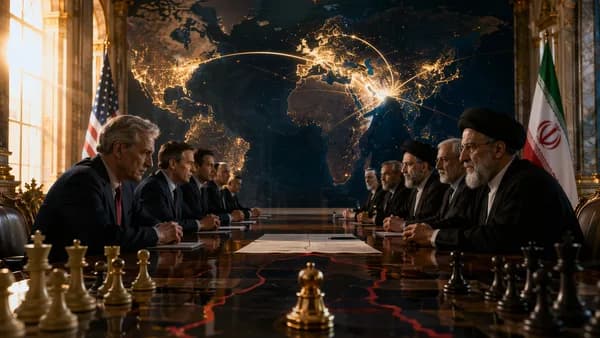
The real question after the JD Vance Switzerland trip was canceled is whether Washington still controls the timetable for its Iran track.
XOOMAR Intelligence
Analyst Take
US Vice President JD Vance canceled his planned trip to Switzerland for talks with Iran, CNN reported Friday, according to FXStreet. The immediate explanation from a spokesman was logistical, not a declared rupture in the talks.
Why was the JD Vance Switzerland trip canceled now?
The White House statement left the door open for a later departure, but made clear Vance was not leaving as scheduled.
“As the Vice President said at his press conference, the plans for the upcoming technical talks have not been finalized, and the U.S. delegation has been prepared to depart at the first available opportunity. But the logistics of these negotiations have never been simple or predictable. As of now the Vice President is not departing tonight. We will let you know as soon as we have a concrete update about next steps.”
That phrasing matters. It does not say the talks are dead. It says the technical talks were not finalized, the delegation was ready, and Vance was not departing “tonight.”
The distinction between canceled, delayed, and postponed is doing a lot of work here. FXStreet described the trip as canceled, while the statement itself framed the issue around timing and logistics. For now, the most precise read is that Vance’s planned departure was called off, with no confirmed new itinerary.
A separate Associated Press report via ABC News said the White House described Vance as delaying a trip to lead a new round of negotiations with Iran over its nuclear program. That report also said the delay raised questions about the next phase of a tentative Iran peace deal to end the Iran war.
| Issue | Reported status |
|---|---|
| Vance departure | Not departing “tonight,” according to the spokesman |
| Talks venue | Switzerland was the planned destination |
| Talks status | Technical talks “have not been finalized” |
| Replacement plan | No concrete next step announced in the supplied statement |
| Reason given | Negotiation logistics described as “never simple or predictable” |
Why does a canceled trip matter if the talks are still alive?
A canceled vice presidential trip is not routine scheduling noise when it sits inside a live nuclear and ceasefire track. Vance was not a junior envoy. AP reported he was set to lead a new round of US-Iran talks.
That gives the JD Vance Switzerland trip a bigger signal value than a calendar change. If the vice president is the face of the U.S. side, his absence forces allies, critics, and Tehran to parse whether Washington is slowing down, recalibrating, or simply waiting for the logistics to catch up.
AP reported that the postponement followed a report from Al-Mayadeen, a pan-Arab satellite channel politically allied with Hezbollah, that Iran was delaying its own delegation to Switzerland over Israel’s ongoing military campaign in Lebanon. That detail has not been confirmed in the White House statement quoted by FXStreet, but it adds a second timing problem around the same talks.
The delay also lands after the U.S. said it had lifted its blockade, allowing oil tankers to move freely through the Strait of Hormuz after months of being unable to use the channel, according to AP. That makes the diplomatic timetable relevant to energy markets, even before any new policy decision is announced.
FXStreet reported that West Texas Intermediate was down 0.23% on the day at $75.28 at the time of writing. That move alone does not prove traders are pricing the Vance delay, but oil is the cleanest market gauge in the supplied material because Hormuz access is directly tied to tanker flows.
For context on the same agreement’s shipping clock, XOOMAR’s US-Iran Deal Bets Hormuz Shipping on 60 Fragile Days tracks why the next phase hinges on more than the signing ceremony.
What does Washington need to clarify before this becomes a diplomatic problem?
The first question is simple: who shows up if Vance does not?
The White House statement says the U.S. delegation “has been prepared to depart at the first available opportunity,” but it does not name an alternative lead, confirm whether another official will travel, or say whether the talks will proceed without the vice president.
The second question is whether Iran was formally notified of the change and how Tehran reads it. AP reported that Iranian Supreme Leader Ayatollah Mojtaba Khamenei appeared to endorse direct negotiations for his officials, saying in a statement read by state media:
“It is obvious that the face-to-face negotiations that will be held in the future will not mean accepting the enemy’s opinion.”
That matters because direct talks themselves are part of the diplomatic signal. If either delegation hesitates, the optics can harden quickly, even if the underlying paperwork remains intact.
There is also pressure inside Washington. AP reported that the initial agreement has drawn criticism from some in the U.S., including a few congressional Republicans, over sanctions relief and a potential $300 billion fund to help with rebuilding. Vance defended the deal at the White House, arguing that relief would track Iranian compliance.
“As they dial up their good behavior, we can dial up the economic relief,” Vance said. “If they dial down their good behavior, we can turn it off.”
That is the administration’s core sales pitch: concessions are reversible. A delayed trip makes that pitch harder to manage because critics can point to the first logistical breakdown before technical talks even begin.
For the political fight around that potential funding pledge, see XOOMAR’s Trump Iran MoU Ignites GOP Revolt Over $300bn Pledge.
Which part of this delay could still matter 60 days from now?
The 60-day clock is the piece to watch.
AP reported that President Donald Trump signed the initial pact with Iran on Wednesday while dining with French President Emmanuel Macron at the Palace of Versailles. The deal was slated to take immediate effect and gives both sides 60 days to hammer out broader agreements.
That means the JD Vance Switzerland trip was not just symbolic. It was tied to the early execution phase of a deal that still needs technical follow-through.
AP also reported that Trump envoy Steve Witkoff told U.S. lawmakers in a private briefing that Iran will invite the International Atomic Energy Agency to inspect its nuclear sites and begin work on identifying and uncovering the locations of Tehran’s enriched material, believed to be buried under rubble. The agreement, according to AP, requires Iran to commit in writing to renounce nuclear ambitions.
XOOMAR analysis: the cancellation becomes more serious if it delays those technical steps, especially inspections, uranium dilution under international supervision, or the sequencing of economic relief. If the talks restart quickly with Vance or another senior official, the episode may read as procedural friction. If the White House stays vague, the delay becomes evidence of poor coordination at the worst possible point in the deal’s rollout.
The next official statement needs to answer three things fast: when the U.S. delegation travels, who leads it, and whether Iran’s team is still prepared to engage. Until then, the trip cancellation adds uncertainty to a deal that was already being judged on a tight clock.
Impact Analysis
- The canceled departure raises uncertainty over the timing of U.S.-Iran nuclear negotiations.
- The White House framing suggests talks are not dead, but logistics remain unresolved.
- The delay could affect confidence in the next phase of efforts tied to ending the war.
How the Vance Switzerland Trip Was Framed
| Source | Description | Implication |
|---|---|---|
| FXStreet/CNN | Reported the Switzerland trip as canceled | Signals the planned departure did not happen as scheduled |
| White House statement | Said technical talks were not finalized and Vance was not departing tonight | Leaves open the possibility of a later departure |
| Associated Press via ABC News | Described the trip as delayed for talks with Iran over its nuclear program | Suggests negotiations may still continue despite timing uncertainty |
Primary Sources & Disclosures

Written by
XOOMAR
Data desk
XOOMAR is a capital markets software and data company. Every brief on this site starts from a dataset the company collects itself from primary sources (CFTC, SEC EDGAR, FINRA, the Federal Reserve, exchange APIs) and names the numbers it is built on, with a link to the data page so you can check them. Briefs are reviewed before they go out and corrected in place when the data is revised.