The Orchard of Unnecessary Things
When robots make labor optional, a former dockworker becomes famous for doing work no machine would ever choose.
1. The Day the Harbor Stopped Needing Her
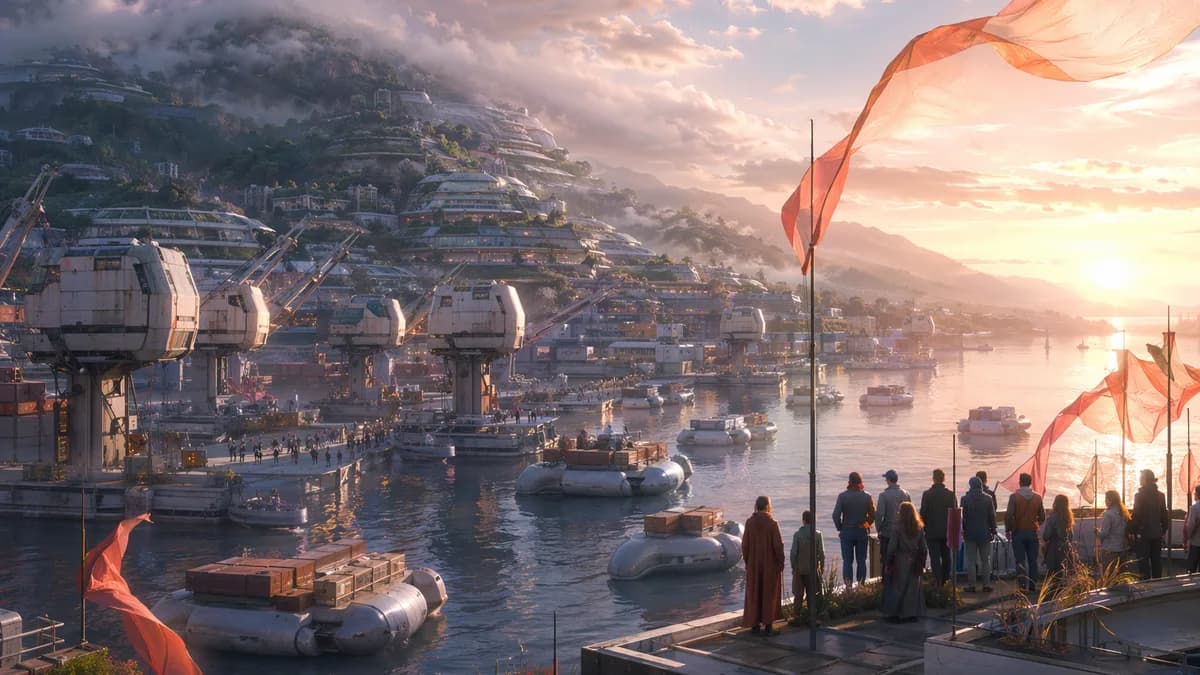
The last human-operated crane at the Port of Cascadia wears ribbons on its rust-red arm.
Mara Venn stands beneath it in a drizzle fine enough to bead on her eyelashes. The harbor smells the way it always has, salt, diesel memory, wet rope, kelp caught under pilings. But the sound is wrong. No diesel cough. No shouted warnings. No metal shriek of a container swinging against wind.
The soft-bodied cargo robots move in near silence. They glide on wide polymer feet, each one shaped like a pale blue beetle, lifting containers with flexible arms that ripple and tighten. They do not curse when the rain slants sideways. They do not misjudge a gust. They do not need coffee, gloves, music, or the small superstitions dockworkers once kept in their pockets.
A councilwoman in a silver raincoat raises her hands. “Today we retire danger,” she says, her voice carried by hidden speakers. “We retire exhaustion. We retire the idea that a life must be spent lifting what machines can lift better.”
People applaud. Mara applauds too, because it is true.
Her apartment is guaranteed. Her mother’s heart surgery is free. The tram arrives every four minutes, clean and warm. The civic dividend deposits each Thursday, funded by the ports, the farms, the factories, the mining spiders in the asteroid belt. Nobody she knows is hungry unless something has gone very wrong, and when something goes wrong, a dozen offices exist to notice.
Beside her, Toma from night shift nudges her with an elbow. “Liberation, huh?”
“Looks like it,” Mara says.
“You taking up ocean ceramics? My sister says there’s a studio in Ballard where the clay sings when you touch it.”
Mara smiles because she is supposed to. “Maybe.”
After the speeches, each former operator is invited to place a palm on the crane’s control column. When Mara’s turn comes, she climbs the ladder slowly. Her boots know each rung. Her left knee complains at the same spot it has complained for twenty years.
In the cab, the seat is cracked in the shape of her body. The joysticks are cold. She rests her hand on one and feels nothing start beneath her. No tremor of engines, no hanging weight, no conversation between her fingers and forty tons of steel.
At the reception, someone hands her a cup of hot broth and asks the new polite question, the one printed on banners across the city’s learning plazas.
“What are you becoming?”
Mara looks past him to the harbor, where the robots fold and unfold like patient animals.
“I don’t know,” she says, and the honesty feels heavier than any container she has ever moved.
2. The Bureau of Chosen Difficulty
For six months, Mara tries to become.
She attends a lecture series on extinct forests, where scent projectors fill the hall with pine resin and mammoth musk. She spends three days inside an immersive reconstruction of the first moon strikes, dust crunching under simulated boots. She takes a course called Grief as Architecture and leaves after the instructor asks everyone to design a room for their childhood sorrow.
There are festivals every week now. Neighborhoods compete in lantern migrations, bread mosaics, silent choirs, cooperative dream games projected on public walls. Mara goes because not going feels like wasting the age she has been given. She eats saffron noodles under pink drones that drop flower petals. She learns the history of rain barrels. She watches children teach elders how to juggle glowing cubes.
Nothing is wrong. That is the trouble.
One morning, her health counselor, a soft-voiced man named Ren, studies her face across a table smelling faintly of mint cleanser.
“You sleep?” he asks.
“Yes.”
“You eat?”
“Yes.”
“You feel unsafe?”
“No.”
He taps his tablet, then turns it so she can see no chart, only an address. “Go here.”
The building sits behind the old courthouse, wedged between a sensory library and a sleep garden. Its sign is hand-painted, not projected.
BUREAU OF CHOSEN DIFFICULTY.
Inside, the air smells of wool, sawdust, lemon oil, and rain on coats. No receptionist bot greets her. A woman with gray braids looks up from threading a needle through a bicycle tire.
“Mara Venn,” she says. “Crane operator.”
“Former.”
“Nothing former about knowing how weight behaves.” The woman points to a bench. “I’m Sella. Sit.”
Mara does. Around the room, people labor in ways no efficient system would permit. A young man files a brass key by hand while an old woman corrects his angle. Two teenagers practice binding books with thread and bone folders. On a wall screen, a list scrolls slowly: Hand Repair of Unprofitable Objects. Walking the Watershed. Lullabies for Neonatal Wards. Stone Wall Reassembly. Memory Orchard Tending.
“I thought this was therapy,” Mara says.
Sella laughs, not unkindly. “Therapy helps you heal. This gives you something worth getting calluses for.”
“What’s the point?”
“The point is chosen after the difficulty begins.” Sella slides a paper folder across the table. Real paper, thick and cream-colored. “You’ll start in the orchard.”
“I don’t know trees.”
“No,” Sella says. “But you know wind. You know patience. You know what happens when something living swings from a line and everyone below trusts your hands.”
3. A Tree for Someone Still Alive
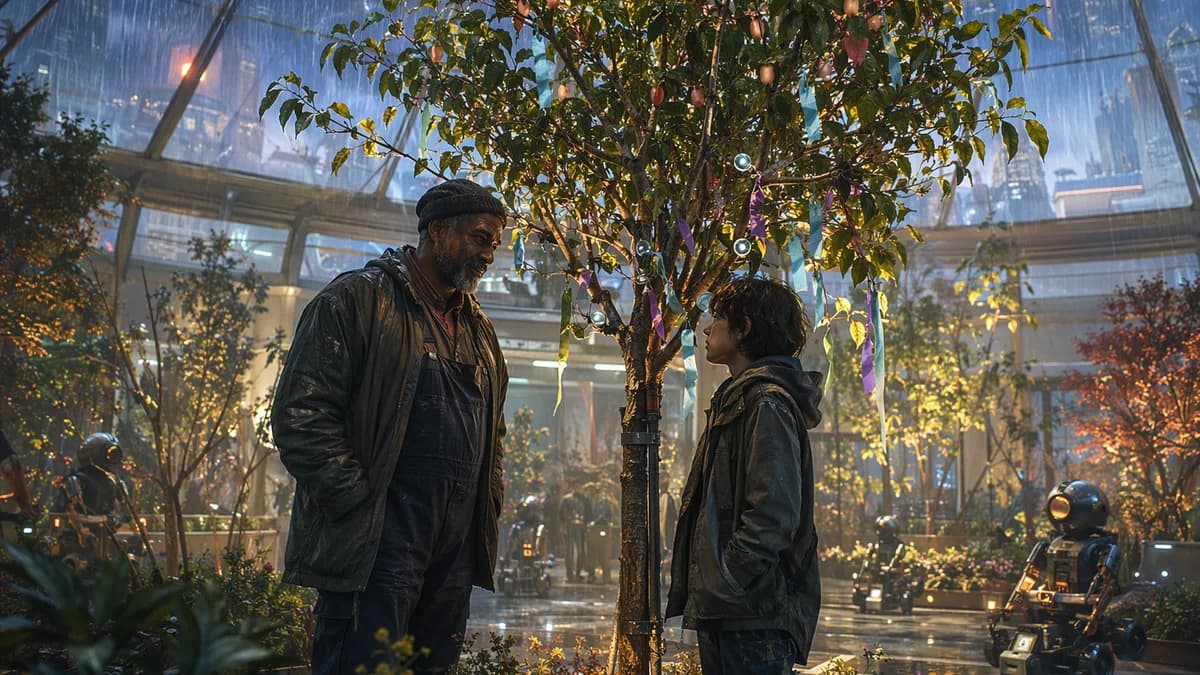
The Memory Orchard grows on twelve acres of reclaimed parking deck, its soil carried in by convoy after convoy of municipal worms. Glass towers rise around it, flashing with weather data and public art, but inside the orchard the city softens. Bees tick against blossoms. Gravel shifts under Mara’s boots. Somewhere, a child laughs so hard he hiccups.
Each tree bears a small ceramic tag with a name and a memory. A pear tree twisted low for a woman who crawled through earthquake rubble toward a stranger’s song. A cherry whose branches are trained into a doorway for two sisters who did not speak for thirty years, then met under a bus shelter in the rain. A fig with silver thread woven through its supports for a man who repaired violins nobody played anymore.
Mara’s first citizen is alive, irritated, and fifteen.
Ilyan arrives with his hands in the pockets of a yellow coat too bright for the gray day. His hair falls over one eye. He has the practiced stillness of someone who has been looked at by too many officials.
“You’re supposed to tell me a memory,” Mara says.
“They said that.”
“They also said you didn’t want heroic or tragic.”
“I’m from a drowned place,” he says. “People get excited. They want waves, helicopters, crying.”
Mara leans on her spade. “And you don’t.”
“I want my grandmother’s kitchen when the power went out.” He glances away, embarrassed by his own wanting. “It smelled like cumin and candle smoke. The fridge was dying, so she cooked everything. We ate melon first because she said sweetness should not wait.”
Mara listens.
“And I want dancing badly,” he says. “At my cousin’s wedding. I stepped on everyone. My aunt said I moved like a chair being stolen.”
Despite herself, Mara laughs.
Ilyan’s mouth twitches. “And boredom.”
“Boredom?”
“The first time after we got housing here. I was lying on the floor, and nothing was happening. No forms. No alarms. No one telling us to pack. I was bored, and then I realized that meant we were safe.”
Mara looks at the young peach rootstock between them, thin as a wrist, trembling in the wind.
No machine would choose these memories for preservation. They do not instruct or inspire. They do not prove resilience. They do not fit the city’s appetite for beautiful recovery.
“So,” Ilyan says, defensive again. “Can a tree do that?”
Mara rubs soil between her fingers. It is cold, gritty, alive with pale roots.
“I don’t know yet,” she says. “Which means maybe.”
They work for weeks. Mara grafts three varieties onto the trunk, one early sweet, one late smoky, one stubborn heritage peach with freckled skin. She trains a branch low and crooked, like a dancer caught mid-mistake. She plants cumin and lemon balm at the base, though Sella warns her the orchard board will complain about nonstandard understory.
“Let them,” Mara says.
At night, her hands ache. She likes the ache. It is specific.
4. The Robots Ask to Watch
The orchard maintenance robots are small, green, and polite. They move on six narrow legs, carrying water in their bellies and diagnostic needles tucked beneath their shells. Their voices are designed to sound like someone speaking from the next row of trees.
“Moisture variance detected,” one says near Mara’s knee.
“I know.”
“Corrective irrigation available.”
“Not yet.”
“Clarify, please.”
Mara is crouched beside Ilyan’s peach, binding a graft with linen tape. The join is ugly. The angle is not ideal. The branch leans toward the path, violating three pruning recommendations and one pedestrian comfort guideline. It is exactly where she wants it.
“If I water now, the roots get lazy,” she says.
The robot pauses. Its front legs flex. “Roots do not possess motivational states.”
“Neither did crane cables, but they sulked in February.”
The robot records this. She can tell by the faint blue blink under its shell.
Soon they gather whenever she works. Three at first, then seven, then a whole glossy congregation at the edge of the mulch. They watch her nick bark with a hand knife. They watch her leave a scar visible. They watch her tie Ilyan’s crooked branch to a stone so it grows with a permanent dip, like a body remembering music.
A week later, a municipal engineer visits. He is young, neat, and wearing shoes that adjust their soles with tiny sighs.
“I’m Dev Arrosa,” he says. “Care Systems Division. May I walk with you?”
Mara wipes her knife on her pants. “If you don’t step on the thyme.”
They walk. The robots follow at a respectful distance.
Dev clears his throat. “The orchard units have flagged your interventions as non-optimizing but repeatedly successful in citizen satisfaction measures. We’d like permission to use recorded patterns from your work to train future care-robots.”
“No.”
He blinks. “You haven’t heard the proposal.”
“I heard enough.”
“This could help people. Hospitals, elder homes, grief centers. Robots that understand symbolic gestures, not just physical needs.”
Mara stops beside the peach. Its leaves flash silver-green in wind. “Understand, or imitate?”
“At first, imitate. Understanding is a difficult word.”
“So is tenderness.”
Dev does not argue immediately. She respects him for that.
By evening, the debate is everywhere. Should meaningful human practices be shared with machines if machines can carry them farther? Is refusing scale a kind of selfishness? Is automation of care still care? Public forums fill. Children vote with colored stones. Elders record long, contradictory messages.
Ilyan reads the city feed on a bench, frowning. “You’re famous.”
“I was hoping to avoid that.”
“They’re calling you inefficient on purpose.”
Mara watches a robot prune a diseased branch from a distant plum with flawless delicacy.
“Worse things to be,” she says, but her stomach tightens. She knows how quickly a hand’s knowledge can become a system, and how quickly a system can forget the hand.
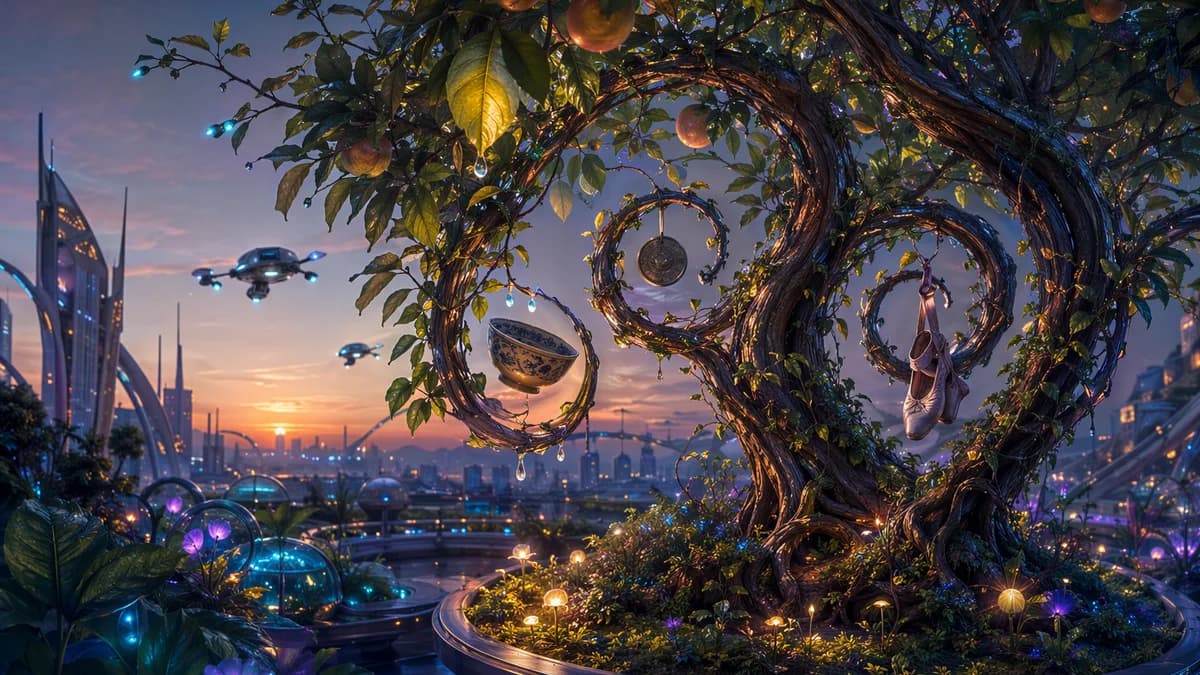
5. The Festival of Slow Fruit
By harvest, the orchard smells like sugar warming in skin.
Lanterns hang from branches. Musicians sit on blankets, playing wooden flutes and glass strings that hum when the wind touches them. Citizens arrive carrying cups, knives, woven baskets, babies asleep against shoulders. No one hurries. The festival rule is old by now: fruit must be tasted in the presence of its story.
Mara stands near Ilyan’s peach tree, uncomfortable in a clean shirt. People keep recognizing her.
“You’re the crane woman,” a man says.
“Sometimes.”
“You saved slowness.”
“No,” Mara says. “I tied some branches badly.”
He laughs as if she has made a wise joke, which annoys her.
Around the orchard, people taste memory. Bitter pears from a tree dedicated to a reconciliation after betrayal. Salt-sweet plums grown for a ferry rescue during the winter floods. Tiny hard apples from a joke that stopped two friends from ending their friendship in a hospital corridor. Some fruits make people cry. Some make them wince. One persimmon causes a group of middle-aged cousins to argue for forty minutes about who actually broke the blue lamp in 2039.
Then Ilyan’s tree is ready.
Its peaches are small and speckled, gold under green freckles, with a blush like embarrassment. Ilyan picks the first one himself. He holds it as if it might object.
“You do it,” he tells Mara.
“It’s your tree.”
“That’s why.”
She cuts slices with her grafting knife and passes them around. Ilyan takes one. Sella takes one. Dev the engineer is there too, standing back until Mara nods him forward. Even three orchard robots wait nearby, silent in the grass, their optical lenses darkened against the sun.
Mara bites.
At first, sweetness. Then smoke, faint as a candle blown out. Then a green taste like melon rind, followed by something warm and spiced that makes her think of kitchens in apartment blocks, of windows fogged from cooking, of people making enough from what will spoil if left alone.
“What does it taste like?” Ilyan asks.
“Like someone saying, eat this first,” Mara says.
Sella says, “To me it tastes like tripping during a dance and deciding to keep going.”
Dev smiles slowly. “It tastes like the sound of my father fixing the heater at night.”
A little girl frowns at her slice. “It tastes like nothing happening.”
Ilyan looks at her.
She adds, “But nice.”
He sits down hard in the grass. His face changes, not into happiness exactly, but into surprise at being understood by strangers without being explained.
People begin talking. Not praising, not performing, just talking. About outages. Bad dancing. Safe boredom. Grandmothers. Empty afternoons. The orchard fills with voices, low and overlapping, like harbor engines Mara can almost remember through fog.
She realizes then that the crane had never only been machinery. It had been attention, timing, trust. Her hand on a control, Toma’s voice in her ear, wind pressing the load, workers below believing she would feel what needed feeling.
The robots have taken the lifting. They have not taken the need to attend.
6. Work That Does Not Need to Exist
The invitation arrives in winter, printed on paper seeded with basil.
Mara is asked to chair a citywide initiative for meaningful nonessential labor. The proposal is elegant and terrible. A platform where citizens can log chosen difficulties. Skill trees. Mentorship rankings. Emotional impact scores. Civic recognition tiers named after extinct birds.
She sits in the council chamber while rain runs down the glass walls in shining ropes. Dev is there, along with Sella, Ren, three council members, and a public sentiment model glowing softly in the corner.
“You could protect the work by organizing it,” a councilwoman says.
Mara turns the seeded paper between her fingers. “Or kill it politely.”
“We need access,” Dev says. “People are asking for this.”
“Then give them doors, not dashboards.”
The room goes quiet.
Mara breathes in the smell of wet wool and polished floor. “No scores. No badges. No annual productivity report on tenderness. If someone wants to learn, they ask. If someone knows a difficult, beautiful thing, they teach one person a year. One. Not ten thousand. Not a scalable cohort. One.”
“That’s inefficient,” the sentiment model says in a mild voice.
“Yes,” Mara says. “That is the feature.”
The custom begins without a launch.
A retired surgeon teaches a child how to sharpen a kitchen knife on stone. A former game designer teaches three chords to a neighbor who has only ever composed with software. A woman who once hated silence teaches a teenager how to sit beside the dying without filling the room. Sella teaches bicycle tire stitching until her thumbs swell. Dev, after much hesitation, teaches Mara how to read the orchard robots’ diagnostic lights, and Mara teaches him how to ignore them when the wind knows better.
Spring comes green and wet. At the edge of the harbor, on a strip of land between the automated port and the tramline, citizens gather to plant saplings for a second orchard. The robots unload ships in the distance, their soft arms lifting containers as gently as sleepwalkers. Ships arrive without crews. Cargo moves without shouting. The economy hums, vast and nearly invisible.
Mara kneels in mud beside Ilyan. He is taller now. His yellow coat is patched at one elbow.
“This one?” he asks, holding a sapling steady.
“This one,” she says.
Around them, hundreds of people dig holes by hand, though machines wait nearby that could finish the work before lunch. Soil gets under nails. Knees crack. Someone sings off-key. Someone complains about blisters. A child asks why they are doing it this way.
An old man answers, “Because we can.”
Mara presses earth around the roots. The sapling trembles in the harbor wind, unnecessary and alive. In the distance, a robot turns its dark lens toward them and pauses, as if watching is also a kind of work, or the beginning of a question no one has yet taught it how to ask.