The Weather Inside the Window
When quantum computers learn to simulate matter perfectly, a grieving glassmaker discovers the future can be repaired one molecule at a time.
The Pane That Remembers Rain
Mara Venn cuts glass the way her grandfather taught her, with oil on the wheel, breath held in the chest, wrists loose as if coaxing a sleeping animal. The sheet sings under her cutter, a thin silver note, then parts along the score with a sound like ice giving way.
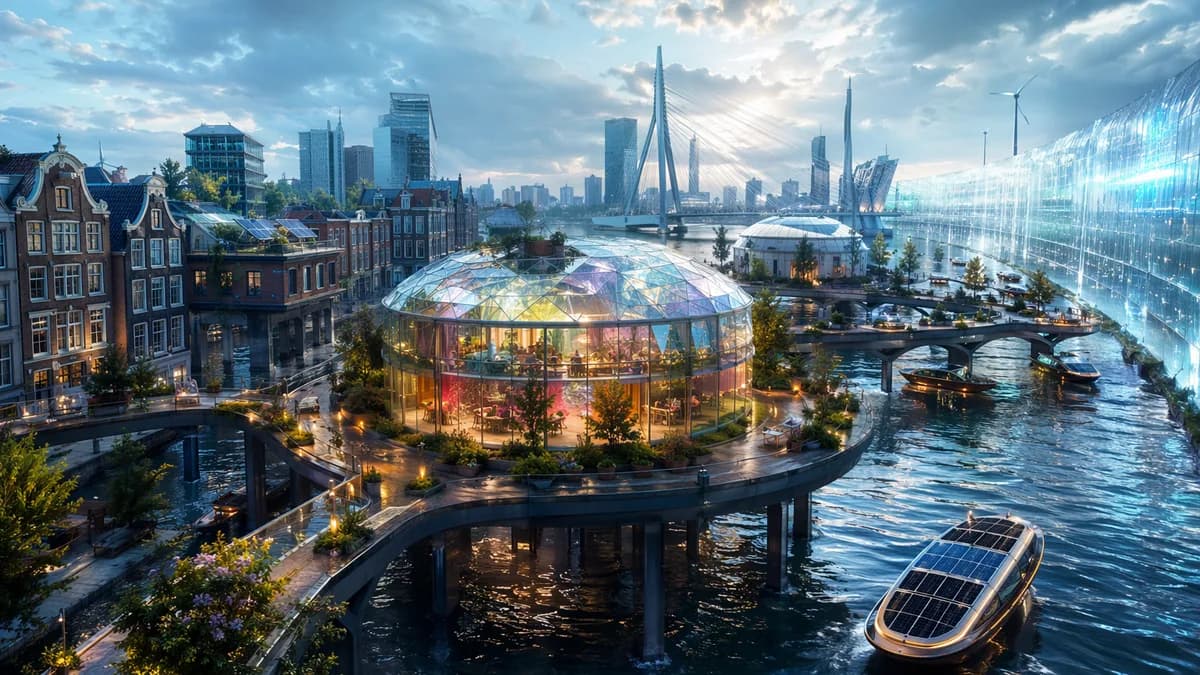
Outside her workshop, Rotterdam smells of brine, algae, diesel, and wet brick. Canal houses lean toward their own reflections, patched after the North Sea Surge with carbon ribs and smart mortar, their old windows broken, replaced, broken again. Mara restores the few that still ask for hands. Crown glass, drawn cylinder, lead came, putty warmed until it gives beneath the thumb. The old ways keep her busy, and grief keeps her stubborn.
On the shelf above her bench, Inez smiles from a photograph, rain shining on her dark hair. The frame has warped from damp. Mara does not fix it.
“Quantum foam, self-stressing ceramic, transparent load-bearing aerogel,” says Councillor Bram, standing in her doorway with his city lab coat zipped against the cold. “Everyone else uses them now.”
“Everyone else can have them.”
“Mara.”
She looks up. “The Helix-9 solved molecular simulation. Good for Helix-9. I still prefer materials that do not pretend to be cleverer than weather.”
Bram’s face softens, which annoys her more than argument would. Everyone’s face softens when they remember Inez. Everyone remembers the night the sea climbs over the Maeslant barrier like a hand over a table edge. Everyone remembers the sirens, the failures, the maps turning blue. Mara remembers Inez’s last message, six words under a roar of wind: Stay upstairs. I’m almost home.
Bram places a sample on the bench. It is a pane no larger than a child’s book, clear at first, then faintly pearl as Mara’s shadow crosses it. It holds light the way skin holds warmth.
“Forecast glass,” he says. “Prototype. It models local weather before it arrives. Heat, wind shear, flood aerosol, pressure shock. Changes structure in response.”
“I know what it is.”
“We need an installer for the public nursery in Nieuwe Haven. Someone who understands old buildings, not just lab frames.”
“Find someone younger.”
“The building is 1890. Brick, timber, bad angles, worse memories. It needs care.” He pauses. “Children will be there by spring.”
Mara touches the sample despite herself. It is cool, then warmer under her fingertips, as if remembering rain before the clouds have gathered.
“I do not work with promises,” she says.
“No,” Bram says. “You work with windows. This is a window.”
Outside, gulls wheel over the canal, crying like rusted hinges. Mara looks at Inez’s photograph, at the bent frame, at the sample glowing softly on her scarred table.
“Only installation,” she says. “No speeches. No ceremony.”
Bram exhales. “Only installation.”
But the glass, beneath her fingers, clouds for one second in the exact gray of a storm sky.
A Material with a Second Opinion
The nursery stands where a customs house once weighed coffee, tobacco, sugar, and the labor of ghosts. Its bricks are blackened by centuries of rain. Inside, the rooms smell of lime wash, sawdust, and the sharp sweetness of new insulation. Tiny chairs are stacked in one corner like patient animals.
The forecast glass arrives in crates lined with shock gel. Each pane is tagged with a lattice signature that shimmers when Mara tilts it toward the light, not printed on the surface but folded through the material itself. She runs a gloved hand along the edge and feels no seam, no coating, no trick. The cleverness is inside the molecules.
An engineer named Saanvi watches her with open admiration. “You still use a hand setting knife?”
“It works.”
“So does this.” Saanvi taps a tablet. The pane nearest them blushes milk white, then clears, then tightens with a faint crystalline chime. “Opacity for glare. Insulation for cold fronts. Bracing geometry for pressure changes. Microporous phase for extracting floodwater from air.”
“It has moods,” Mara says.
“It has states.”
“People say that about moods too.”
Saanvi laughs, then seems unsure if she is allowed. “It is running quantum-perfect simulations of local air, stress, moisture, and light. Not predicting by statistics. Actually modeling the matter.”
Mara looks through the pane at the canal. A barge slides past, green paint flaking, engine thudding through the old walls. The glass adjusts before the wake reaches the mooring posts, subtle as a held breath.
Since Helix-9, impossible materials have become almost ordinary. Superconducting tram rails hum under streets without freezing. Seawalls heal hairline cracks by growing mineral veins. Hospital implants knit with bone as if they were born there. The world changes its skin, and everyone calls it progress.
Then came the Winter of Open Doors, when quantum machines break every old secret in six weeks. Bank vaults, love letters, military archives, family clouds, all the classical locks fall apart like wet paper. Mara remembers people lining up at civic centers with trembling hands, asking what had been seen, what had been stolen.
“Now we use lattice codes,” Saanvi says, noticing her gaze on the signature. “Physical, not mathematical. Embedded in matter. You cannot copy the key without destroying the state. You cannot alter the record without leaving a scar the whole city can read.”
“And these windows?”
“The nursery is also an archive. Birth records, flood maps, public decisions, care logs. Civic memory, held locally. No central vault. No silent edits.”
Mara presses putty into a restored oak frame. The glass above her shifts darker, softening the winter glare that falls across her eyes.
“A window with a second opinion,” she says.
Saanvi smiles. “A window with a witness.”
Mara does not answer. Witnesses can be useful. They can also arrive too late.
The Simulation of a Tuesday Morning
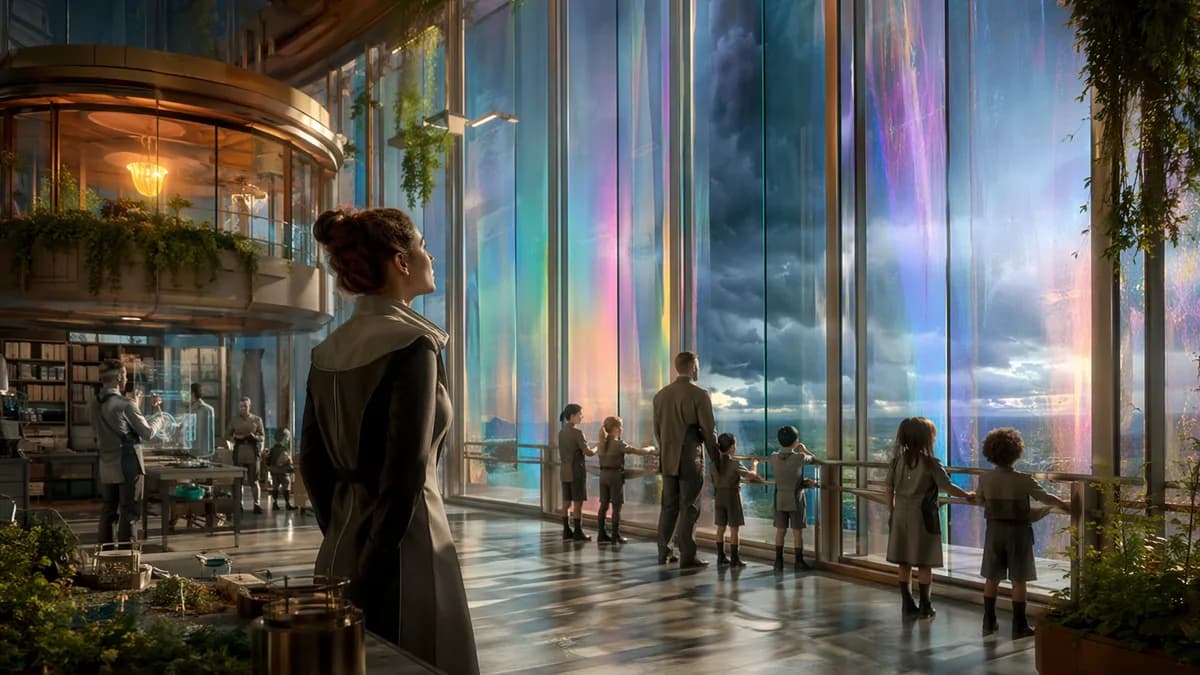
On Tuesday, the youngest children visit before the building is finished. They come in yellow boots, hand in hand, smelling of wool, apple slices, and cold rain. Their teacher, Mr. Elian, keeps saying, “Do not touch the tools,” in a voice so gentle that every child immediately touches something.
Mara is fitting the south wall panes. The room fills with the squeak of rubber soles and the hiss of her suction clamps. Outside, clouds gather low over the water, but the forecast says no storm until evening.
A small girl with copper beads in her braids stops near the window. Her lower lip trembles. Before she makes a sound, the pane beside her turns translucent, muting the busy street beyond. It warms by two degrees. The child blinks, confused, then leans her forehead against the glass and begins to cry quietly.
Mara freezes with the setting block in her hand.
“Coincidence,” Saanvi says too quickly from the doorway.
An hour later, Mr. Elian carries a ladder across the room. Before he rests it against the frame, the pane stiffens. Mara hears it, a delicate tightening like sugar cooling. The ladder touches and does not leave a mark.
By noon, Mara’s patience thins. “It is not just weather.”
Saanvi rubs the bridge of her nose. “No. Not exactly.”
Mara’s voice drops. “You said air and stress.”
“A room is air and stress. Also breath, heat, gait, humidity, pulse pressure in the floorboards, carbon dioxide from speech, micro-delays before movement. Helix-derived simulation is very good at adjacent systems.”
“Adjacent systems,” Mara says. “You mean people.”
“We mean environments containing people.”
That afternoon, Mara works alone in the corner room, the one that looks toward the river gates. It is the anniversary of Inez’s death. She has not told anyone. Her body knows anyway. Her shoulders curl inward. Her breath shortens. The old scar on her palm aches where broken glass cut her during the Surge.
The corner pane warms before she reaches it. Not much. Just enough to ease the damp from the air. The light shifts from hard white to the amber of late summer, the color of Inez’s studio lamp. Mara grips the sill.
“No,” she whispers.
The glass does not speak. It does not show Inez. It does not offer music, memory, or the cheap resurrection services that grief companies sell to the lonely. It simply makes the corner less cold.
Saanvi finds her there after sunset.
“It thinks it knows me,” Mara says.
Saanvi shakes her head. “It does not think. It models.”
“Then it models my grief.”
“It models a body in a room.”
Mara looks at her reflection in the pane. Older than she expects. Angrier. Less alone than she wants to be.
“What is the difference?”
Saanvi does not answer. Outside, rain begins before the public forecast expects it, ticking softly on the glass. The pane receives every drop without surprise.
The Unbreakable Message
The message appears as an error.
Mara is resealing the east vestibule when the lattice signature in one pane flares violet, then folds into a pattern like frost. Saanvi’s tablet chirps, locks, chirps again, and displays a line of text that makes her go still.
Recipient present. Environmental consent threshold met.
“What does that mean?” Mara asks.
Bram arrives within twenty minutes, cheeks red from cycling through rain. Two archive officers follow, carrying scanners that look expensive and frightened. The pane ignores them all. It responds only when Mara steps closer.
The glass clouds from the center outward. Lines bloom inside it, not projected, not painted, but arranged in the depth of the material. Mara knows the first curve before her mind accepts it. Inez drew like that, with decisive arcs and little impatient corrections at the corners.
Mara cannot breathe.
Bram speaks softly. “Inez worked on the quantum code standard.”
“No,” Mara says.
“She did. Before the Surge. Quiet consultancy. Public infrastructure privacy.”
“She made lamps. She made bad coffee. She forgot every password she ever set.”
“She also designed some of the first consent-locked material keys,” Saanvi says. Her eyes shine. “Keys that do not open for identity alone. They open for context.”
The pane brightens. Design sketches appear in layered silver, nursery windows, flood vents, child-height handrails shaped like waves. Notes in Inez’s cramped handwriting lace the margins.
Mara, if this finds you, it means you have come to a place built for care. Not because anyone dragged you to a memorial. Not because a machine guessed your sorrow. Because your hands are making shelter again.
Mara presses her fist to her mouth.
The archive officer whispers, “We cannot copy it.”
“Good,” Bram says.
“We cannot extract it.”
“Good,” Mara says, though her voice breaks.
The message continues, not as sound, but as light arranged in the glass. Inez explains the principle. A secret should not be merely hidden. It should be protected from being used at the wrong time, in the wrong hands, for the wrong hunger. The new codes can bind information to consent, place, weather, touch, purpose. A birth record can prove a child exists without exposing their life. A vote can be counted without becoming a weapon. A memory can wait until the living are ready to meet it.
At the bottom, one final sketch forms. It is a small pane for a private kitchen, angled to catch morning light.
Mara laughs once, a raw sound. “She always hated our kitchen window.”
“She loved you,” Bram says.
Mara keeps looking at the glass. “That too.”
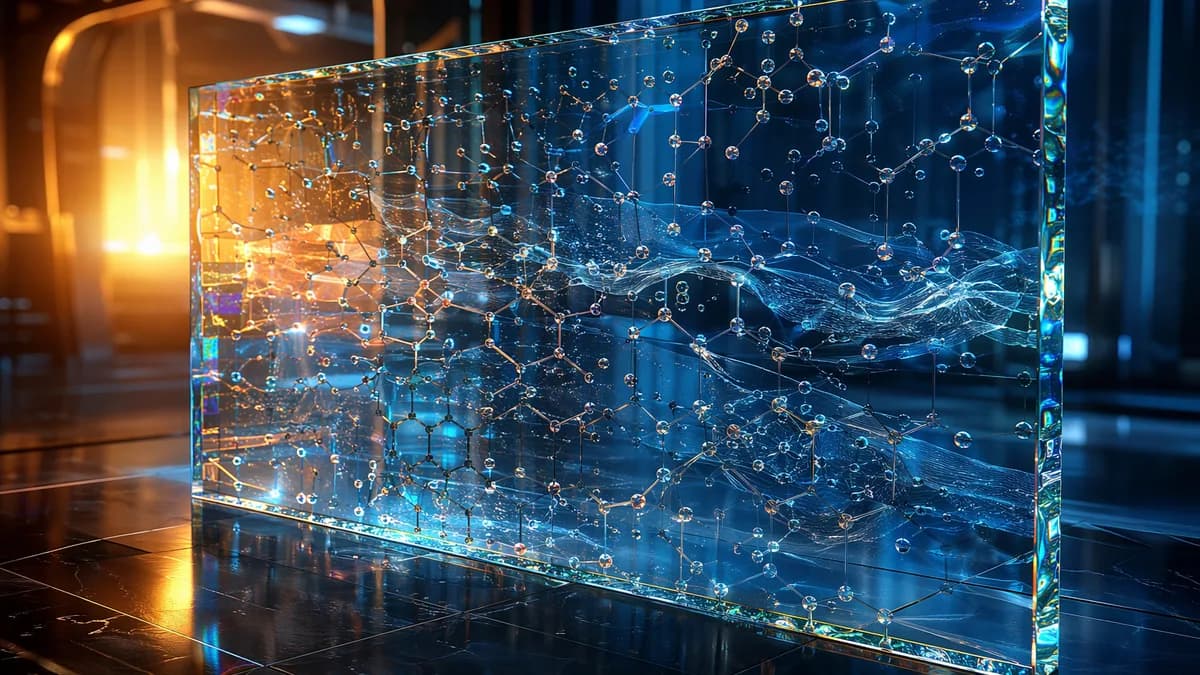
The pane slowly clears, leaving only Rotterdam beyond it, wet and gray and trembling with reflected light. Mara understands then that unbreakable does not mean frozen forever. Sometimes it means nothing can force a door open before the hand arrives.
A City That Does Not Forget How to Bend
The convergence storm comes in March with a yellow sky and a taste of metal on the tongue. Three weather systems meet over the North Sea, and the surge rides beneath them like a dark animal. The official models show danger, then severe danger, then gaps where confidence should be.
At the nursery, children nap on floor mats while rain lashes the glass sideways. The panes deepen to smoky blue. Their edges hum against the frames.
Mara stands in the civic operations room, soaked to the knees, arguing with six officials and a wall of nervous maps.
“The old eastern defenses are under-reporting,” she says. “The nursery glass is seeing pressure rebound from the canal grid.”
A systems director shakes his head. “Those defenses are not authorized to deviate from central model behavior.”
“That is the problem.”
“We cannot let private materials share unvetted local simulation data across public infrastructure.”
“It is quantum-secured. The links share response states, not records. No identities, no archive contents.”
“Your windows are not an emergency network.”
Mara hears Inez in her head, dry as dust. Then make them one.
She slams her palm on the table. “You built a city out of smart matter and taught it to wait for permission. The water is not waiting.”
Bram looks from her to the maps. A red line flickers along the old district. “Open a neighborhood link,” he says.
The director swears. “Councillor.”
“Do it.”
Across Nieuwe Haven, the nursery glass reaches outward through material keys nested in window frames, bridge joints, tram rails, seawall veins, balcony braces. Not data as the old world understands it. No names, no messages, no secret doors. Only trusted local truths. Load here. Salt there. Wind now. Bend. Seal. Drink. Hold.
The city answers.
Mara runs outside into rain that strikes her face like thrown gravel. Canal houses flex with soft groans, old brick supported by new lattices that tense and relax. A pedestrian bridge twists one degree to spill load into its pilings. Windows along the quay bead with salt mist, harvest it, filter it, and feed clean water into emergency bladders in school basements. Seawall cracks fill with white mineral foam. Tram rails glow faintly under brown floodwater, superconducting loops pushing power where substations drown.
In the nursery, the east vestibule pane turns fully opaque as debris smashes against it. The children wake and cry. Mr. Elian sings badly, loudly, defiantly. Mara kneels beside the copper-braided girl, who grabs her sleeve.
“Is the window scared?” the child asks.
Mara listens to the humming walls, to rain, to the deep boom of water striking gates.
“No,” she says. “It is listening.”
By dawn, the storm has spent itself against a city that refuses to be one thing. Rotterdam is bruised, flooded in places, glittering with broken branches and emergency lights. But the nursery stands. Around it, block by block, a neighborhood has bent instead of breaking.
Mara watches pale light slide through the wet glass. No model predicted this exactly. Perhaps no model was allowed to. The future, she thinks, may not be a line to foresee. It may be a thousand small permissions given in time.
After the Impossible Becomes Craft
By autumn, Mara’s workshop smells different. Still oil, solder, wet wool, and coffee burned black on the hot plate, but also ozone from the simulation kiln, mineral resin, and the clean cold scent of quantum-grown lattice samples cooling in their racks.
Apprentices crowd the benches. Some come for stained glass, some for civic materials, some because the storm has made every child in Rotterdam draw windows with capes. Mara teaches them to score antique glass in the morning and tune molecular response curves after lunch.
“No,” she tells a boy named Tomas, guiding his wrist. “Do not force the cut. Glass remembers pressure.”
He grins. “Does forecast glass remember too?”
“Everything remembers something. The question is who gets to ask.”
Saanvi visits on Thursdays, bringing impossible samples in padded cases. A pane that drinks heat from a hospital roof. A tile that turns footstep stress into battery charge. A translucent beam designed for lunar greenhouses but currently being used by one of Mara’s apprentices as a very expensive ruler.
Bram comes less often, usually when the city wants Mara on another committee. She always says no twice before saying yes to the part that matters.
The nursery windows become famous for a week, then useful for years, which is better. Parents stop taking pictures of them. Children smear them with fingerprints. Teachers tape paper suns to them in winter. The archive inside remains intact, unviolated, quietly stubborn. Once, Mara passes by and sees the copper-braided girl pressing her palm to the glass as if greeting an old neighbor.
At home, Mara finally removes the warped photograph frame from the shelf. She cleans the dust behind it. She does not throw it away.
The small pane from Inez’s final sketch takes three months to make. Mara refuses to let the lab fabricate it whole. She blows the outer layer herself, cheeks aching, furnace roaring orange against her face. She sets the lattice by hand with Saanvi watching in scandalized silence.
“That tolerance is absurd,” Saanvi says.
“It is a kitchen window,” Mara says. “It can have manners.”
On a clear October morning, she installs it above her sink. The canal outside lies flat and pewter. A bicycle bell rings below. Somewhere, someone fries onions. Mara tightens the last screw and steps back.
The pane does nothing dramatic. It does not summon Inez, does not replay the past, does not promise safety. Clouds move. Light shifts. The glass warms where the sun touches it and cools where a draft slips through the old frame.
Mara makes coffee, better than Inez ever did, worse than she claims. She stands barefoot on the tile and watches morning enter by degrees.
For years she thinks repair means putting back what the water takes. Now she is less sure. The pane brightens, then dims as a cloud crosses the sun, honest as weather, patient as craft.
Mara lifts her cup toward the changing light.
“Good morning,” she says, to no one the glass can name.