
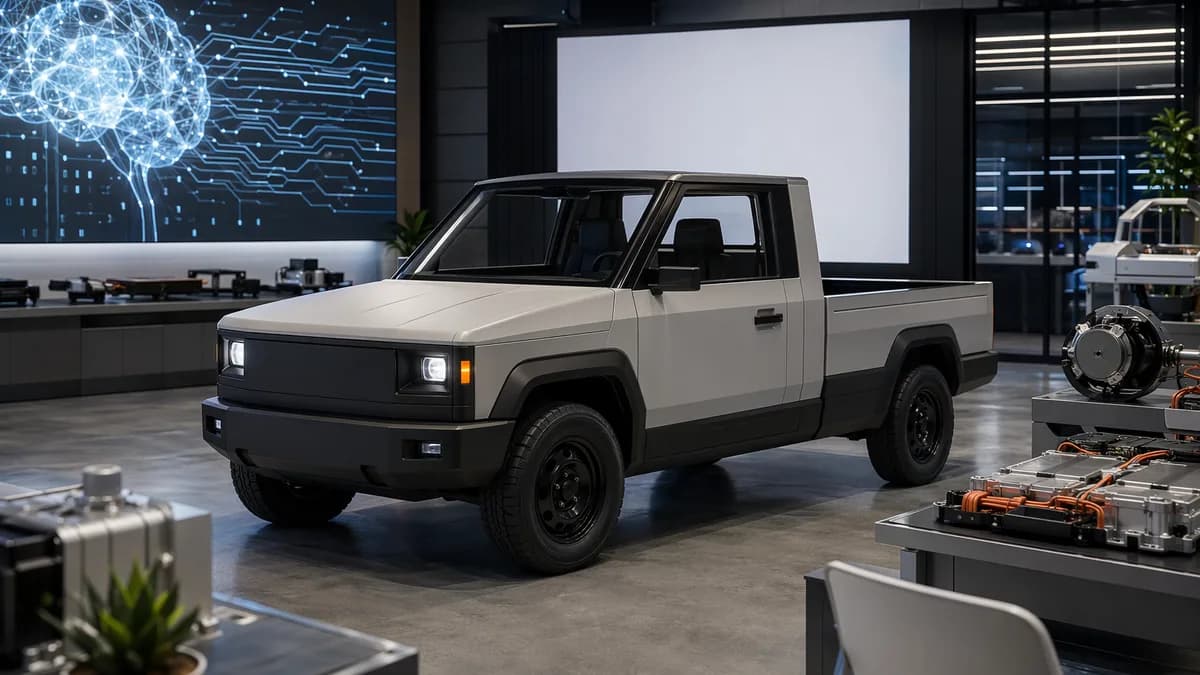
Slate Truck is less a minimalist EV experiment than a direct attack on the feature creep that helped push new vehicles toward luxury pricing.
TechnologyJune 24, 2026· 8 min read· By XOOMAR Insights Team
$24,950 Slate Truck Rips Luxury Bloat Out of New EVs
Updated on June 24, 2026
XOOMAR Intelligence
Analyst Take
69/ 100
4 sources analyzedMedium confidenceTrend10Freshness100Source Trust88Factual Grounding92Signal Cluster20
The core number is $24,950. Slate Auto announced that starting price for its American-made electric pickup, making it the least expensive pickup truck and EV available today, according to The Verge. That price is the story. The manual windows, missing stereo, and phone-mounted dashboard are the mechanism.
Slate Truck turns affordability into the main feature
Slate Auto is betting that a large enough group of buyers will trade modern conveniences for a new vehicle that costs far less than the market average. That sounds obvious until you look at the current auto business. For years, automakers have added larger screens, premium trims, more software, and driver-assistance packages, then defended higher prices as consumer choice.
Slate is moving in the opposite direction. The Slate Truck has no touchscreen, no stereo, no speakers, and manual hand-crank windows. It includes a dash mount for a phone instead of a built-in infotainment system. It also avoids the industry’s push toward semi-automated driving features. The driver drives.
That could read as deprivation. The stronger interpretation is that Slate is trying to make the base vehicle feel honest rather than cheap. The Verge’s Rani Molla drove the truck in Southern California and found that, despite the attention-grabbing omissions, it felt surprisingly normal on the road.
The risk is clear. Buyers often say they want affordability, then reject vehicles that remind them too strongly of what they gave up. Slate has to make “basic” feel intentional.
Slate Truck pricing lands far below the market it wants to disrupt
The $24,950 Slate Truck price matters because it sits below several benchmarks that define how expensive new vehicles have become.
| Vehicle or category | Price cited in source |
|---|---|
| Slate Truck starting price | $24,950 |
| Average new vehicle in May, Cox Automotive | $49,220 |
| Small and midsize pickups average | $43,044 |
| New EVs average | $54,532 |
| Average used vehicle | $26,918 |
| Ford Maverick starting price | Around $30,000 |
| Chevrolet Bolt EV starting price | Roughly $29,000 |
That table explains Slate’s opening. The truck doesn’t merely undercut premium EV pickups. It comes in below the average used vehicle cited in the source material. For price-sensitive buyers, that changes the comparison set.
The counterpoint is that the sticker price is not the full buying experience. The supplied reporting does not establish financing terms, insurance costs, taxes, fees, or how incentives may apply. It also does not show how many buyers will keep the vehicle close to its base configuration once accessories enter the picture.
Still, Slate’s first move is powerful. A sub-$25,000 new EV pickup gives the company a marketing weapon that doesn’t require a software demo or a luxury cabin walkthrough. It asks a simpler question: what are buyers actually willing to pay for?
Minimalism with a purpose, not just a cheaper parts bin
Slate removed the features that usually make a vehicle feel modern, but it did not strip out everything. The truck includes air conditioning, power locks, old-school cruise control, and a back-up camera. Its battery and powertrain warranty runs 10 years or 110,000 miles, which The Verge describes as toward the higher end of the industry standard. Slate says it is engineered for a five-star safety rating and Top Safety Pick.
The design also avoids the punishment-box problem. The truck uses simple, boxy proportions that echo older compact pickups and utility vehicles. That matters because low-cost vehicles often fail when they look like buyers settled. Slate’s job is to make the customer feel disciplined, not downgraded.
Customization is the pressure valve. Slate offers more than 200 accessories, with 80 percent priced under $500. For roughly $5,000, owners can convert the two-seat pickup into a five-seat SUV. Buyers can add wraps, seat covers, speakers, roof racks, trailer hitches, lighting upgrades, and interior accents.
That model shifts the transaction from trim packages to after-purchase choice. It also mirrors a broader consumer instinct XOOMAR tracks in practical hardware coverage, from 40% Off Hoto Electric Screwdriver Steals Drill Jobs to $390 Cuts Drag Dyson Prime Day Deals Into Practical Range: buyers respond when the value case is obvious. With a vehicle, though, the stakes are much higher.
Slate revives the basic truck idea after pickups moved upscale
The most useful frame for the Slate Truck is not “minimalist EV.” It is “basic compact truck,” a category that mostly disappeared as pickups grew larger, more luxurious, and more expensive.
The Verge points to older compact pickups such as the Toyota Pickup, Ford Ranger, and Nissan Hardbody as the kind of utilitarian vehicles Slate is implicitly reviving. Those trucks served young buyers, tradespeople, and people who needed cargo capacity without buying a luxury machine.
Slate’s electric architecture gives the idea a different feel. On the road, Molla said the truck drove more like a compact crossover than a traditional pickup, closer to a hybrid Honda CR-V than an aging Toyota Tundra. Its battery placement helped it feel planted and predictable, despite rear-wheel drive.
Performance is modest but usable. The truck accelerates from 0 to 30 mph in about three seconds and reaches 60 mph in roughly eight. Payload is up to 1,550 pounds, and towing capacity is 2,000 pounds. Estimated range is 205 miles, above Slate’s earlier 150-mile target but below many higher-end EVs.
The constraint is baked in. This is not a heavy-duty work truck. Slate is not claiming otherwise.
Buyers and fleets will split on what “enough truck” means
The likely buyer split is sharp. Some drivers will see the missing touchscreen, stereo, speakers, and power windows as unacceptable in a new vehicle. Others already use their phone for navigation, music, and communication, so paying for a second embedded screen may feel wasteful.
Chris Barman, Slate’s President of Vehicles, made that argument directly:
“It’s an ecosystem they already know, so they don’t have to learn anything new,” she said. “Why pay for a second screen that’s embedded in the car?”
For small businesses or local-use buyers, the case is easier to understand. Purchase price, payload, warranty, and predictable use matter more than cabin theater. The source does not provide fleet orders or commercial customer data, so that remains XOOMAR analysis rather than a proven demand signal.
Slate’s sales model also matters. The truck is sold direct-to-consumer, with a fixed manufacturer-set price instead of dealer-negotiated pricing. Upgrades can be self-installed through online tutorials branded as “Slate U”, or installed through more than 3,000 RepairPal-affiliated shops.
That could support affordability. It could also create friction if buyers expect the traditional service experience.
Reservations prove curiosity, not conversion
Slate says it has roughly 180,000 reservations ahead of production. Production is scheduled to begin at the company’s Warsaw, Indiana, factory before customer deliveries start in the fourth quarter. The company expects annual production to reach 150,000 vehicles by the end of 2027.
Those are meaningful signals, but they are not the same as completed sales. The strongest test will be whether reservation holders accept the real transaction price once accessories, taxes, delivery costs, financing, and personal feature expectations enter the decision.
Deloitte’s 2026 Global Automotive Consumer Study, cited in the source material, supports Slate’s thesis at a high level. Americans ranked quality at 58 percent, performance at 51 percent, and price at 46 percent as the most important factors influencing new vehicle brand choice. Nearly two-thirds said getting a good deal is a top priority in the purchase process.
That data does not guarantee Slate demand. It does show the company is attacking a real pain point.
The evidence that would prove Slate right or wrong
XOOMAR analysis: Slate does not need to outsell Detroit’s biggest trucks to matter. It only needs to prove that a basic American-made EV pickup can be desirable at $24,950 without becoming overloaded by options, service problems, or production delays.
The evidence to watch is concrete:
- Conversion: How many of the 180,000 reservations become paid purchases.
- Pricing discipline: Whether most buyers can actually stay near the $24,950 base price.
- Production scale: Whether Warsaw output moves toward the planned 150,000 vehicles annually by the end of 2027.
- Durability and service: Whether the warranty, RepairPal network, and DIY accessory model satisfy owners after launch.
- Cabin tolerance: Whether drivers still accept the stripped-down interior after the novelty fades.
If Slate holds the price, delivers volume, and keeps the truck feeling intentional rather than cheap, it will force a harder question across the auto industry: why did an affordable new vehicle become so rare?
The Bottom Line
- Slate is testing whether affordability can outweigh missing conveniences in the new-car market.
- The $24,950 price directly challenges the industry’s move toward higher-priced, feature-heavy vehicles.
- If buyers respond, other automakers may face pressure to offer simpler, lower-cost models.
Slate Truck vs. Feature-Heavy New Vehicles
| Category | Slate Truck | Mainstream industry trend |
|---|---|---|
| Starting price | $24,950 | Higher prices tied to added features and premium trims |
| Infotainment | Phone dash mount; no touchscreen, stereo, or speakers | Built-in screens, software, and audio systems |
| Windows | Manual hand-crank windows | Power conveniences are common |
| Driver assistance | Avoids semi-automated driving features | Driver-assistance packages are increasingly pushed |
Sources

Written by
XOOMAR Insights Team
Research and Editorial Desk
The XOOMAR Insights Team pairs automated research with human editorial judgment. We track hundreds of sources across technology, fintech, trading, SaaS, and cybersecurity, cross-check the facts, and explain what happened, why it matters, and what to watch next. We do not just rewrite headlines. Every article is fact-checked and scored for reliability before it goes live, and we link back to the original sources so you can verify anything yourself.
Explore More Topics
Related Articles
 Technology
Hall Effect Keyboard Hits Historic Low At $104
Keychron's flagship Hall effect keyboard has dropped to its lowest-ever price of $104, part of a broader trend where premium PC and gaming hardware is becoming
Aug 10, 20265 min
 Technology
No Dogs in Space Abandons Its Avant-Garde Mission
The music podcast No Dogs in Space has gone silent after announcing a return to punk rock, abandoning its ambitious dive into experimental music and leaving its
Aug 9, 20266 min
 Technology
Honda's Profit Doubles After Worst Annual Loss Ever
Honda's quarterly profit more than doubled to $2.9 billion in a dramatic recovery, just months after posting its first-ever annual loss, driven by vehicle sales
Aug 9, 20264 min
 Technology
Amazon's Gas Plant Permits 33 Million Tons of CO2
Amazon's planned Texas data center, powered by a dedicated natural gas plant, has a permit to emit 33 million tons of CO2 annually, potentially making it the la
Aug 8, 20267 min
 Technology
Human Curation Beats AI Doomscrolls for Tech Fans
A tech newsletter is thriving by focusing on how gadgets make you feel better, not their raw specs.
Aug 8, 20266 min
 Trading
Stocks Ignore Record Job Losses as Fed Pledge Trumps Payrolls
The Dow Jones Industrial Average showed no fear after July's shocking job losses, as investors bet weak labor data will keep the Federal Reserve from raising ra
Aug 10, 20266 min
 Fintech
CPI Print Holds Key to Crypto Rally or Ruin
Crypto's fate this week balances on a knife edge, with the July CPI report poised to dictate Fed policy and market risk appetite, while earnings reveal which co
Aug 10, 20266 min
 Global Trends
Oil Plunges 2% on Secret Iran Peace Deal Hints
Crude oil prices dropped 2% on unconfirmed reports that a ceasefire deal between the U.S. and Iran could reopen the Strait of Hormuz, despite ongoing attacks on
Aug 10, 20267 min
 Fintech
Erebor Quadruples Deposits In 100 Days For $8B Valuation
Startup-focused Erebor Bank has quadrupled deposits in three months and is now raising $1.5 billion at an $8 billion valuation, a giant bet on its post-SVB nich
Aug 10, 20265 min
 Fintech
DOJ Charges 455 Providers for $6.5B in Healthcare Fraud
The Department of Justice has replaced traditional fraud investigations with AI-driven analytics, charging 455 defendants in a $6.5 billion scheme and forcing p
Aug 10, 20267 min
Don't miss the signal
Get our weekly roundup of the stories that matter across tech, fintech, and trading. No noise, just signal.
Free forever. No spam. Unsubscribe anytime.