
UK holidaymakers can now miss flights home because EU Entry/Exit System queues, not airline delays, are blocking them at border control.
Global TrendsJune 24, 2026· 9 min read· By XOOMAR Insights Team
Six-Hour Queues Trap UK Travellers in EU Entry/Exit System
Updated on June 24, 2026
XOOMAR Intelligence
Analyst Take
58/ 100
4 sources analyzedLow confidenceTrend10Freshness96Source Trust92Factual Grounding92Signal Cluster20
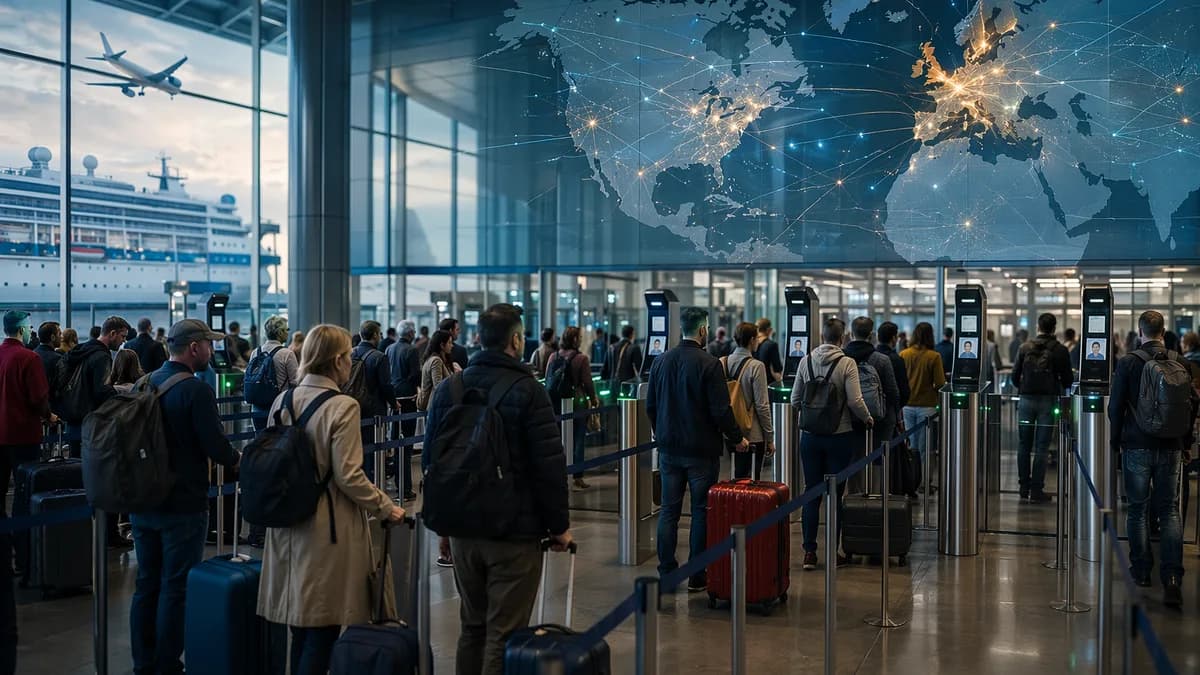
The warning matters this summer because it is the first peak holiday period since the EU’s Entry/Exit System, or EES, came in, according to BBC World. The system changes a familiar border routine for UK travellers: no more simple passport stamp at many checkpoints. Instead, non-EU citizens entering and leaving the Schengen Area must register fingerprints and a photo alongside a passport scan.
That extra step is where the delays start. The system covers 29 European countries, including major UK holiday routes to France, Spain, Portugal and Italy. It has worked well at some airports, BBC World reports, but waits of several hours have been reported elsewhere. A representative of airline trade body IATA has warned queues in some places could be as long as six hours.
Why could the EU Entry/Exit System slow UK trips to Europe during peak holidays?
The EU Entry/Exit System slows travel because it turns a border check into a biometric registration process. UK passengers must provide fingerprints and a photo at passport control, along with a passport scan. That takes longer than a stamp.
The risk rises during school holidays because border systems are being tested at their busiest point. The source material does not give a single Europe-wide delay figure, and that matters. This is not one uniform queue spreading across the continent. It is a patchwork problem: some airports are coping, while others have seen waits stretch into hours.
The sharpest warning is for the journey home. The UK boss of Wizz Air told the BBC passengers should be prepared for a wait and turn up three hours before their flight home. Some passengers have already missed flights because EES checks took so long they could not reach the gate in time.
Airlines are not giving one answer on whether they will hold aircraft. Some say they will wait where possible. Ryanair, BBC World reports, has said it will not.
The European Commission is allowing EES to be suspended in “exceptional circumstances that lead to excessive waiting times”, until September.
XOOMAR analysis: That carve-out shows the EU knows the system’s operational weak point. The database may be digital, but the queue is physical. If kiosks, staffing and passenger flow do not line up, the bottleneck appears immediately.
What will change for UK passport holders under the EU Entry/Exit System?
For UK citizens, the biggest change is status. They are treated as “third country” nationals under EES, which means they must go through the biometric process when entering and leaving the Schengen free movement zone.
EES replaces manual passport stamping. It tracks who enters and leaves the Schengen Area, which covers 29 European countries. For many UK passengers flying to destinations such as France, Spain, Portugal and Italy, the process means using automated kiosks after landing. The information is then verified when they leave.
Some passengers are handled differently. Children under 12, for example, have their passport checked by border staff instead.
The system began rolling out in October last year and is now fully up and running, according to the BBC. During the introductory period, queues flared up at certain airports during busy times. Since then, performance has split: smooth in some locations, strained in others.
| Travel setting | EES process described in source | Main delay risk |
|---|---|---|
| Airports in Europe | UK travellers register fingerprints, photo and passport scan after landing | Busy arrival halls, technology issues, staffing levels |
| Dover ferry port | French border checks take place before leaving the UK | Car queues and suspended processing during pressure points |
| Eurostar at St Pancras | 49 EES processing machines have been installed | Machines are present, but not yet in routine use |
| Eurotunnel at Folkestone | More than 100 EES kiosks installed at each side of the Channel | Process depends on how checks are run in practice |
This is also where digital-border policy overlaps with civil-liberties questions. XOOMAR has covered rights disputes in other contexts, including Supreme Court Blocks Damages Over Rastafarian Dreadlocks, a reminder that state processes can become personal fast when identity, documentation and enforcement collide.
How will fingerprint and photo checks work at airports, ferry ports, Eurotunnel and Eurostar?
At airports, UK travellers heading to many Schengen destinations will use automated kiosks after they land. They must scan their passport, provide fingerprints and have a photo taken. When they leave, that information is verified.
That sounds simple. In practice, the BBC reports three problems: technology issues, border staffing levels and cases where people have had to register biometric information more than once. Those are the details that turn a new database into a missed departure.
The UK has several unusual choke points because French border police conduct passport checks before passengers leave Britain at three locations:
- Dover’s ferry port
- Eurotunnel’s Folkestone terminal
- Eurostar’s St Pancras rail terminus
For months, automated machines have been installed at those sites, but they are not yet in routine use. Border staff are doing part of the process instead.
At Dover, long queues of cars built up at the start of the May half term holidays, even though fingerprints and photos were not yet being collected. French border authorities ended up suspending the process. For coaches, BBC World reports that vehicles will be sealed after passengers complete EES checks, before driving to the ferry terminal.
The mobile app is not yet a broad fix. It has been developed so passengers can do part of the process before reaching the border, but the BBC says it is currently being used by only two countries. Sweden is using it to help register passport data and photos. Portugal is using it only for an entry questionnaire.
Where are EES holiday queues most likely to build?
The clearest pressure points are places where a lot of passengers arrive in waves and every extra border step compounds. Airports face that risk in arrival halls. Dover, Eurotunnel and St Pancras face it before departure from the UK because French checks happen on British soil.
Dover has already shown how fragile the flow can be. The May half term queues happened before full biometric collection was in routine use there. That is the warning sign. If a partial process can snarl traffic, the full process needs enough staff, machines and lane management to absorb holiday peaks.
Portugal is one example of a country trying to add capacity. It has announced hundreds of extra border staff for July after some places saw the worst queues.
Greece is taking another route. It is not applying biometric checks to British visitors over the peak period, according to the BBC. That does not mean EES has disappeared. It means the European Commission’s temporary flexibility is being used where waiting times risk becoming excessive.
XOOMAR analysis: The uneven rollout is the story. Travellers should not assume one friend’s smooth arrival in one airport means the whole system is working the same way elsewhere.
What would EES mean for a UK family driving to France for a half-term ferry?
Take a simple scenario: two adults and two children driving to Dover for a ferry during a school holiday. This is an illustrative example, but it follows the process described by the BBC.
The family reaches the port and joins the vehicle lanes. Because French border checks happen before departure from Dover, they are processed in the UK. The adults may need to register fingerprints and photos once biometric collection is active at that site. Children under 12 have their passport checked by border staff instead.
If the process slows, the delay does not sit neatly at one desk. It backs into the vehicle lanes. Coaches add another layer because passengers complete EES checks before the coach is sealed and driven toward the ferry terminal.
That is why ferry passengers should treat operator timing guidance as operational, not optional. BBC World says airports advise passengers to follow airline guidance on how early to arrive for flights back to the UK. The same logic applies across modes: the operator sees the queue before you do.
How can UK travellers reduce the chance of missing a flight, ferry or Eurostar train under EES?
The practical response is boring but effective: build in more time and check operator guidance before travelling. For flights home, the clearest sourced advice is the Wizz Air UK boss’s warning that passengers should be prepared for a wait and arrive three hours before their flight home.
Passengers should also expect different experiences by route. A Spanish airport, a Greek airport, Dover and St Pancras may all sit inside the same EES story, but they are not running identical passenger flows.
ETIAS is separate. The EU is also introducing the European Travel Information and Authorisation System, a visa waiver system linked to passports. It will build on EES, but it is not due to start until the end of 2026, and the final date has not been confirmed. It will cost €20 (£17.47) per application and be valid for three years. People aged under 18 and over 70 will need to apply, but will not have to pay.
The watch item now is not whether EES exists. It does. The test is whether airports, ferry ports and rail terminals can process peak holiday volumes without repeated suspensions, missed flights and six-hour queues. For UK travellers, the safest assumption this summer is simple: if your route crosses the Schengen border, the border may take longer than the journey planner says.
Key Takeaways
- UK travellers may need significantly more time at EU border control during peak holiday periods.
- The biggest risk is missing flights home because biometric exit checks can create long queues.
- Delays vary by airport, so passengers should check local guidance before travelling.
EU Border Checks: Old Routine vs Entry/Exit System
| Before EES | With EES |
|---|---|
| Passport stamp at many checkpoints | Passport scan plus fingerprints and photo |
| Generally quicker manual border processing | Longer biometric registration process |
| Lower risk of border-control-related missed flights | Higher risk of delays during peak holiday periods |
EES Travel Delay Warnings
Recommended early arrival
hours3
Possible queue warning
hours6
Sources

Written by
XOOMAR Insights Team
Research and Editorial Desk
The XOOMAR Insights Team pairs automated research with human editorial judgment. We track hundreds of sources across technology, fintech, trading, SaaS, and cybersecurity, cross-check the facts, and explain what happened, why it matters, and what to watch next. We do not just rewrite headlines. Every article is fact-checked and scored for reliability before it goes live, and we link back to the original sources so you can verify anything yourself.
Explore More Topics
Related Articles
 Global Trends
40C Europe Heatwave Cracks Rails, Schools and Cities
Europe's 40C heatwave is forcing UK travel warnings and Italian red alerts, showing infrastructure can't keep up with rising heat.
Jun 24, 20269 min
 Global Trends
40 Drowning Deaths Drag France Heatwave Into Crisis
France's record heat has killed far beyond the thermostat, with 40 drownings tied to dangerous relief in rivers and canals.
Jun 23, 20266 min
 Global Trends
Israel Defies Sanctions With West Bank Settlements Cash
Allies sanctioned settler networks while Israel advanced $388m for 69 West Bank settlements, deepening the split over annexation.
Jun 21, 20265 min
 Global Trends
Trump Meloni G7 Photo Claim Erupts Into Alliance Fight
Trump turned Meloni's denied photo plea into a fight over Iran, status and whether Italy owes Washington deference.
Jun 20, 20268 min
 Global Trends
Russian Warning Shots Rattle British Yacht in the Channel
A British couple say a Russian frigate fired warning shots near their yacht, while Moscow claims the boat made a dangerous approach.
Jun 20, 20268 min
 Fintech
30 EEA Markets Swing into Play on Ripple MiCA Approval
Ripple’s preliminary Luxembourg approval could open 30 EEA markets for crypto payments, but final CASP conditions still stand in the way.
Jun 23, 20267 min
 Cybersecurity
£39m Transport for London Cyber-Attack Ends in Guilty Pleas
Two young Britons admitted roles in the £39m TfL cyber-attack, which exposed data from 10 million customers and crippled key apps.
Jun 23, 20267 min
 Technology
$24,950 Slate Truck Rips Luxury Bloat Out of New EVs
Slate Truck's $24,950 price turns missing features into a weapon against bloated EV pricing.
Jun 24, 20268 min
 Technology
$145 Vanishes From Orbi 770 in Prime Day Router Deals
Netgear's Orbi 770 3-pack drops to $555 in Prime Day router deals, putting a top Wi-Fi 7 mesh setup within easier reach.
Jun 24, 20266 min
 Global Trends
France Ebola Case Forces Hospitals Into Alert Mode
France confirmed an imported Ebola case in a doctor back from Congo, triggering isolation, contact tracing, and hospital alerts.
Jun 24, 20265 min
Don't miss the signal
Get our weekly roundup of the stories that matter across tech, fintech, and trading. No noise, just signal.
Free forever. No spam. Unsubscribe anytime.