The Night the Strait Went Quiet
When fusion power makes oil routes obsolete, a former tanker pilot must teach the world how to share invisible rivers of energy.
The Last Convoy
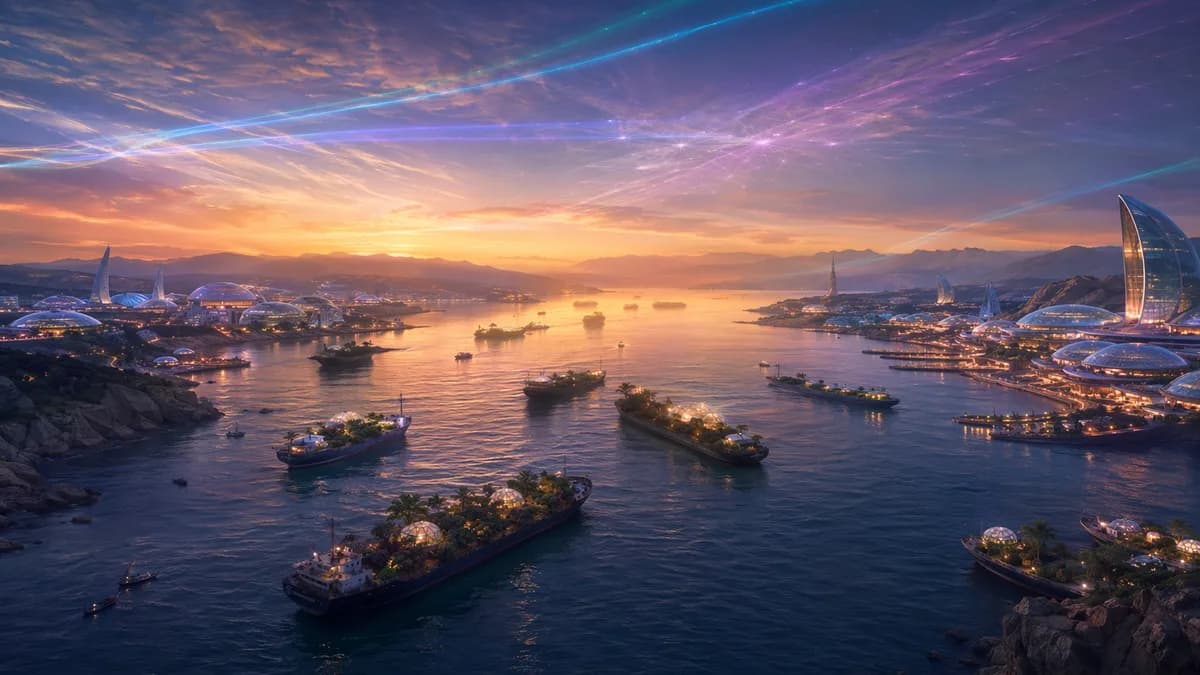
The last tankers come through at sunset, black hulks moving in single file along the orange skin of the Strait of Hormuz. Their decks shine with ceremonial lights. Their horns do not blast. They hum, low and embarrassed, like old men clearing their throats in a room where no one has asked them to speak.
Samira al-Basri stands on the observation deck of the new harbor control tower with her father beside her. The tower rises from what used to be a crude terminal, its legs drilled into the same concrete that once sweated oil in the heat. Now the tanks are gone. In their place sit fusion housings, white and round as moon shells, their containment fields buried behind walls of salt-glass and basalt. Above them, receiver masts angle toward the sky like reeds listening for rain.
Her father leans on a carbon cane, though she knows he hates the look of it. Khalid al-Basri once piloted tankers through this strait by memory and nerve. Kings sent watches. Admirals sent escorts. Insurance companies sent prayers. He knew every current, every shallow, every bluff in a captain’s voice when missiles were warming in their tubes.
“Too straight,” he says.
Samira glances at him. “The convoy?”
“The whole world now.” His eyes follow the ships. “They put lines on a screen and think danger obeys.”
Below them, officials in pressed white robes and navy suits applaud from a viewing platform. Drones drift overhead, recording the end of the age that made and wounded them. Across the water, the Musandam cliffs turn purple. The air smells different tonight, less diesel and salt rot, more hot stone and ozone from the transmission arrays charging in their cradles.
On the horizon, the old sea lane is emptying. Behind it, the Gulf Ring wakes.
Fusion plants stand on former oil terminals from Basra to Fujairah, from Qatar’s old export islands to the refitted yards near Bandar Abbas. They do not send barrels into the world. They send beams. Tight microwave corridors, invisible until a flock of calibration drones crosses through and glows faint blue at the edges, carry power to cities, farms, desalination basins, vertical orchards, and refugee settlements stitched along the coasts.
A tanker called the Zainab Star passes closest. Samira remembers guiding her through once, years ago, before she left ships for sky traffic. Her father lifts two fingers in salute.
“No one will need us now,” he murmurs.
Samira watches a beam-test marker blink green over the water, where a tanker route once meant war plans, embargoes, bribes, ransom, hunger.
“No,” she says. “They’ll need us differently.”
Harbor Master of the Invisible
By morning, Samira’s harbor has no ships to berth and no cargo to weigh, yet the control room is louder than any port she has known. Screens curve around her in bands of blue and amber. Weather models bloom like bruises over the Gulf. Airspace windows open and close. Bird migration paths scatter in thin gold threads. Treaty quotas stack in columns beside live demand from cities, farms, clinics, cold rooms, charging docks, data vaults, and refugee shelters with names that change depending on which ministry is speaking.
She is Harbor Master of the Invisible, though the title still makes her laugh when she signs it.
“Bandar school district requesting two extra minutes for afternoon cooling,” says Leena, her youngest dispatcher, from station five.
“Approved if they accept reduced draw at nineteen hundred,” Samira says.
“Muscat aviation wants corridor M-4 cleared. Crane migration conflict.”
“Delay aviation by six minutes. The cranes were here first.”
Leena grins without looking up. “I’ll quote you.”
Outside the tower glass, no tanker wakes bruise the water. Instead, guide buoys mark beam safety zones, blinking green when the sky lane above them is clear. On calm days, children in skiffs dare one another to pass under the transmission arcs, though there is nothing to feel unless you carry unshielded metal and a death wish. The beams are tight, layered, negotiated every second by machines and argued over by people.
The changes reach far beyond the tower. In old generator alleys of Karachi and Basra, the night no longer coughs black smoke. Mechanics who once slept beside drums of diesel now repair receiver cloth, flexible gray fabric stretched over rooftops like laundry for the gods. Families wet it at dusk, and by midnight their rooms are cool enough for infants to sleep without salt crusting on their lips.
In villages that used to count electricity in hours, children run between rows of dwarf citrus trees under desalinated mist. Their feet slap mud that should not exist. In the refugee terraces outside Chabahar, women wash lettuce in clean water while overhead a municipal receiver trembles softly, drinking energy from a fusion plant two hundred kilometers away.
Still, abundance has schedules. Every watt has a tag. Every beam has a permission code.
At noon, Samira walks the exterior gantry. Heat presses through her coveralls. The sea below flashes hard silver, empty of tankers but busy with small boats, gulls, maintenance drones, and fishers who no longer fear being mistaken for smugglers at every patrol line.
Her wrist screen vibrates. A forecast packet opens. Humidity spike. Night temperature anomaly. Wet-bulb risk rising.
She looks east, where the air over the strait seems to thicken, as if the horizon is holding its breath.
A Heatwave Without a Flag
The heat arrives after midnight with no wind and no mercy. It does not roar. It settles. Glass fogs from the outside. Metal handrails grow slick. The air tastes like warm cloth held over the mouth.
Samira stands barefoot on the control room’s cooling grate because her shoes are soaked through. Everyone is sweating despite the tower systems. On the main wall, the Gulf Ring pulses in nervous color. Bandar Abbas flashes orange, then red. Gwadar follows. Then three floating neighborhoods south of the traffic lane, unnamed in the treaty database, appear as gray clusters surrounded by demand estimates that should not exist.
“Wet-bulb thirty-five point one in Bandar,” Leena says. Her voice is thin. “Hospitals report cooling loads at ninety-three percent. Neonatal wards requesting priority.”
“Give it,” Samira says.
“Quota cap in twelve minutes.”
Samira looks at the treaty column. National allotments. Emergency buffers. Agricultural deferrals. Defense reserves, always fat and untouchable. Below them, the floating neighborhoods remain gray. Stateless habitation rafts, storm migrants, dock labor families, former crews from bankrupt shipping companies. People who live in welded barges and composite pontoons because no coast has agreed to claim them.
A diplomatic channel opens in fragments.
“Emergency transfer to Bandar Abbas is within Iranian allocation,” says a voice from Tehran.
“Gwadar requires Pakistani authorization before external beam support,” says another.
A Gulf Secretariat official speaks too calmly. “Unregistered recipients are not recognized loads under Ring protocols.”
Samira grips the edge of the console. “They are human beings in lethal heat.”
“That is a humanitarian category,” the official says. “Not an energy category.”
From Gwadar General, a doctor pushes through on a medical channel, her face shiny with sweat under a surgical cap. Behind her, nurses tape reflective sheets over windows.
“We have thirty-seven ventilated patients,” the doctor says. “Our chillers are cycling down. If you have power, send it.”

“Stand by,” Samira says.
“Don’t say stand by.” The doctor’s control cracks. “They are lying still because movement cooks them.”
On another screen, a floating neighborhood uploads shaky footage. Children sleep on wet mats. Men pour seawater over tarps, uselessly. An old woman sits in a plastic chair with a fan that does not turn. Someone keeps saying, “Is the beam coming? Is it coming?”
The treaty clock moves toward quota breach.
Samira calls the Secretariat. “Authorize regional emergency redistribution.”
“We cannot establish precedent during an active event.”
“People will die during your grammar.”
Silence.
Then her father’s name appears on her private line. He is at home in Muscat, where rooftop cloth glows faintly in the heat.
“I’m watching,” he says.
“So is everyone,” Samira replies.
“No,” he says. “Everyone is waiting to see who they are allowed to save.”
The Reef Thieves
At 02:18, beam corridor S-7 shivers.
The distortion is small, a lace of interference along the edge of a low-power agricultural transfer meant for a desalination basin in Ras al-Khaimah. The system flags it as atmospheric scatter. Samira does not believe it. Weather has patterns. This has intention.
“Pull up thermal over the south reef,” she says.
Leena wipes sweat from her upper lip and throws the image onto the wall. At first it is only black sea and pale heat blooming from the water. Then the unauthorized receivers appear.
They are beautiful in a criminal way.
Dozens of floating rectennas ring a recovering coral reef like silver lily pads, hand-built from scavenged mesh, antenna cloth, old tanker radar frames, and the curved ribs of dismantled fuel skiffs. Cables run to pontoon sheds, submerged pumps, barrel filters, cold kitchens under awnings. Blue-white work lamps reveal people moving fast, barefoot and soaked, adjusting angles with ropes.
“Reef thieves,” Leena whispers.
Samira has read the enforcement briefings. Former fuel smugglers, the ones who used to run diesel at night between sanctions and shortages, now accused of siphoning Ring scatter. The security ministry calls them parasites with soldering irons.
The live feed says something else.
A boy no older than twelve carries trays of ice to a line of migrant workers crouched under misting pipes. Women stir huge pots over induction plates. Men in masks lower coolant coils into the reef shallows, where coral glows under lamps, pink and bone-white and stubbornly alive. A hand-painted sign on a pontoon roof reads, in Arabic, Farsi, Urdu, and bad English, COOL WATER IS FOR BREATHING TOO.
“They’re stealing three megawatts,” says a security liaison over the channel. “Shut them down before they destabilize the corridor.”
Samira zooms in. The reef temperature is four degrees lower inside the ring. Oxygen levels are rising. The smugglers have tied their illegal receivers into emergency shelters on the floating neighborhoods. Crude, dangerous, brilliant.
A call punches through from the reef itself, audio only. Static, then a man’s rough voice.
“Harbor Master. We know you see us.”
Samira says nothing.
“We do not sell it,” he says. “Come count the kitchens. Come count the children.”
“You are interfering with a treaty beam,” she says.
“The treaty does not know our names.”
In the control room, no one moves.
On the wall, hospital loads climb. The gray neighborhoods flicker, unrecognized and overheating, while the illegal reef receivers sit directly under the cleanest angle for a reroute.
Abundant energy waits in the air above them, invisible, harmless until law tells it where to land.
The Old Law of Rescue
Samira’s father’s face fills the private screen, soft with age and lit green by his own receiver cloth. Sweat beads in the lines beside his nose.
“When I was twenty-eight,” he says, “a fishing boat caught fire off Qeshm. Iraqi registry, during the war. We were carrying crude for Kuwait under American watch. Every radio told us to maintain course.”
“What did you do?”
He smiles without joy. “I disobeyed too slowly. Two men drowned before we lowered boats.”
Samira closes her eyes for one second. The control room smells of hot plastic, coffee gone sour, human fear. The treaty clock is red now. Defense reserves remain locked behind sovereign seals. The hospitals are begging. The floating neighborhoods are no longer sending video, only temperature and pulse pings from cheap medical bands.
“There is old law,” her father says. “Older than flags on tankers. Older than insurance. If a soul is in peril at sea, you render aid. You do not ask whose anthem they know.”
“This is energy infrastructure.”
“This is the sea,” he says. “The sea has changed clothes.”

Samira opens her eyes.
“Leena,” she says, “prepare manual reroute. Corridor S-7, S-9, and hospital reserve band H-2. Use the reef receivers as distributed landing nodes. Push cooling priority to Bandar, Gwadar, and all unregistered heat shelters within thermal radius.”
Leena stares at her. “That crosses three national caps.”
“Yes.”
“It uses illegal equipment.”
“Yes.”
“The Secretariat will revoke your authority.”
“Not if they are busy surviving the precedent.”
The diplomatic channel erupts before the beams move.
“Harbor Master, you do not have authorization.”
“Stand down.”
“This may be construed as energy trespass.”
Samira keys the open channel, voice steady, though her hand shakes above the execute field.
“Under maritime rescue obligation, I am declaring persons in heat peril equivalent to persons in distress at sea. The Gulf Ring will render immediate energy aid to preserve life. Record my name.”
A pause follows, deep as water.
Then Leena says, “Manual reroute ready.”
“Send it.”
Nothing visible happens at first. That is the strange holiness of the new age. No floodgate opens. No tanker turns. Yet across the black water, rectennas wake one by one, trembling with captured power. The reef ring glitters. Pumps surge. On the hospital feeds, chiller graphs stop falling. In Gwadar, a doctor presses both hands to her face and laughs once, like a sob knocked sideways.
On the floating rafts, fans begin to turn. Wet-bulb shelters inflate with cool air. Someone’s camera comes back online to show children lying under silver cloth, hair plastered to their foreheads, still breathing.
Military encryption warnings bloom across Samira’s screen. Legal injunctions stack in red. News drones pivot toward the strait.
Her father exhales. “Faster than I was,” he says.
Samira watches the beams hold through the wet, murderous night, invisible rivers crossing every line humans have drawn on maps.
A Strait for Everyone
By dawn, the strait is quiet in a way Samira has never known.
No tanker horns roll between the cliffs. No patrol boats challenge each other in clipped voices. No helicopters thump low over suspected smugglers. The water lies pale and wrinkled beneath a white sky, warm as bathwater, with fishing boats moving through it carefully, their nets dark with sardines. Above them, power corridors remain active, harmless arcs marked only by drone lights and the soft green blink of safety buoys.
Samira steps onto the observation deck with a paper cup of coffee she has forgotten to drink. Her shirt clings to her back. Her eyes burn. The emergency is not over, not really, but the lethal peak has passed. Bandar’s hospitals hold. Gwadar’s chillers recover. The floating neighborhoods report no mass deaths, though three elderly residents and a dockworker are gone before cooling reaches them. Their names scroll on a side screen inside, waiting to become statistics, or martyrs, or footnotes.
Below the tower, security officers wait beside an electric launch. They do not look eager. One of them keeps checking his phone, where the footage from the rafts is already everywhere. Children under silver cloth. Reef cooks handing out bowls of lentils. A coral polyp opening in chilled water as if the whole sea has taken a breath.
Leena joins Samira at the rail. “Secretariat wants you in closed session.”
“I imagine they do.”
“My aunt in Gwadar says to tell you her neighbor’s baby is alive.”
Samira nods, but the words lodge under her ribs. “Tell her the Ring did what it was built to do.”
Leena snorts. “That is not what it was built to do. That is what you made it do.”
Across the harbor, the old convoy lane glows under morning haze. Samira remembers her father saying the world has become too straight. She sees now that the problem is not straightness, but ownership of the line.
By noon, the first draft of the Watt Refuge Accord begins circulating, though no one agrees on the name yet. Lawyers argue over “energy asylum,” “thermal distress,” and “non-sovereign survival loads.” Admirals complain about unsecured receivers. Climate ministers cry on camera and deny crying. The reef thieves become either criminals or pioneers, depending on which broadcast is playing.
Samira is suspended before sunset. By then, three governments have quietly copied her reroute protocol into their emergency systems.
That evening, she visits her father. He sits on his balcony while rooftop receiver cloth ripples above him, feeding coolness into the rooms behind. The sea is a dark strip beyond the city lights.
“They will make a law,” he says.
“They will make many,” Samira replies.
“And break some.”
“Yes.”
He hands her tea, hot despite the weather, because some habits survive every revolution. They sit without speaking while invisible power moves overhead, crossing borders no eye can see.
Out on the strait, a fishing boat raises a small sail for no practical reason. It catches the weak evening wind and leans toward open water, under a sky full of rivers that belong to everyone and no one, depending on who is thirsty enough to ask.