
If Uganda's army chief can order a leading media group shut and publicly say he does not believe in a free press, the real question is no longer about one newsroom. It is about who now decides what Ugandans are allowed to hear.
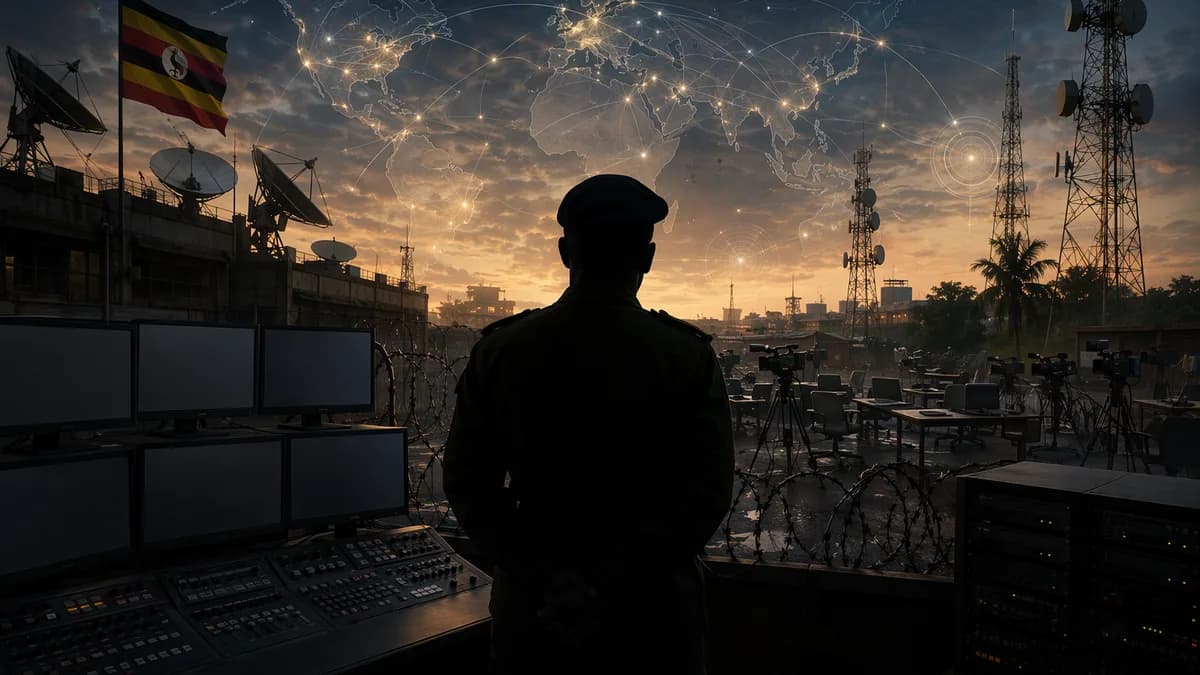
Global TrendsJune 28, 2026· 8 min read· By XOOMAR Insights Team
Army Chief Turns Uganda Media Shutdown Into Power Test
Updated on June 28, 2026
XOOMAR Intelligence
Analyst Take
58/ 100
4 sources analyzedLow confidenceTrend10Freshness95Source Trust92Factual Grounding91Signal Cluster20
Gen Muhoozi Kainerugaba, Uganda's army chief and son of President Yoweri Museveni, ordered the closure of NTV, Spark TV, and the Daily Monitor, while the newspaper said armed soldiers were stationed outside its Kampala headquarters, according to BBC World. The outlets belong to Nation Media Group, described by the BBC as one of the most influential media companies in East Africa.
The Uganda media shutdown is not being framed by its most important actor as a narrow legal dispute. Kainerugaba wrote on X:
"I DO NOT believe in a free press! The press should be guided by cadres of the revolution."
That sentence strips away the usual language governments use when they move against journalists. No careful claim of licensing breaches. No public evidence cited in the supplied source. No detailed security justification. Just power, stated plainly.
Does the Uganda media shutdown target a newsroom, or the country's public square?
The obvious answer is a newsroom. The harder answer is Uganda's information bloodstream.
NTV, Spark TV, and the Daily Monitor are not fringe outlets. They sit inside Nation Media Group, a major regional media company. The BBC reports that NTV and Spark TV were taken off air, while the Daily Monitor said its headquarters was under "military siege" and that staff reported "no-one was allowed to enter or leave the compound."
Viewers of NTV Uganda and Spark TV were reportedly met with blank screens displaying: "video unavailable."
That detail matters. A media shutdown is not only about stopping one article or one broadcast. It blocks editorial meetings, source calls, live coverage, printing decisions, studio operations, and the ordinary work of checking power in real time.
XOOMAR analysis: the chilling effect is likely broader than the affected outlets. Editors at rival stations will now know that sensitive political or military coverage can draw more than a complaint. Sources may hesitate before speaking. Producers may avoid stories that involve succession politics, opposition activity, or the army. None of that requires a formal censorship law. The presence of soldiers outside a media compound sends its own instruction.
This is a different kind of information-control story from platform policy fights. For separate XOOMAR coverage of online access and platform regulation, see Australia Social Media Ban Dares Meta to Prove Teens Are Out and Australia Social Media Ban Slams Big Tech With $68M Fines. The Uganda case, as described in the supplied sources, is more direct: armed force at media facilities and an army chief asserting personal authority over reopening.
Which numbers show this is bigger than one Sunday crackdown?
The most important numbers are political, not commercial.
President Museveni, 81, is a former rebel leader who took power about 40 years ago. He won a record seventh term in disputed elections in January, according to the BBC. The same report says there is widespread speculation that he is grooming Kainerugaba to succeed him.
RFI, citing AFP, reported that Uganda ranked 143 out of 180 countries in the 2025 Reporters Without Borders press freedom index. That ranking does not prove the facts of this specific shutdown, but it places the episode inside a documented pressure environment for media.
There is also a paper trail involving the same media group:
| Year | Outlet | Reported action | Stated context in source |
|---|---|---|---|
| 2007 | NTV | Forced off air | Government accused its news coverage of being negative |
| 2013 | Daily Monitor | Raided by police, and RFI says shut for 13 days | Publication of a letter allegedly linking senior officials to a succession plan dubbed the "Muhoozi Project" |
| January | Opposition politics and media climate | Election held after disrupted opposition rallies | UN said the vote took place in an "environment marked by widespread repression and intimidation against the political opposition" |
| Sunday | NTV, Spark TV, Daily Monitor | Taken off air or placed under armed guard | Kainerugaba said outlets would "not re-open without my permission" |
The supplied sources do not provide circulation, audience reach, web traffic, or social following for the affected outlets. That gap matters. It limits any precise measurement of the shutdown's audience impact.
But the political significance does not depend on a traffic chart. The affected outlets are described as leading independent media institutions. The order came from the army chief. The language used was sweeping.
Why does Muhoozi's wording change the nature of the confrontation?
Governments often dress media pressure in procedural clothes. This episode looks different because Kainerugaba did not hide the ideology behind the action.
He wrote that his "great father" had given him the "power to shut down any media house I want to". He also said both NTV and the Daily Monitor would "not re-open without my permission".
"From now on ALL media in Uganda will follow the rules!"
The source material says it is unclear exactly what led to the crackdown. That uncertainty is central. If no specific public allegation is presented, the closure reads less like enforcement and more like a demonstration.
Opposition and human rights groups accuse Kainerugaba of being a central figure in a highly repressive regime led by his father, the BBC reports. Supporters of Museveni and his family say they have guaranteed stability in Uganda, and that the economy has improved under their rule.
Those two positions define the political split. One side sees order. The other sees coercion.
XOOMAR analysis: the most consequential shift is not that the state pressured media. The sources show that has happened before. The shift is the army chief's open rejection of free-press principles and his claim that reopening depends on his permission. That bypasses the normal idea that courts, regulators, or written law should decide the limits of media conduct.
Who now has to choose sides?
Editors face the first choice. Keep reporting aggressively and risk direct confrontation, or retreat into safer coverage. That choice becomes sharper when the military, not just a regulator, appears at the gate.
Media owners face another calculation. Nation Media Group has major regional interests. Its Ugandan outlets now sit inside a confrontation with one of the most powerful figures in the country. The supplied sources do not report the group's broader strategy, but the immediate operational reality is stark: stations off air, soldiers present, reopening tied by Kainerugaba to his permission.
Advertisers and business partners also have a decision, though no advertiser reaction is reported in the supplied material.
XOOMAR analysis: companies that buy media exposure typically dislike instability, but they may also fear being seen as backing outlets targeted by security forces. If the shutdown drags on, commercial pressure could become another layer of constraint on independent journalism.
Citizens face the least formal choice and maybe the most important one. Loyalists may accept the shutdown as discipline against critical outlets. Opposition supporters and rights groups are likely to read it as proof that political power is moving deeper into military hands. The BBC reports that during January's election period, opposition rallies were disrupted and security forces at times opened fire. It also reports that Kainerugaba caused outrage when deleted posts threatened defeated opposition candidate Bobi Wine.
If the outlets reopen, does the warning still work?
Yes. That is the danger.
Even if NTV, Spark TV, and the Daily Monitor return, the message has already landed: a leading media house can be surrounded, broadcasts can go dark, and the army chief can publicly say the press should be guided by "cadres of the revolution."
The practical next steps are clear, even if the outcome is not. Watch for:
- Legal response: whether courts, regulators, or lawyers challenge the order and on what basis.
- Official justification: whether the government presents a specific allegation against the outlets.
- Reopening terms: whether any return to air comes with editorial conditions.
- Media behavior: whether rival outlets continue covering succession politics, opposition figures, and the military with the same intensity.
- International pressure: whether press freedom groups and foreign partners escalate statements beyond condemnation.
The thesis is simple: the Uganda media shutdown is less a dispute over one media group's coverage than a stress test for the country's remaining institutional limits. Evidence that would weaken that thesis would be a rapid reopening under a transparent legal process, with no editorial conditions and no further threats. Evidence that would confirm it would be silence from civilian authorities, conditional reopening, or more outlets adjusting coverage before soldiers ever arrive.
The Stakes
- The shutdown affects major Ugandan outlets that many citizens rely on for news and public accountability.
- A senior military leader openly rejecting press freedom signals a broader threat to independent journalism.
- The presence of armed soldiers at a newsroom raises concerns about intimidation and who controls public information.
Sources

Written by
XOOMAR Insights Team
Research and Editorial Desk
The XOOMAR Insights Team pairs automated research with human editorial judgment. We track hundreds of sources across technology, fintech, trading, SaaS, and cybersecurity, cross-check the facts, and explain what happened, why it matters, and what to watch next. We do not just rewrite headlines. Every article is fact-checked and scored for reliability before it goes live, and we link back to the original sources so you can verify anything yourself.
Explore More Topics
Related Articles
 Global Trends
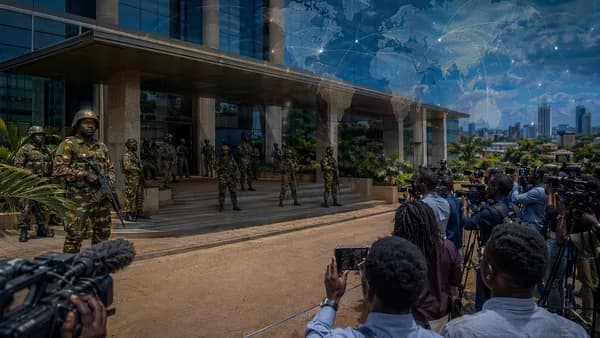
Soldiers Ring Newsroom in Uganda Media Shutdown Order
Uganda's army chief ordered a major media house shut and soldiers appeared outside Daily Monitor. The warning reaches every newsroom.
Jun 28, 20268 min
 Global Trends
Ukraine Drone Strike Plunges Sevastopol Into Darkness
Ukraine’s strike left parts of Sevastopol dark and exposed Crimea’s fragile grid, fuel supply and military logistics.
Jun 24, 20267 min
 Global Trends
Canada Eurovision Bid Clears Crucial EBU Hurdle at Last
CBC's EBU membership makes Canada Eurovision-eligible, but a real entry now depends on politics, money, and broadcaster will.
Jun 28, 20267 min
 Global Trends
Venezuela Earthquake Rescuers Race a 72-Hour Clock
Rescuers in Venezuela are racing the 72-hour survival window as foreign teams arrive and missing counts keep shifting.
Jun 27, 20267 min
 Global Trends
US Tariffs Trap Canada Economy as Debt Pain Spreads
Canada's economy is technically shrinking, but tariffs, debt and job strain are the real squeeze households can feel first.
Jun 27, 20267 min
 Technology
Stunning OLED Can't Save MSI Prestige 16 AI+ Review
MSI's OLED upgrade looks fantastic, but heat, worse battery life, lower performance and missing ports blunt the Prestige 16 AI+.
Jun 28, 20269 min
 SaaS & Tools
Figma Code Layers Drag Product Logic Into the Canvas
Figma code layers pull repos, animations, and AI deeper into the canvas, turning design files into early product battlegrounds.
Jun 28, 20267 min
 Future Fiction
The Night the Strait Went Quiet
In 2056, Samira al-Basri oversees the first wireless fusion-energy harbor in the Strait of Hormuz, where microwave beams now cross the sky instead of oil tankers crossing the sea. On the opening night, a deadly heatwave forces her to choose between obeying national power quotas or inventing a new law of energy rescue that could redefine sovereignty itself.
Jun 28, 202613 min
 Technology
M7 Pro Delay Traps MacBook Pro Upgrade Plans to 2027
Apple may skip M6 Pro and M6 Max, leaving high-end MacBook Pro buyers waiting for M7 Pro in 2027.
Jun 28, 20268 min
 Trading
AAVE Rips 8.9% as CoinDesk 20 Rally Faces Breadth Test
AAVE's 8.9% jump lifted the CoinDesk 20, but uneven breadth keeps the rally on trial.
Jun 28, 20267 min
Don't miss the signal
Get our weekly roundup of the stories that matter across tech, fintech, and trading. No noise, just signal.
Free forever. No spam. Unsubscribe anytime.