
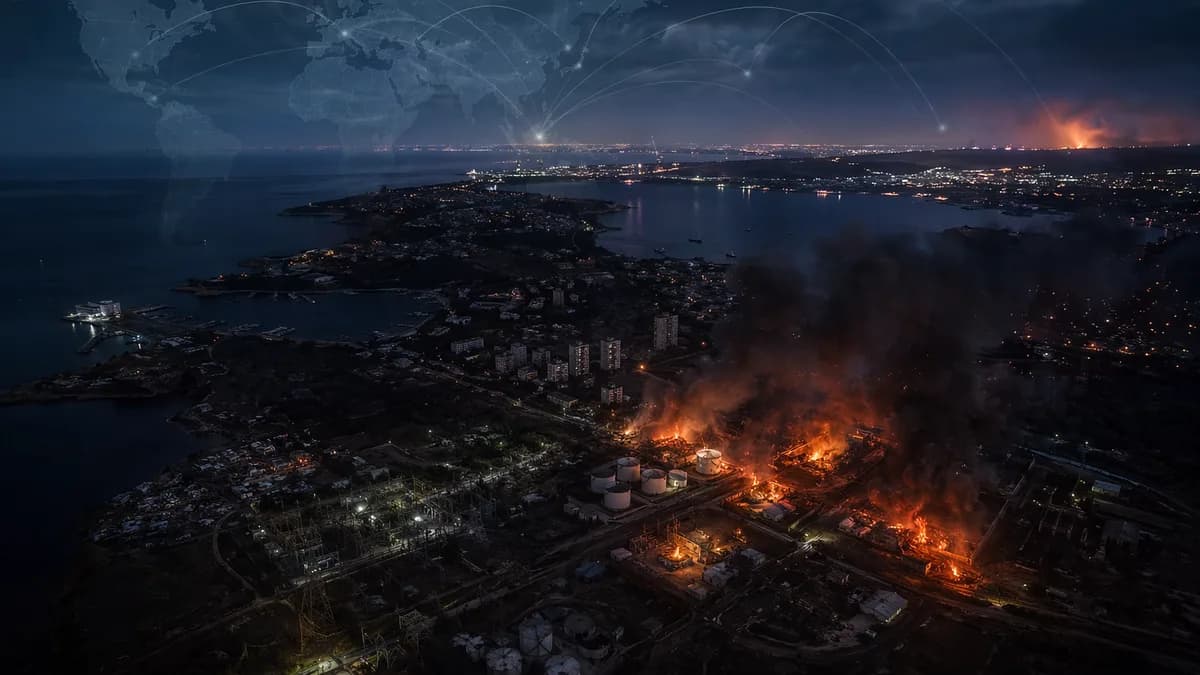
A Sevastopol power outage after a Ukrainian drone strike has exposed the weakness Ukraine is trying to exploit most: occupied Crimea depends on connected power, fuel, transport, and military infrastructure that can be hit without a direct ground assault.
Global TrendsJune 24, 2026· 7 min read· By XOOMAR Insights Team
Ukraine Drone Strike Plunges Sevastopol Into Darkness
Updated on June 24, 2026
XOOMAR Intelligence
Analyst Take
60/ 100
4 sources analyzedLow confidenceTrend10Freshness96Source Trust92Factual Grounding91Signal Cluster40
The outage affected Sevastopol, the largest city in Russian-occupied Crimea, where Moscow-installed governor Mikhail Razvozhayev said some areas would remain without electricity until Wednesday evening, according to BBC World. For residents, this means heat, phone batteries, and basic services. For Russian forces, the concern is broader: Ukraine is testing whether infrastructure pressure can make the peninsula harder to operate, supply, and present as secure.
Sevastopol residents face the immediate cost of a strike on Crimea’s grid
Razvozhayev said a “special regime” had been introduced at energy facilities while damage was assessed, with emergency services placed on full alert. Residents were told to conserve power, including by lowering phone screen brightness and closing background apps. They were also urged to check on elderly neighbours as temperatures were expected to reach 30C.
“We will not be intimidated by the lack of light. We have gone through more than that, and we will survive now,” Razvozhayev said in a Telegram message to the public.
He also accused Ukraine of trying to “deprive us of our usual living conditions and sow panic.”
The practical question is blunt: how long can Russian-installed authorities keep public services running if outages, fuel restrictions, and logistics disruptions begin stacking on top of each other?
The Sevastopol power outage comes amid fuel shortages in the city. BBC reported that Russian-installed leader Sergei Aksyonov announced on Sunday that all petrol sales had been suspended, with fuel mostly reserved for government services. For more context on that pressure point, see Ukrainian Strikes Shut Crimea Gasoline Sales to Civilians.
Ukraine’s drone commanders are treating utilities as military pressure points
Robert Brovdi, commander of Ukraine’s Unmanned Systems Forces, said on Wednesday that Ukrainian drones had targeted 48 operational and planned military sites and that Sevastopol’s main power substation had been hit.
BBC also reported explosions in Bakhchisarai, Kerch, and near Mount Ai-Petri, where the radio engineering battalion of the Russian Aerospace Forces is based. Russia’s defence ministry said it destroyed over 300 drones from Ukraine overnight. Kyiv’s air force said Moscow launched 101 drones at Ukraine overnight, of which 95 were intercepted and destroyed.
These are official claims from opposing sides. The full damage picture is not independently established in the supplied material.
Still, the operational logic is clear. Power infrastructure can support command sites, radar coverage, air-defence networks, port activity, and logistics. A strike on a substation may not look as dramatic as a hit on a warship, but if it forces rerouting, emergency generation, repair deployments, or load shedding, it can create friction across the occupation network.
XOOMAR analysis: Ukraine appears to be looking for weak links rather than single knockout blows. The question is whether repeated disruptions create cumulative strain, not whether one blackout changes the war.
Moscow’s Crimea project now has more exposed targets than it can easily hide
Crimea was annexed by Russia in 2014, but it remains internationally recognised as Ukrainian. Since Russia’s full-scale invasion, the peninsula has been linked to Russia by road and rail through occupied southern Ukraine and by a road and rail bridge through the Kerch Strait.
That connectivity is now a vulnerability. Kyiv has targeted key bridges linking Crimea with other occupied areas, while also hitting logistics routes, energy sites, and fuel infrastructure. The BBC describes Sevastopol as an important logistical and strategic port city. That makes the current outage politically louder than a routine grid failure.
A related report from the Kyiv Independent said occupation authority spokesperson Oleg Kryuchkov reported on June 23 that preliminary data showed around half of Crimea without power after attacks on energy infrastructure, with rolling blackouts planned if the grid overloaded. The same report cited Brovdi saying strikes had hit fuel reservoirs at the Kerch Thermal Power Plant, the Simferopol gas distribution station, and the West Crimea 330/110 kV electrical substation.
The hard question for Moscow: can it defend every bridge, substation, depot, air-defence site, and rail link at once?
Kyiv and Moscow are selling opposite stories about the same blackout
Ukraine frames the attacks as part of a campaign to damage Russian war capacity and increase pressure on President Vladimir Putin. BBC reported that Ukraine has intensified attacks on power facilities in Russian-held areas to damage oil revenues and try to force Putin to the negotiating table.
Moscow’s message is administrative control. Razvozhayev emphasized repairs, public instructions, and resilience. That is why the language matters. Officials are not only trying to restore electricity, they are trying to prevent the Sevastopol power outage from becoming proof that Crimea is less secure than the Kremlin claims.
Residents sit between those narratives. The source material shows fuel restrictions, queues, power-saving instructions, and panic-buying in some shops, with sugar said to be in especially short supply. It does not show reliable public opinion from inside occupied Crimea, and any claim about local sentiment would be speculative.
The diplomatic backdrop is frozen. BBC reported that on June, 4, Volodymyr Zelensky sent an open letter to Putin calling for direct face-to-face negotiations to end the war and agree a ceasefire. Putin called the note “rude” and refused a meeting, saying peace talks should come before any ceasefire. For a wider look at political pressure around Kyiv, see Poland Ukraine History Feud Costs Zelensky Top Honour.
Black Sea risk is the external signal, not an energy-market shock yet
For readers outside the battlefield, the signal is not a confirmed market shock. The supplied sources do not provide shipping insurance prices, commodity moves, port closure data, or grain flow figures.
But the direction of risk is visible. Crimea hosts military, logistics, fuel, rail, and port infrastructure around the Black Sea. Repeated attacks around Sevastopol, Kerch, and other nodes can feed risk assessments even before they show up in quoted prices.
| Stakeholder | Immediate concern | What would change the assessment |
|---|---|---|
| Crimean residents | Power cuts, fuel limits, heat, basic services | Longer outages or wider rationing |
| Russian-installed authorities | Repair speed and public control | Repeated failures at substations or fuel sites |
| Ukrainian forces | Whether strikes create lasting friction | Evidence of disrupted Russian logistics or air defence |
| External risk managers | Black Sea instability | Verified disruption to ports, shipping lanes, or energy flows |
The question for companies and governments watching the Black Sea is simple: does this remain a localized military pressure campaign, or does it begin to interfere with regional movement and supply planning?
More Crimea blackouts will test Russia’s occupation network
Ukraine is likely to keep probing Crimea’s power grid, air-defence sites, ports, bridges, and logistics corridors if visible disruption continues. That is analysis, not a sourced prediction. The source material already shows a pattern: drone strikes, fuel shortages, bridge targeting, and outages hitting multiple parts of the peninsula.
Russia’s likely response is also constrained by the facts on the ground: more air-defence effort, faster repair cycles, tighter public messaging, and continued strikes on Ukraine. BBC reported that Moscow launched its own 101 drones overnight, with Kyiv saying 95 were destroyed.
The evidence that would confirm Ukraine’s strategy is working would be practical, not rhetorical: longer repair times, repeated load shedding, fuel restrictions extending further, or confirmed disruption to Russian military operations. Evidence that would weaken the thesis would include rapid restoration, stable fuel access, and no visible operational effect beyond short-term civilian inconvenience.
For now, every successful disruption in Sevastopol chips away at one Kremlin claim: that occupied Crimea is untouchable.
Impact Analysis
- The strike shows Ukraine is targeting Crimea’s power and logistics networks without launching a direct ground assault.
- Power outages and fuel restrictions could strain daily life for civilians in Sevastopol.
- Repeated infrastructure disruptions may make it harder for Russia to supply forces and project control over occupied Crimea.
Sources

Written by
XOOMAR Insights Team
Research and Editorial Desk
The XOOMAR Insights Team pairs automated research with human editorial judgment. We track hundreds of sources across technology, fintech, trading, SaaS, and cybersecurity, cross-check the facts, and explain what happened, why it matters, and what to watch next. We do not just rewrite headlines. Every article is fact-checked and scored for reliability before it goes live, and we link back to the original sources so you can verify anything yourself.
Explore More Topics
Related Articles
 Global Trends
Russian Soldier Kills Comrades, Civilians in Crimea Rampage
A Russian soldier killed a comrade and three civilians in a shooting spree in occupied Crimea, puncturing Moscow's narrative of control and exposing turmoil beh
Aug 4, 20264 min
 Global Trends
Ukraine's 'Deep Strike' Strategy Cripples Russia's Oil Revenue
Ukraine has shifted to a strategy of 'deep strikes', using drones to attack oil refineries and military hubs inside Russia, aiming to cripple the economic engin
Aug 6, 20267 min
 Global Trends
UK General Warns: Russia’s Next War Targets Britons at Home
The UK's former head of Defence Intelligence reveals why the next major conflict will be fought at home, targeting the public with disinformation long before tr
Aug 10, 20267 min
 Global Trends
Zelenskyy Demands Patriots as Kyiv Missile Toll Rises
Ukraine lacks the specific Patriot systems needed to intercept ballistic missiles, a critical weakness laid bare by a deadly Russian attack on Kyiv.
Aug 9, 20266 min
 Global Trends
Ukraine's Interceptor Gap Is Killing Civilians Now
A deadly overnight barrage in Kyiv succeeded entirely because Ukraine had no Patriot interceptors left to stop Russia's ballistic missiles. Officials say this i
Aug 5, 20265 min
 Trading
Strait of Hormuz Shutdown Lifts Oil Prices 6%
WTI crude oil jumped over 6% after Iran confirmed talks on shipping routes don't mean the Strait of Hormuz will reopen, setting the stage for a prolonged geopol
Aug 10, 20268 min
 Fintech
Erebor Quadruples Deposits In 100 Days For $8B Valuation
Startup-focused Erebor Bank has quadrupled deposits in three months and is now raising $1.5 billion at an $8 billion valuation, a giant bet on its post-SVB nich
Aug 10, 20265 min
 Trading
Stocks Ignore Record Job Losses as Fed Pledge Trumps Payrolls
The Dow Jones Industrial Average showed no fear after July's shocking job losses, as investors bet weak labor data will keep the Federal Reserve from raising ra
Aug 10, 20266 min
 Fintech
DOJ Charges 455 Providers for $6.5B in Healthcare Fraud
The Department of Justice has replaced traditional fraud investigations with AI-driven analytics, charging 455 defendants in a $6.5 billion scheme and forcing p
Aug 10, 20267 min
 Fintech
Poland Launch Tests Paysafe's Legacy Card Pivot
Paysafe's launch in Poland is a strategic test of whether it can upgrade its existing prepaid card users into full digital wallet customers, following a wave of
Aug 10, 20266 min
Don't miss the signal
Get our weekly roundup of the stories that matter across tech, fintech, and trading. No noise, just signal.
Free forever. No spam. Unsubscribe anytime.