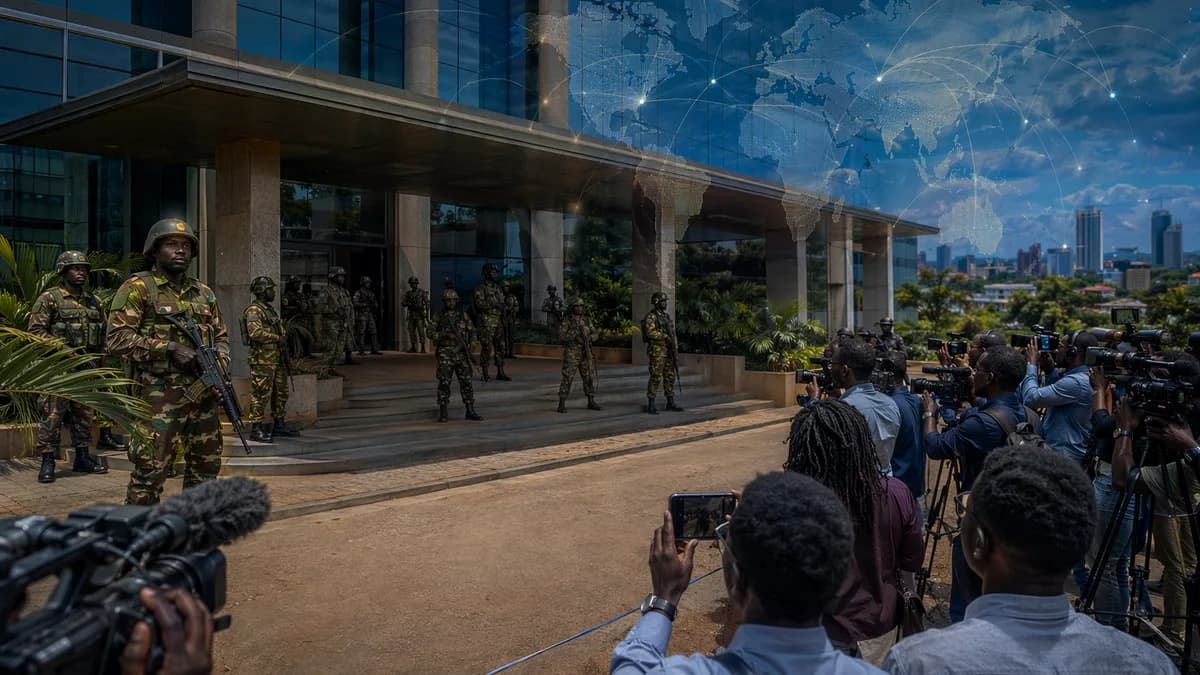
Gen. Muhoozi Kainerugaba, Uganda’s military chief and the eldest son of President Yoweri Museveni, ordered the closure of a major news organization, according to ABC International. Soldiers were deployed outside the Kampala offices of the Daily Monitor early Sunday. The paper is part of Nation Media Group, headquartered in Nairobi.
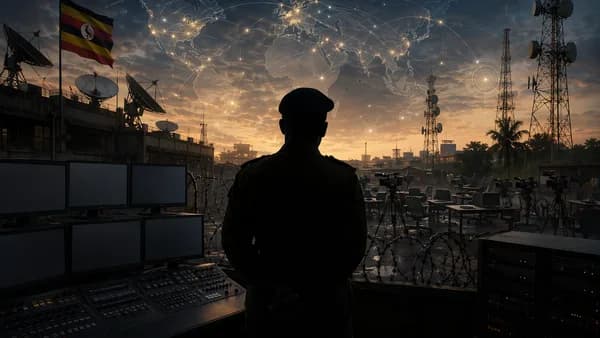
This is not a normal media dispute. It is a power signal. When the president’s son, who has served as Uganda’s top military commander since 2024, says he can close “ANY media house,” the message travels far beyond one newsroom.
“I have the power in Uganda to shut down ANY media house I want to,” Kainerugaba wrote on X. “I have had this power since 2017. This power was given to me by my great father.”
The question is simple: if this power is real, where is the public legal process that restrains it?
XOOMAR’s view is blunt. A Uganda media shutdown ordered by a military figure should be treated as an attack on civic space, not as a bureaucratic enforcement action. As we argued in Army Chief Turns Uganda Media Shutdown Into Power Test, the target matters, but the method matters more.
The identity of the person issuing the order is central to the story. A military chief does not speak like a media regulator. He carries the weight of force.
Kainerugaba also said the closure directive targeted NTV, another Nation Media Group outlet. The National Association of Broadcasters said at least six publishing and broadcasting outlets, all under Nation Media Group, were closed.
“We are deeply concerned about this action and its impact on the media ecosystem,” the National Association of Broadcasters said.
A functioning democracy separates security institutions from media oversight. Soldiers do not decide which journalists remain in print, online, or on air. If a newsroom breaks the law, the state has tools: courts, published charges, evidence, hearings, rights of appeal. A public command from a general backed by soldiers is a different instrument entirely.
| Route |
What it signals |
Who gets protected |
| Open legal process |
The state must prove its case |
Public, press, and accused outlet |
| Military shutdown order |
Rank substitutes for law |
Officials holding coercive power |
| Public threat on X |
Fear becomes the enforcement mechanism |
Nobody outside the chain of command |
What happens to a small local reporter after seeing soldiers outside the offices of one of Uganda’s most visible media brands? They do not need a second warning. They can read the room.
This order lands inside a power structure already shaped by succession. Kainerugaba is not an ordinary officer. He is the president’s eldest son, the top military commander, and a man who asserts that he will succeed Museveni.
Museveni, 81, has ruled Uganda since 1986 and has not said when he will retire. The source reports that he has no rivals within the ruling party, which is why many believe the military will have a say in choosing his successor. That is the context in which a press closure order becomes more than a press closure order.
The president was recently sworn in for a seventh consecutive term. In recent days, Kainerugaba has strengthened his grip with directives and orders usually reserved for the head of state, according to the report. That matters because media freedom gets fragile fast when family power, military authority, and state leadership overlap.
The strongest defense of Kainerugaba from his associates is that he is a dedicated military officer, avoids ostentatious displays of wealth, opposes official corruption, and would punish it heavily as president. Fine. Even if accepted, that does not answer the central issue. Anti-corruption rhetoric does not grant a general the right to silence newsrooms.
A major news organization is a symbolic target. If Daily Monitor and NTV can be threatened, smaller outlets will assume they have less protection, not more.
The first visible victims are editors and reporters. The deeper injury is to the public.
Citizens need independent media to track security decisions, public spending, elections, corruption claims, court cases, and abuses of power. Press freedom is practical. It is how a citizen tests official narratives against reported facts.
A Uganda media shutdown also creates an information vacuum. People do not stop seeking news because a newsroom is closed. They move to weaker channels, rumor chains, partisan accounts, and anonymous claims. That can make a tense political moment worse, not safer.
This matters beyond Uganda’s press corps. The same institutional question runs through many crises: who protects the individual when formal power moves first and explains later? That question also sits behind XOOMAR’s coverage of Son Escapes, French Woman Rescued in Pakistan Ordeal, where state response and personal vulnerability were impossible to separate.
A country does not become calmer by narrowing the public’s access to credible reporting. It becomes easier to manage from above and harder to understand from below.
The counterargument deserves a fair hearing. Governments often claim irresponsible reporting can inflame tensions, spread falsehoods, or endanger public order. Media organizations can make mistakes. They can defame, misreport, or publish material that deserves correction.
But shutdowns are the wrong remedy.
A state that has a lawful case should bring it in the open. It should identify the law allegedly broken, the conduct at issue, and the forum where the accused outlet can respond. That is not a courtesy. It is the difference between law and intimidation.
Closing or threatening a major platform is collective punishment. It punishes reporters who had nothing to do with any disputed story. It punishes readers who need information. It also invites officials to relabel inconvenient reporting as a security risk whenever it bites.
The source material does not specify a public court order or detailed legal basis for the closures. That silence is not a small omission. It is the point that institutions should now be forced to clarify.
Uganda’s legal institutions and parliament should draw a hard line: military officials have no business ordering media closures. If the state claims an outlet violated the law, judges and civilian regulators, not generals, should handle it through a visible process.
Civil society groups, journalists’ associations, and rights organizations should document the order, preserve records of who was blocked from working, and track any retaliation against reporters or staff. That work matters because vague fear is hard to contest. A dated record is harder to erase.
Regional bodies, diplomatic partners, and press freedom organizations should respond quickly and specifically. Silence will be read as permission. Broad concern is not enough. The response should name the outlets, name the official who issued the order, and ask what legal authority was used.
The pressure should focus on three points:
- Due process: Was there a court order or published legal notice?
- Civilian authority: Why was a military chief directing media closures?
- Protection: What guarantees exist for Daily Monitor, NTV, and other Nation Media Group staff?
Uganda’s partners do not need to pretend they can solve its succession politics from outside. But they can refuse to normalize soldiers at newsroom doors.
The demand here is narrow and non-negotiable. If Uganda’s government has a lawful case against Daily Monitor, NTV, or any Nation Media Group outlet, it should bring that case in open court. If it does not, the order should be withdrawn.
A newsroom should not depend on the mood of a military commander. Neither should a voter’s access to information.
The next test is not abstract. It is whether Uganda’s courts, lawmakers, civil society, and partners treat this as a passing threat or as a line that cannot be crossed. Defend the newsroom now, because once fear starts editing the public record, the next target may be anyone who speaks too loudly.
- A military-led media shutdown raises serious concerns about press freedom in Uganda.
- The order targets major Nation Media Group outlets that provide independent news to the public.
- The case blurs the line between lawful regulation and coercive state power.