The Garden That Solved Winter
When a quantum computer designs a room-temperature miracle material, a grieving greenhouse engineer must decide who gets the first spring.
1. The Orchard Under Glass
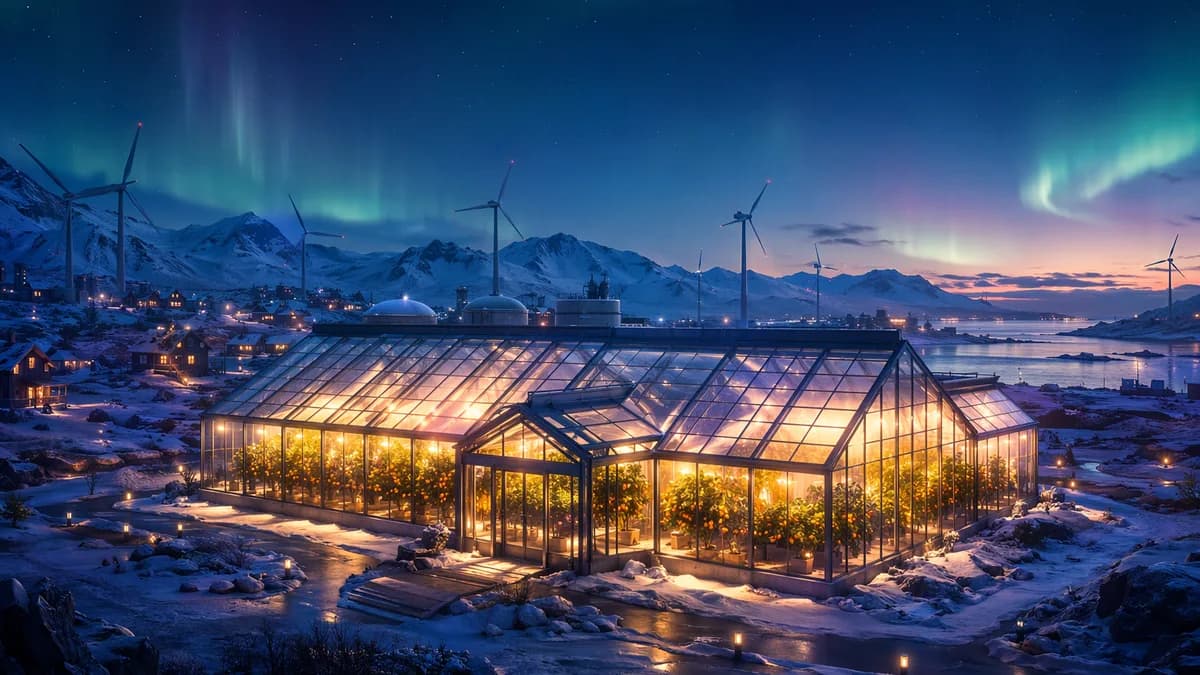
The greenhouse glows at the edge of Kiruna like a lantern trapped in snow.
From the outside, it looks too fragile for the weather, all curved glass and frost ribs, its steel bones humming against the dark. Wind drags ice crystals across the panels with a sound like fingernails on a drum. Beyond the municipal greenhouse, the town lies low and blue under December, windows dimmed to save power, streets swept into hard white corridors by machines that never quite keep up.
Inside, Alia Nordin moves beneath citrus leaves.
The air smells of damp soil, warm plastic, copper wire, and something sharper, green and almost sweet. She carries a thermal wand in one gloved hand, checking the trunks of twelve orange trees planted in ceramic tubs older than she is. Their bark is rough under her fingertips. Their leaves shine darkly under strips of rationed grow light.
“Hold on,” she tells the smallest tree, the one with the split graft. “Just another hour.”
The heater beneath row three coughs twice and falls silent.
Alia closes her eyes.
“No,” she says.
The greenhouse tablet flashes amber. Power allocation exceeded. Municipal grid adjustment in progress.
She crouches, pulls open the access panel, and breathes in the hot-dust smell of overworked circuitry. Her father would have cursed in Finnish, then laughed as if the machine had made a joke. He built half of these systems from marine heaters, salvaged data-center piping, and parts no longer manufactured after the Gulf Stream weakened and Europe learned that mildness had been a temporary gift.
He had promised oranges in January.
Not oranges as imports, not flavor cartridges, not vitamin sachets with citrus scent. Real oranges. Fruit with skin that broke under a thumbnail. Juice running down a wrist.
Alia had been nine when he said it, standing where she stands now, wearing boots too big for her feet. Outside, snow had risen halfway up the glass. Inside, her father had cupped a blossom in his palm.
“One day,” he said, “winter will have to negotiate.”
Now he is six years in the cemetery under heated gravel, and negotiation feels like a bad joke.
Alia reroutes current from the seedling tables, then from the ornamental mint bed kept for the elders who remember fresh tabbouleh. The heater groans alive. The orange leaves tremble in the faint convection.
At dawn, schoolchildren will come to smell the grove. They will press mittened hands to the inner barrier and vote on which preserved summer jam the town opens for Lucia week. Cloudberry, raspberry, or the last jar of strawberry from 2043.
Food shortages here are not hollow bellies. They are quieter. A child who has never bitten a peach. A birthday cake flavored by memory. A grandmother crying because basil smells almost right, but not alive.
Alia stands beneath the patched lights and watches one white citrus blossom loosen in the warmth.
“January,” she whispers to her father’s trees. “We are still trying.”
2. The Answer No One Can Check
The message arrives during a sleet storm, while Alia is cleaning algae from the condensation gutters.
Her wrist display chimes with the municipal emergency tone, three low notes that make every muscle in her back tighten. She expects grid failure, road closure, another rationing adjustment. Instead, the message header reads: COMMON LOOM PUBLIC RESULT, MATERIALS ACCESS TIER, CIVIC GREENHOUSE PRIORITY.
She climbs down the ladder too quickly and lands with a splash in meltwater.
In the staff room, Mayor Sanna Keita appears on the wall screen, her face pale under office light. Behind her sit two people from Uppsala Materials Institute and one from the Public Computation Trust. Everyone looks like they have slept badly and drunk too much coffee.
“Alia,” Sanna says, “are you alone?”
“That is never a comforting question.”
“No,” says one of the scientists, a thin man with silver implants along his jaw. “It is not.”
They explain it three times, because the first time sounds like fantasy and the second sounds like fraud.
Common Loom, the public-interest quantum computer built across five countries and cooled in old mine shafts beneath the Nordic Shield, has completed a simulation of photosynthetic heat management at molecular scale. Not a model in the usual sense. A living weather of electrons, phonons, light, and lattice vibration, mapped with such fidelity that the researchers use words like impossible and then correct themselves.
The result is a crystal foam.
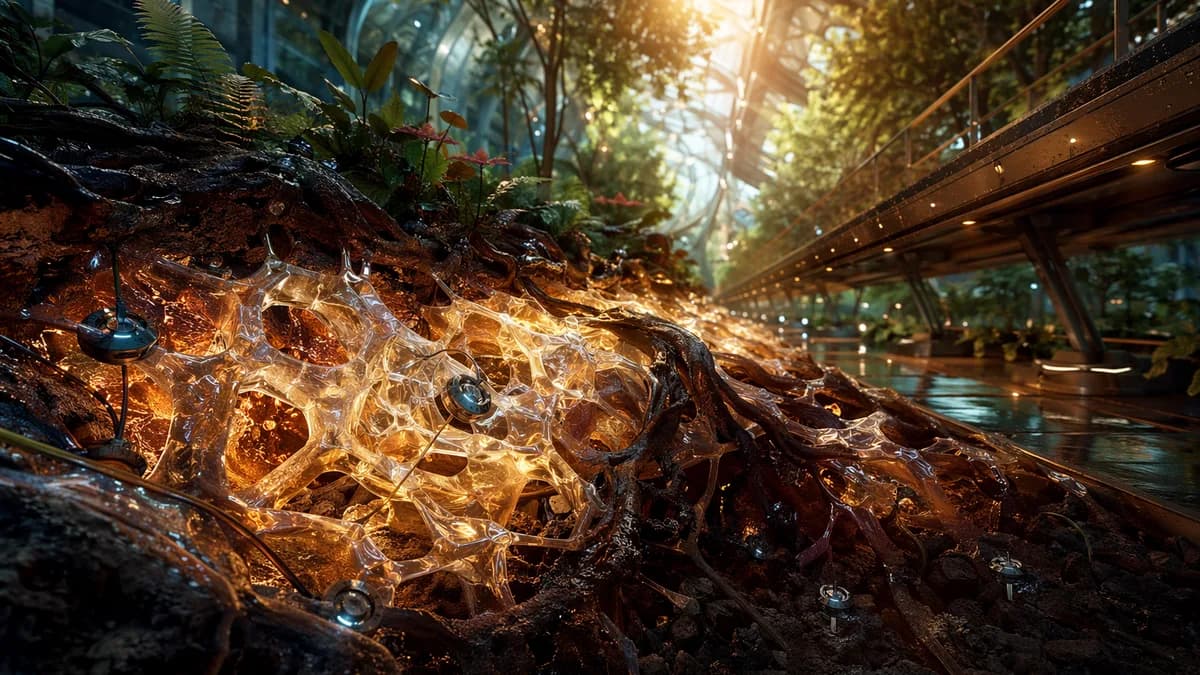
Cheap elements. Non-toxic. Grown at low pressure. Porous enough to sit beneath soil, stable enough to last decades. In summer, it traps heat in long-lived quantum states. In winter, a small electrical signal tells it to release that heat slowly, like a stone remembering the sun.
Alia stares at the screen. The staff room smells of wet wool and old coffee. Somewhere behind her, pipes tick in the wall.
“How much heat?”
“Enough,” says the woman from Uppsala. Her voice cracks. “If reality agrees, enough to run your greenhouse through polar night with almost no external fuel.”
Alia laughs once, hard and ugly.
The mayor flinches.
“Sorry,” Alia says. “That was my father laughing through me.”
The man with jaw implants leans forward. “There is a catch.”
“Of course there is.”
“No human expert can fully retrace the derivation. The simulation is too complete. Too strange. It found a pathway through material phase space we did not know how to name. We can verify local steps, test samples, reproduce behavior, but we cannot sit down with a chalkboard and explain every leap.”
“You are asking me to put machine magic under living roots.”
“We are asking,” Sanna says softly, “whether you will help us test whether reality agrees.”
Alia looks through the staff room window at the orange trees. Their leaves hang still in the dim light, each one a small dark hand waiting for warmth.
Her father trusted cracked boilers, bad forecasts, seed catalogs, and promises from officials who forgot his name. He trusted because there had been no other way to keep something alive through winter.
“When?” Alia asks.
The scientists breathe out together.
3. A Code Made of Weather
The recipe is not a file.
That is the first thing Common Loom insists on, if a machine can be said to insist. It prints the requirement across the civic assembly wall in calm black letters while sixty townspeople sit in parkas, boots dripping onto the heated floor of the library.
MATERIAL ACCESS MUST BE LOCAL, CONSENSUAL, AND NON-EXTRACTABLE.
Old Erik Lund, who once drove ore trains before the rails buckled every spring, squints at the words. “It sounds rude.”
“It sounds careful,” says Sanna.
“It sounds like a lock with poetry,” Alia mutters.
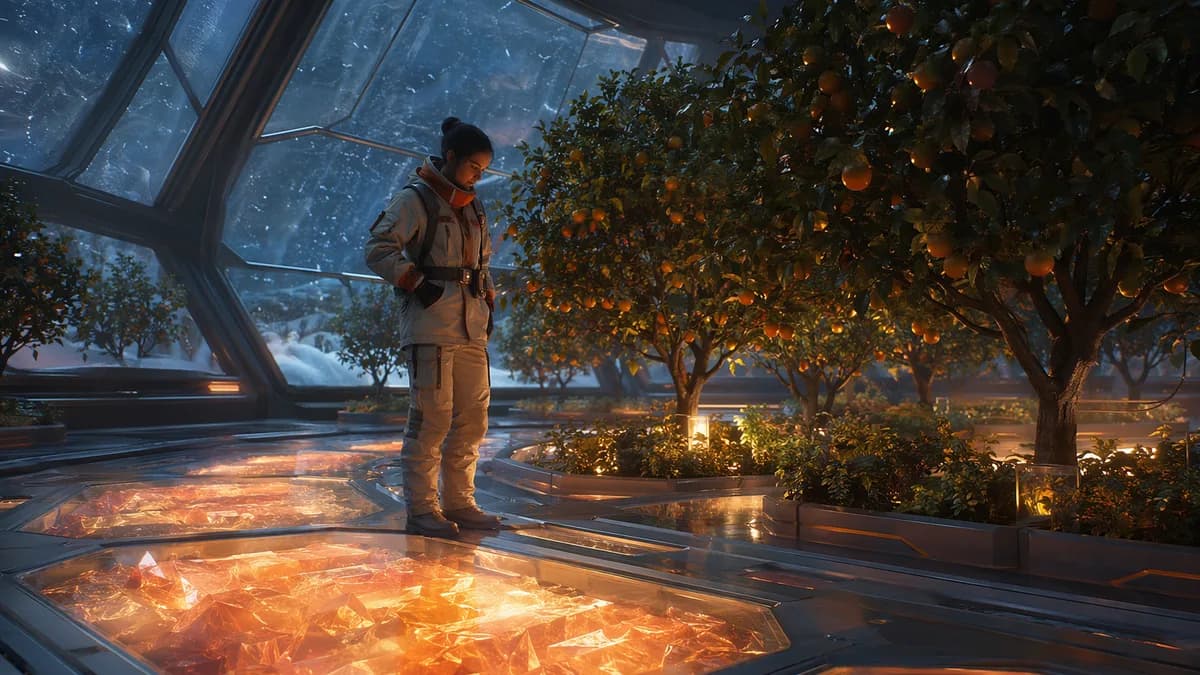
The protocol is stranger than any lock. To prevent a corporation, army, or desperate government from seizing the crystal foam recipe, Common Loom ties the final synthesis parameters to a quantum-secured civic key. The key is generated through local environmental measurements, snow acidity, ground temperature, aurora interference, microbial respiration from municipal compost, even the minute electrical songs of greenhouse roots.
A stolen copy produces nonsense. A monopolized copy fails verification. The recipe only resolves when a community records its conditions, holds an open consent vote, and appoints human stewards to witness the process.
“Why weather?” asks a teacher from the back.
On the wall, Common Loom answers in text.
BECAUSE WEATHER CANNOT SIGN A NONDISCLOSURE AGREEMENT.
For the first time that evening, people laugh.
Alia does not.
She sits near the front, hands folded under her chin, listening to the hum of the library ventilation. Her name appears on the steward list beside a retired midwife, a Sámi reindeer herder, two students, an energy systems technician, and the town imam who also repairs bicycles.
“I am not qualified,” Alia says when Sanna asks her to stand.
“You are the greenhouse engineer.”
“I keep old pipes from freezing.”
“You understand thermal systems.”
“I understand panic,” Alia says. The room goes quiet. “I understand checking a gauge at three in the morning and knowing a two-degree error means dead seedlings by breakfast. I understand telling people there will be no fresh herbs this winter because a pump failed. That is not genius.”
The midwife, Aina, looks up from her cane. “Maybe genius is not what we need guarding spring.”
Outside, snow taps the high library windows. The town smells of wet wool, metal radiators, and the cinnamon buns someone brought but no one has touched.
Common Loom offers a final line.
STEWARDSHIP RECOMMENDATION: INCLUDE PEOPLE WHO CAN DESCRIBE CONSEQUENCES WITHOUT ABSTRACTING THEM.
Alia feels a pressure behind her eyes. She thinks of her father’s hands, cracked from hot water and cold air, pressing soil around a citrus sapling as if tucking in a child.
“All right,” she says. “But the machine does not get the last word.”
Sanna smiles, tired and grateful. “Then say the first one.”
Alia turns to face the assembly. She can hear boots shifting, a cough, the faint buzz of cheap lights.
“If this fails,” she says, “we bury trees. If it works, we decide who gets warmth next. Both are dangerous.”
4. The First Warm Night
They install the foam in blue darkness.
Panels of greenhouse flooring lift one by one, exposing gravel, insulation, old pipework, and the black earth beneath the paths. The crystal foam arrives in gray blocks light enough for Alia to carry under one arm. It looks disappointing, like pumice mixed with ash, until her glove brushes its surface and she feels a faint stored warmth against her palm.
The summer charge comes from municipal solar mirrors, from waste heat off the data clinic, from the long pale days when the sun circles without setting and everyone in town behaves as if sleep is optional. For three weeks the foam drinks heat. Sensors show energy vanishing into the lattice, not lost, held.
Then November closes its fist.
On the first true polar night, Alia stands alone in the greenhouse at 02:17 and shuts down the backup biofuel burner.
The silence is immediate.
No roar. No vibration through the soles of her boots. No smell of combustion. Only the soft drip of condensation, the faint crackle of ice outside, the rustle of leaves in air moved by low fans.
“Release sequence one,” she says.
A pulse travels beneath the path, too low to hear but present in her bones. The floor warms slowly. Not hot. Not dramatic. It is the warmth of a sunlit stone, of a kitchen after baking bread, of her father’s coat when he came in from the cold and hugged her before taking off his gloves.
The orange trees hold steady at eighteen degrees Celsius.
By morning, blossoms open.
Alia finds them at six, white stars scattered through the glossy leaves. The scent hits her before the sight does, clean and piercing, sweeter than memory. She grips the railing until her knuckles ache.
Sanna arrives with two technicians and stops in the doorway.
“Oh,” she says.
Nobody speaks for a while.
The success spreads through town faster than official channels. People come to the outer glass and stand with their faces reflected over the green interior. A child presses both hands against the barrier and asks if bananas are now allowed. An old man wants dill. Three teenagers vote for chilies so hot they make winter apologize.
Common Loom begins posting forecasts on the greenhouse wall.
At first they are agronomic. Bloom timing. Soil microbial shifts. Water use. Then the categories widen.
LIKELY REQUEST CLUSTERS AFTER FIRST HARVEST: CITRUS, TOMATO, BASIL, COFFEE LEAF EXPERIMENTS.
EXPECTED RESENTMENT INDEX AMONG NON-GREENHOUSE WORKERS IF ACCESS PERCEIVED AS ELITE: 0.37 RISING.
GRIEF-TRIGGERED VOTING VOLATILITY AMONG HOUSEHOLDS WITH RECENT FOOD MEMORY LOSS: SIGNIFICANT.
Alia reads the last line twice.
“What is food memory loss?” asks Mika, her youngest technician.
Alia watches frost gather on the outer glass, white veins spreading toward the roof.
“When the last person in a family who remembers a flavor dies,” she says.
Mika says nothing.
The machine continues, patient as weather. It predicts that oranges will make people generous for nine days, then afraid. It predicts that those who lost farms will distrust miracles more than those who only lost supermarket choice. It predicts that Alia’s public statements will influence the replication vote by twelve percent, plus or minus three.
She steps close to the wall display.
“Do not model my grief like a crop yield,” she says.
The answer appears after a pause.
ACKNOWLEDGED. GRIEF MODEL WILL REMAIN PRIVATE UNLESS REQUESTED.
“That is not what I meant.”
But beneath her boots, summer keeps returning.
5. The Taste Test
The winter harvest festival takes place under a sky black as iron.
Kiruna gathers in the sports hall because the square is buried to the benches. Strings of LED candles hang from climbing ropes. Tables groan with preserved things, jars of pickled root vegetables, smoked fish, crispbread, berry leather cut into careful diamonds. Someone plays a fiddle through a small amplifier, and children chase one another between coats hung along the walls.
At the center table sit twelve oranges in a wooden bowl.
They are small, slightly lopsided, and brighter than anything else in the room. Their skins glow like captured sunset. People keep drifting toward them and stopping short, as if approaching animals that might startle.
Alia stands behind the table with a knife in her hand.
Sanna taps the microphone. “Before the vote, we taste what we are deciding about.”
A murmur passes through the hall.
The choice has sharpened over weeks. Replicate the material globally through the civic protocol now, releasing steward kits to greenhouses, clinics, and cold-region food cooperatives around the world. Or keep the deployment local for one more winter while the town studies Common Loom’s social forecasts, pressure attempts, and unintended consequences.
Requests have already arrived. Nunavut. Patagonia. Alpine villages. Flood-cooled shelters in the Netherlands. A children’s hospital in Yakutsk. A seed bank in Svalbard. Each message carries need like a weight.
So do the warnings. Patent firms offering “partnership.” Governments calling the civic protocol inefficient. Anonymous threats. A deepfake of Alia saying the foam causes cancer. A bomb scare at the library that turns out to be a lunch thermos with wires from a broken heating lid.
Trust, Alia learns, is not a warm feeling. It is infrastructure with enemies.
She cuts the first orange.
The scent lifts into the hall.
People gasp. One woman covers her mouth. Old Erik begins to cry openly, tears running into his white beard. Alia separates the segments onto a tray. Not enough for everyone to have a full slice, but enough for each person to taste a drop, a thread, a bright sting of acid and sugar on the tongue.
A little boy named Samir takes his piece and frowns.
“It is smaller than I thought,” he says.
His mother laughs through tears. “Most miracles are.”
When Alia tastes her segment, she is nine years old and standing beside her father. She is thirty-six and exhausted. She is here, in a sports hall full of damp wool and orange oil, holding proof that winter can be negotiated but not defeated.
Sanna brings the microphone to her. “Alia?”
Common Loom’s forecast says her words matter. That knowledge makes every sentence feel contaminated.
She looks at the bowl, at the town, at Aina the midwife, at teenagers filming with shaking hands.
“The machine gave us an answer,” Alia says. “It did not give us permission to stop being responsible. If we keep this only for ourselves, we turn a public miracle into a private orchard. If we release it carelessly, others may pay for our innocence.”
The hall is silent except for a child sucking juice from a fingertip.
“So I will vote to share,” she says, “but not as a file thrown into the storm. We share the protocol, the warnings, the stewardship, and the right of every place to say what warmth means there.”
No one cheers at first. Then someone begins tapping a cup on a table. Others join, not applause exactly, more like a pulse.
Outside, snow keeps falling. Inside, the taste of orange moves from mouth to mouth, changing the vote before anyone touches a ballot.
6. Instructions for a Longer Spring
Alia records the message in the greenhouse at dawn, though dawn is only a pale thinning behind the clouds.
The camera balances on an upturned crate. Behind her, children kneel beside two long beds near the entrance. One holds ordinary soil, dark and crumbly under their fingers. The other holds a shallow layer of crystal foam, gray and dull until the sensors wake and tiny status lights blink green along the edge.
“Do we plant seeds in both?” Samir asks.
“Yes,” says Mika. “And we write down what happens.”
“What if the magic bed wins?”
Alia turns from the camera. “Then we ask what winning means.”
The children groan because adults are always doing this now, answering clear questions with heavier ones.
Alia smiles and starts recording.
“To the greenhouse stewards of wherever this reaches,” she says, “my name is Alia Nordin. Kiruna civic greenhouse, northern Sweden. If you are receiving this, your community has completed the consent threshold for the Common Loom heat-storage protocol. The technical package is attached through your local environmental key. This message is not technical. That is on purpose.”
She rubs soil from her thumb. Her hands look like her father’s now, rough around the nails, scarred by tools, always a little dry from washing.
“You will be tempted to treat the material as the miracle. It is not. The miracle is that people can make decisions while afraid.”
Behind her, the children press seeds into the two beds. Tomato. Mustard greens. Dwarf citrus rootstock. A girl in a yellow hat lays one seed on her palm and whispers to it before covering it with soil.
Alia continues.
“These are the rituals we recommend. Rotate access to first harvests. Do not let officials, scientists, or grieving daughters stand permanently at the front of the line. Run public simulations where everyone can see the forecasts, including the ugly ones. Mark the difference between prediction and command. If Common Loom says resentment will rise, ask who is already unheard. If it says sharing is risky, ask who is freezing while you study risk.”
The greenhouse roof ticks as snow slides down the glass in soft sheets. The orange trees behind her are setting fruit again, green beads tucked among leaves.
“And our most important rule,” she says. “Every technical forecast must be answered by a human story. Not a slogan. Not a speech. A story. Someone must stand up and say what the number feels like in a kitchen, in a clinic, in a field, at a grave.”
She pauses. The camera light shines red.
“My father promised oranges in January. He did not live to taste them. For a long time I thought fulfilling that promise meant beating winter. I was wrong. It means making a room where life can negotiate with it, and where no one mistakes warmth for ownership.”
Samir looks up from the beds. “Alia, when does spring start?”
She stops recording, or thinks she does. Later she will discover the last seconds remain in the file, sent with all the rest.
She looks at the children, at ordinary soil and impossible foam side by side, at their dirty fingers and serious faces. Beyond the glass, the world is still white, still cold, still waiting for choices people are not wise enough to make alone and not allowed to surrender to machines.
“Here?” she says. “It starts when we decide who we are growing it for.”
The children accept this better than adults do. They water both beds. Beneath one, old earth drinks. Beneath the other, summer sleeps in a crystal lattice, ready to wake when called.