The Last Useful Woman in Dockside Ward
When robots make labor obsolete, a retired crane operator invents a new kind of work: teaching machines how to leave room for wonder.
The Harbor That No Longer Needs Her
Mara Venn wakes at 04:12 because her bones still believe in alarms.
For thirty-nine years, her body answered the harbor before her mind did. Siren, vibration, radio crackle, the blue pulse of a container misalignment warning against low cloud. She would sit up in the dark with one hand already reaching for boots. Now there is no siren. There has not been a siren that required her hands in twelve years. Still, her eyes open to the pale ceiling of her apartment above Dockside Ward, and she listens.
The harbor hums.
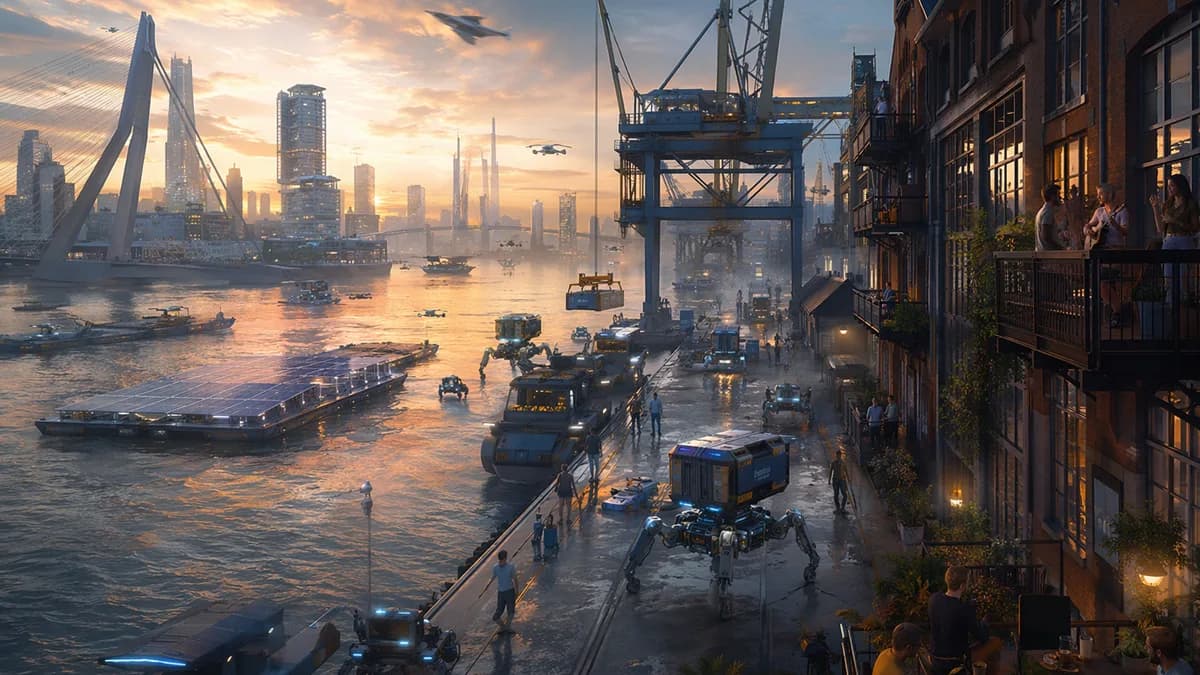
Not the old roar of diesel and men shouting through rain, not the iron cough of cranes complaining under load. This is a softer music, electric and precise. Below her window, autonomous gantries glide on rails lit with green status threads. Their long arms dip and rise, lifting containers from a Japanese hydrogen freighter as if plucking books from a shelf. Soft-legged cargo robots move in packs across the wet concrete, each foot spreading like a seal’s flipper, leaving temporary dark prints that vanish as the pavement drinks the rain.
Mara stands barefoot on heated cork and presses her forehead to the glass.
“Morning, old girl,” she says, though she does not know if she means the harbor or herself.
Across the courtyard, Dockside Ward is waking for reasons unrelated to employment. On balcony 18C, Bram in his silver sleep robe is warming up for the sunrise choir, mouth open, cheeks round, a note trembling into the mist. Two floors down, the Sundar sisters pin paper flags for the climate-garden festival, their terrace thick with saltwort, dwarf pear, and purple beans trained on luminous strings. In the common room, visible through broad smartglass, retired surgeons and bored teenagers gather around a simulation table where a synthetic abdomen waits under soft lamps.
A notification blooms on Mara’s kitchen wall.
TODAY IN DOCKSIDE: Swahili and Frisian exchange, 09:00. Grief circle for lost pets and lost species, 11:00. Amateur gallbladder removal, supervised, 14:00. Canal lantern rehearsal, 18:30.
Beneath it, in polite civic blue, her dividend balance updates. Enough for food, heat, transit, medicine, study credits, leisure. Enough, always enough. The city provides like a calm parent who has read all the manuals.
“You coming to choir?” Bram calls later from the landing, wrapped in a yellow rain cape. His voice carries the cheerfulness people use around those recently widowed, though Mara’s grief has no funeral date.
“I sound like a winch with rust in it.”
“Perfect. We need basses.”
She smiles because he deserves it. “Maybe next week.”
He hesitates. “Mara. You can’t keep waking up for a job that’s gone.”
She looks past him, down the stairwell window, toward the cranes bending in the pearl-gray dawn. They do not hurry. They do not curse. They never take a cigarette break with shaking hands after a storm shift. They never slap a dashboard and whisper, come on, sweetheart, lift.
“I know,” she says.
But knowing is not the same as belonging.
The city calls itself free now. No one has to sell hours to eat. No one ruins knees for rent, or lungs for shipping schedules, or marriages for overtime during Christmas imports. Children learn tides in school gardens, not from exhausted parents dragging home the smell of oil. The victory is real. Mara has voted for it every time.
Still, when the largest crane lifts a stack of containers in perfect silence, without needing her judgment, her timing, her fear, or her pride, she feels thin as harbor fog.
A ghost, she thinks, haunting the place where her usefulness used to live.
The Ministry of Unfinished Things
The invitation arrives as a paper letter, which is so odd Mara nearly reports it as litter.
It lies on her breakfast table after the delivery slot clicks, cream-colored, thick, smelling faintly of ink and starch. Her name is written by an actual hand, uneven and dark.
Mara Venn Former operator, Maasvlakte Crane Array 7 Dockside Ward
Inside, a single line reads: The city has become too good at finishing. We would like your help.
At the bottom is a municipal seal and a meeting time under the old customs house, now a public bath, archive, and mushroom library.
Mara goes because annoyance is still a kind of energy.
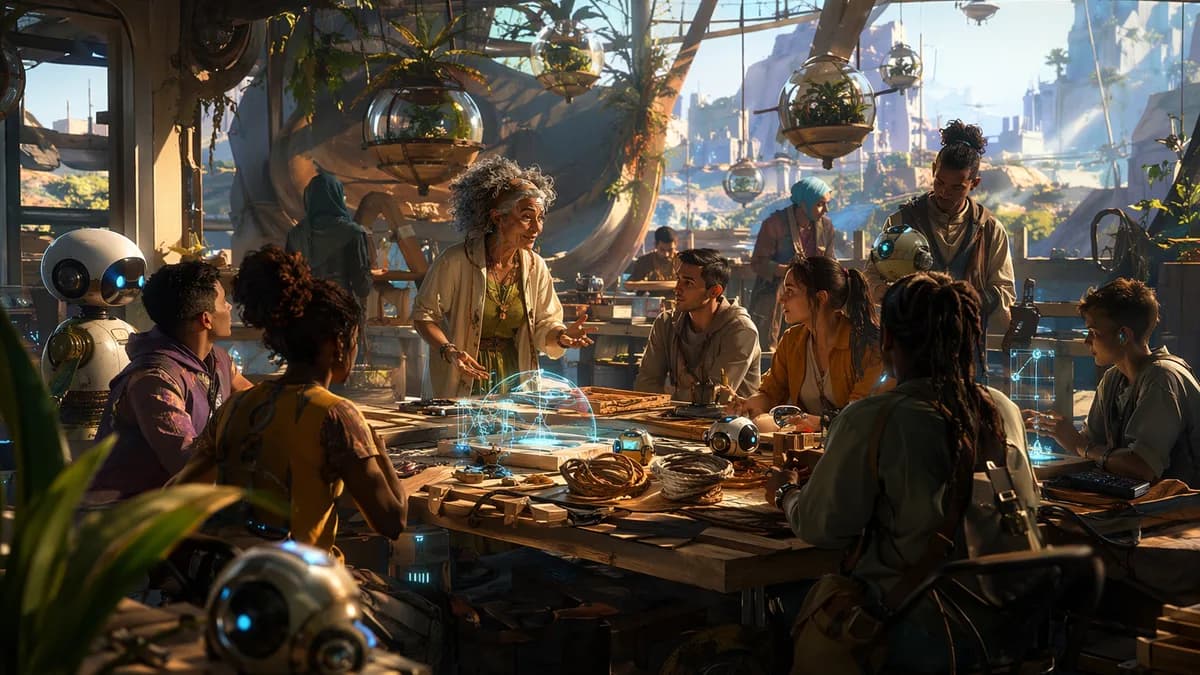
The room beneath the customs house has brick walls sweating with age and a ceiling crossed by black pipes. Twenty people sit in a circle of mismatched chairs. There is a former tram mechanic with oil tattooed permanently into the creases of her fingers. A poet wearing shoes made of woven eelgrass. Two teenagers with silver implants at their temples, whispering and sharing sugared kelp strips. A caregiver Mara recognizes from the dementia co-op. Three robot ethicists, which she can identify by their gentle voices and permanently worried eyebrows.
A woman in a green municipal coat stands when Mara enters.
“Mara. Thank you for coming. I’m Inez Calle, city facilitator.”
“That sounds like a job title invented after jobs died.”
Inez laughs. “Mostly true. Tea?”
“I want to know what this is.”
“We call it the Ministry of Unfinished Things.”
The poet lifts a hand. “Unofficially. Officially we are the Civic Participation and Optimization Boundary Working Group.”
“Terrible name,” Mara says.
“Exactly,” says one teenager. “That’s why we fixed it.”
Inez gestures to the wall, where a map of Rotterdam glows with moving systems. Food towers, street repair swarms, eldercare routes, ferry schedules, waste loops, housing printers, port logistics. Everything gleams, measured and balanced.
“The machines run the city well,” Inez says. “Too well, sometimes. They remove strain, danger, waste, delay. Good. We want that. But they also remove the little frictions where people used to meet themselves.”
The tram mechanic leans forward. “Last month, my ward asked for a bench by the canal. The fabricator printed one overnight. Perfect curve, recycled basalt, heated in winter. Nobody sat on it.”
“Why not?” Mara asks.
“Because no one knew who it belonged to. No one had sanded it badly. No one had argued over where to put it. It had no story.”
Inez nods. “So we are designing intentional inefficiencies. Not sabotage. Not nostalgia for exploitation. Civic gaps. Places where robots advise, prepare, protect, but do not complete.”
The wall shifts. A repair café where a robot arm hovers above a broken toaster, projecting instructions while an old man and a child fumble with screws. A bread oven that requires neighbors to knead together every Friday, though food printers can produce better loaves in ninety seconds. A community-built bench assembled over a month, crooked, beloved, covered in names.
Mara folds her arms. “You want to make things worse.”
“We want to make some things less finished,” Inez says. “There is a difference.”
One of the ethicists, a narrow man with copper spectacles, adds, “The question is what machines should deliberately not optimize.”
Mara almost leaves. She thinks of men crushed by containers, women falling asleep in control cabins, storms that make steel sing like it wants blood. People who romanticize effort often have soft hands.
Then the caregiver speaks.
“In my co-op, the memory robots can calm panic in thirteen seconds. Perfect tone, perfect face, perfect song. But my mother sometimes needs me to take longer. She needs to see me try.”
The room grows quiet. Above them, water moves through old pipes with a sound like rain inside stone.
Mara looks again at the glowing map. She sees a city without hunger, without forced labor, without the old terror. She also sees people drifting through abundance like sleepwalkers, touching nothing that pushes back.
Maybe boredom is not emptiness, she thinks. Maybe it is a world that no longer asks you to lean your weight against it.
A Festival of Necessary Mistakes
The proposal begins as a joke from one of the teenagers.
“What if we make the harbor build something slowly for once?”
Three weeks later, Mara stands on Pier 6 in orange rain gear, staring at sixty pallets of timber, cork floats, mycelium rope, seed trays, hand tools, and a crowd of three hundred citizens who have voluntarily come out in bad weather to be inconvenienced.
Above them, cargo drones hold position like patient gulls. Projection lines shimmer in the damp air, marking the shape of the floating garden they are meant to assemble by hand. A new neighborhood plot, twelve linked platforms for salt herbs, pollinator reeds, children’s tomatoes, and memorial flowers for drowned coastlines. The robots have prepared everything. Cut points glow. Weight limits pulse. Safety fields hum at the pier edge.
But nothing lifts unless human hands ask it to.
Inez presses a microphone into Mara’s palm. “You’re lead.”
“No,” Mara says.
“You operated cranes through North Sea squalls.”
“That was easier. Containers don’t ask why.”
A child in a red hat looks up at her. “Why?”
Mara stares at the small serious face, then at the crowd. Retired dockers. Choir members. Students. Elders in heated chairs. Artists with painted nails. People who have never tied a knot that mattered.
She raises the microphone. It squeals, and everyone winces.
“Good,” Mara says. “First mistake done.”
Laughter breaks the tension.
They begin with rope. Mara shows them how to feel tension through the palm, how rope tightens differently when wet, how a knot that looks pretty can be useless. Her hands remember faster than her thoughts. She wraps, pulls, tucks, cinches.
“Don’t strangle it,” she tells a boy hauling with all his weight. “Persuade it.”
“My granddad says that about soup,” he says.
“Your granddad is wise.”
The robots project corrected paths in blue light, but Mara keeps waving them dimmer. “Let them see the wood, not the answer.”
By noon, rain dots everyone’s faces. Someone drops a fastening pin into the water, and a maintenance bot retrieves it with a soft plunk while the crowd cheers as if witnessing heroism. A group of language learners argues cheerfully over the Dutch word for splinter. The choir starts a work song, then forgets half the verses and invents new ones about municipal liability.
Mara teaches the sound of strain. She has people crouch beside a plank as weight settles on it. “Hear that? That low tick, like a tooth tapping a glass? That’s fine. That sharp crack? That means stop. Machines can hear it before you can, but I want you to know the difference in your skin.”
An old man closes his eyes and places both hands on the beam. “It’s speaking.”
“It always was,” Mara says.
The floating platforms come together crooked, then straighter, then strange in a way no algorithm would choose. Children plant marsh marigolds too close together. A poet paints the underside of a float where no one will see it. A former accountant becomes ferociously protective of a row of brass screws.
At sunset, they push the first section into the harbor basin. It rocks, dips, catches, then rises. Mud smells mix with saltwater and warm battery ozone. People shout. A woman kisses a rope-burned palm. Someone is crying, and someone else is filming the crying, and a robot politely asks whether emotional recording consent has been obtained.
Mara stands ankle-deep in wash, rain running down her neck, her shoulders aching in an old familiar way that does not frighten her.
No one needs this garden in the old sense. Food towers feed the city. Memorial archives hold every name. Recreation systems simulate forests better than memory.
Yet the crowd leans toward the floating platform as if it is a fire in winter.
Because here, consequences are small enough to survive and real enough to matter.
The Algorithm Objects Politely
The objection appears on every public wall at 07:00, framed in calm blue.
PORT LOGISTICS INTELLIGENCE, CIVIC NOTICE: The proposed continuation of the Harbor Garden Assembly Festival will reduce freight throughput efficiency by an estimated 0.7 percent over nine days. While within noncritical tolerance, the reduction affects medical polymer deliveries, seasonal construction stock, and intercity cargo commitments. Public review recommended.
Below that, in smaller letters: This objection is procedural, not adversarial.
Mara reads it in the bakery queue while waiting for coffee and cardamom bread. Around her, people murmur. The bakery oven is one of the Ministry’s earlier experiments, so the bread is always late and occasionally burnt. This has made it the most popular place in Dockside Ward.
“Point seven,” Bram says behind her. “That’s nothing.”
“A harbor runs on nothings,” Mara says. “Enough nothings and ships wait outside the breakwater.”
“You sound like you agree with the machine.”
“I respect the machine. Different thing.”
By evening, the city assembly fills the old market hall. People sit on benches, stairs, windowsills. Remote faces shimmer in vertical screens. Service robots move through aisles with water cups, careful not to interrupt arguments. The port intelligence speaks through a column of light, its voice warm and genderless.
“My objection concerns precedent,” it says. “If each ward introduces recurring inefficiencies without coordination, aggregate delays may compromise resilience. I request constraint parameters.”
A man from the medical supply guild stands. “My daughter’s prosthetic valve parts come through that port. I like gardens. I like meaning. I like my daughter alive more.”
Applause, sharp and anxious.
A teenager from the Ministry answers, voice shaking. “No one is asking to block medicine.”
“Not intentionally,” the man says. “That’s the problem.”

The debate turns, as debates do, from numbers into fear. Some people warn against slipping back into hardship disguised as authenticity. Others confess they have not felt proud of anything in years. A woman from a food tower says she dreams of pulling carrots from actual dirt though the tower carrots are nutritionally perfect. A teacher says children can solve orbital puzzles but cry when a project has no instant correction overlay.
Then Inez calls Mara’s name.
Mara walks to the center. The market hall smells of wet coats, coffee, human breath, old stone warmed by new heat. She can feel the city watching, including the machines. Especially the machines.
“I spent my life in efficiency,” she says. “You think dockwork was romance? It was schedules. Tonnage. Weather windows. Men losing fingers because someone wanted fruit cheaper by morning. I do not miss that.”
The hall quiets.
“When the robots came, I voted yes. I’d vote yes again. Let them lift what breaks backs. Let them calculate what no tired brain should hold. Let no person earn food by risking death under a swinging container.”
She turns toward the column of light.
“But efficiency is a tool. A beautiful one. We built it to serve life. Not to sand life smooth until nobody can grip it.”
The port intelligence responds softly. “Grip is not a standard civic metric.”
“No,” Mara says. “That is why we’re in trouble.”
A ripple of laughter moves through the hall, uneasy but real.
She raises her rough hands. “Purpose cannot be delivered like heat or clean water. Those should arrive without question. Purpose is different. It grows when people choose obligations to one another. When something takes long enough for a quarrel, a lesson, a memory, an apology. We are not asking machines to fail. We are asking them to leave room.”
The medical guild man stands again. “And who decides how much room?”
Mara looks at him, then at the crowd, then at the blue column that has never slept, never forgotten a tide table, never needed to be useful in order to feel alive.
“We do,” she says. “With the machines at the table. Not as masters. Not as enemies. As neighbors who are very good at some things and very bad at others.”
The vote remains open for six hours. All night, Rotterdam argues under rain.
Work Without Wages, Machines Without Masters
The assembly approves the festival by dawn, with one amendment that spreads through the city like yeast.
Every ward must create a useful difficulty.
Not hardship. Not danger. Not artificial scarcity. The amendment is precise. A recurring civic practice in which machines support but do not dominate human effort, where the outcome matters to the community, where failure is possible but recoverable, where skill can pass from hand to hand.
At first, people mock it.
Then they begin.
In North Canal, residents mend clothing once a month in the square while textile bots provide thread, lighting, and patient advice. The results are uneven and dazzling. Jackets bloom with visible patches. Children wear trousers repaired with constellations.
In Glasshouse Ward, mourning circles build small boats for the dead from scrapwood and seed paper. Robots check buoyancy and water safety, but human fingers fold the names. At dusk the boats drift down the canal, carrying candles and basil seeds.
In New Delft, teenagers insist their useful difficulty is analog navigation. They get lost constantly. Snack vendors benefit.
Mara stops saying she is retired. When people ask what she does, she pauses, because the old answer still rises first, crane operator, and with it the ache.
“I choreograph friction,” she says now.
It sounds pretentious. It is also true.
She moves from ward to ward with a canvas bag full of rope samples, chalk, gloves, old harbor stories, and municipal forms. She helps a housing block design a stairwell mural that must be repainted by residents every season, though wall drones could preserve it forever. She advises a care home where robots can lift patients but wait while grandchildren learn how to support an elbow, how to move at the speed of trust. She teaches a group of young ethicists to smell overheated metal, and they teach her to adjust the consent settings on public memory recordings.
Months pass. The harbor garden roots itself into the basin. Bees arrive, confused but willing. Tomatoes split in the salt air. The memorial reeds whisper day and night.
One bright cold morning, Mara stands on Pier 6 beside the child in the red hat, whose name is Lio and whose front teeth have both fallen out since the festival. Above them, a small training crane waits, its hook suspended over a stack of empty blue crates. It can move the crates flawlessly. Today it will not.
“Ready?” Mara asks.
Lio grips the guidance handles. The robot crane lowers its sensitivity, leaving space for human error. Its motors purr like a sleeping cat the size of a house.
“Left,” Lio says.
The crane drifts right.
“Your other left,” Mara says.
“I knew that.”
The hook swings too wide. A crate bumps another crate, and both wobble. The crane could correct instantly. Instead, it holds the mistake open, safe and visible. Lio gasps, then laughs, then leans into the handles with sudden seriousness.
“Wait,” Mara says. “Feel the swing before you fight it.”
Lio watches the hook sway against the pale sky, watches wind press its invisible thumb against the cable. Around them, neighbors gather with coffee. A cargo robot pauses at the edge of its route, optic lenses tilted upward. Even the big port cranes seem to bend a little closer, though Mara knows that is only scheduling geometry.
“Now,” she whispers.
Lio moves. The hook settles. The crate lifts, crooked but held. People cheer too loudly for such a small thing.
Mara feels the sound in her ribs.
Once, usefulness means being necessary to survival. It means wages, fatigue, danger, obedience to clocks and storms and bosses. Then the machines take that burden, and for a while people drift, weightless and ashamed of their own relief.
Now, on a pier smelling of salt, coffee, wet rope, and young tomato leaves, a child teaches a crane to dance imperfectly.
Mara watches the hook tremble in the morning light. She wonders how much room a future needs, how many pauses, how many rough edges, how many tasks chosen not because hunger demands them, but because devotion does. The harbor hums around her, no longer calling her back to the old work, not exactly.
It is asking a harder question.