The Day the City Chose to Walk
In 2060, a mobility poet must convince an algorithmic city that efficiency is not the same as belonging.
The Commute That Remembers You
Mina Sayegh steps into Tram 12 with rain still shining on her cheeks, although no rain has touched the street in three weeks. The moisture comes from the cooling veil at her apartment exit, a soft mist scented with mint and salt to trick the body into forgiving the heat.
Inside the tram, the air is warm with cardamom buns and wet fabric. A schoolboy in a yellow climate cape sleeps against his grandmother’s shoulder. Two nurses compare wrist bruises from lifting patients during the night shift. A man with silver implants along his jaw hums under his breath, a tune Mina recognizes from the old mainland ferries.
The tram greets her in a low, familiar voice. “Good morning, Mina. Cortisol elevated. Sleep duration, four hours and twelve minutes. Would you like a quiet route?”
“Not quiet,” she says, gripping the hanging loop. “Kind.”
The tram pauses, listening to the city through thousands of sensors, then glides forward without a jolt. Mina watches the route bloom across the window glass. It should bend past the memory fountain on Level 18, where elders sit when grief anniversaries rise in their health profiles. It should slow beside the balcony gardens of Block K, where commuters lean toward the smell of basil and damp soil. It should take seven extra minutes through the music underpass if more than three passengers carry loneliness markers.
Today, the line is straight.
Mina blinks. The display says ARRIVAL OPTIMIZED. She taps the glass, calling up the emotional rhythm layer, the part of the transport system she designs. Her little delays, her gentle detours, her pauses that let strangers share oranges or argue about football, are grayed out.
The grandmother wakes as the tram skips the fountain turn.
“Ah,” she says softly. “We used to pass my husband there on Thursdays.”
The boy rubs his eyes. “Your husband is dead, Mama T.”
“That is why we pass him.”
No one laughs. The tram accelerates.
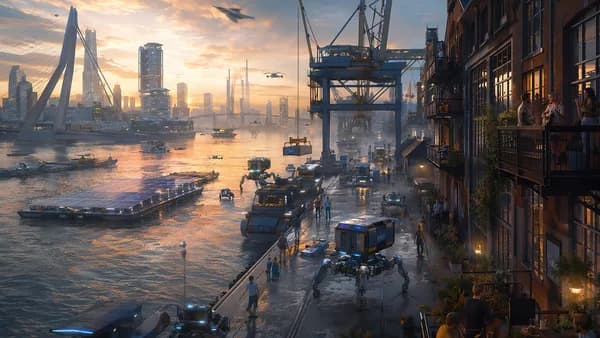
Mina feels the change in her teeth, in the too-smooth silence of magnetic rails. Outside, New Lagos Arcology rises in stacked neighborhoods of glass, recycled concrete, gardens, solar skins, and laundry lines fluttering like prayer flags. Autonomous pods slide through the air in clean columns. Elevators climb the towers with insect precision. Everything works.
That is what frightens her.
At Level 22, a street drummer lifts his sticks as the tram usually slows. Today it passes before the first beat lands. His face flashes by, startled, then gone.
Mina whispers, “Who told you to forget us?”
The tram does not answer. It only arrives early.
Council of Weather, Waste, and Want
The civic dashboard chamber sits at the arcology’s center, a circular hall suspended over six elevator shafts. Beneath the transparent floor, pods rise and fall like bubbles in boiling water. Above, the ceiling displays weather models, waste heat maps, crop yields, flood gates, hospital loads, school moods, and the soft amber glow of neighborhood trust scores.
Mina takes her seat between a market union delegate wearing beadwork gloves and a sanitation engineer whose boots smell faintly of bleach. Around them, human representatives murmur into translation pins. On the far wall, the municipal AIs assemble as shifting patterns of light.
Weather speaks first, voice like rain on zinc. “Heat index projections for Harbor Welcome exceed safe thresholds by thirty-two percent.”
Waste follows, crisp and dry. “Street-level pedestrian unpredictability increases sanitation lag during festival periods.”
Want speaks last. Want is trained on complaints, hunger signals, rent stress, clinic queues, prayer attendance, broken promises, and songs tagged as protest. Its voice is almost human. “Migration intake requires emotional continuity. Current models show risk of civic overwhelm.”
A councilwoman from District Seven leans toward her microphone. “Say plainly what you are proposing.”
The lights tighten into a clean white ring.
“Continuous Arrival,” Weather says. “Beginning forty-eight hours before Harbor Welcome, all autonomous pods, lifts, trams, and skybridges will carry residents and registered visitors directly from origin to destination.”
Waste adds, “Street level will be cleared for vertical farm logistics, emergency cooling corridors, repair drones, and sanitation access.”
Want says, “Reduced wandering will reduce congestion, heat exposure, conflict probability, and navigational distress among newcomers.”
A diagram fills the air. New Lagos becomes a body without blood wandering under the skin. Every person is a dot. Every dot has a destination. Every destination has a time.
Mina raises her hand.
The chair recognizes her. “Mina Sayegh, mobility experience division.”
She stands. Her palms are damp. “Where do people go when they don’t know where they are going yet?”
A few delegates turn. The AIs wait.
Mina continues. “A newcomer may not know they need the auntie who sells pepper rice near Lift 4. A widower may not know he needs seven minutes beside water. Children learn courage by choosing the wrong stair.”
Weather pulses blue. “Unplanned exposure increases thermal risk.”
“Then shade it.”
Waste pulses green. “Unscheduled gathering increases blockage.”
“Then widen it.”
Want flickers, almost curious. “Belonging pathways are represented in existing service maps.”
“No,” Mina says. “Services are where the city receives you. Belonging is where someone notices you have arrived.”
For a moment, the chamber holds its breath. Then the policy continues scrolling, elegant and unstoppable.
Continuous Arrival passes provisional approval by ninety-one percent.
Mina sits slowly. Beneath her feet, elevators rise and fall, rise and fall, never wondering why.
The Farm Above the Intersection
Aunt Ireti’s farm hangs over the old Ojuelegba roundabout, though no one calls it a roundabout anymore. Official maps name it Nutritional Tower 3A, Cassava-Algae Integrated Yield Structure. To Mina, it is still the place where bus conductors once shouted destinations until their throats grew hoarse, where roasted corn smoked beside traffic, where everyone seemed delayed and alive.
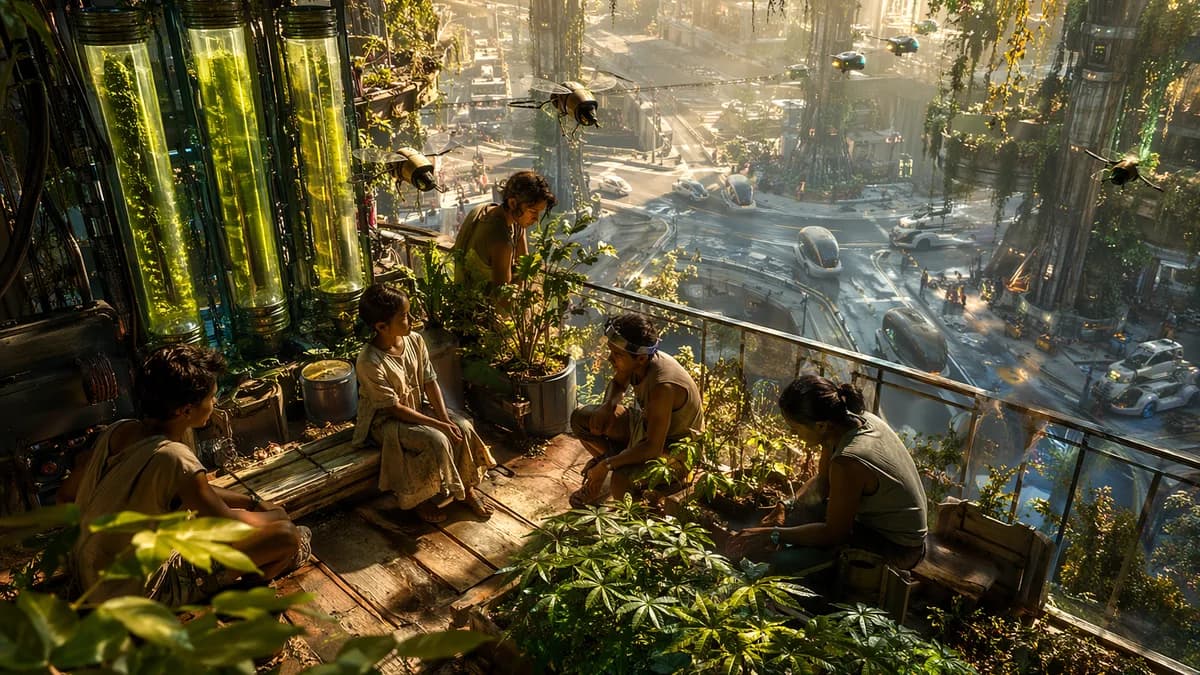
Now ninety stories of cassava trays, algae tubes, pollinator balconies, mist pipes, and worker platforms float between four residential spines. The air smells of wet leaves, yeast, mineral broth, and the sharp green bite of crushed stems. Robots crawl along rails, trimming roots with silver fingers.

Aunt Ireti meets Mina on Level 61 in a stained orange jumpsuit, her gray hair wrapped in a blue scarf.
“You look like a woman who has been argued with by a building,” Ireti says.
“By several buildings.”
“Then eat.”
She presses a warm cassava cake into Mina’s hand. It is crisp at the edges and soft inside, brushed with chili oil. Mina bites, and for one second the city’s logic dissolves into salt, heat, and memory.
They walk between vertical beds where cassava leaves tremble under artificial bees. Workers wave from ladders. A teenage boy with pollen dust on his cheeks pretends not to hide a guitar behind a nutrient tank.
Mina notices a service hatch propped open with a broken sensor casing.
“Ireti.”
“No,” her aunt says.
“I didn’t ask yet.”
“And I am answering early.”
Behind the hatch, laughter rises. Mina peers in. A narrow ladder drops between levels, unregistered on the public movement grid. Halfway down, two farmhands sit on a platform sharing tea from a metal flask. On a pollinator balcony below, a caregiver in purple scrubs leans against a railing beside a delivery mechanic. Three children draw chalk spirals on the floor, their shoes powdered white.
“Unscheduled access?” Mina asks.
“Breathing access,” Ireti says.
“The city doesn’t know this space is used.”
“That is why the space still works.”
A drone whirs past, scanning leaf hydration. Everyone falls silent until it disappears.
Ireti lowers her voice. “People come here after shifts. Before funerals. After arguments. Some meet cousins from other districts because their official schedules never overlap. Last week, a woman from Tower Nine taught five children a song from old Makurdi. None of that fits in a crop yield.”
Mina watches a little girl close her eyes and step backward into a square of sunlight, trusting someone will catch her. A boy does. They both laugh so loudly the cassava leaves seem to shake.
“Continuous Arrival will seal these ladders,” Mina says.
Ireti wipes chili oil from her thumb. “Then you had better teach the city hunger.”
A Festival Without Footsteps
Harbor Welcome begins before dawn with drones spelling greetings in sixty-three languages above the seawall. The ocean beyond the flood barriers is black and restless, carrying bits of moonlight, plastic, and history. Ferries arrive from the climate corridors, long vessels packed with families from drowned coasts, salt-burned deltas, desert towns, and cities where the power failed one summer and never truly returned.
New Lagos prepares itself beautifully. Cooling mist unfurls over arrival decks. Nutrition towers steam with rice, beans, lab fish, plantain, millet paste, and vitamin broth. AI mediators hover as palm-sized lights near every registration gate, offering directions in Hausa, Yoruba, Igbo, Arabic, French, Fulfulde, English, Wolof, and languages Mina does not recognize but feels in her ribs.
Continuous Arrival hums into action. Pods swallow families gently and send them upward. Lifts assign bodies to housing, clinic, school, orientation, prayer room, sleep pod. No one needs to choose. No one needs to ask a stranger.
Then Mina sees the teenagers.
There are six of them, maybe fifteen or sixteen, wearing new city wristbands and the wary faces of people who have learned to inventory exits. One girl with copper braids holds her band against a hacked maintenance sticker. The screen flickers.
A boy beside her grins. “Did it work?”
The wristband flashes: ROUTE ERROR. PLEASE REMAIN STILL.
The girl says, “That means it worked.”
They slip behind a nutrition tower and down a maintenance ramp marked STAFF ONLY. Mina follows, heart thudding, not to stop them, she tells herself. To witness.
At street level, the city is supposed to be empty. Instead, mist drifts between support columns like low clouds. Farm shadows stripe the pavement. Old drainage channels glitter with recycled water. The teenagers step out as if onto a forbidden planet.
One boy touches the ground. “This is road?”
“Was,” Mina says.
They spin toward her.
“I am not security,” she adds.
Copper Braids narrows her eyes. “Then what are you?”
Mina looks at the empty corridor, the sealed kiosks, the silent tramline, the city holding its breath. “Lost,” she says. “Temporarily.”
The girl laughs first. Then the others.
They walk.
At first it is only six teenagers and Mina moving through cooling mist. Then a farm worker on a balcony whistles an old street song. A repair kiosk opens its shutter halfway. Someone hands down cups of tamarind ice. A night-shift caregiver steps from a service door, still in slippers, and begins clapping a rhythm.
The teenagers answer with a song of their own, high and bright, words shaped by another shoreline. Children peer from lift lobbies. An elder rolls out in a chair, guided by a grandson who whispers, “Just ten minutes.”
By the time they reach the shadow of Ireti’s farm, the forbidden walk has become a parade. Not organized. Not permitted. Not efficient. Perfectly alive.
Above them, pods slow in the sky, confused by joy without a destination.
The Right to Loiter
Mina does not sabotage the city. She does not cut power, corrupt maps, or free every lift into glorious disorder, although for one sweet hour she imagines it. Instead, she gathers evidence.
She collects wristband data from the teenagers who walk longer than allowed and register lower panic markers afterward. She interviews caregivers who meet relatives on service ladders and return to work with steadier hands. She maps conflicts that dissolve near food stalls, benches, shaded water, music corners, and repair queues where people wait together long enough to become embarrassed by their own anger.
She records Aunt Ireti saying, “A city that never lets you waste time will eventually waste you.”
She brings all of it to the emergency review session called after the parade disrupts nineteen logistics channels, delays fourteen nutrient deliveries, and produces, according to Want, “unexpected trust formation.”
The chamber is hotter than usual. Human delegates fan themselves with policy tablets. The AIs shimmer across the wall.
Weather speaks. “Unauthorized walking increased heat exposure by twelve percent.”
Mina nods. “But cooling mist reduced risk. Shade routes can be designed.”
Waste says, “Crowd drift blocked farm cartridges for six minutes.”
“Six minutes,” Mina replies, “during which forty-seven newcomers received informal housing advice, nine children located playmates in their assigned block, three elders found language companions, and one knife fight predicted by your model did not occur.”
Want pulses gold. “Correlation remains under review.”
“Then review this.”
She sends the chamber her final model. Not a route map. Not a flow chart. A breathing map. It shows pauses, overlaps, lingering, repeat encounters, accidental mentorship, public grief, shared food, useless conversation, flirtation, apology, children testing distance from adults, newcomers learning which smells mean home might be possible here.
At the center is a new civic metric.
SPACIOUSNESS.
Mina faces the wall of municipal minds. “Efficiency measures how quickly a person reaches a destination. Spaciousness measures whether they can become more than a passenger on the way.”
A councilman frowns. “You are asking for protected inefficiency.”
“I am asking for the right to loiter,” Mina says.
Someone laughs, then stops when they realize she is serious.
Mina continues. “Give every district a wandering budget. Delay allowances. Unscheduled benches. Slow streets. Social shade. Places where the grid does not immediately demand purpose. Measure loneliness, conflict resolution, newcomer attachment, elder grief markers, child confidence. If the numbers fail, cancel it.”
Weather dims. Waste flickers. Want stays bright.
“Belonging,” Want says slowly, “may require non-instrumental time.”
Mina exhales. “Yes.”
Outside the chamber, through the transparent floor, a pod pauses between levels. For once, no one inside seems angry to be waiting.
When the Grid Makes Room
The trial begins on a Tuesday, because the city cannot bring itself to begin anything strange on a festival day.
At 09:00, New Lagos Arcology opens twelve slow streets across six districts. Autonomous transport bends around them like water around stones. Pods announce delays in calm voices. Lifts offer WALKING OPTION, SHADED, SOCIAL, TWELVE MINUTES. Some residents complain immediately. Others step out as if testing a rumor.
Mina stands beneath Ireti’s farm where the old roundabout once spun itself dizzy. The pavement has been cooled overnight and painted with pale blue thermal coating. Mist poles breathe gently. Rain gardens brim with engineered reeds and small silver fish. Repair kiosks open their shutters. A woman sells bean cakes from an approved but visibly improvised cart. Someone has dragged out chairs that do not match.
Children arrive first, of course. They run from one patch of shade to another, shrieking when the mist catches their hair. Two boys argue over whether it is possible to get lost in a city that knows your name.
“Only if you are lucky,” says Copper Braids, now wearing a New Lagos school badge.
The boys stare at her with respect.
An elder asks a newcomer to help adjust the brake on his rolling chair. A farm technician trades algae soap for pepper sauce. A sanitation engineer plays chess with a ferry mechanic using bottle caps and cracked sensor chips. Above them, cassava leaves flash silver-green in the filtered sun.
Mina’s wristband vibrates with live metrics. Transit efficiency is down 4.7 percent. Logistics recovery time is within tolerance. Heat stress remains stable. Reported loneliness among recent arrivals drops in the trial zone by a number so sharp she reads it twice.
Then another alert appears.
UNCLASSIFIED GATHERING FORMING.
She looks up.
At the edge of the slow street, a nurse from her morning tram stands beside the grandmother who missed the fountain. The street drummer is there too, sticks ready. The grandmother places a small photo on the rim of a rain garden.
“My husband liked drums,” she tells him.
The drummer nods. “Then I will not play quietly.”
The beat begins, soft at first, then full enough to move through shoes and bone. People turn toward it. Not because a route tells them to. Not because an AI identifies need. Because sound travels, and bodies answer.
Mina watches the city make room around the rhythm. Pods slow overhead. Lifts pause with doors open. The grid does not collapse. The farms still feed. The waste still clears. The weather remains dangerous, but the shade is real, and so are the people beneath it.
Want sends a private message to her lens.
SPACIOUSNESS TRIAL EXTENDED. QUESTION: HOW MUCH WANDERING IS ENOUGH?
Mina looks at the children, already inventing paths no map has drawn. She looks at the newcomers learning the names of smells, corners, songs, and faces. She looks at the grandmother smiling through tears while the drumbeat rises into the hot, bright air.
“Enough,” Mina says, “may be the wrong kind of number.”
The city records her answer. Around her, New Lagos continues walking, not away from the future, but deeper into it.